
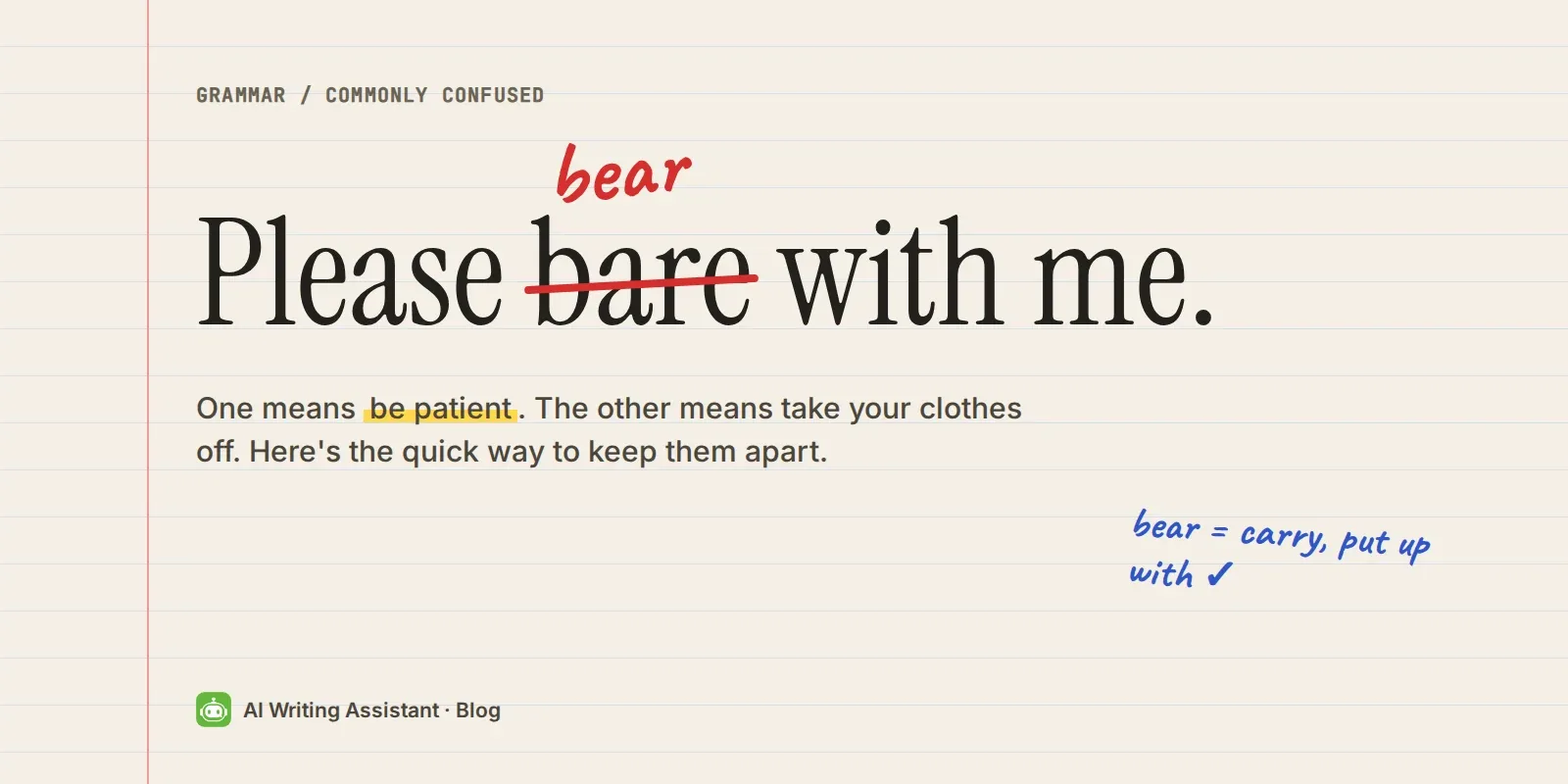
You're typing a quick message to a client, your mind on the problem, and your thumb hesitates over one letter. Bear or bare? Both are real words and both sound the same. Only one of them asks for patience.
Is it "bear with me" or "bare with me"?
It's "bear with me." Merriam-Webster defines "bear with" as "to be indulgent, patient, or forbearing with (someone)." Its example is "Please bear with me while I get my equipment set up." "Bare with me" is a spelling mistake. Bare means uncovered, so the literal meaning of "bare with me" is a request to take your clothes off together.
What "bear with me" means
The verb bear has meant "carry" for over a thousand years. It comes from the Old English beran, which is related to the Latin ferre, "to carry". From "carry a load" it grew the meaning "put up with" or "endure", which is the sense in "I can't bear it" and "bear with me".
So when you write "please bear with me," you're asking someone to put up with a short delay or a bit of confusion. People use it when they're fixing a tech problem on a call, explaining something complicated, or waiting on information.
- "Bear with me for a moment while I find that file."
- "Our site is being updated, so please bear with us."
- "Bear with me, this story has a point."
What "bare" means
Bare is mostly an adjective meaning "lacking a natural, usual, or appropriate covering." Think bare feet, bare walls, a bare tree in winter. It can also mean "only just enough," as in the bare minimum or bare essentials.
Bare is also a verb, but with only one meaning, "to uncover." Merriam-Webster points out that every other verb sense is spelled bear. You can bare your teeth, bare your arms or bare your soul. You can't bare with anyone.
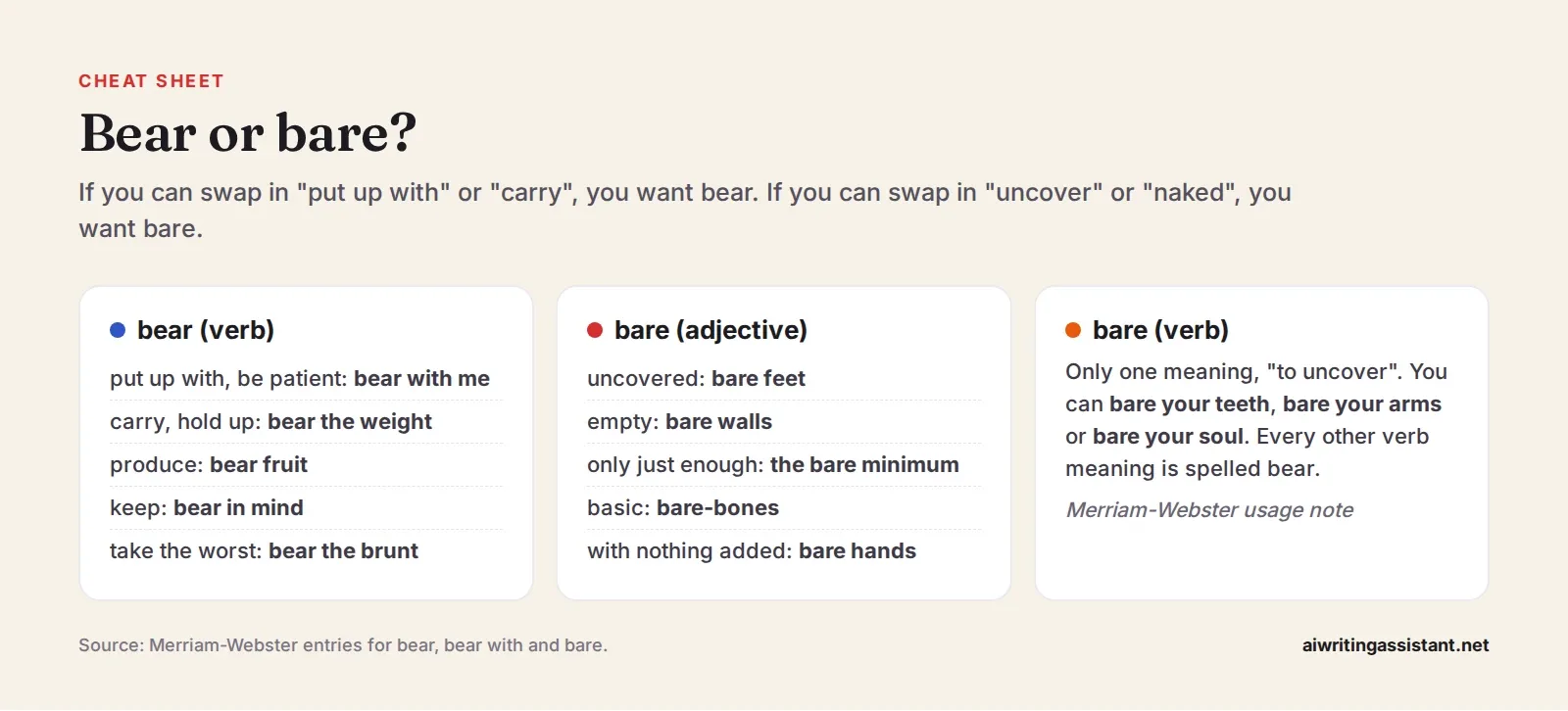
Bear vs bare in common phrases
| Phrase | Correct spelling | What it means |
|---|---|---|
| Please ___ with me | bear | Be patient with me |
| ___ in mind | bear | Remember, keep in your thoughts |
| ___ fruit | bear | Produce a result |
| ___ the brunt | bear | Take the worst of something |
| ___ a resemblance | bear | Look like |
| Grin and ___ it | bear | Put up with something unpleasant |
| The ___ minimum | bare | The least possible |
| ___-bones | bare | Basic, with nothing extra |
| With my ___ hands | bare | With no tools or gloves |
| ___ your soul | bare | Reveal your private feelings |
"Grin and bear it" trips people up because it sounds like a picture of a smiling bear. It's the verb again, "put up with it while smiling."
Why so many people write "bare with me"
The two words are homophones. They sound exactly alike, so the ear can't help. Bare also shows up in very common phrases like bare feet and the bare minimum, while bear as a verb mostly lives in a few set expressions. When you type fast, your fingers reach for the spelling you see more often.
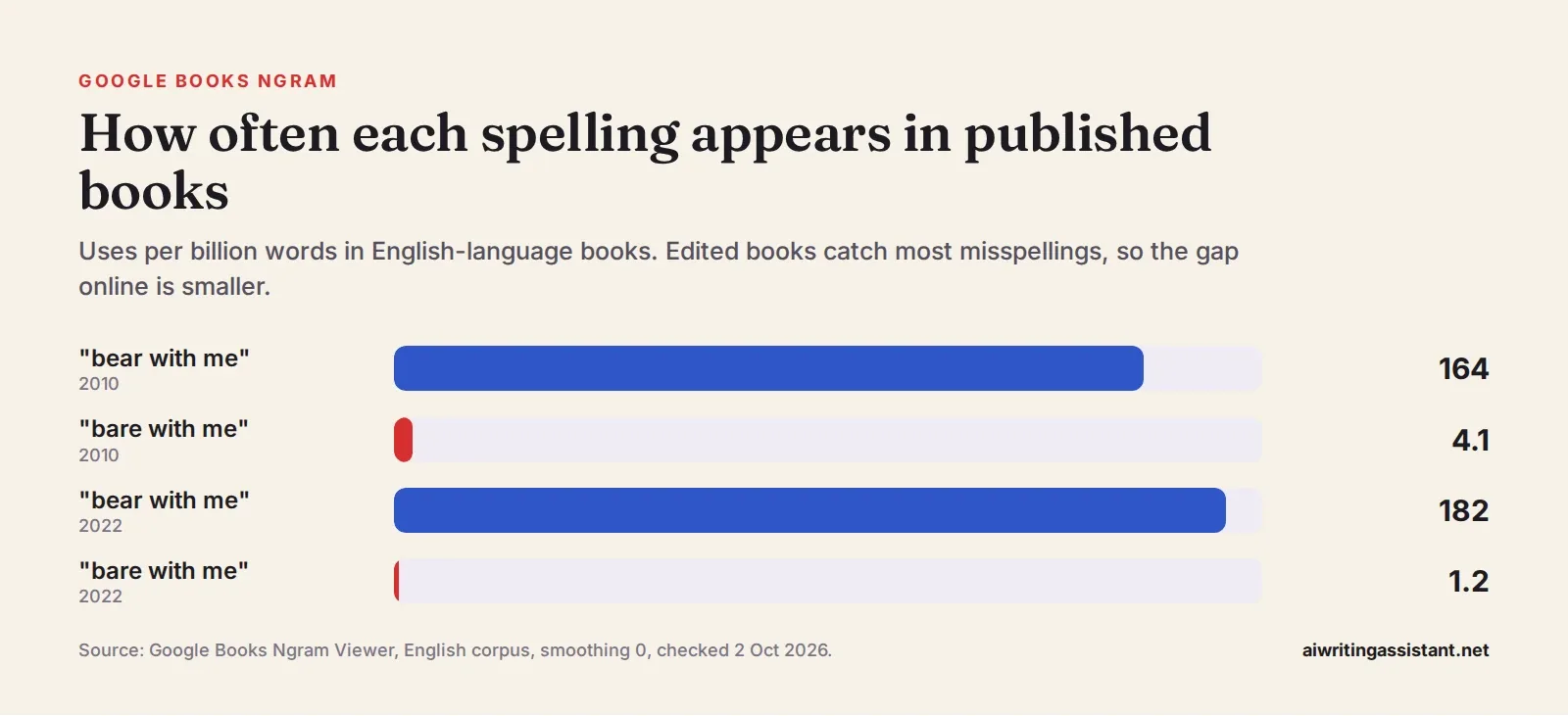
Still, the mistake is rarer in edited writing than it feels online. In the Google Books Ngram data, "bear with me" appeared about 182 times per billion words in 2022, against about 1.2 for "bare with me." That's roughly 150 to 1. Editors catch it. Spell checkers often don't, because both words are spelled correctly on their own.
Should you say "bear with me" at work?
Yes, it's fine in emails, chats and meetings. It's polite and a little informal. A few tips keep it from sounding like an excuse.
- Say how long. "Bear with me for two minutes" is kinder than an open-ended delay.
- Don't overuse it. One "bear with me" per conversation is plenty. After that, give an update instead.
- In formal writing, try another phrase. "Thank you for your patience" or "I appreciate your patience while we fix this" sound more polished in customer emails.
Other ways to say it: "give me a moment," "thanks for waiting," "hang on a second" (casual), "I appreciate your patience" (formal), "one moment, please."
Frequently asked questions
Is it bear with me or bare with me?
It's "bear with me." It means "be patient with me." "Bare with me" is a misspelling, because bare means uncovered or naked.
What does "bear with me" mean?
It means "please be patient while I do something or explain something." The verb bear here means to put up with or endure.
Why is it "bear" with me?
Because the verb bear means to carry or put up with. It comes from the Old English beran, "to carry". You're asking someone to put up with a short wait.
Is "bare with me" ever correct?
Practically never. It would only make sense if you were literally asking someone to undress with you.
Is "bear with me" rude or unprofessional?
No. It's polite and widely used at work. In very formal emails, "thank you for your patience" can sound more polished.
Is it "bare minimum" or "bear minimum"?
It's "bare minimum." Bare here means "only just enough."
Is it "bear in mind" or "bare in mind"?
It's "bear in mind." The verb bear means to keep or hold, so you're holding something in your mind.
 Grammar Checker
 Paraphraser
 Summarizer
 AI Writer
 AI Humanizer
 Text Compare