 Upgrade
Add at least 40 words
Paste an essay, article, email or assignment, or upload the file. The language is detected for you. Not sure what a result looks like? Load one of the human, AI or mixed samples first.
Let’s check this text!
Paste an essay, article, email or assignment (at least 40 words) — or upload a Word, PDF or text file. Every sentence is scored and highlighted.
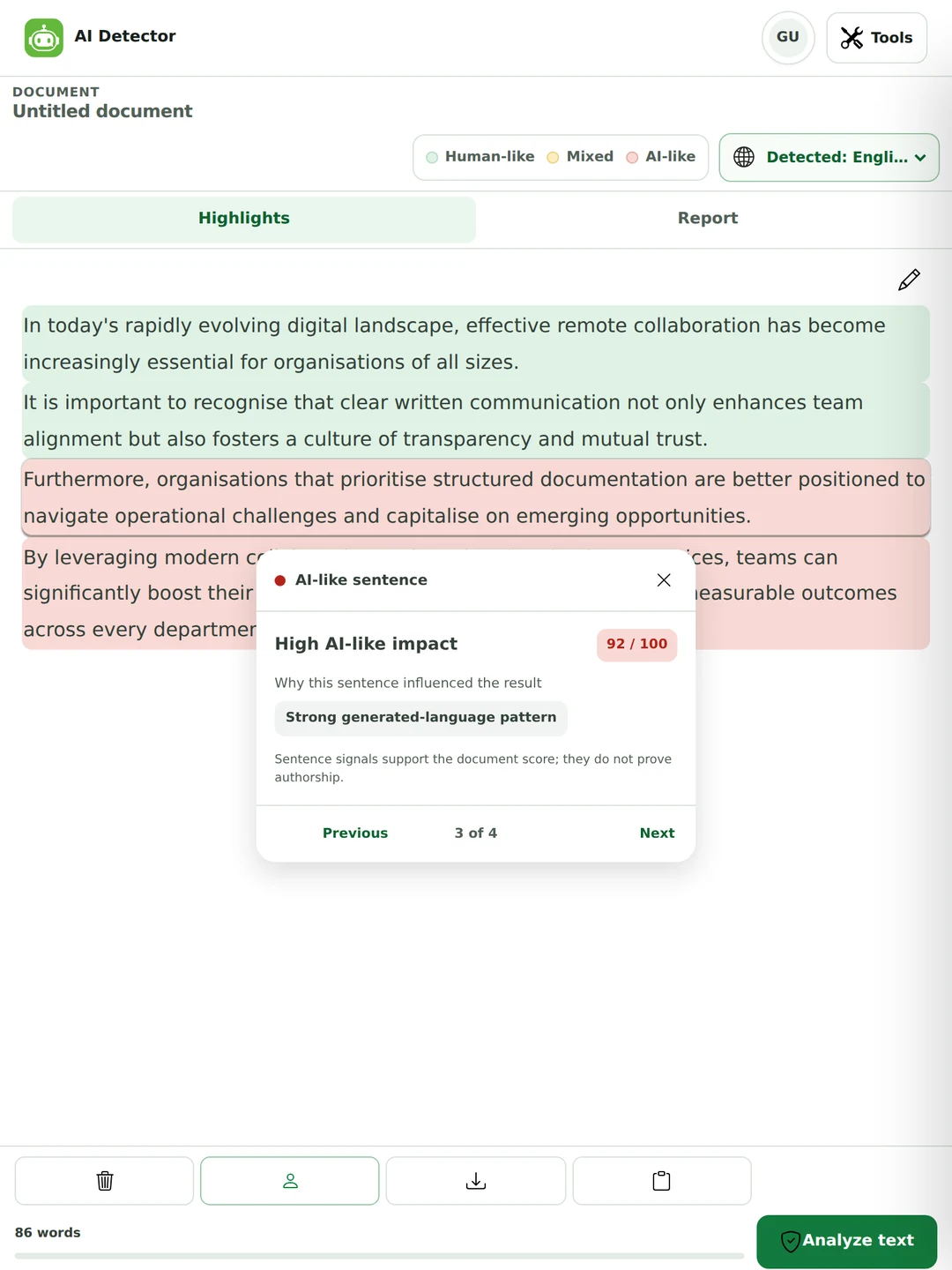
An AI detector reads a piece of writing and estimates how likely it is to have been generated by an AI model. Paste 40 words or more above and you get a likelihood, the range it could fall in, how confident the tool is, and every sentence highlighted as human-like, mixed or AI-like, with the reason for each one. It’s free, and you don’t need an account.
Last updated 9 October 2026 by the AI Writing Assistant team.
Three steps, and the third is the one most people skip.
Paste an essay, article, email or assignment, or upload the file. The language is detected for you. Not sure what a result looks like? Load one of the human, AI or mixed samples first.
The whole document is scored, and then each sentence is scored against its neighbours, so you can see where the AI-like patterns actually are.
A wide range with low confidence means the sample can’t carry a firm answer. Then click the highlighted sentences to see what drove each score.
Most AI checkers give you one big percentage. This one shows its working, so you can decide how much weight the result deserves.
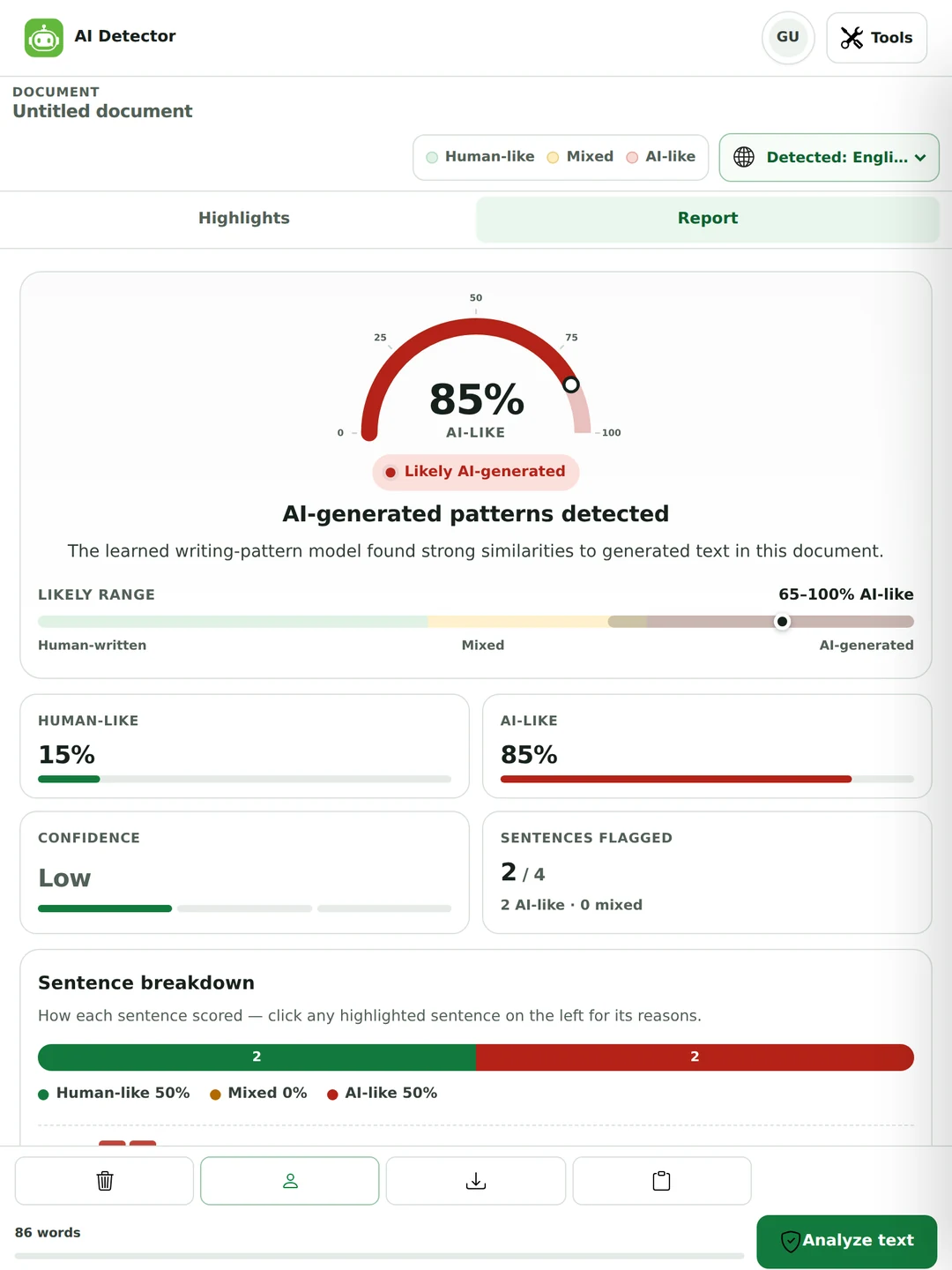
A document can score high because three stiff sentences pulled the average up. The sentence view shows you which ones.
Every AI detector says it’s 99% accurate. Here are our own numbers instead, with the details you need to judge them.
| Detector | AI texts caught | Human texts wrongly flagged | Correct overall |
|---|---|---|---|
| This AI detector | 12 of 12 | 0 of 12 | 24 of 24 |
The 24 texts were new to our detector (written that day, or taken from test sets it was never trained on): 12 AI texts (essays, blog posts, emails, a product review, an academic abstract) from five different AI models, and 12 human texts (including news articles, a student essay, a product review and a forum post). They covered English, Spanish, German, Urdu and Hindi. A text counted as flagged at 50% AI or more.
Since 8 October 2026, English text is scored by a deep language model, a transformer that runs on our own server. On a locked test of 400 texts it caught 197 of the 200 AI texts and flagged none of the 200 human texts (70 or above counts as AI). Across eleven groups of writers, from students and teachers to journalists and legal or medical writers, it caught 92% to 99% of AI texts and flagged 0% to 0.6% of the human texts. It caught 99% to 100% of text from Claude models. On 40-word texts it catches 69% of AI text, so a short check still comes with a low-confidence label. If our server is busy or offline, the built-in model answers instead, and every check still gets a result.
Since 9 October 2026 a deep language model also reads Spanish, French, German, Italian, Portuguese, Russian, Turkish, Arabic, Urdu, Hindi, Indonesian, Tagalog, Chinese, Japanese, Korean and Thai. On 20,326 held-out texts it caught 95.9% of AI texts (the built-in model caught 88.2%) and wrongly scored 0.15% of human texts 45 or above (built-in 1.54%). Passages from published literature were wrongly scored 0.16% of the time, down from 3.6%. Thai improved the most, from 63% to 92% of AI texts caught.
Twenty-four texts is a small test, and held-out sets aren’t your classroom. Error rates rise on short text, heavily edited text and formal writing by non-native speakers.
Accuracy changes with length, subject, language and how much the text was edited. A single number hides that. A range and a confidence level show it.
Numbers copied from real reports from this AI detector, run on 3 October 2026. None of them were made up for the page.
| What was checked | AI-like | Likely range | Confidence | Verdict |
|---|---|---|---|---|
| AI-written business copy, 85 words | 100% | 86–100% | Moderate | Likely AI-generated |
| The same copy, extended to 298 words | 100% | 92–100% | High | Likely AI-generated |
| AI-written customer-service reply, 47 words | 7% | 0–27% | Low | Likely human-written |
| Benjamin Franklin, Autobiography (1791), 113 words | 0% | 0–14% | Moderate | Likely human-written |
Going from 85 to 298 words moved confidence from moderate to high and narrowed the range from 14 points to 8. If you want a result worth quoting, give it more than the minimum.
The 47-word reply was written by AI, and it scored 7. A few polite sentences look the same whoever wrote them. That’s why anything under 80 words gets a low-confidence label and a wide range.
Most AI checkers are trained almost entirely on English. This one reads 17 languages with a deep language model, trained on real human writing such as news articles and books from before ChatGPT existed.
The signals an AI detector measures aren’t magic. Once they have names you can spot them yourself, and fix them in your own drafts.
If your own draft scores high and you want it to sound like you, the AI humanizer is built for that, and the Humanize button in the report sends your text there.
It’s one of the most searched questions about AI detection, and the answer matters if your work is being checked.
Many universities and schools use Turnitin AI writing detection, which sits inside the plagiarism checks they already run. Others license GPTZero or Copyleaks. Learning platforms such as Canvas usually connect to one of these rather than running their own.
Each detector is trained differently, so the same text gets different scores. Different detectors often give the same text very different scores. A free AI checker can show you how your writing reads. It can’t tell you what Turnitin will say.
Vanderbilt disabled the Turnitin AI detector in 2023. The University of Waterloo stopped using it in September 2025, saying the tools are unreliable and biased against students whose first language isn’t English (University of Waterloo).
We read the accuracy claims on 21 AI content detectors. They run from 80% to 100% for the same job. They can’t all be right.
They miss AI text, and they flag human writing. The people most likely to be wrongly flagged are the least able to argue with a number.

A low score isn’t a certificate either. It means the writing didn’t carry the patterns this method looks for, which is a weaker statement, and the one we’re willing to stand behind.
What actually helps, in the order it helps.
Which detector produced the flag, what score, what range and confidence, and what score the institution treats as actionable. If nobody can tell you, there’s nothing to answer yet.
Version history in Google Docs or Word, drafts, notes, timestamps and the sources you read. Work that happened over time is the one thing a generated document can’t fake afterwards.
OpenAI withdrew its own classifier, Turnitin says its score shouldn’t stand alone, and Waterloo found human text flagged as 100% AI. You’re not saying detectors are always wrong. You’re saying this one can’t carry that much weight.
The Stanford finding of a 61.22% average false positive rate on non-native essays is directly relevant, and many people making these decisions have never seen it.
They answer different questions, and people often need both.
| AI detector | Plagiarism checker | |
|---|---|---|
| Question | Does this read like AI-generated text? | Was this copied from something that already exists? |
| How | Infers from writing style alone | Matches the text against published sources |
| Can point to a source | No, it gives an estimate | Yes, the matching document |
| Best for | Spotting template writing, reviewing drafts | Checking quotations and citations |
Check your own work before you hand it in, and keep the report with your drafts. Cite sources with the citation generator.
Use a flag to start a conversation, never to end one. The range and confidence level make a weak result visibly weak.
Screen submitted copy for template writing. The sentence view shows which paragraphs to send back, which helps a writer more than a percentage.
A tool that reads a piece of text and estimates how strongly it carries the patterns of AI-generated writing, such as even sentence length, predictable phrasing and stock transitions. It’s an estimate of style. It has no record of who typed the words. No AI detector can prove authorship.
Yes, on every plan, and you can use it without an account. The detector runs on our own model, so checks never use your daily word allowance. You can check up to 3,000 words at a time as a guest, 5,000 with a free account and 15,000 on Pro. The range, confidence level, sentence breakdown and downloadable report are all included. The only limit is a fair-use cap against automated use, such as 100 checks a day as a guest. The pricing page lists it for each plan.
It compares your text with large sets of human and AI writing it learned from, and measures signals such as sentence consistency, predictable word choices and repetition. This one uses a deep language model, a transformer trained on human and AI writing in 17 languages, which runs on our own server. It scores the whole document and then each sentence in context, and reports a likelihood with a range and a confidence level.
Yes. It looks at general properties of AI-generated prose rather than one model’s signature, so it covers ChatGPT, Claude, Gemini, DeepSeek, Copilot and newer models too. Heavily edited or humanized AI text is harder for every detector.
In our blind test on 28 September 2026 it classified all 24 texts correctly (12 AI, 12 human, in five languages). On 20,326 held-out texts in 16 languages other than English, it caught 95.9% of AI texts and wrongly scored 0.15% of human texts 45 or above. On a locked English test it caught 197 of 200 AI texts and flagged none of the 200 human texts. It’s still an estimate, and error rates rise on short or heavily edited text. See the test.
The one that shows you why it reached its answer and tells you when it’s unsure. Check a few paragraphs you wrote yourself and a few an AI wrote, and see which tool gets both right, gives a range, and explains its flags. Be wary of any tool that only shows one confident number.
There’s no neutral answer yet. Each vendor’s benchmark ranks itself first, and accuracy changes with language, length and editing. Independent studies find lower accuracy than the marketing. Our own results, with their limits, are in the accuracy section above.
Many use Turnitin AI writing detection, which is built into the plagiarism checks they already run. Others use GPTZero or Copyleaks, and platforms such as Canvas usually connect to one of these. Some universities, including Vanderbilt and Waterloo, have switched AI detection off.
None can reproduce a Turnitin score, because each detector is trained differently and they often disagree on the same text. A free AI checker can show you how your writing reads. It can’t predict another tool’s number.
Yes, in both directions. They miss AI text and they flag human writing. OpenAI withdrew its own classifier in 2023 after measuring 26% of AI text caught and 9% of human text wrongly flagged, and Waterloo found human-written text flagged as 100% AI in its own testing.
Formal, tidy writing with even sentences and common transitions looks like AI output, whoever wrote it. Short samples and second-language English make false flags more likely. Look at the confidence level and the flagged sentences, and add more text if you can.
The evidence says yes. A Stanford study found seven detectors wrongly flagged 61.22% of TOEFL essays on average, while scoring essays by US schoolchildren almost perfectly. Simpler vocabulary and uniform sentences read as machine-like.
How much the tool trusts its own estimate, driven mostly by the amount of text. In our checks, 85 words of AI-written business copy gave moderate confidence with a 14-point range, and 298 words of the same writing gave high confidence with an 8-point range.
At least 40 words, and a few hundred if you want a result worth quoting. Short samples are where every AI detector is least reliable.
Yes. A deep language model reads 17 languages: English, Spanish, French, German, Italian, Portuguese, Russian, Turkish, Arabic, Urdu, Hindi, Indonesian, Tagalog (Filipino), Chinese, Japanese, Korean and Thai. Other languages are checked with a general model and should be treated as a hint.
Yes. Upload a .docx, .pdf or .txt file up to 25 MB and the text is read out for you. Older .doc files need to be saved as .docx first.
No. Your text is sent to run the analysis and isn’t stored as text afterwards or used for training. The last few reports are kept on your own device so they survive a refresh. Clearing them removes them.
A plagiarism checker matches your text against existing documents and can point to a source. An AI detector has nothing to match against. It works from style alone, so it can only give an estimate.
No. It reads text only. Detecting AI-generated images is a different problem that needs different methods.
Look at the flagged sentences first. The reasons usually point at stock openers, even rhythm or vague claims. Rewrite those parts in your own words, or press Humanize to send the text to the AI humanizer, then check it again.
A detector tells you a draft reads like a template. These tools help you do something about it. Recent work is kept in Drafts.
Longer pieces on what these tools measure, where they fail, and what to do when one gets you wrong.
What the score is actually counting, the four ways detection fails, and why 78% isn’t proof of anything.
Why “99% accurate” tells you almost nothing, with the arithmetic that shows what such a claim leaves out.
False positives aren’t a bug in these models. Here is the mechanism behind them, and who gets caught most often.
A step-by-step guide for anyone whose own writing was flagged: what evidence holds up, and what makes it worse.
Everything else we’ve written is on the AI Writing Assistant blog. Run a blog, a school site or a class page? You can add this AI detector to your own website with one snippet of HTML.