Every AI detector advertises an accuracy figure. Very few of those figures answer the question a worried student or a careful teacher is asking: if this tool says AI, how likely is it to be right?
This guide puts the published research, our own test results and the arithmetic in one place. We build an AI detector ourselves, so we've marked clearly where a number comes from us.
Are AI detectors accurate?
Sometimes very, sometimes barely better than guessing. On full-length, unedited AI text in a familiar genre, the best detectors are right almost every time. On a short paragraph, a lightly edited draft, an essay by a non-native English speaker or a passage of 19th-century prose, error rates jump. A single accuracy number hides all of that.
So the useful answer is: accurate enough to tell you where to look, and never accurate enough to prove what someone did.
What independent studies found
| Study | What was tested | Main finding |
|---|---|---|
| Jabarian and Imas, Chicago Booth (2025) | About 2,000 human passages in six genres, AI versions from four models, four detectors, four lengths | The Pangram false positive rate was "essentially 0". GPTZero and Originality.ai were under 1%. All three lost accuracy under 50 words. The open-source RoBERTa detector was close to random. |
| Weber-Wulff and others, IJEI (2023) | 14 detection tools on human, AI, edited and translated text | None reached 80% accuracy and only five passed 70%. Paraphrased and machine-translated AI text was missed far more often. |
| Liang and others, Stanford (2023) | 7 detectors on 91 TOEFL essays and 88 US 8th-grade essays | On average 61.22% of the non-native essays were flagged as AI. 89 of 91 (97.8%) were flagged by at least one detector. Native essays were flagged about 5% of the time. |
| OpenAI classifier (2023) | The public AI text classifier from OpenAI | It caught 26% of AI text and wrongly flagged 9% of human text. OpenAI withdrew it on 20 July 2023 "due to its low rate of accuracy". |
These don't contradict each other as much as they seem to. Detectors improved a lot between 2023 and 2025. The 2025 study tested clean, unedited text, which is the easiest case. The 2023 studies tested harder cases: editing, translation and second-language writers. Both kinds of result are true at the same time.
Our own test: 24 texts
On 28 September 2026 we ran 12 fresh AI texts and 12 real human texts through our own detector. The texts covered English, Spanish, German, Urdu and Hindi. None of the human texts were in any of our training data. A text counted as flagged at 50% AI or more.
| Detector | AI texts caught | Human texts wrongly flagged | Correct overall |
|---|---|---|---|
| Our AI Detector | 12 of 12 | 0 of 12 | 24 of 24 |
Two caveats. Twenty-four texts is a small sample, and we built the detector being tested. Treat it as one data point.
We hold our own tool to the same standard. In a larger test on 2 October 2026, our detector wrongly flagged 7 of 36 older literary passages across six languages. We retrained it that day on public-domain books, and on passages by authors it had never seen the rate fell sharply. In Japanese, for example, it went from 31.6% to 2.5%. No detector is finished.
If your text isn't in English, check whether a detector actually supports your language before you trust its number.
Is GPTZero accurate?
In the 2025 Chicago Booth study, GPTZero wrongly flagged under 1% of human passages and missed roughly 0% to 2% of AI passages, depending on the setting. Like the other tools, it lost accuracy on passages under 50 words. GPTZero was also in the 2023 Stanford study, which used the version available in March 2023. We haven't tested GPTZero ourselves, so we can't add our own numbers.
Is the Turnitin AI detector accurate?
Turnitin publishes a document-level false positive rate under 1% for documents marked 20% or more AI, and a sentence-level rate of around 4%. It also says its score shouldn't be the only basis for action against a student. Several universities have switched the feature off anyway. The details, and what changed in 2025 and 2026, are in our guide to Turnitin AI detection.
Why one accuracy number tells you almost nothing
Accuracy is the share of all judgements that were right. That sounds useful until you notice a trick. Give a detector 100 documents of which 2 are AI-written, and a tool that answers "human" every time scores 98% while catching nothing.
Four numbers matter more:
| Term | Question it answers | Who it matters to |
|---|---|---|
| Recall | Of all the AI text, how much did it catch? | A school worried about missing cheating |
| Precision | Of everything it flagged, how much really was AI? | The student sitting in the meeting |
| False positive rate | Of all the human text, how much did it wrongly flag? | Everyone. It's the number vendors tend to bury. |
| Threshold | At what score does it call something AI? | All of the above move when this moves |
Recall and false positives always trade against each other. Lower the threshold and you catch more AI and accuse more innocent people. Raise it and you accuse fewer and miss more. Picking the setting is a policy decision, not a technical one.
Why the same detector can be right or mostly wrong
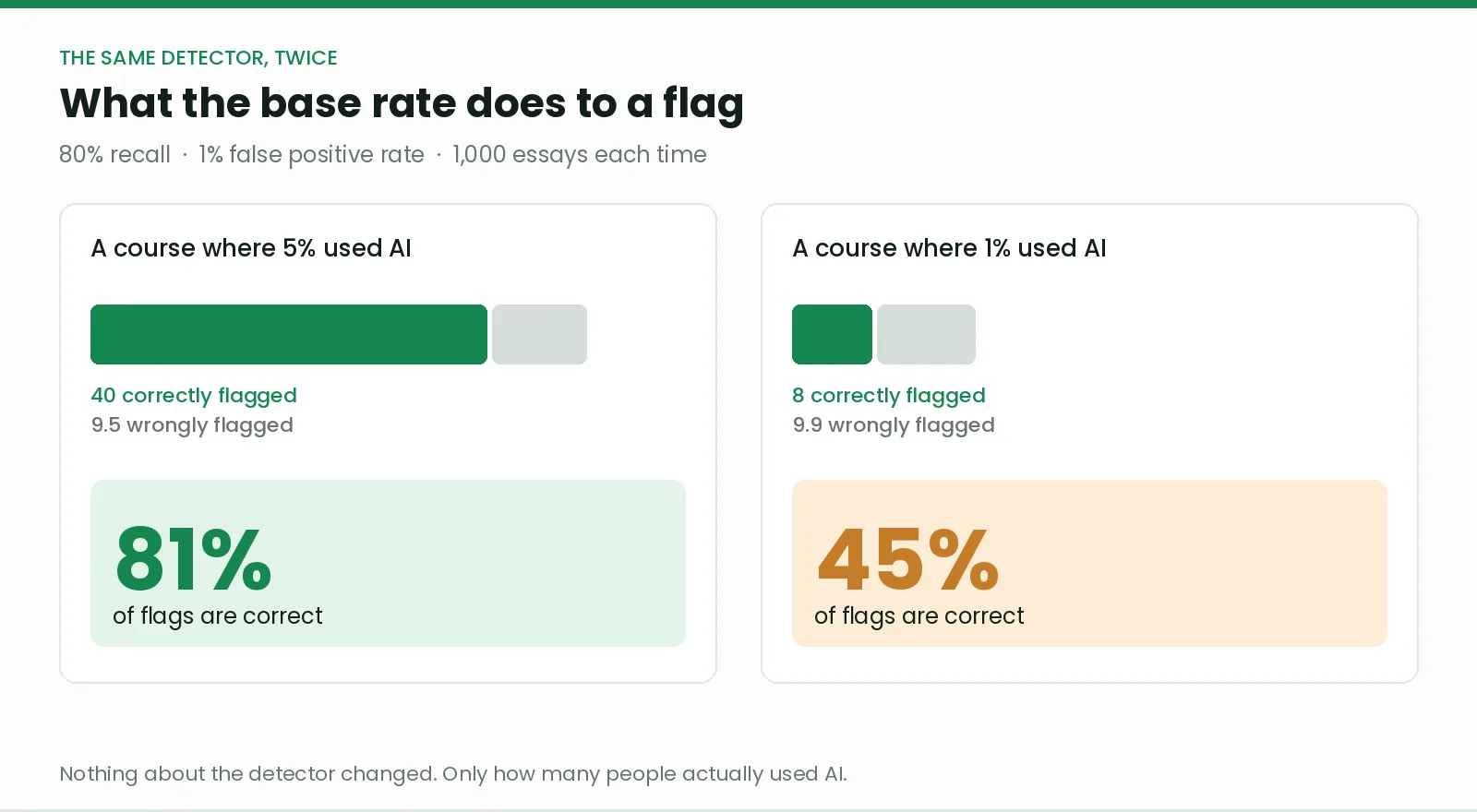
Take a detector with good numbers. It catches 80% of AI text and wrongly flags only 1% of human text. Run it over 1,000 essays in a course where 5% of students used AI without permission:
| AI-written (50) | Human-written (950) | Total flagged | |
|---|---|---|---|
| Flagged | 40 (80% recall) | 9.5 (1% of 950) | 49.5 |
| Precision | 40 / 49.5 = 81% |
About four in five flags are real. Now run the identical detector over a course where only 1% used AI:
| AI-written (10) | Human-written (990) | Total flagged | |
|---|---|---|---|
| Flagged | 8 (80% recall) | 9.9 (1% of 990) | 17.9 |
| Precision | 8 / 17.9 = 45% |
Nothing about the detector changed. But in the second course, more than half the students it flagged did nothing wrong. The rarer AI use is, the more of the flags are false. That's exactly the setting where a wrong accusation does the most damage.
When do AI detectors get it wrong?
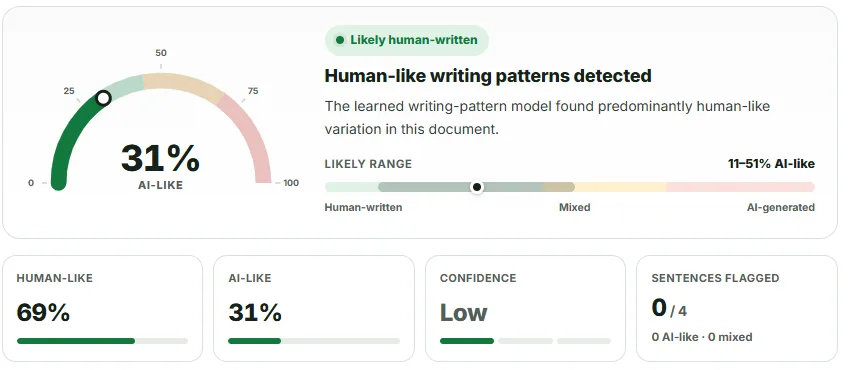
- Short text. Every signal is a statistic over a sample of words. In the Chicago Booth study all three commercial tools lost accuracy under 50 words. In our own test, the same AI passage scored 68% at 263 words and 31% at its first 94 words.
- Edited or paraphrased AI text. The 2023 IJEI study found paraphrasing and translation sharply cut detection rates.
- Non-native English. Plainer vocabulary reads as machine-like to many detectors. See why your writing gets flagged.
- Older literature. Long, formal sentences from the 19th and early 20th century can look generated. Our own detector had this problem until we retrained it.
- New AI models. A detector trained on last year's models can miss this year's.
- Unsupported languages. A detector that can't read a language may return a confident number anyway, as some tools do with Hindi and Urdu.
Questions to ask before you trust any AI detector
- What's the false positive rate, and at what threshold was it measured?
- What text was it tested on: which AI models, genres, lengths and languages?
- Below what length does it refuse to give a result?
- What does it do when it's unsure? Does it say so, or show a number anyway?
- Does the company say in writing that the score isn't enough to act on?
A tool that answers all five is being straight with you. A tool that answers none and leads with "99% accurate" is selling confidence, which is the one thing this technology can't supply.
Frequently asked questions
Are AI detectors accurate?
On long, unedited AI text in familiar genres, the best detectors are very accurate. A 2025 Chicago Booth study found false positive rates under 1% for the top commercial tools. Accuracy drops sharply on short, edited, translated or non-native writing, so a score is a signal to look closer, never proof.
How accurate are AI detectors in 2026?
It depends on the tool and the text. Recent independent tests show the best tools wrongly flag under 1% of clean human text, while older or cheaper tools do far worse, especially outside English.
Do AI detectors work?
They work as a screening tool on long text. They don't work as evidence. No detector can see how a text was written, and every published study finds error rates that are too high to justify acting on a score alone.
Is GPTZero accurate?
In the 2025 Chicago Booth study, GPTZero wrongly flagged under 1% of human passages and missed about 0% to 2% of AI passages. Like every detector, it was less accurate on passages under 50 words.
What is the most accurate AI detector?
There's no single answer, because accuracy depends on length, language and genre. In the largest recent independent study (Chicago Booth, 2025), Pangram had the lowest error rates. Check any tool on text like yours before you rely on it.
Can AI detectors be wrong?
Yes, in both directions. They flag human writing as AI (false positives) and miss AI writing (false negatives). OpenAI withdrew its own classifier in 2023 because it caught only 26% of AI text.
Why are AI detectors less accurate on short text?
Detectors judge statistical patterns across many words. A short passage doesn't have enough of them, so the result is close to a guess. Most tools need at least 80 to 300 words.
 Grammar Checker
 Paraphraser
 Summarizer
 AI Writer
 AI Humanizer
 Text Compare