

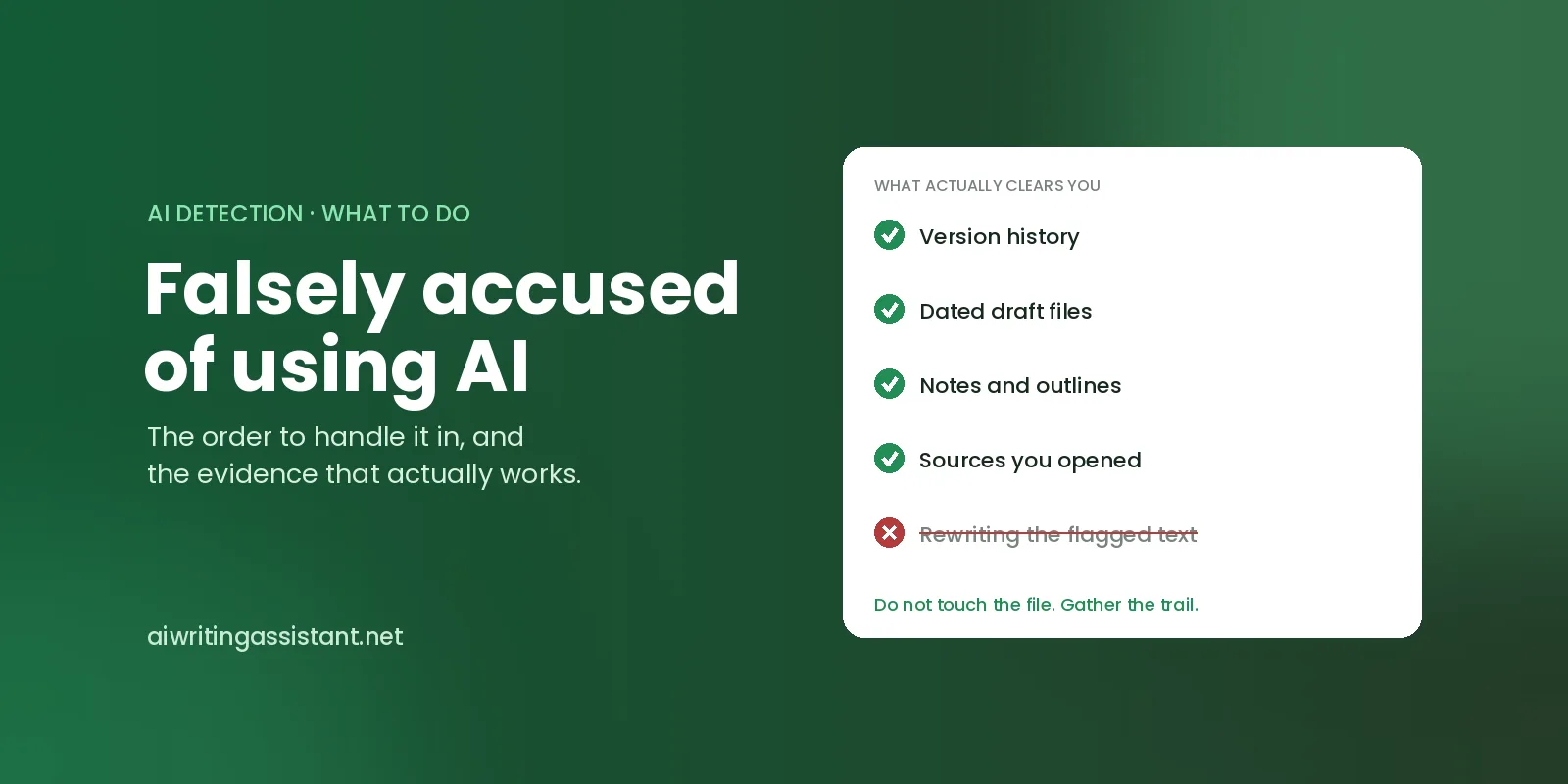
Being accused of something you did not do is disorienting, and the instinct is to over-explain. Resist it. The situation is more procedural than it feels, and there is a fairly reliable order in which to handle it.
Step 1 — Collect your evidence before you reply
Do this first, while everything still exists. You are assembling a record of the work happening over time:
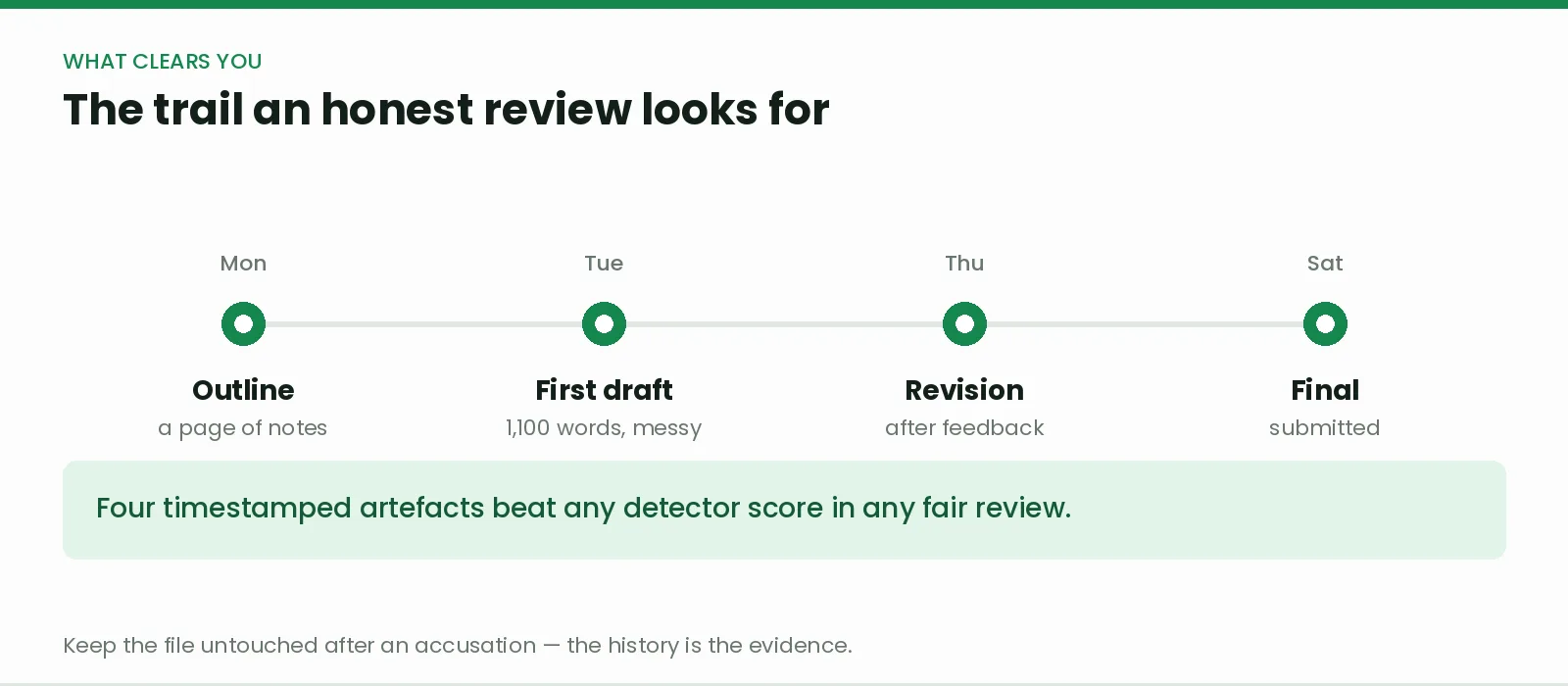
- Version history. Google Docs, Word with autosave, or any editor that keeps revisions. This is the strongest single item you can produce — it shows the document growing.
- Draft files. Every intermediate save, with its original timestamp. Copy the folder somewhere safe; do not move or rename the originals.
- Notes and outlines. Handwritten pages photographed with a date, a notes app, index cards, a whiteboard photo. Messy is better than tidy here.
- Sources. Library loans, database access logs, browser history, PDFs with your highlighting on them.
- Anything you sent anyone. A paragraph texted to a friend, an email to a tutor asking about your argument, a draft shared for feedback.
If you drafted in an editor without version history, look for what surrounds the work rather than the work itself: the reading you did, the questions you asked, the outline you built. A trail through the process is what an honest reviewer is looking for.
Step 2 — Ask for the accusation in writing
Reply briefly and ask for specifics before you argue anything. A short, neutral message is enough:
Thank you for letting me know. So that I can respond properly, could you tell me which tool produced the result, what score it reported, and which specific passages were flagged? I wrote this work myself and I have my drafts and version history available.
This does three things at once. It puts your denial on the record immediately. It forces the vague “the system flagged you” into a specific, checkable claim. And it signals, without any drama, that you have evidence.
Step 3 — Understand what the number actually is
You do not need to become a statistician, but two facts are worth carrying into the meeting.
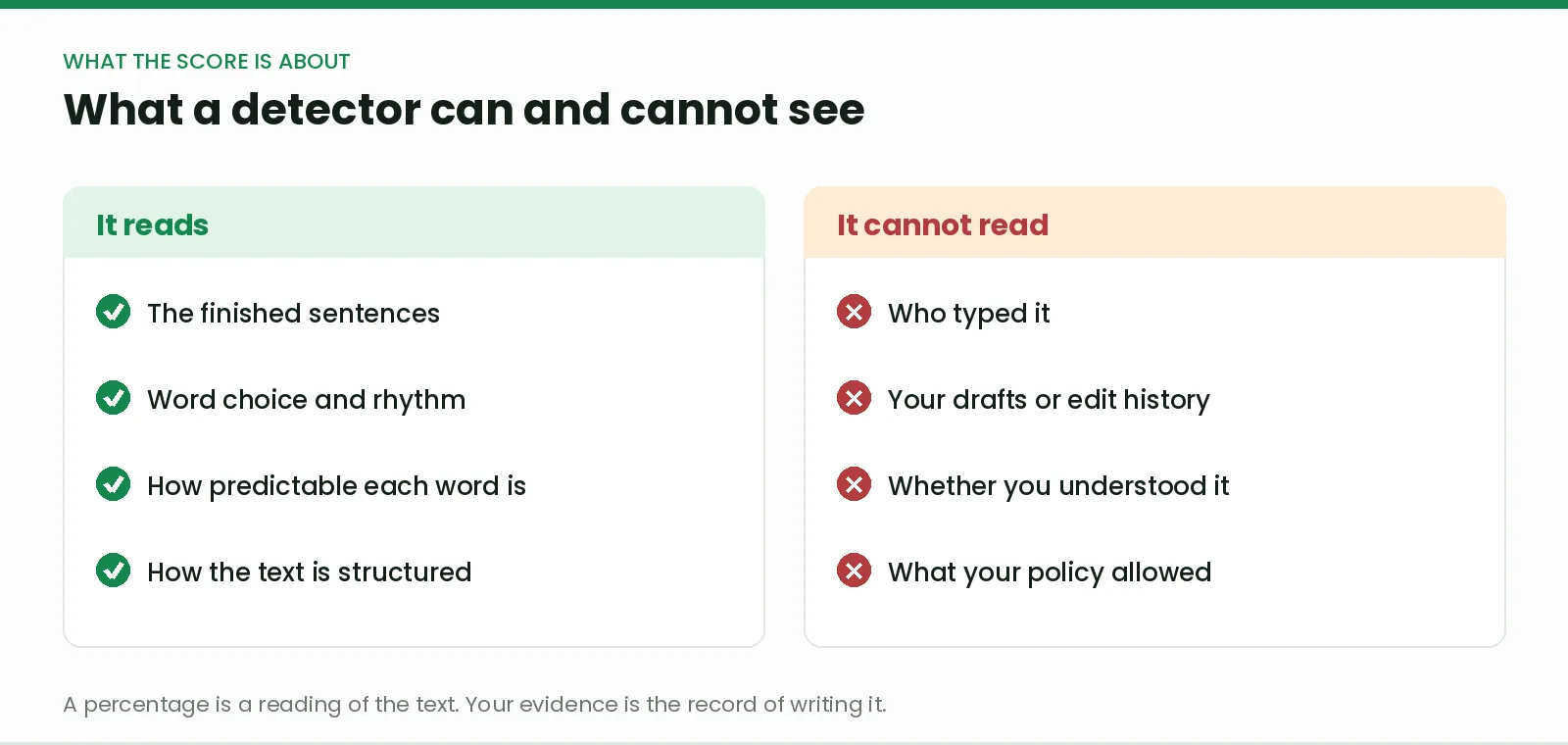
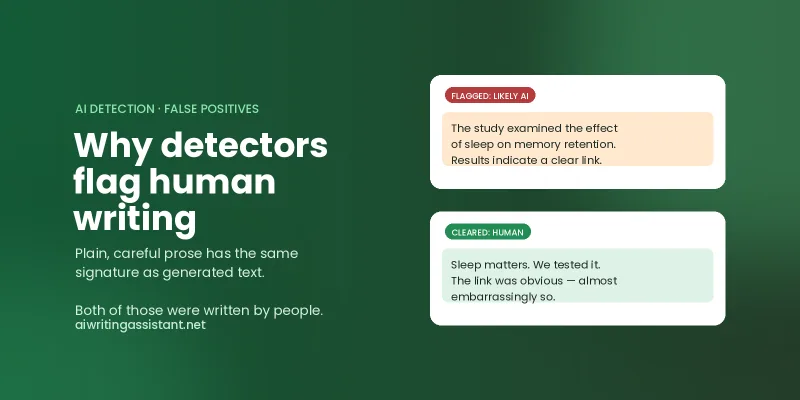
First, the score is about how the text reads, not about how it was produced. Detectors measure predictability and rhythm. Careful, plain, structurally conventional writing produces the same signature as generated text — which is why the writers flagged most often include second-language writers and anyone taught to write in a tidy scaffold. The evidence for that is in why AI detectors flag human writing.
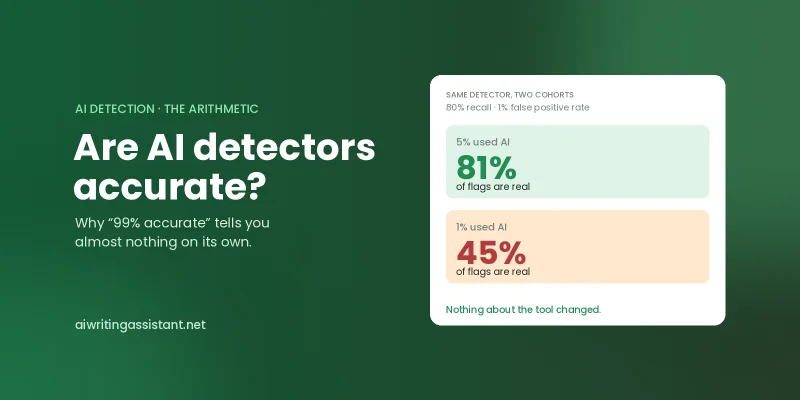
Second, a low error rate still produces a lot of wrong accusations. When undisclosed AI use is rare in a cohort, most flags can be false even from a good detector. The arithmetic is worked through in Are AI detectors accurate? — and it is a genuinely useful thing to be able to explain in one calm sentence.
Step 4 — Use the vendor's own words
This is the most effective single move available to you, because it does not require anyone to take your word for anything.
An AI Writing score should not be used as the sole basis for adverse actions against a student.
Turnitin also publishes a sentence-level false positive rate of around 4% — meaning that on a page of highlighted sentences, one or two being wrong is the tool's stated normal behaviour, not evidence of anything. If your institution's procedure treats a percentage as proof, that procedure is at odds with the detector's own vendor, and saying so politely is entirely reasonable.
Step 5 — The meeting
- Bring the evidence, organised. A single folder or a printed timeline. Do not make anyone hunt.
- Offer to talk about the content. Explaining why you structured the argument the way you did, what you cut and why, is enormously persuasive — nobody who pasted an essay can do it.
- Stay factual. Outrage reads as defensiveness. “Here is the version history” is stronger than any amount of insistence.
- Ask what standard of evidence is being applied. A fair process should be able to answer this without difficulty.
- Take notes, or bring someone who will. Most institutions permit a support person — check your student union or ombuds office.
Step 6 — Make it harder to happen again
Not because you did anything wrong, but because the evidence is free to create and enormously valuable to have:
- Draft in something that keeps version history, always.
- Save dated intermediate copies at natural checkpoints — outline, first draft, after feedback.
- Keep the notes. A photo of a page of scribbles is a timestamped artefact.
- If you use AI legitimately, disclose it in the format your institution asks for and keep the record of what you used it for.
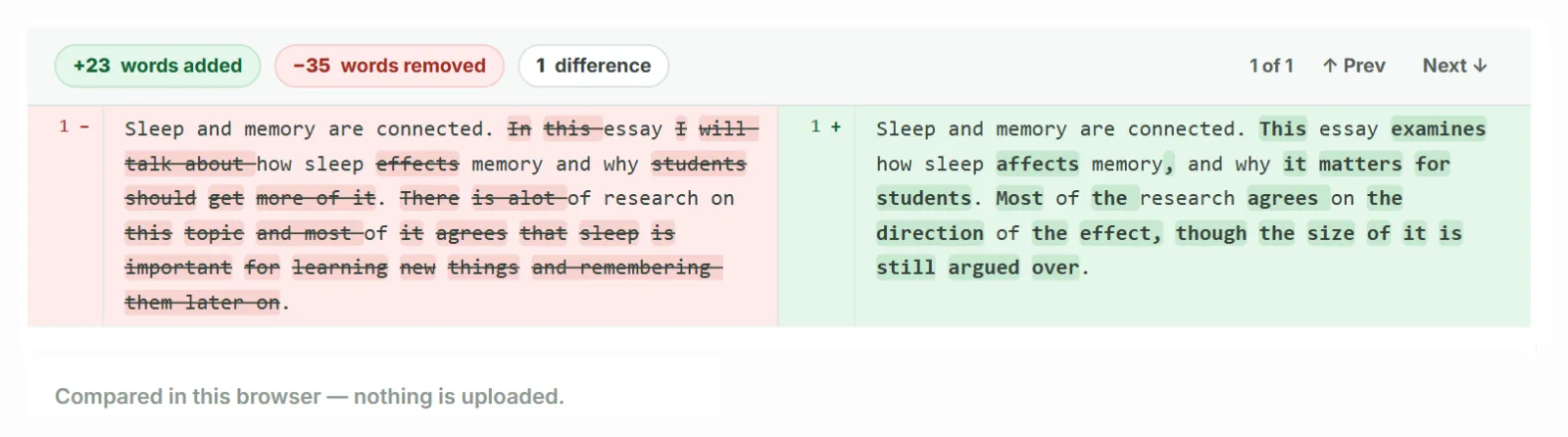
Our Text Compare tool shows exactly what changed between two versions of a document, which is a clean way to demonstrate a draft becoming a final piece. It runs entirely in your browser — nothing you paste into it is sent anywhere, and a test fails our build if that ever stops being true.
If you did use AI
Then this guide is not the one you need, and pretending otherwise will make things worse. Most institutions treat an early, honest account far more leniently than a denial that collapses. Our academic integrity page sets out where we think the line sits, and we would rather say that plainly than sell you a way around it.
The one-line version
Keep the file untouched, gather the process evidence, get the claim in writing, quote the vendor's own limitation, and have one calm conversation about the work itself. That sequence resolves the large majority of these cases.
What should I do if I am falsely accused of using AI?
Do not edit the document. Gather your drafts, version history and notes, ask for the accusation in writing with the specific tool, score and passages, and then respond factually. Bring the evidence to the meeting and offer to discuss the content of the work.
How can I prove I wrote something myself?
Process evidence: document version history, dated draft files, outlines and notes, source access records, and messages where you discussed the work. No tool can certify authorship; a trail of the work happening over time is what a fair review looks for.
Should I rewrite the flagged passages?
No. Editing the file after an accusation destroys the evidence that would clear you and looks like concealment. Leave it exactly as submitted.
Can I appeal an AI detection accusation?
Almost always. Institutions have appeals procedures, and most have an independent student advocate, ombuds office or union caseworker who handles these routinely. Ask early rather than after a decision.
Does Turnitin admit its AI score can be wrong?
Turnitin publishes a sentence-level false positive rate of around 4% and states in its own guidance that an AI writing score should not be used as the sole basis for adverse actions against a student.
What if I used AI only for grammar or spelling?
Say so, clearly and early, and check your institution's policy — many explicitly permit language support with disclosure. The problem is almost never the tool; it is an undisclosed use that the policy required you to declare.
 Grammar Checker
 Paraphraser
 Summarizer
 AI Writer
 AI Humanizer
 Text Compare