Being told that something you wrote yourself is "likely AI-generated" feels like being called a liar by a machine. It isn't calling you anything. It's reporting a property of your sentences, and that property isn't authorship.
Below are the eight most common reasons human writing gets flagged, with the research behind each one, and what to do about it.
Why does my writing get flagged as AI?
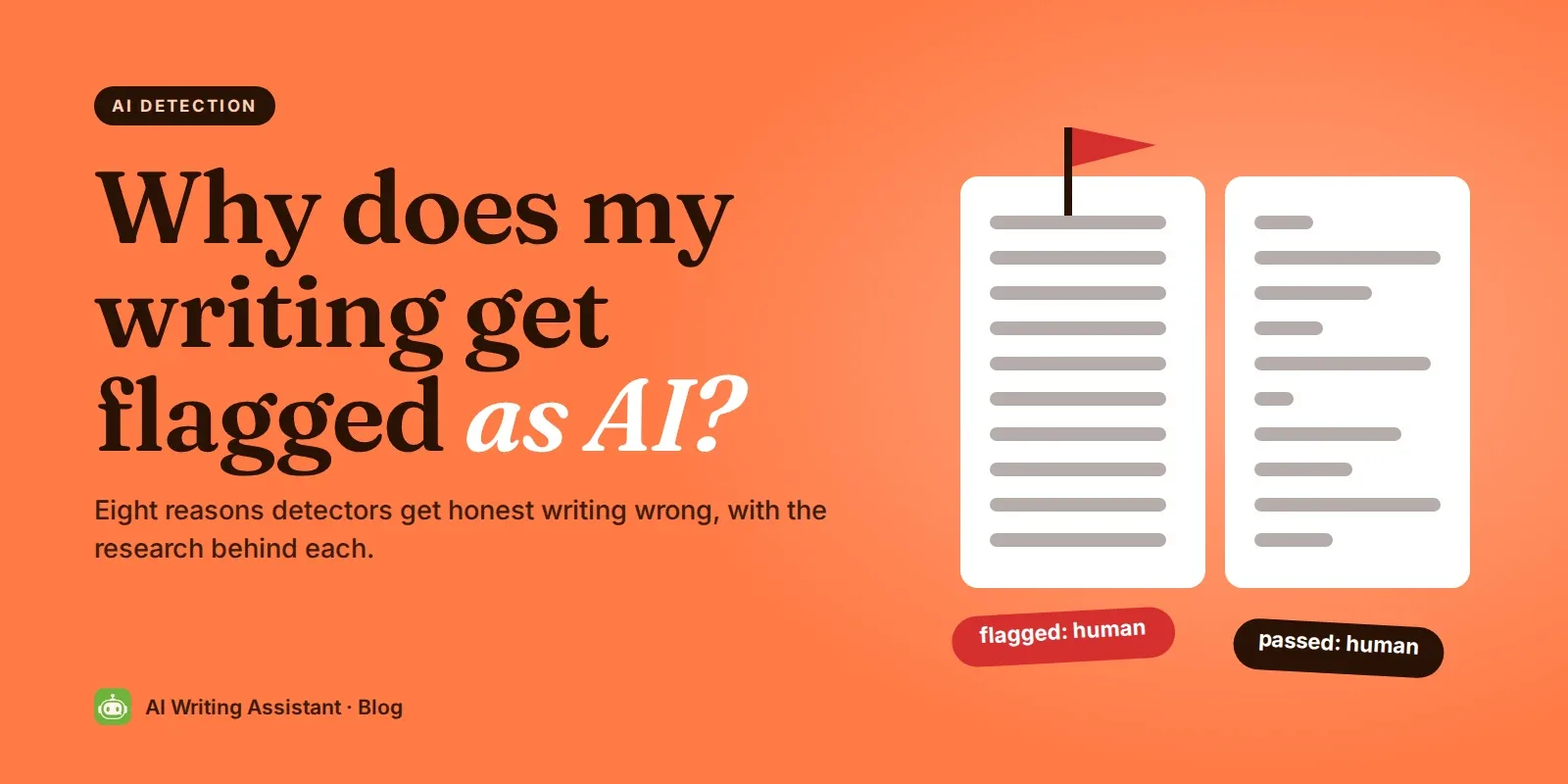
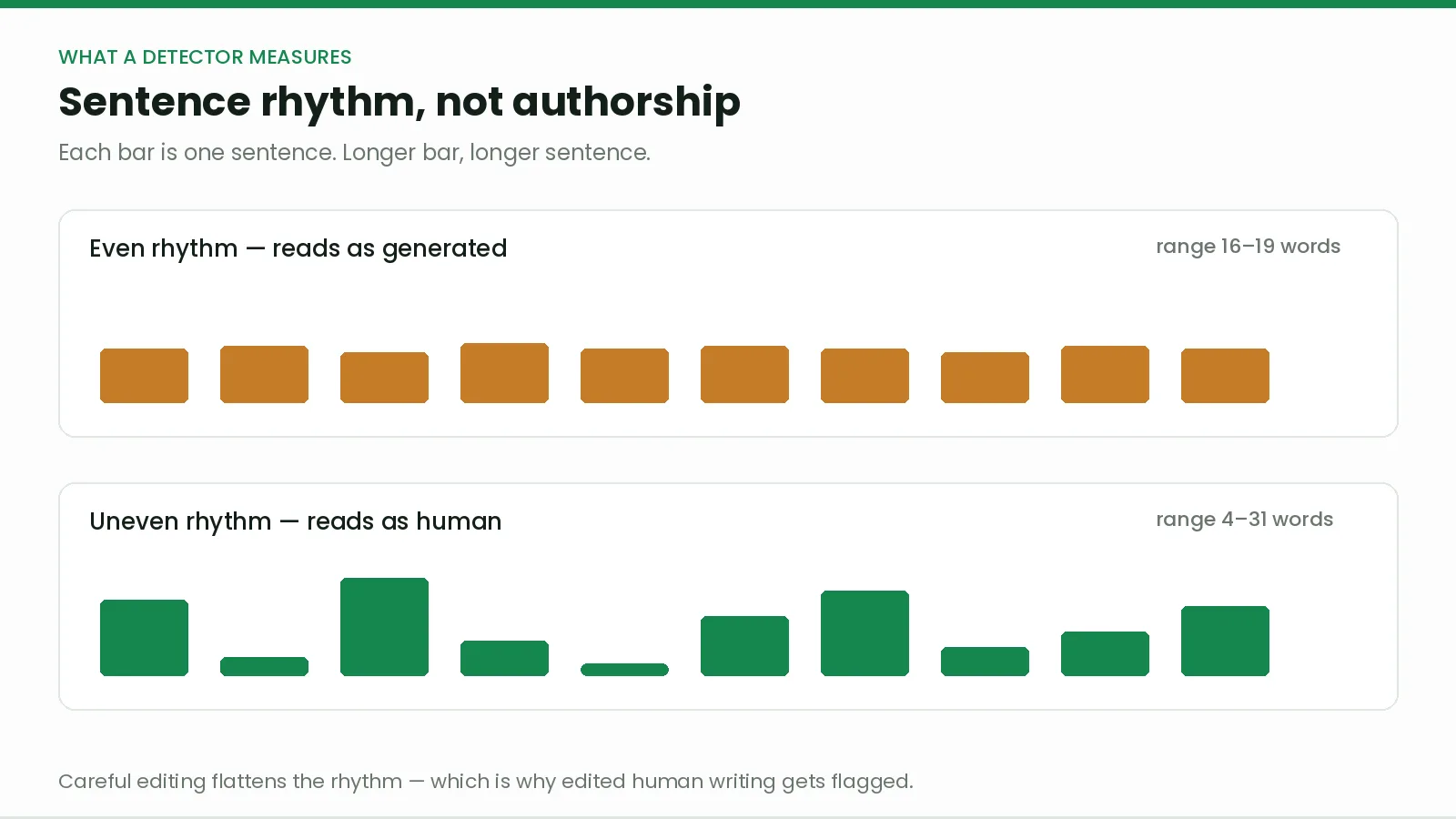
Because AI detectors don't check who wrote a text. They measure how predictable the words are and how steady the rhythm is, then compare that with what AI writing looks like. Clear, correct, well-organised writing is predictable by design, so it can score as AI even when every word is yours. The plainer and more polished the text, the more likely a false flag.
8 reasons human writing gets flagged as AI
1. You write plainly and carefully
If you were taught to avoid flourishes, use common words and keep sentences tidy, your writing is low in surprise. That's exactly what detectors look for. Careful editing makes it worse, because editing smooths out the uneven rhythm that reads as human.
2. English isn't your first language
This is the best-documented cause. In Liang and colleagues' 2023 Stanford study, seven detectors flagged on average 61.22% of 91 TOEFL essays by non-native speakers as AI. Essays by US eighth-graders were flagged about 5% of the time. When the researchers used ChatGPT to enrich the TOEFL essays' vocabulary, the false positive rate fell to 11.77%. The writers hadn't changed. Only the word choice had.
The picture isn't the same everywhere. Turnitin published its own research in October 2023 finding no statistically significant difference for English learners on texts over 300 words, though both groups had higher error rates on shorter texts. A 2026 study of Czech found non-native writers there actually produced less predictable text than native writers. The bias depends on the language and the detector, which is one more reason not to trust a score on its own.
3. You followed a template
Five-paragraph essays, lab reports, legal summaries, cover letters and abstracts all follow fixed patterns. The conventions of the form do the flagging, not you. If your genre is formulaic, expect a higher reading.
4. A tool rewrote parts of it
Spelling fixes rarely matter. Heavier rewriting does. If you accepted whole-sentence rewrites from an AI writing assistant, those sentences now carry the patterns of AI text, because an AI produced them. Turnitin has flagged AI-paraphrased text in English since August 2025. If your school allows AI editing help, say so when you submit.
5. The text is short
Every detector works on statistics across many words. On a single paragraph there isn't much to measure, so scores swing. In our own test, an AI-written passage scored 68% at 263 words and 31% when cut to its first 94 words. Turnitin won't score anything under 300 words.
6. It reads like older literature
Long, balanced sentences and formal vocabulary from the 19th and early 20th century can look generated. In our live test on 2 October 2026, our own detector wrongly flagged 7 of 36 older literary passages in Spanish, French, German, Japanese, Chinese and Arabic. Two of them were famous Japanese stories, Dazai's 走れメロス and Nakajima's 山月記. We retrained it that day on public-domain books. On authors it had never seen, false alarms dropped from 31.6% to 2.5% in Japanese and from 13.1% to 4.0% in Spanish. Other detectors may still have this blind spot.
7. The detector doesn't really read your language
Many detectors are trained mostly on English. Some tools return a confident score for a language they can't really read, and the score can even land the wrong way round. Our own detector caught only 1 of 10 AI texts in Traditional Chinese until we fixed how it reads that script. If you write in another language, check that the tool actually supports it.
8. It sits next to AI text
In a document that mixes human and AI writing, the human sentences closest to the AI parts get flagged most. Turnitin says 54% of its wrongly flagged sentences are right next to real AI writing. If you used AI for one section, your own sentences around it are at higher risk.
Can AI detectors be wrong?
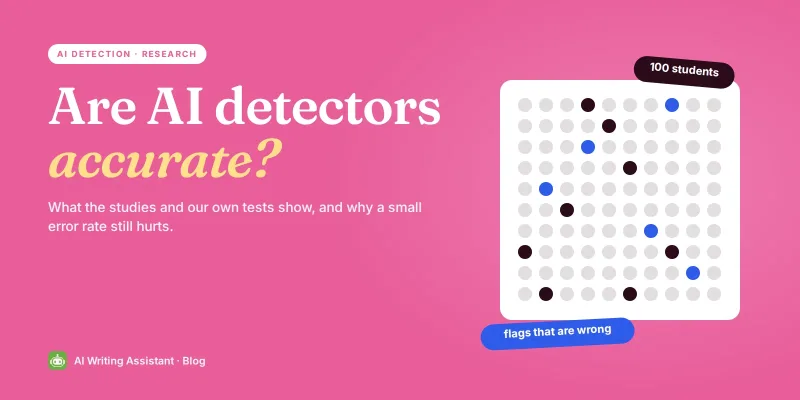
Yes, in both directions, and the companies that make them say so. Turnitin publishes a sentence-level false positive rate of around 4%, so about 1 in 25 highlighted sentences may be human. The AI text classifier from OpenAI wrongly flagged 9% of human text and was withdrawn in July 2023 for low accuracy. A detector result is a probability, and probabilities are sometimes wrong about the case in front of you.
Who false flags fall on
International students. People who learned English in a classroom. Students taught rigid essay scaffolds because scaffolds earn marks. Autistic writers whose prose is precise and even. Anyone in a field where the house style is deliberately flat.
They're also often the people least able to push back: far from home, less confident in the language of an appeal, worried about a visa, with nobody to call. The errors don't fall evenly, and neither does the cost of them.
What to do if your writing gets flagged
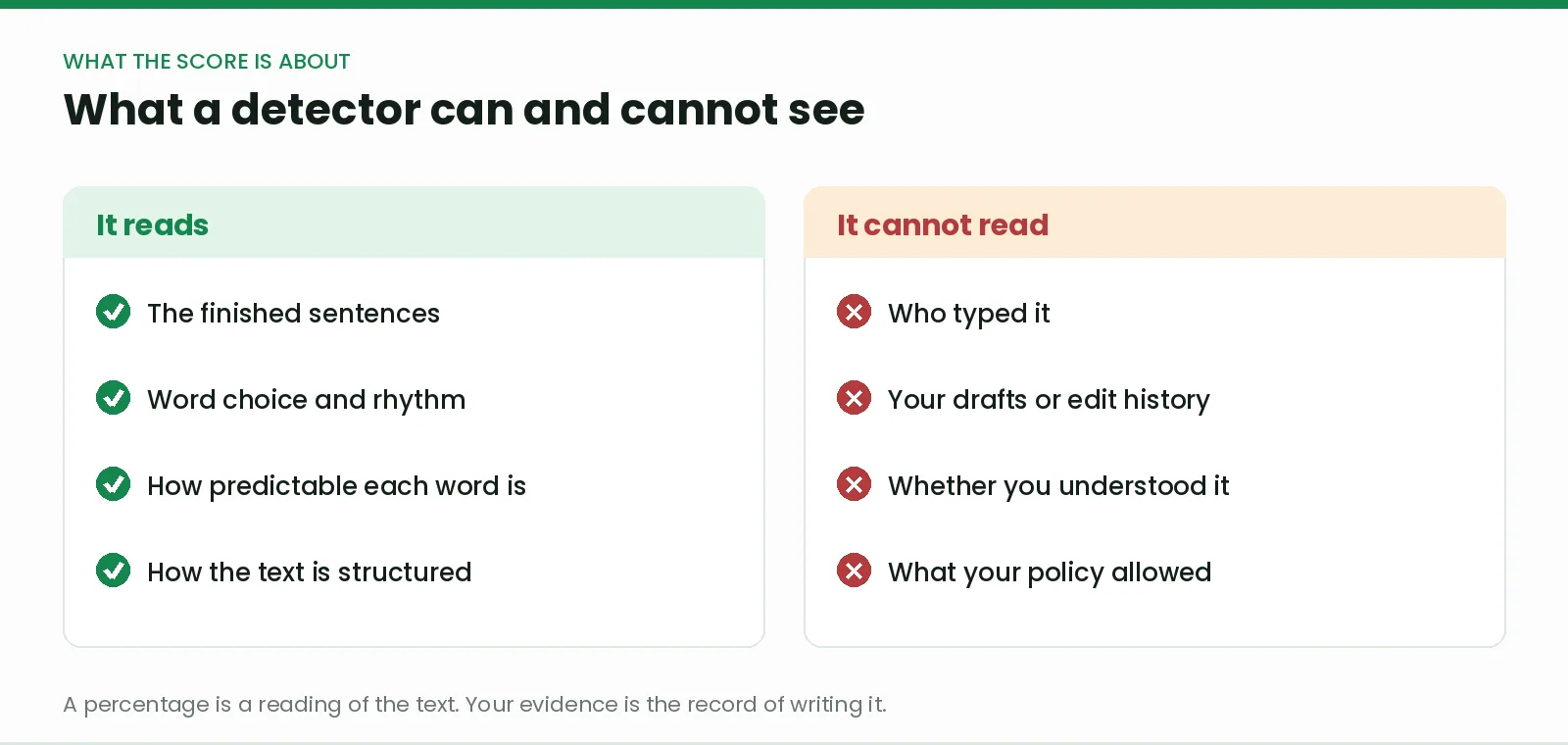
- Don't edit the file. Its version history is your best evidence.
- Check the length, range and confidence. A low-confidence score on a short text is close to no result.
- Look at which sentences were flagged. If they're your most formal or most template-like lines, that explains the score.
- Gather your process. Drafts, notes, outlines, sources and version history.
- Don't rewrite to lower the number. You'll make the writing worse and prove nothing.
If you're facing an accusation, follow our step-by-step guide: falsely accused of using AI? How to prove you didn't. For why even a low error rate produces many wrong flags, see are AI detectors accurate?.
Frequently asked questions
Why does my writing get flagged as AI when I wrote it myself?
Detectors measure how predictable and evenly paced text is, not who wrote it. Clear, well-edited, conventional writing has the same statistical pattern as AI text, so honest work can score as AI.
Why do AI detectors flag my writing but not my friend's?
Style, not honesty. Plainer vocabulary, steadier sentence lengths, template structures, heavy editing and short length all push a score up. Writing with more personal detail and varied rhythm reads as more human.
Can AI detectors be wrong?
Yes. Turnitin says about 4% of its highlighted sentences may be human-written, and OpenAI withdrew its own classifier in 2023 after it wrongly flagged 9% of human text. Every detector makes mistakes in both directions.
Are AI detectors biased against non-native English speakers?
In a 2023 Stanford study, seven detectors flagged 61.22% of TOEFL essays as AI on average, against about 5% for native eighth-graders. A 2023 Turnitin study found no significant gap for texts over 300 words. Results depend on the tool and the text length.
Does Grammarly make my writing look like AI?
Spelling and grammar fixes usually don't change much. Accepting whole-sentence AI rewrites can, because those sentences were produced by an AI. If your course allows AI editing help, disclose it.
How do I stop my writing being flagged as AI?
Write with specifics only you know, vary your sentence length, and keep your drafts and version history. Don't use tricks or rewriters to lower a score. They make writing worse and can look like tampering.
Can I prove I wrote something myself?
Not with a detector. Use process evidence: document version history, dated drafts, notes, outlines and sources. That outweighs any score in a fair review.
 Grammar Checker
 Paraphraser
 Summarizer
 AI Writer
 AI Humanizer
 Text Compare