If you have typed this question into a search box at eleven at night with a deadline in the morning, you probably want a yes or a no. The honest answer is yes, Turnitin runs an AI writing detector, and no, its output is not the thing you think it is.
What follows is drawn from Turnitin's own published documentation rather than from anybody's marketing. Where a number appears, it is a number Turnitin printed itself, and the link is there so you can check it.
The short answer
Turnitin added an AI writing detection capability to its similarity reports. It produces a percentage: the proportion of the qualifying prose in your document that its model believes was generated by a large language model. ChatGPT output is exactly the kind of text it was built to notice.
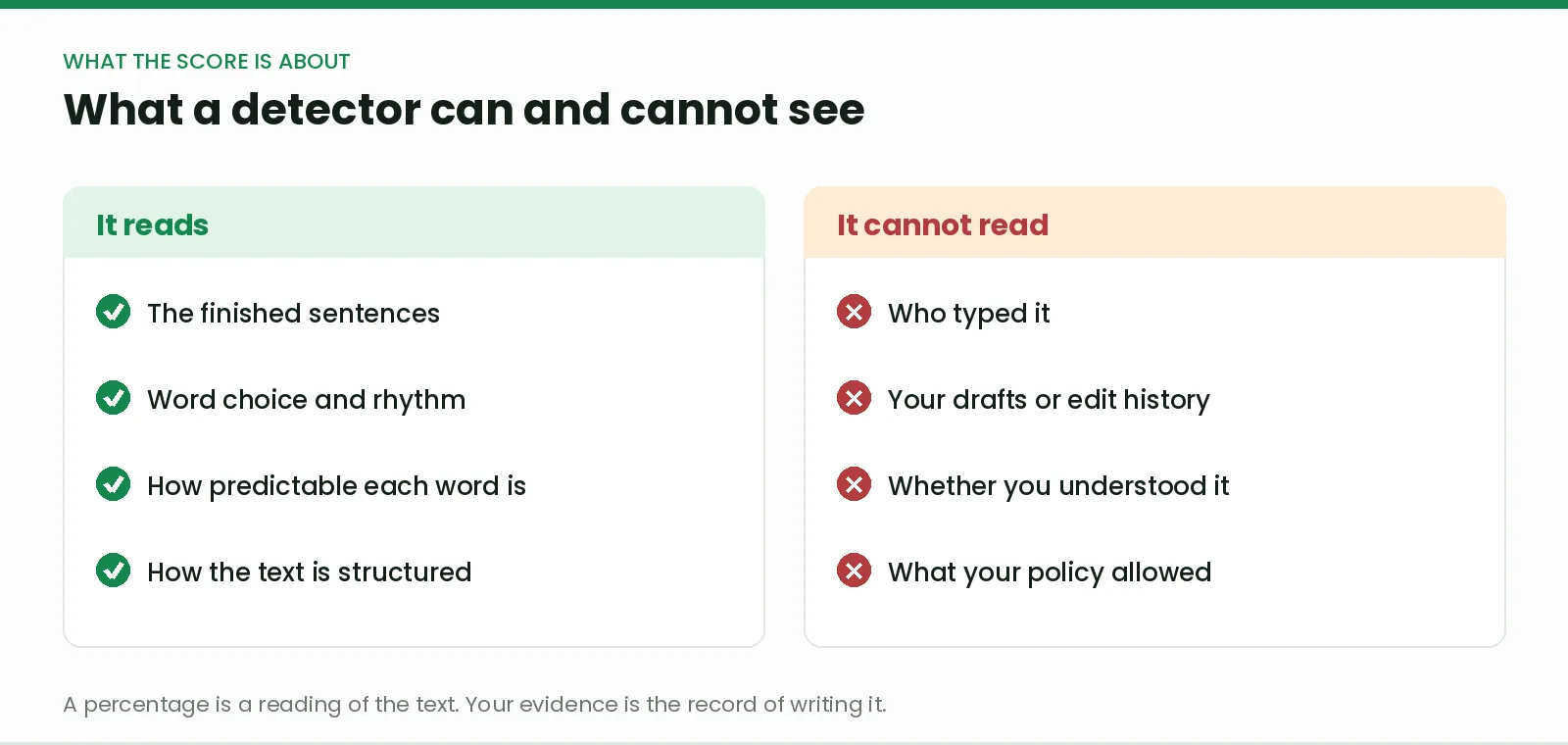
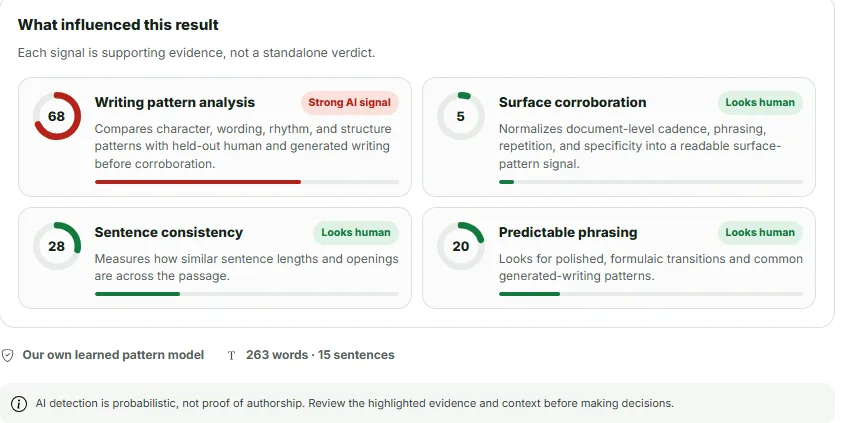
But the detector is a statistical model reading finished sentences. It has no access to your keystrokes, your browser, your account, or your intentions. It reports how the writing reads. Everything else — what you actually did — is a separate question that a percentage cannot answer.
What Turnitin actually checks
Turnitin's file requirements page is specific, and the specifics matter more than most students realise:
| Requirement | What Turnitin states |
|---|---|
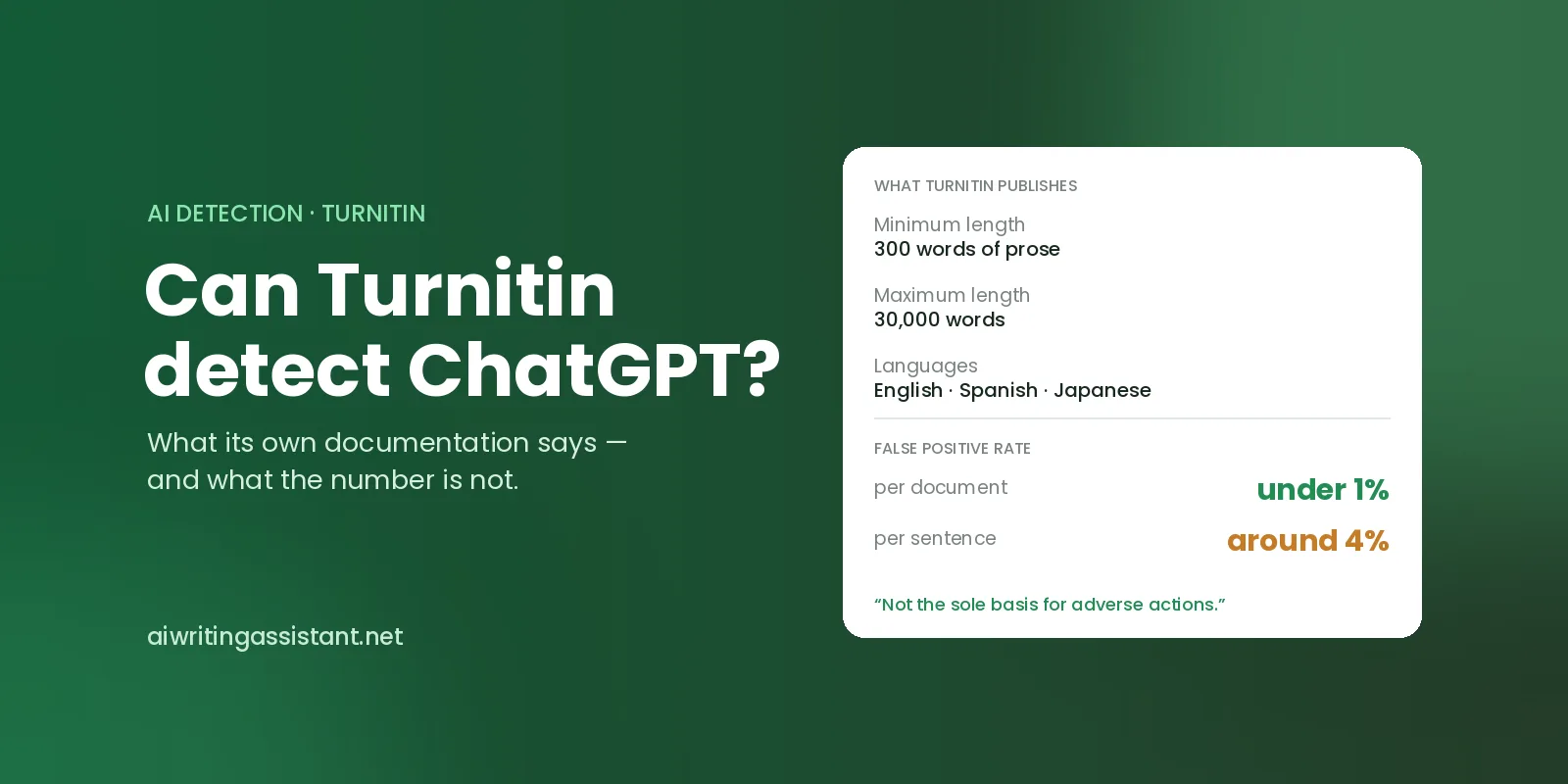
| Minimum length | At least 300 words of prose text in a long-form writing format |
| Maximum length | Not more than 30,000 words |
| Languages | English, Spanish and Japanese |
| File types | .docx, .pdf, .txt, .rtf |
| File size | Under 100 MB |
Two consequences fall straight out of that table. A short reflective piece under 300 words does not get an AI writing report at all. And the model is looking for long-form prose — continuous paragraphs. Bullet-heavy documents, code, tables and reference lists are not what it was trained to judge.
What the percentage means — and what it does not
The number is the share of qualifying text the model attributes to AI generation. It is not a confidence level, not a probability that you cheated, and not a similarity score. It is closer to a reading than a ruling.
This is the single most misread number in academic integrity right now, and the misreading runs in both directions. A student sees 40% and assumes they are about to be expelled. An assessor sees 40% and assumes two fifths of the essay was pasted from a chatbot. Neither reading is what the model is claiming.
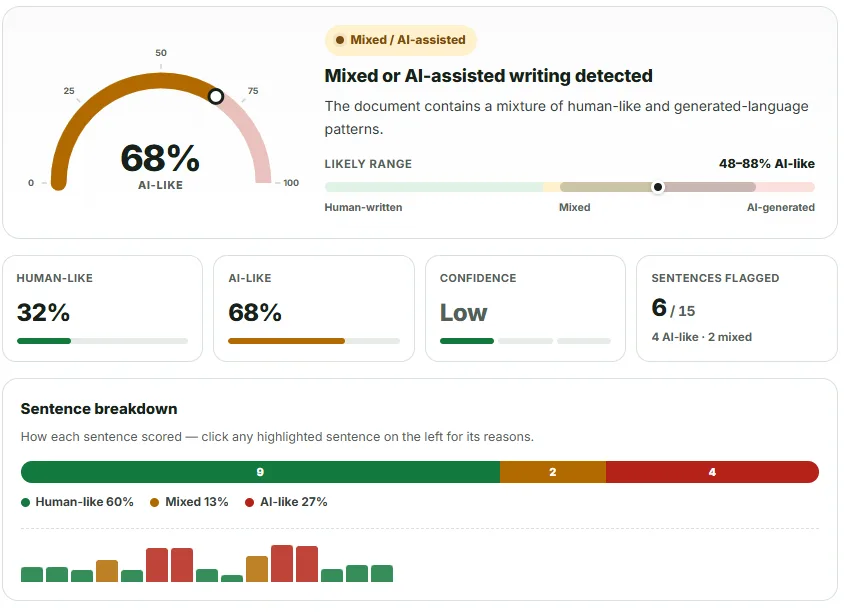
If you want the mechanics of how any of these systems arrive at a number — perplexity, burstiness, the classifier layer — we wrote that up separately in How AI detectors work.
The two false positive rates, and why the gap matters
Turnitin publishes two different false positive figures, and conflating them causes a lot of unnecessary distress:
| Level | Turnitin's published rate | What it means |
|---|---|---|
| Document | Less than 1%, for documents marked 20% or more AI | Roughly 1 in 100 flagged documents is wrongly flagged overall |
| Sentence | Around 4% | Roughly 1 in 25 individually highlighted sentences may be human-written |
The sentence figure is the one that bites in a meeting. If a marker prints your essay with eleven sentences highlighted and asks you to explain them, a 4% sentence-level error rate means it is entirely ordinary for one or two of those highlights to be wrong. That is not a scandal; it is the stated behaviour of the tool. It is also why arguing about a single highlighted sentence is usually the wrong fight.
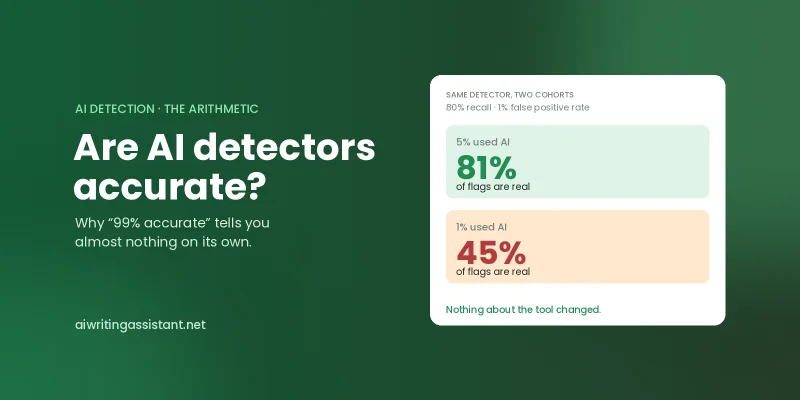
A document-level rate under 1% also sounds reassuring until you multiply it by a cohort. Across a department submitting ten thousand essays a term, under 1% is still a meaningful number of students who did nothing wrong and now have a conversation to survive. Low rates and real harm coexist comfortably at scale — which is the whole argument of Are AI detectors accurate?
What Turnitin says assessors should do
This is the part worth quoting to anyone who treats the percentage as a verdict. Turnitin's own guidance states plainly:
An AI Writing score should not be used as the sole basis for adverse actions against a student.
Their supporting material points assessors towards reviewing the report in context, comparing it against the student's other work, and talking to the student rather than acting on a figure. That is the vendor of the detector saying the detector is not sufficient. It is a stronger statement than most critics of these tools bother to make.
If you use AI openly and legitimately
Plenty of coursework now permits AI assistance with disclosure. If that describes you, the detector is not your enemy — the absence of a record is. Three habits cover almost every case:
- Keep the process, not just the product. Outline, notes, rough draft, revised draft. A folder of ugly intermediate files is worth more than any tool's certificate.
- Disclose in the format your institution asks for. An appendix naming what you used and for what is boring, unglamorous and almost impossible to argue with.
- Write the argument yourself. Assistance with phrasing is a different thing from assistance with thinking, and every policy worth reading draws the line there.
Our own position on all of this is set out on the academic integrity page, including where we think the line sits and why we will not help anyone cross it.
What we are not going to tell you
Our AI Humanizer exists to make clumsy machine phrasing readable, and its own page says at length that it is not a detector-evasion tool. Our AI Detector reports its own uncertainty instead of hiding it. Those two positions are the same position.
The honest summary
Turnitin can detect text that reads like ChatGPT wrote it, within limits that Turnitin publishes and largely does not oversell. It cannot detect what you did. If you wrote the essay, your defence is the trail you left while writing it — and if you are already in that conversation, we wrote a practical guide to responding to a false accusation.
Can Turnitin detect ChatGPT?
Turnitin runs an AI writing detector that produces a percentage estimate of how much of a document reads as AI-generated, and ChatGPT output is the kind of text it was built to notice. It is an estimate about the writing, not a record of how the writing was produced.
What is a safe Turnitin AI score?
There is no published safe threshold, and any number quoted as one is invented. Institutions set their own review thresholds, and Turnitin's own guidance says the score should not be the sole basis for action against a student.
Does Turnitin detect paraphrased AI text?
Paraphrasing changes the surface of a text, and detectors read the surface, so it changes the reading. Nobody can tell you reliably in which direction or by how much for your specific document, and using a paraphraser to hide undisclosed AI use is still the thing your institution is asking about.
Why did my human-written essay get flagged?
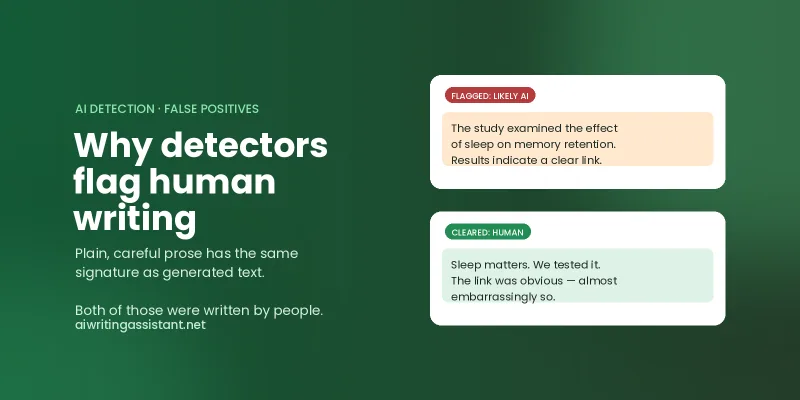
Because the model judges how writing reads, and plain, evenly-paced, structurally tidy prose reads the way generated text reads. Writers using formulaic academic structures and writers working in a second language are affected more often. We covered the mechanism in detail in why AI detectors flag human writing.
Does Turnitin check documents under 300 words?
No. Turnitin states that an AI writing report requires at least 300 words of long-form prose, with a maximum of 30,000 words.
Can I check my work in Turnitin before submitting?
Only if your institution gives you access to a draft submission point. Third-party sites offering “Turnitin checks” are not Turnitin, cannot see your institution's configuration, and often keep the document you upload.
 Grammar Checker
 Paraphraser
 Summarizer
 AI Writer
 AI Humanizer
 Text Compare