
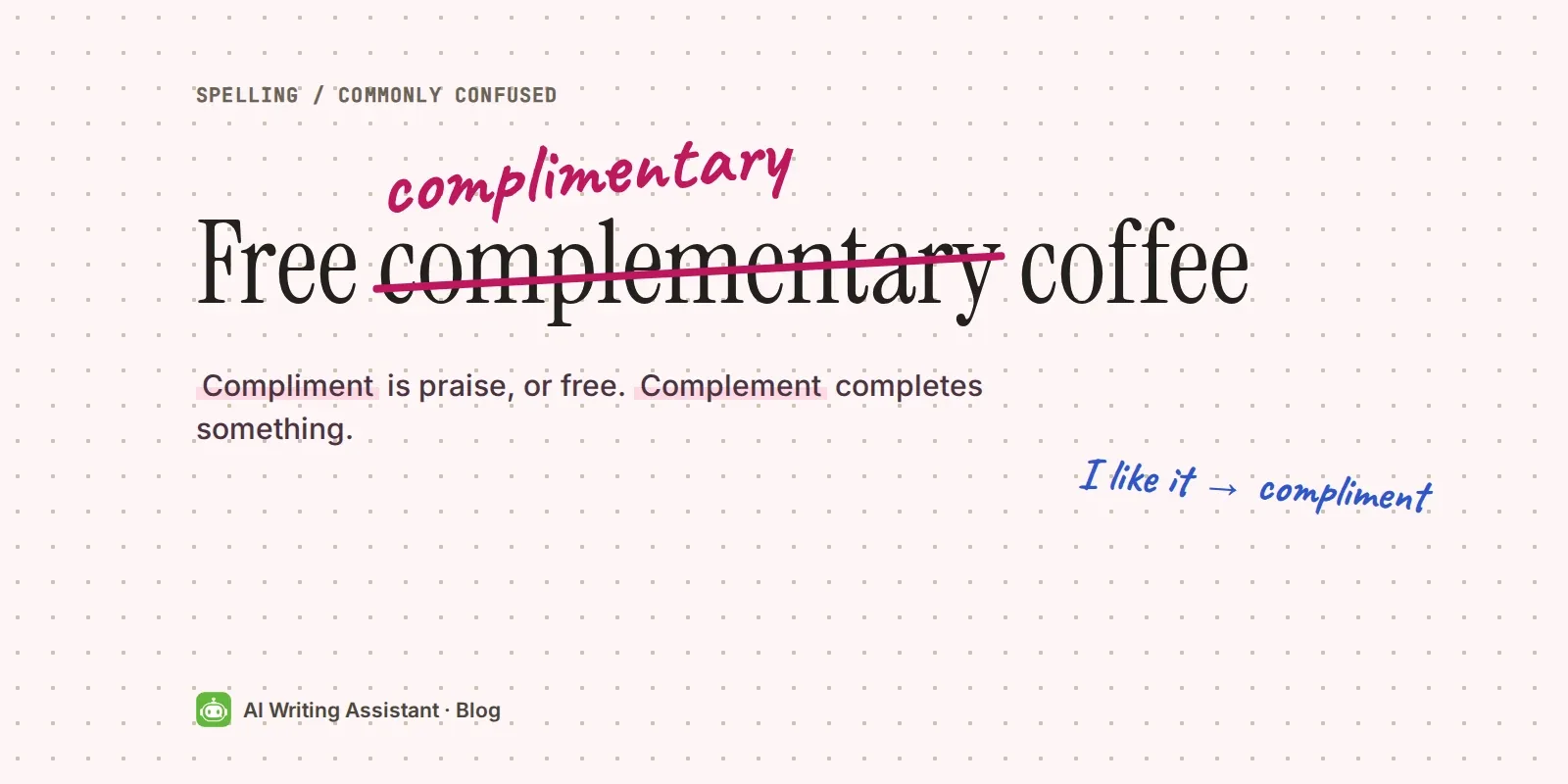
Compliment and complement sound alike and look alike, so spell check rarely saves you. The good news is that one letter tells you everything. Here's what each word means, where they came from, and a memory trick that sticks.
What is the difference between compliment and complement?
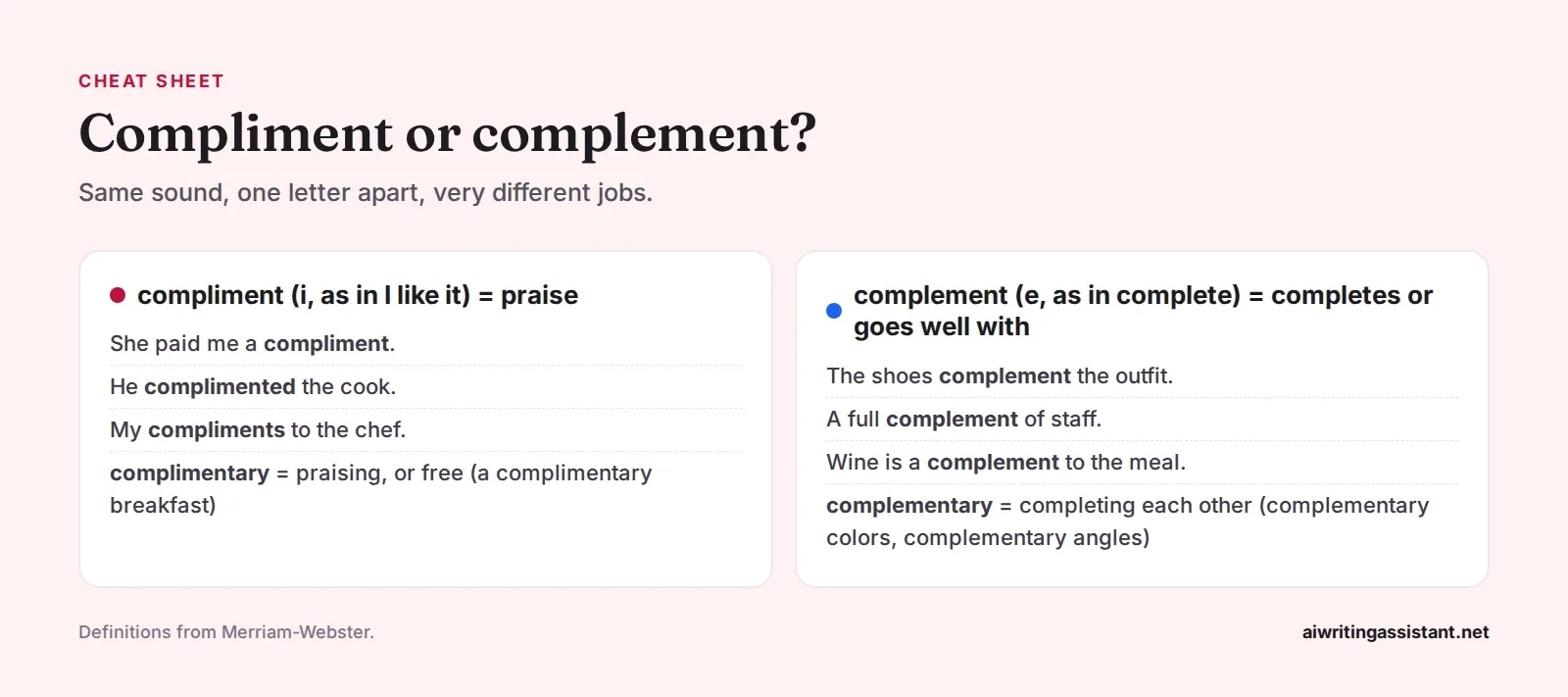
A compliment is an expression of praise, like "She paid me a compliment on my essay." A complement is something that completes or improves something else, like "The sauce is a perfect complement to the fish." Both can be verbs too. You compliment a person by praising them. One thing complements another by going well with it. The adjectives follow the same split, so a free hotel breakfast is complimentary, while matching colors are complementary.
What compliment means
Merriam-Webster defines the noun as an expression of esteem, "an admiring remark." In the plural, compliments also means best wishes or regards, which is why you send "my compliments to the chef." The noun dates to 1598 and the verb to 1673.
- Thanks for the compliment.
- Jordan complimented the design team on the launch.
- Please give my compliments to your parents.
The phrase "compliments of" names the giver of something free, as in "a voucher, compliments of the hotel." Merriam-Webster notes it can be ironic too, with the example "a speeding ticket, compliments of the state police."
What complement means
The Merriam-Webster entry for complement defines the noun as "something that fills up, completes, or makes better or perfect." It also means the full number of something, as in a ship's complement (its full crew). As a verb, it means to complete or enhance by adding something, as in "The illustrations complement the text."
- The new hire complements the team's skills.
- Rice is a good complement to this curry.
- The office has a full complement of staff again.
Don't worry about saying them differently. Merriam-Webster gives the noun complement the same pronunciation as compliment (\ˈkäm-plə-mənt\). You can only tell them apart in writing.
Complimentary vs complementary
The adjectives cause the most trouble, because each has two meanings.
| Word | Meaning | Example |
|---|---|---|
| complimentary | expressing praise or admiration | Her review was very complimentary. |
| complimentary | given free as a courtesy | Guests get a complimentary breakfast. |
| complementary | serving to fill out or complete | The two reports are complementary. |
| complementary | supplying each other's lack | Their skills are complementary. |
| complementary | colors that produce a neutral color when combined | Red and green are complementary colors. |
The definitions come from the Merriam-Webster entries for complimentary and complementary. A free drink is complimentary, because it's given as a courtesy. It has nothing to do with completing anything.
Why are the two words so similar?
Because they started as the same word. Etymonline traces complement to the Latin complementum, "that which fills up or completes," from complere, "to fill up." Compliment came later, through French and Italian, from the same Latin verb. Etymonline calls complement "essentially the same word."
The link is the idea of completing the obligations of politeness. In the 16th century, complement carried the politeness senses too. Etymonline says those politeness senses were taken up by compliment around 1650 to 1725, when the French-style spelling caught on. Since then, the i spelling has meant praise and the e spelling has meant completing.
A memory trick that works
The Merriam-Webster usage guide explains the e link to "something that completes." The "I like it" half is a common add-on, not part of the dictionary. Use whichever half you find easier, since knowing one tells you the other.
Complementary angles, colors and other technical uses
Complementary angles
In geometry, two angles are complementary when their measures add up to 90 degrees, the measure of a right angle. Wolfram MathWorld notes that 45 degrees is the only angle complementary to itself. Don't confuse these with supplementary angles, which add up to 180 degrees.
Complementary colors
Complementary colors are contrasting colors that produce a neutral color when combined, according to Merriam-Webster. Red and green, or blue and orange, are common examples.
Subject complement in grammar
Grammar has its own complement. A subject complement is a word or phrase that completes the predicate after a linking verb. The Bemidji State University Writing Resource Center gives "Martha is my neighbor" and "She seems shy." Neighbor and shy are the complements. Merriam-Webster offers "mayor" in "they elected her mayor" as another kind of complement. It's always spelled with an e, because it completes the sentence.
How often do books mix them up?
Not often, but more than you might expect. We checked Google Books Ngram data for three phrases where only one spelling is correct. In 2022, "complementary colors" appeared about 16 times for every "complimentary colors." That's about one wrong spelling in every 17 mentions. "Complementary angles" led its misspelling about 67 to 1.
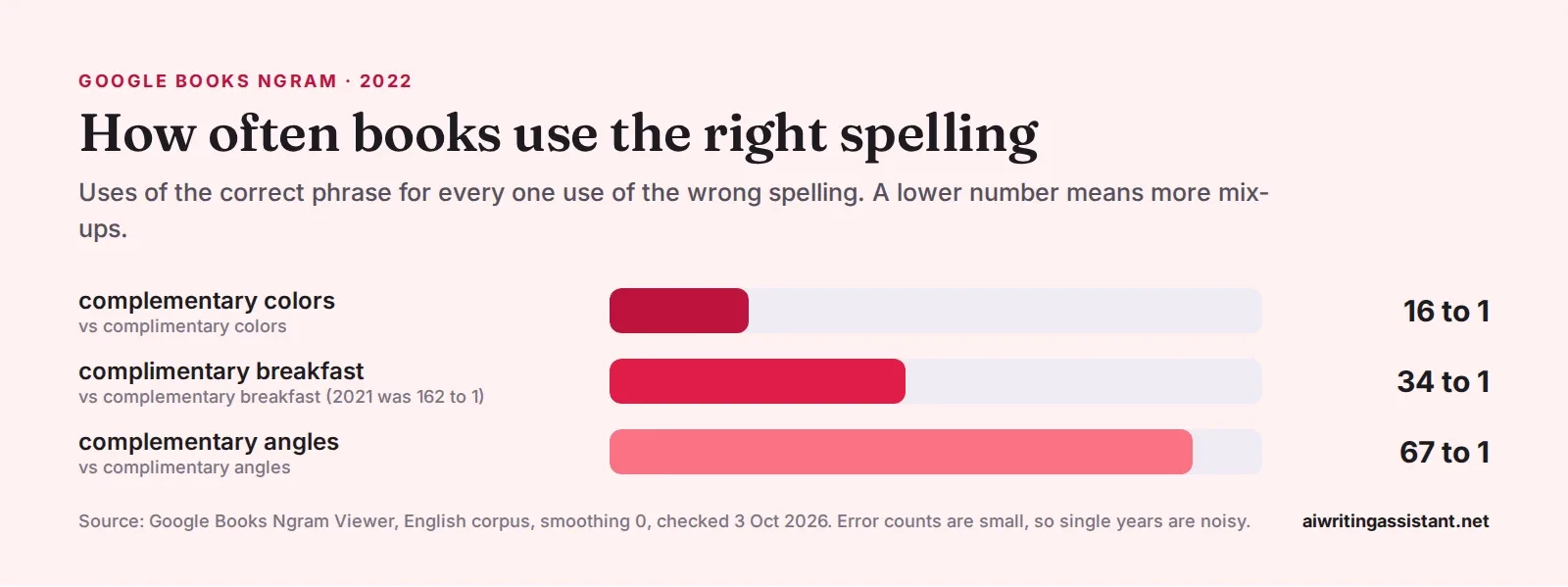
Treat the breakfast number with care. "Complimentary breakfast" beat "complementary breakfast" about 162 to 1 in 2021 but only 34 to 1 in 2022. The misspelling appears in so few books that one or two extra hits swing the ratio a lot. A range of roughly 35 to 160 to 1 is a fair reading. Books are also edited, so error rates in emails and online reviews are likely higher.
Both words are correct in some phrases. "A compliment" and "a complement" are each fine English. In Google Books, "a compliment" roughly tripled in frequency between 2000 and 2022, while "a complement" stayed flat.
Practice: compliment or complement?
| Sentence | Answer |
|---|---|
| Thank you for the kind ___. | compliment |
| The scarf ___s your coat. | complement |
| Parking is ___ary for guests. | complimentary (free) |
| Blue and orange are ___ary colors. | complementary |
| Angles of 30 and 60 degrees are ___ary. | complementary |
| My ___s to the chef. | compliments |
For more sound-alike pairs, see our guides to former vs latter and lose vs loose.
Frequently asked questions
What is the difference between compliment and complement?
A compliment is praise. A complement completes something or goes well with it.
Do compliment and complement sound the same?
Yes. Merriam-Webster gives them the same pronunciation.
Is it complimentary or complementary breakfast?
Complimentary breakfast. Complimentary means given free as a courtesy.
Is it complementary or complimentary colors?
Complementary colors, because the colors complete each other.
What are complementary angles?
Two angles whose measures add up to 90 degrees.
Is it "my compliments to the chef"?
Yes, with an i. In the plural, compliments means best wishes or regards.
What is a subject complement?
The word after a linking verb that renames or describes the subject, such as "neighbor" in "Martha is my neighbor."

 Grammar Checker
 Paraphraser
 Summarizer
 AI Writer
 AI Humanizer
 Text Compare