
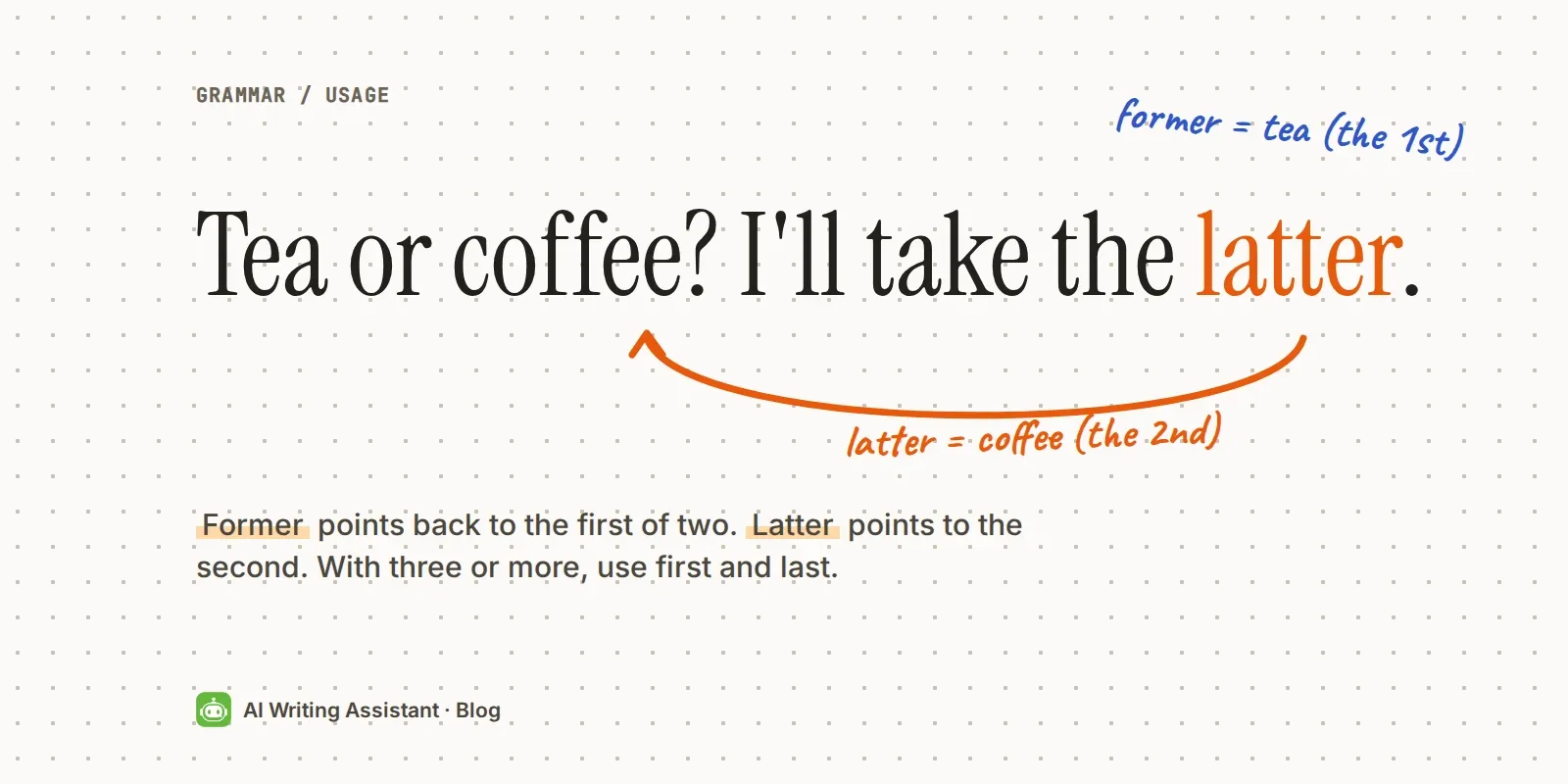
"Former" and "latter" are tidy little words that save you repeating a long phrase. They're also easy to flip, and when you do, your reader ends up drinking tea when you meant coffee. Here's how to keep them straight, plus the one situation where neither fits.
What do former and latter mean?
When you mention two things, "the former" refers to the first one and "the latter" refers to the second. Oxford Learner's Dictionaries defines former as "used to refer to the first of two things or people mentioned" and latter as "used to refer to the second of two things or people mentioned." So in "I like cats and dogs, but the latter are more work," the latter means dogs.
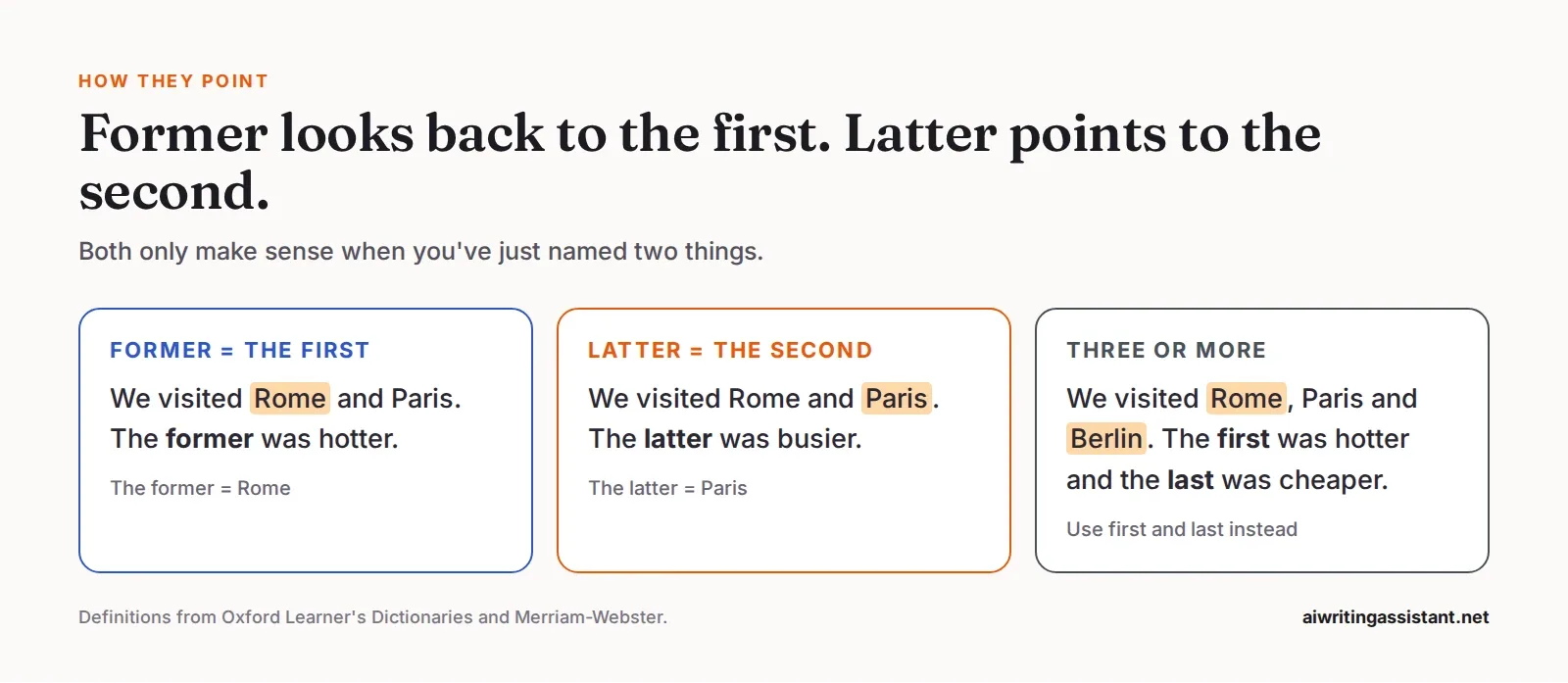
Former vs latter examples
- "You can pay now or pay monthly. The former saves you 10%." (paying now)
- "Both Maya and Leo applied, but only the latter got an interview." (Leo)
- "Between a quick fix and a full redesign, the team chose the latter." (the full redesign)
- "The report covers sales and staffing. The former improved, while the latter got worse." (sales improved, staffing got worse)
Can you use "latter" with three or more things?
This is where style advice and dictionaries part ways. The traditional rule is that former and latter only work with two items. Etymonline calls latter "incorrect if more than two are involved."
Merriam-Webster is more relaxed. It says latter "is used to refer to the last in a series regardless of number," and that this use is "several hundred years old." Its advice for careful writers is still to "use last to refer to the last item in a series of three or more."
So with three or more items, the safe choice is "the first," "the last," or simply repeating the noun. Nobody will mark you down for clarity.
Where the words come from
Latter comes from the Old English lætra, the comparative of læt, "late." It first meant "slower" and is closely related to "later." Former comes from the Old English forma, "first," and Etymonline calls it "an unusual case of a comparative formed from a superlative." The sense "the first of two" dates from the 1580s.
That history explains a lot. Latter is literally "the later one," the one mentioned second.
Other meanings of former and latter
| Word | Use | Example |
|---|---|---|
| former | previous, ex- | a former teacher, the former Soviet Union |
| former | the first of two | Of tea and coffee, I prefer the former. |
| latter | the second of two | Of tea and coffee, I prefer the latter. |
| latter | near the end of a period | the latter half of the year, his latter years |
Don't confuse latter with later (after some time) or ladder (the thing you climb). "I'll call you latter" is a typo for later.
When to avoid former and latter
These words make readers look back. That's fine in a short sentence. It's annoying when the two items were a paragraph ago, or when the items are long phrases. If a reader has to reread to work out which is which, just repeat the noun.
| Hard to follow | Clearer |
|---|---|
| The council debated raising parking fees and extending bus routes into the suburbs. After an hour, it approved the former. | After an hour, it approved the higher parking fees. |
| Customers can choose standard shipping, which takes five days, or express. Most chose the latter. | Most chose express. |
Frequently asked questions
What does former and latter mean?
When two things have just been mentioned, "the former" is the first one and "the latter" is the second one.
Which is first, former or latter?
Former is first. Latter is second. Former and first both start with f, and latter and last both start with l.
Can you use latter for more than two things?
Merriam-Webster accepts it as an old use, but style guides suggest "the last" or "the first" for three or more items to avoid confusion.
How do you use "the latter" in a sentence?
Name two things, then use "the latter" to refer to the second. For example, "Tea or coffee? I'll take the latter," meaning coffee.
What's the difference between latter and later?
Later means after some time. Latter refers to the second of two things or the later part of a period.
Is it rude or too formal to use former and latter?
It's not rude, but it is a bit formal. In casual writing, repeating the noun usually sounds more natural.
 Grammar Checker
 Paraphraser
 Summarizer
 AI Writer
 AI Humanizer
 Text Compare