
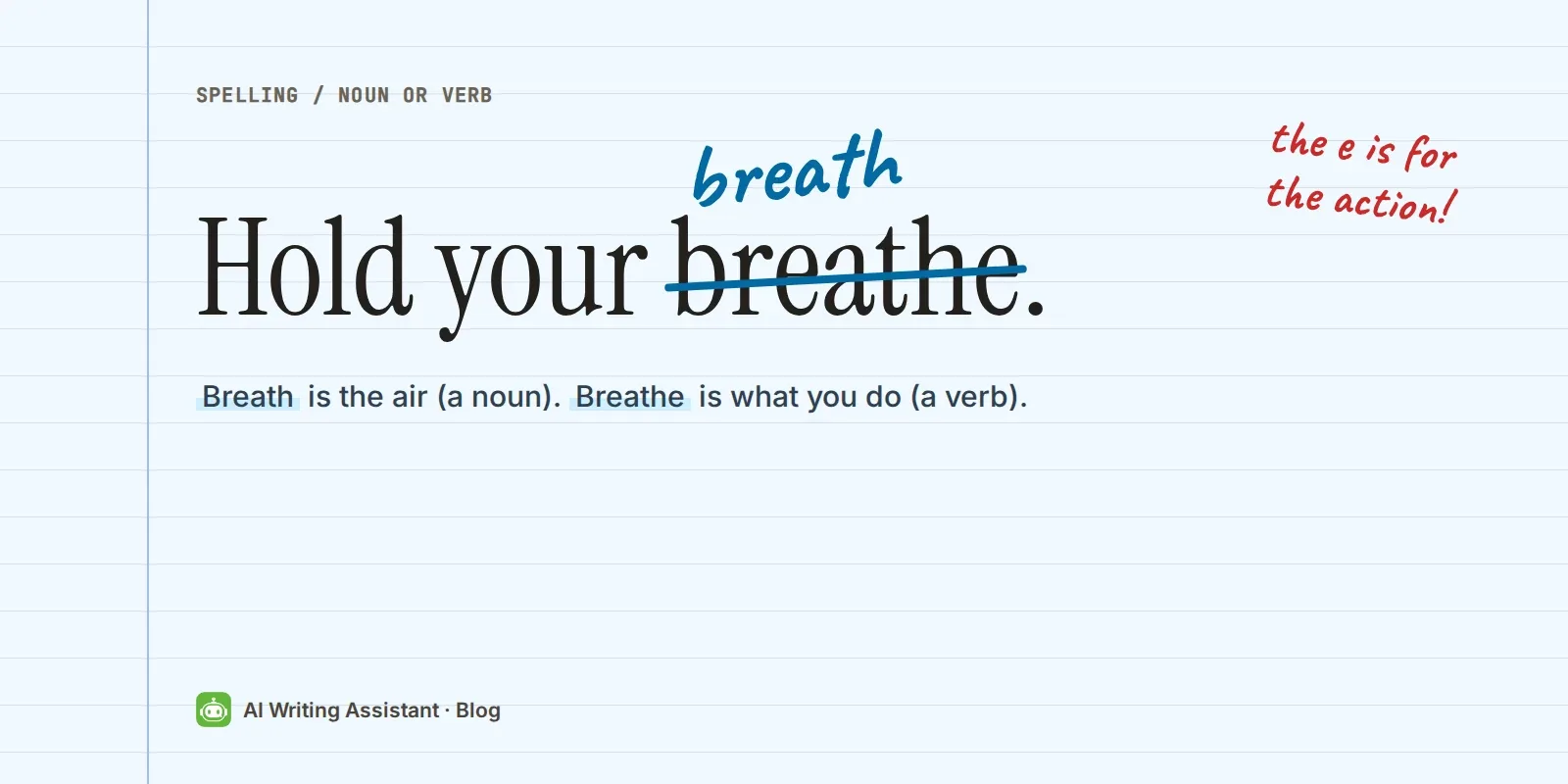
Breath and breathe are one letter apart, so a tired hand or a fast thumb swaps them easily. The fix is simple once you know which one is the thing and which one is the action.
What is the difference between breath and breathe?
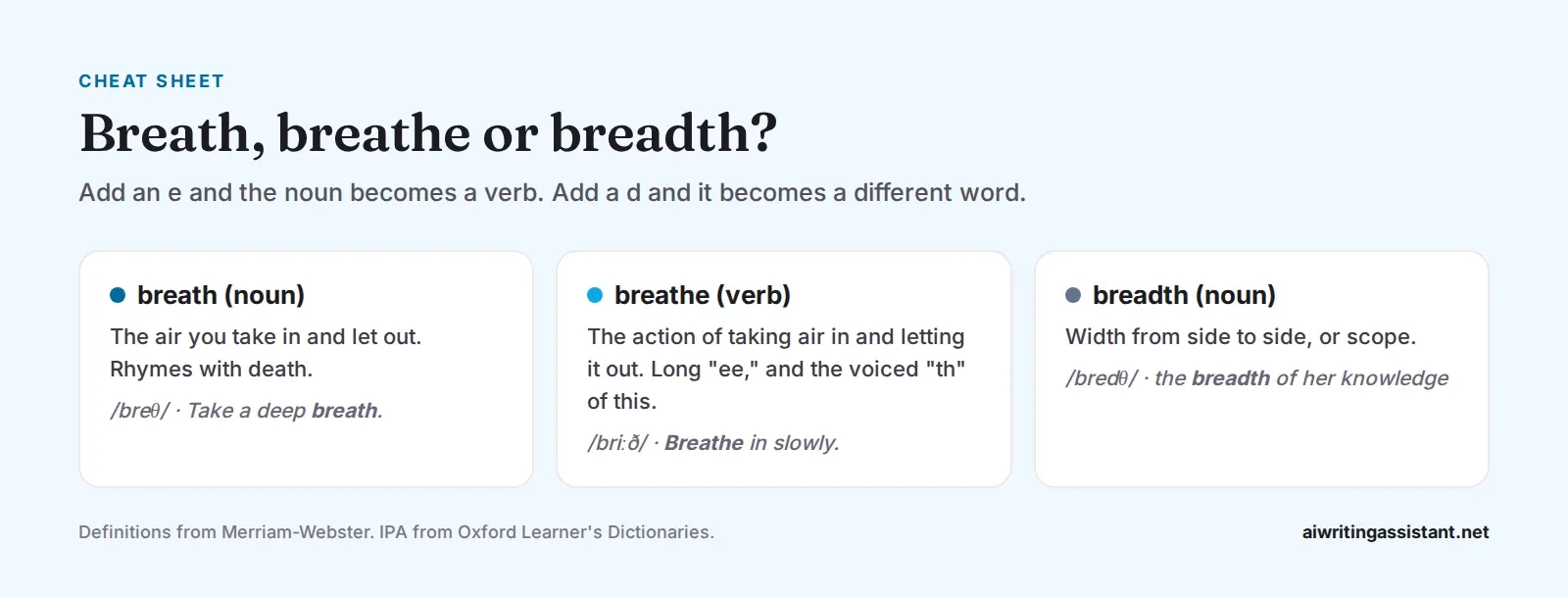
Breath is a noun. It means the air that goes into and out of your lungs, or a single act of breathing, as in "take a deep breath." Breathe is a verb. It means to take air in and send it out, as in "breathe slowly." The Merriam-Webster usage guide sums it up as "Breath is the noun and breathe is the verb." The two words also sound different, and the e on the end is your clue.
Breath is the noun
Merriam-Webster defines breath as "an act of breathing" and "the faculty of breathing." Oxford Learner's Dictionaries puts it as "the air that you take into your lungs and send out again." Like most nouns, it can follow a, the, your or my.
- Take a deep breath.
- I could see my breath in the cold.
- She ran up the stairs and lost her breath.
- He said it under his breath.
Breathe is the verb
Merriam-Webster defines breathe as "to draw air into and expel it from the lungs." It's something you do, so it changes form for tense.
- Breathe in through your nose.
- I can't breathe in this mask.
- She breathes more easily now.
- We breathed a sigh of relief.
| Form | Spelling | Pronunciation (IPA) |
|---|---|---|
| Base | breathe | /briːð/ |
| Third person | breathes | /briːðz/ |
| Past and past participle | breathed | /briːðd/ |
| -ing form | breathing | /ˈbriːðɪŋ/ |
All forms come from the Oxford Learner's entry for breathe. Notice that "breathed" keeps the e. "Breathd" and "breathded" aren't words.
How do you pronounce breath and breathe?
There are two sound differences, not one. According to the Oxford Learner's IPA, breath is /breθ/ with a short e (like bed) and the voiceless "th" in thin. Breathe is /briːð/ with a long "ee" (like see) and the voiced "th" in this. Say "a breath" and "to breathe" out loud, and you'll feel your throat buzz on the second one.
Why do they sound different?
The noun came first. Etymonline traces breath to Old English bræð, which first meant "odor, scent, stink, exhalation, vapor." The Old English word for air from the lungs was a different one, æðm. The sense "ability to breathe" shows up around 1300.
The verb was formed from the noun around 1200, says Etymonline. It "retains the original Old English vowel," which is why the verb and the noun sound different today. Merriam-Webster dates the verb to the 14th century, so the sources differ slightly on the exact date. Either way, the noun is the older word.
Don't confuse breath with breadth
Breadth is a separate noun. Merriam-Webster defines it as "distance from side to side," or width, and also scope. It's pronounced /bredθ/ in the Oxford Learner's entry, with a d before the th. It comes from Old English brǣdu plus -th, the same ending as length.
- Measure the length and breadth of the room.
- The course covers a wide breadth of topics.
Idioms with breath and breathe
Most idioms use the noun. The table lists common phrases from the Merriam-Webster and Oxford Learner's entries, with the form each one needs.
| Phrase | Form | Meaning |
|---|---|---|
| hold your breath | noun | stop breathing for a moment, or wait anxiously |
| out of breath | noun | breathing hard after effort |
| catch your breath | noun | rest until your breathing slows |
| under your breath | noun | quietly, so others can't hear |
| waste your breath / save your breath | noun | speak when it won't help / don't bother |
| take your breath away | noun | amaze you |
| with bated breath | noun | anxiously waiting |
| a breath of fresh air | noun | something new and pleasant |
| breathe a sigh of relief | verb | feel relieved |
| breathe easy | verb | relax after a worry |
| breathe down someone's neck | verb | watch someone too closely |
| breathe new life into something | verb | make something lively again |
| breathe your last | verb | die |
Etymonline dates "breathe one's last" to the 1590s. "Breathe down the back of someone's neck" is much newer, from 1946.
How often do books get it wrong?
Rarely. We checked Google Books Ngram data for three noun phrases where only "breath" is correct. Across 2021 and 2022, "hold your breath" appeared about 910 to 1,180 times for every "hold your breathe." The ratio for "out of breath" was about 574 to 806 to 1, and for "take a deep breath" about 501 to 695 to 1.
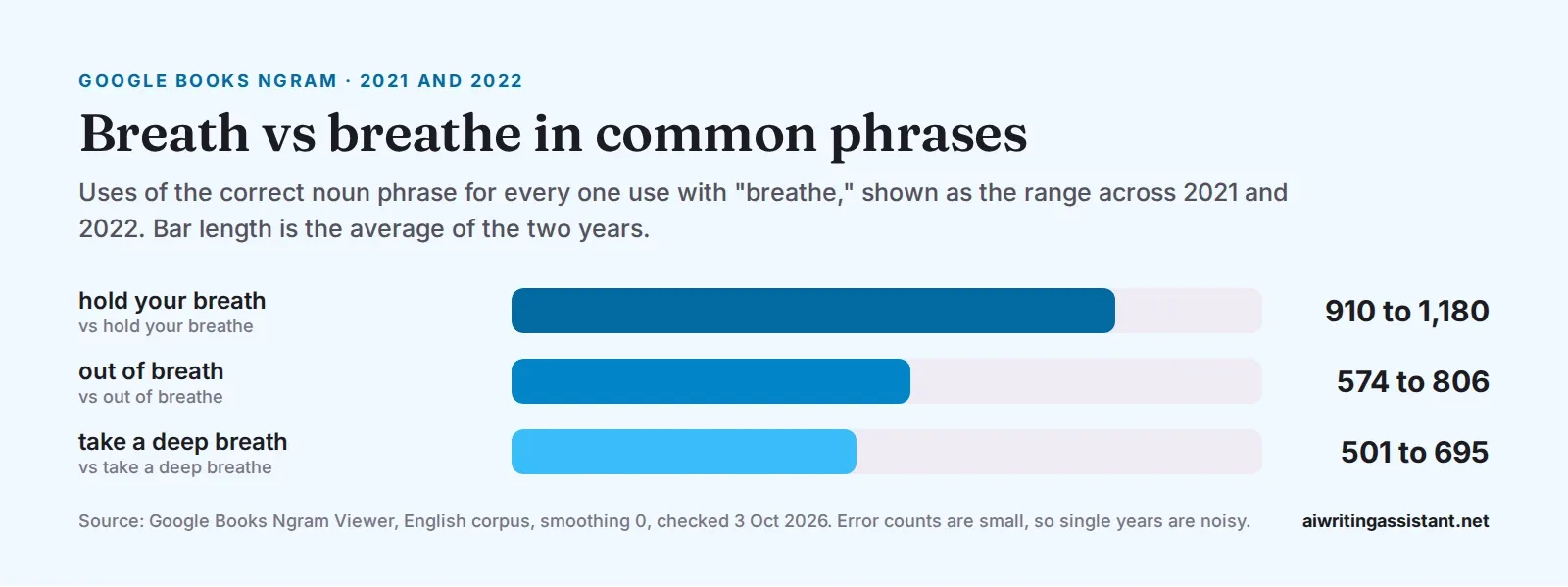
Keep two things in mind. The misspelled forms appear in only a handful of books, so a single year can swing. Books are also edited, so error rates are far lower than in student or web writing.
One more pattern stands out. "Take a deep breath" was about 32 times more frequent in Google Books in 2022 than in 1950, far faster growth than "hold your breath" (about 7 times) or "out of breath" (about 8 times). Part of that rise reflects the changing mix of fiction and nonfiction in Google Books, not only how people write.
Practice: breath or breathe?
| Sentence | Answer |
|---|---|
| Don't hold your ___ waiting for a reply. | breath |
| Try to ___ through your nose. | breathe |
| She was out of ___ after the climb. | breath |
| We all ___d a sigh of relief. | breathe (breathed) |
| He muttered something under his ___. | breath |
| The new manager is a ___ of fresh air. | breath |
More one-letter traps are in our guides to lose vs loose and a lot or alot.
Frequently asked questions
What is the difference between breath and breathe?
Breath is the noun, the air itself. Breathe is the verb, the action of taking air in and out.
How do you pronounce breath and breathe?
Breath /breθ/ rhymes with death. Breathe /briːð/ has a long "ee" and a voiced "th."
What is the past tense of breathe?
Breathed, pronounced /briːðd/.
Is it "take a deep breath" or "take a deep breathe"?
Take a deep breath. After "a deep" you need a noun.
Is it "breathe a sigh of relief" or "breath a sigh of relief"?
Breathe a sigh of relief, because breathe is the verb in that phrase.
What does breadth mean?
Width from side to side, or scope. It's pronounced /bredθ/ and is a different word from breath.
Why do breath and breathe sound different?
The verb kept the original Old English vowel, so it never matched the noun. Etymonline explains this history.
 Grammar Checker
 Paraphraser
 Summarizer
 AI Writer
 AI Humanizer
 Text Compare