
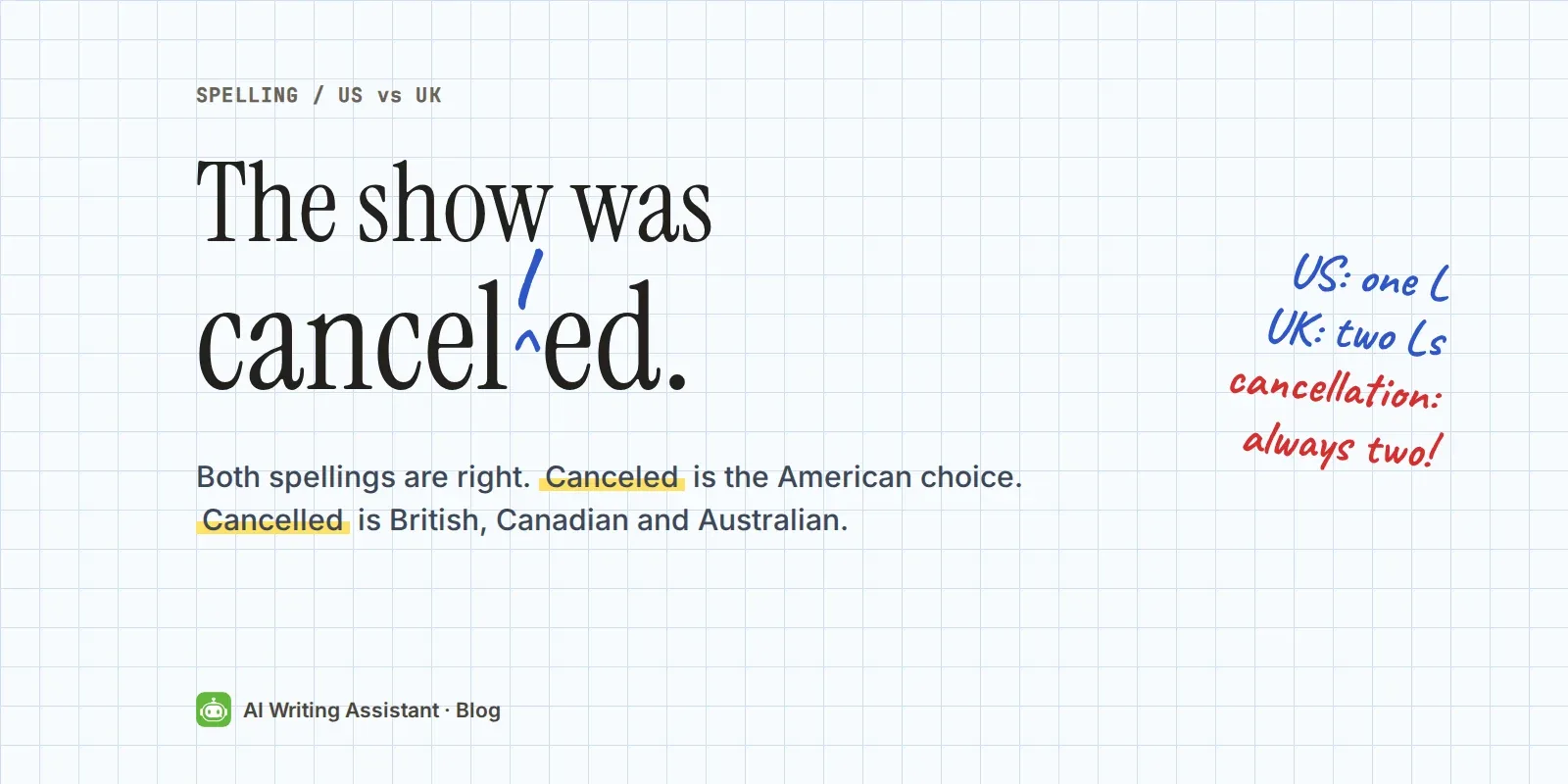
Your flight was canceled. Or was it cancelled? You've probably seen both on the same day, maybe in the same email. Neither one is a typo. The difference is mostly about which side of the Atlantic you're writing for.
Is it canceled or cancelled?
Both are correct. Merriam-Webster says "the version with one L is more common in American English, and the version with two L's is more common in British English." So write "canceled" for an American audience and "cancelled" for readers in the UK, Ireland, Canada, Australia, New Zealand, India or South Africa. Whichever you choose, keep it the same throughout the document.
Which spelling do style guides use?
- AP Stylebook: AP advises "one L in cancel, canceled and canceling, but two Ls in cancellation." News writers in the US follow this.
- Chicago Manual of Style: Chicago usually follows the first spelling listed in Merriam-Webster, as its editors explain here. Merriam-Webster lists "canceled" first, so Chicago-style writing in the US uses one L.
- Merriam-Webster: lists "canceled or cancelled" and "canceling or cancelling," with one L first.
- Canadian government writing: the Government of Canada's writing tips advise a "double l in travelled," following British practice.
Why do Americans use one L?
Two reasons, a rule and a dictionary maker.
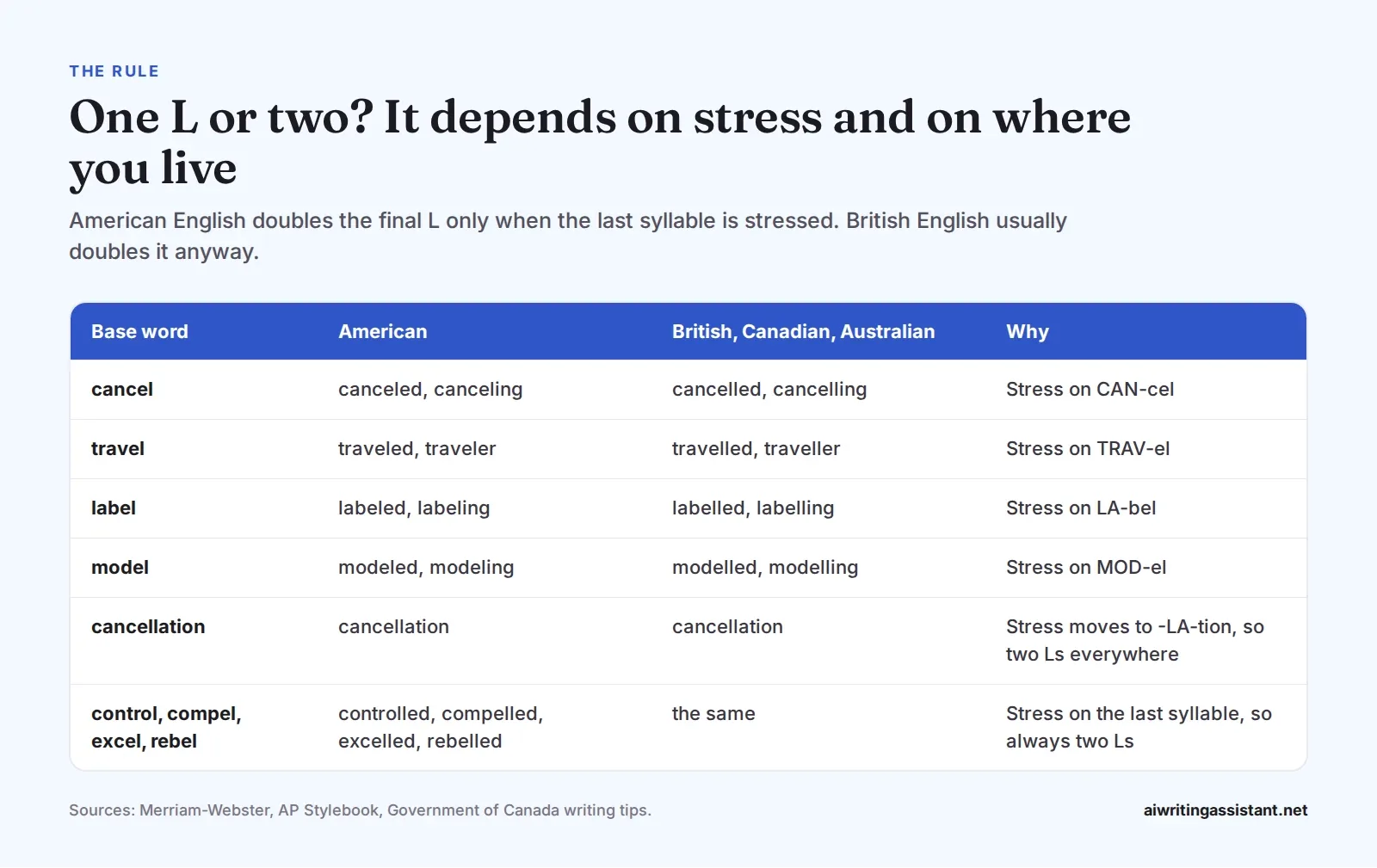
The rule is about stress. In English, you usually double a final consonant before -ed or -ing only when that last syllable is stressed. That's why "control" becomes "controlled" (con-TROL) everywhere. "Cancel" is stressed on the first syllable (CAN-cel), so by that rule there's no need to double. American spelling follows the rule. British spelling doubles the L anyway.
The dictionary maker is Noah Webster. According to Merriam-Webster, his 1806 dictionary spelled it "cancelled," but his 1828 dictionary changed it to "canceled." Merriam-Webster notes he was mostly "making note of an orthographic variation that already existed." He didn't invent it. He helped it stick.
Why "cancellation" always has two Ls
It looks inconsistent, but it follows the same stress rule. In "cancellation," the stress moves to the third syllable (can-cel-LA-tion), so the L is doubled in American English too. Merriam-Webster lists "cancellation" with "cancelation" as a less common variant. AP style uses two Ls.
Americans switched later than you'd think
We checked the Google Books Ngram data for American books. In 1960, 46% of uses were "canceled." By 1980 it was down to 39%. Two Ls were the more common American spelling for most of the 20th century.
Things turned around in the 1990s. One L passed two Ls around 2000 and has led every year since 2007. By 2022, "canceled" made up 66% of uses in American books, about two to one.
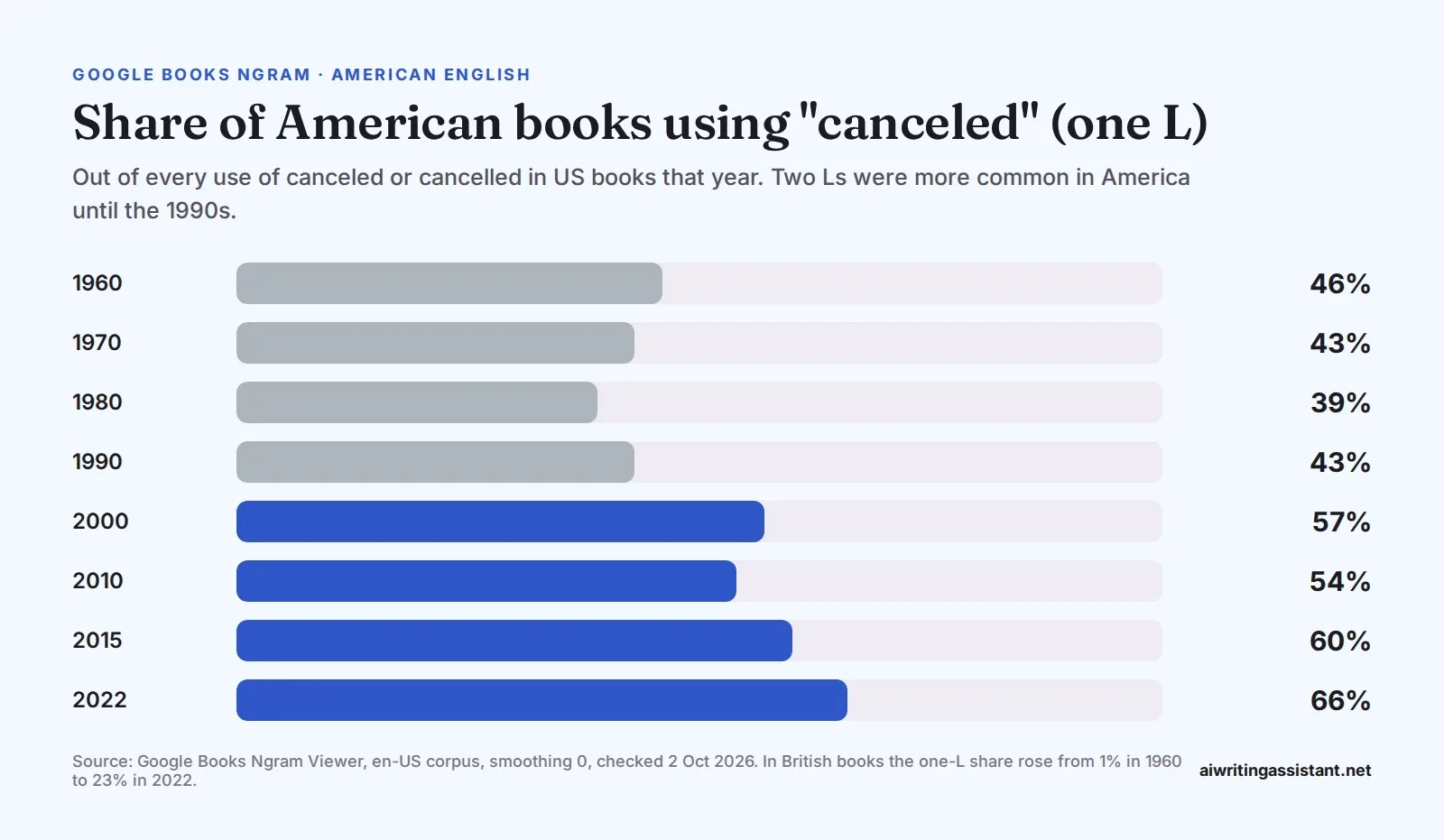
British books are moving a little too. "Canceled" rose from about 1% of uses in 1960 to 23% in 2022, probably helped by American spell checkers and publishing. Two Ls still lead in British books by more than three to one.
Canceled or cancelled in other forms
| Form | US | UK, Canada, Australia |
|---|---|---|
| Past tense | canceled | cancelled |
| -ing form | canceling | cancelling |
| Noun | cancellation | cancellation |
| Base form | cancel | cancel |
What about "cancel culture"?
The noun phrase is the same everywhere, cancel culture. The verb follows the usual split. An American article might say a celebrity was "canceled," while a British one says "cancelled."
Frequently asked questions
Is it canceled or cancelled?
Both are correct. Canceled is the usual American spelling. Cancelled is the usual spelling in British, Canadian, Australian and most other English.
Which is correct in the US, canceled or cancelled?
Canceled. AP style, Merriam-Webster and Chicago all put one L first for American English, though cancelled isn't wrong.
Is it canceling or cancelling?
Canceling in American English and cancelling in British English, following the same rule as canceled and cancelled.
Why does cancellation have two Ls?
Because the stress falls on the third syllable, can-cel-LA-tion. English doubles the consonant before a stressed syllable, so both American and British English use two Ls.
Is it traveled or travelled?
Traveled in American English and travelled in British English. Labeled/labelled and modeled/modelled work the same way.
Do Canadians use canceled or cancelled?
Cancelled. Canadian English generally follows British practice for doubling the final L.
Can I use both spellings in one document?
Pick one and stay consistent. Mixing them looks like a mistake even though each is correct on its own.
 Grammar Checker
 Paraphraser
 Summarizer
 AI Writer
 AI Humanizer
 Text Compare