
Being asked to give a eulogy is an honor, and it can also feel like a lot to carry while you're grieving. You don't need to be a writer or a confident speaker. You need a few true stories, a simple structure and a printed copy you can lean on.
How do you write a eulogy?
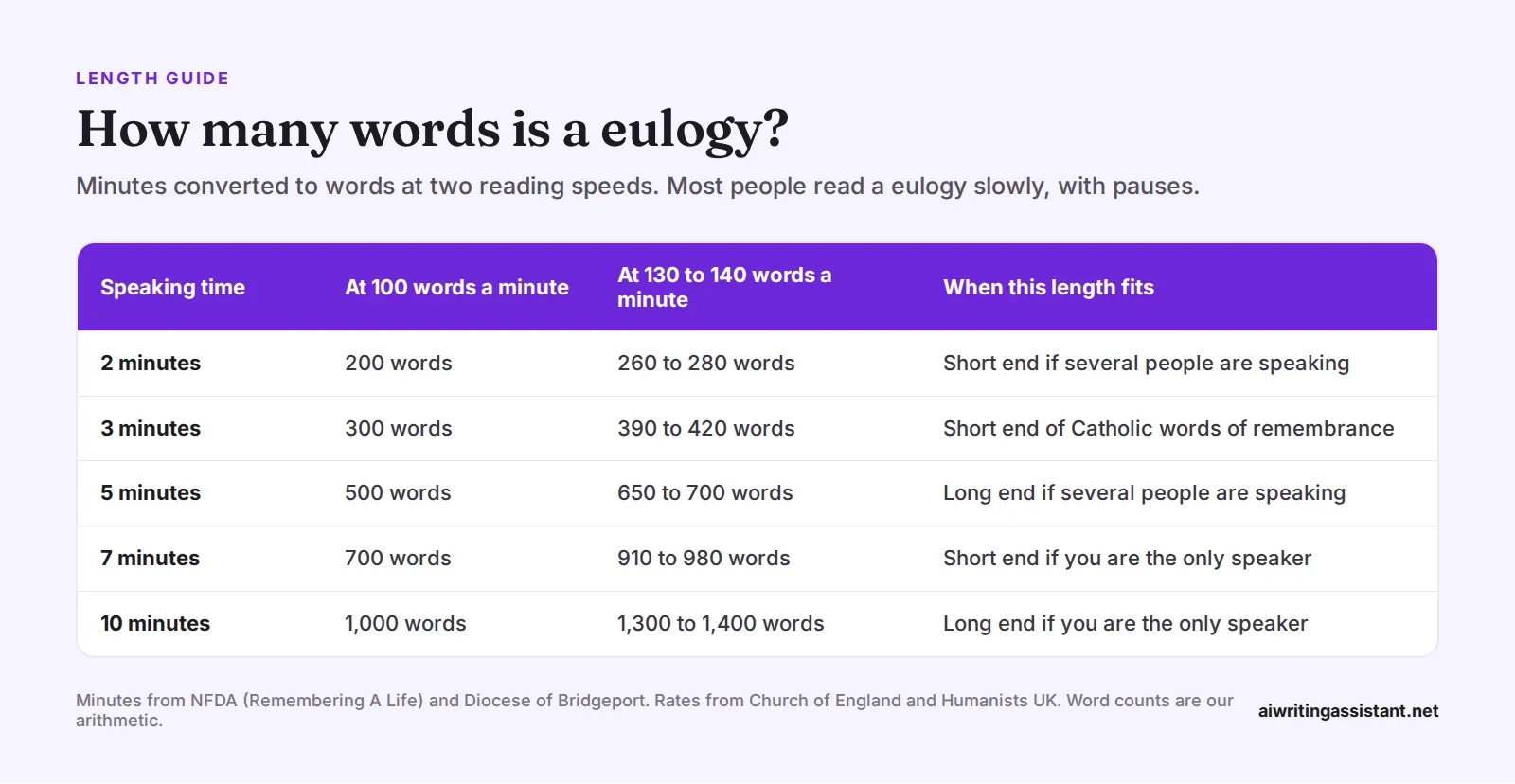
Start by saying who you are and how you knew the person. Then share two or three short stories that show their character, their values and how they treated people. Close on a comforting note, such as a favorite saying, a poem or a prayer. Keep it to about 2 to 5 minutes if others are speaking, or 7 to 10 minutes if you're the only speaker. That's roughly 200 to 700 words, or 700 to 1,400.
What is a eulogy?
Merriam-Webster defines a eulogy as "a commendatory oration or writing especially in honor of one deceased." In plain words, it's praise for someone who has died, and it's usually spoken aloud at the service.
The word is old. Etymonline traces it to the Greek eulogia, "praise," built from eu ("well") and logia ("speaking"). So a eulogy is, quite literally, speaking well of someone. It has been used in English since the mid-15th century.
How long should a eulogy be?
The National Funeral Directors Association, through its Remembering A Life site, suggests 2 to 5 minutes if you're not the only speaker, with one to three anecdotes. If you're the sole speaker, it suggests 7 to 10 minutes.
To turn minutes into words, you need a reading speed. The Church of England says every 100 words takes about one minute to read. Humanists UK suggests assuming 130 to 140 words a minute. Use the slower figure if you expect to pause or get emotional.
Shorter is fine. Some of the most remembered words spoken at a cemetery were brief. The US Government Publishing Office notes that Lincoln's Gettysburg Address, given at a cemetery dedication, lasted only about two minutes and had 272 words. A short eulogy that sounds like the person will mean more than a long one that lists everything they did.
How to structure a eulogy
Most guidance agrees on a three-part shape. NFDA says to "start by mentioning your relationship to the deceased," then build the middle around stories, and "end on a consoling and meaningful note."
| Part | What it does | Example line |
|---|---|---|
| Opening | Says who you are and why you're speaking | "I'm Sam, and Ruth was my grandmother." |
| Stories | Shows character through two or three moments | "When I was nine, I burned a whole tray of rolls..." |
| Closing | Offers comfort, thanks or a goodbye | "Thank you for everything. We'll miss you." |
For the middle, Humanists UK lists four ways to organize the material. You can go in time order (chronological), group stories by theme such as family, work and passions (thematic), focus on the person through different relationships, or simply string together a few anecdotes.
Whichever you pick, keep it focused. Toastmasters International advises you to "limit a eulogy to two or three main points" and reminds speakers that a eulogy "should not be the chronology of a life but a tribute to it."
Step by step, from blank page to final draft
- Check the details. Ask how long you have, who else is speaking and where in the service you'll speak.
- Gather memories. Talk to family and friends. The Church of England suggests including stories that help people recall their own memories.
- Pick two or three points. These might be qualities, like generosity or stubborn humor, or roles, like parent, teacher and friend.
- Choose one story for each point. NFDA recommends "showing rather than telling." A story about the burned rolls says "patient" better than the word itself.
- Write the opening. Introduce yourself and your relationship to the person in one or two sentences.
- Write the close. End with something consoling, such as a favorite saying, a poem, a prayer, a song lyric or a short quote.
- Read it aloud and time it. Cut anything that doesn't sound like you or doesn't fit the time.
A short sample eulogy
Here is a fictional example of about 200 words, written for this guide. It follows the three-part shape and would take around 2 minutes to read slowly.
Good morning. For those I haven't met, I'm Sam, and Ruth was my grandmother. Thank you all for being here.
Grandma Ruth taught me two things. How to make bread, and how to make anyone feel at home. Every Saturday her kitchen smelled of flour and coffee, and every Saturday someone new sat at her table. A neighbor. A friend of a friend. Once, a delivery driver who came to drop off a parcel and stayed for lunch.
When I was nine, I burned a whole tray of rolls. I cried. She laughed, opened the window and said, "Well, now we know what too long looks like." Then we started again. That was Ruth. She never wasted time on blame. She just started again, and she brought you with her.
She loved her garden, crossword puzzles she never quite finished, and the sound of a full house. Most of all, she loved this family, and she showed it in a hundred small ways we're only now starting to count.
Grandma, we'll keep the window open and the table set. Thank you for everything. We love you, and we'll miss you every Saturday.
Borrowing words from history
A short quote can be a gentle way to close. One of the most famous funeral speeches is the oration Pericles gave for the Athenian war dead, recorded by Thucydides. In the Charles Forster Smith translation, hosted by the University of Vermont, it includes this line.
"For heroes have the whole earth for their tomb."
Tips for delivering a eulogy
If the speaking part worries you more than the writing, remember that nobody expects a polished performance. NFDA puts it simply. "You don't have to be perfect."
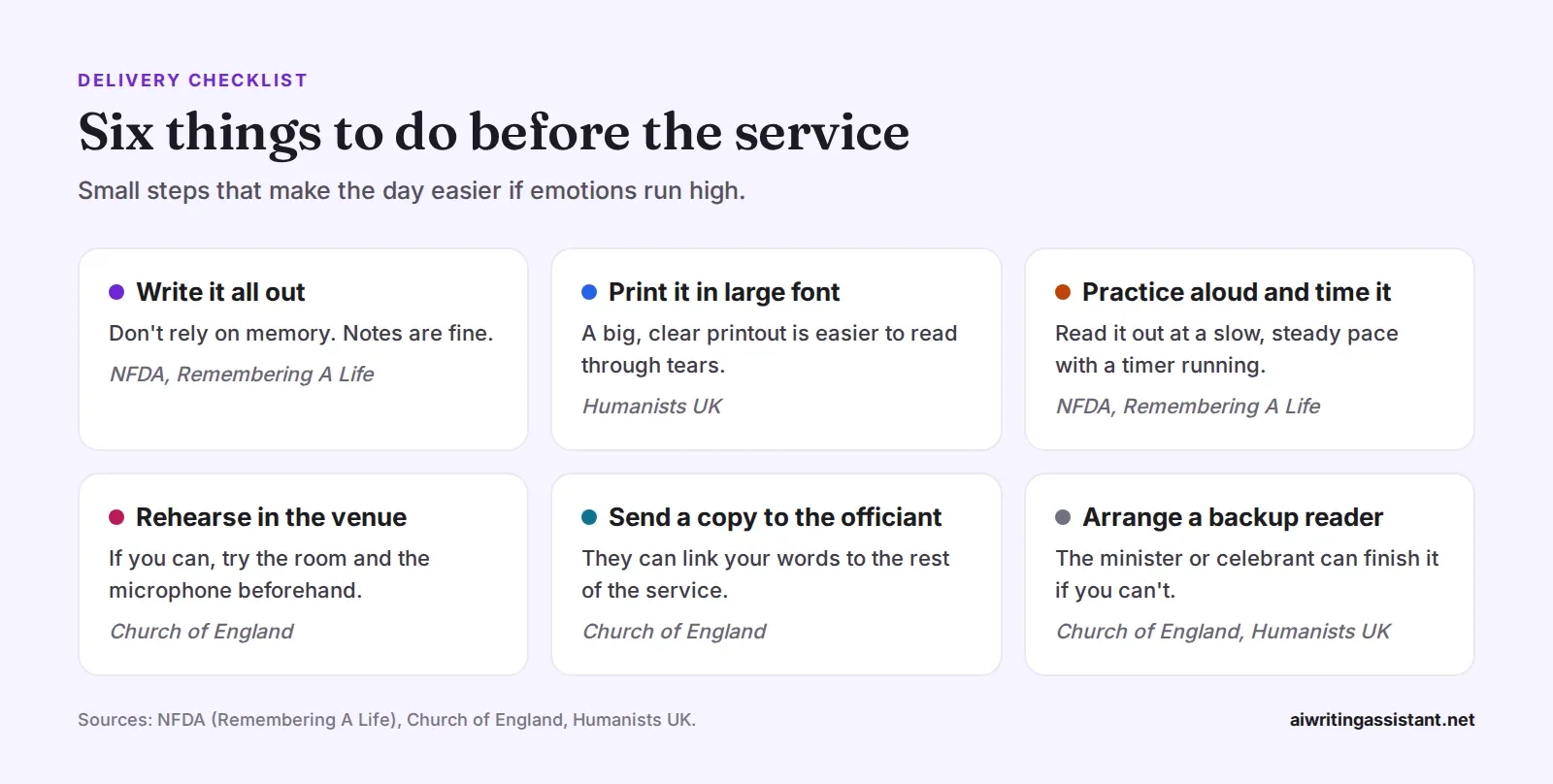
- Use notes. NFDA says "It's okay to use notes" and suggests writing everything down.
- Practice. NFDA repeats it three times. Toastmasters also advises writing a eulogy out in detail and practicing it.
- Go slowly. Humanists UK suggests speaking clearly and slowly, pausing when you need to, and keeping tissues to hand.
- Rehearse where you'll speak. The Church of England suggests asking the vicar whether you can try the microphone in the church.
- Plan a backup. If you can't go on, you can hand your copy to the minister to finish. At a humanist funeral, the celebrant can read it for you or take over partway through.
- Let emotion happen. Humanists UK says "It's okay to show emotion." Pausing to breathe is fine.
Religious and secular services
Ask the person leading the service what's expected before you write.
| Service | What to expect | Source |
|---|---|---|
| Church of England | More than one person may speak. Email your eulogy to the vicar or minister ahead of time so they can link it to the prayers and readings. | Church of England |
| Catholic funeral Mass | Usually brief "words of remembrance," not a full eulogy. One diocese sets no more than 5 minutes, another 3 to 5 minutes. Check with the parish. | St. John Paul II Parish (Diocese of Portland), Diocese of Bridgeport |
| Humanist (non-religious) | The tribute is the heart of the ceremony and lasts up to 15 minutes, often shared between speakers. | Humanists UK |
At a Catholic Mass, St. John Paul II Parish in Maine says the words of remembrance are "not, properly speaking, a 'eulogy'" and are given by one person near the end of Mass, written out in advance. A Diocese of Bridgeport resource suggests roughly one typed page and says "It is not a place to list accomplishments." In U.S. Catholic, Fr. James Field suggests saving fuller personal tributes for the vigil or the meal after the burial.
At a humanist funeral, Humanists UK says the whole ceremony averages around 20 minutes to half an hour. It will include religious content where it helps reflect the person, "but not as an act of worship," and it usually offers a quiet moment when those who wish can pray.
Eulogy vs obituary
People often mix these up. An obituary is a written notice. A eulogy is a spoken tribute. The table below draws on the Merriam-Webster definitions of eulogy and obituary.
| Eulogy | Obituary | |
|---|---|---|
| What it is | Praise for someone who has died | A notice of a death, usually with a short biography |
| Usual form | Spoken at the funeral or memorial | Written and published |
| Focus | Stories, character and what the person meant to people | Key facts about their life and death |
| Voice | Personal, often first person | Usually third person |
| Word origin | Greek eulogia, "praise," in English since the 15th century | Latin obitus, "death," in English from around 1703 |
Check your length before the day
Once you have a draft, paste it into our Word Counter to see the word count and an estimated speaking time. Then read it aloud with a timer, because your own pace matters more than any average.
If you want a second pair of eyes on spelling before you print, run it through the Grammar Checker. For a short life summary in the order of service, see our guide on how to write a bio.
Frequently asked questions
How long should a eulogy be?
About 2 to 5 minutes if others are speaking and 7 to 10 minutes if you're the only speaker, according to NFDA guidance.
How many words is a 5-minute eulogy?
About 500 to 700 words, depending on whether you read at 100 words a minute or 130 to 140.
How do I start a eulogy?
Say who you are and how you knew the person. One or two sentences is enough.
How many stories should I include?
Two or three main points is plenty. Toastmasters advises limiting a eulogy to two or three main points.
Can I read my eulogy from paper?
Yes. NFDA says it's okay to use notes, and Humanists UK suggests a printed copy in a large font.
What if I break down while speaking?
Pause and breathe. If you can't continue, the minister or celebrant can finish reading your copy for you.
Can I give a eulogy at a Catholic funeral Mass?
Usually only brief words of remembrance of up to about 5 minutes. Fuller tributes often go at the vigil or reception, so check with the parish.
 Grammar Checker
 Paraphraser
 Summarizer
 AI Writer
 AI Humanizer
 Text Compare