
Argumentative essays show up everywhere, from high school English to college composition. The format is predictable, which is good news. Once you know the parts, you can plan one in about the time it takes to read this guide.
How do you write an argumentative essay?
Pick a debatable question, research it, and decide where you stand. Write a thesis that states your position and the main reasons for it. Outline an introduction, two or three body paragraphs that each prove one reason with evidence, a paragraph that answers the strongest counterargument, and a conclusion. Draft each paragraph so it explains how its evidence supports your thesis, then revise for logic, transitions and tone.
What is an argumentative essay?
The Purdue OWL describes it as a genre that asks you to investigate a topic, gather and evaluate evidence, and then take a concise position on it. The UNC Writing Center puts it more simply. An argument is a main idea, often called a claim or thesis statement, backed up with evidence.
In US schools, the Common Core standard W.9-10.1 asks students to "write arguments to support claims" using valid reasoning and relevant, sufficient evidence. So when a prompt says "take a position" or "argue for or against," this is the essay it wants.
Argumentative vs persuasive essay
The two get mixed up a lot. A Western Illinois University Libraries guide says persuasive writing aims to "convince the reader to believe something or take a certain action," while argumentative writing "aims to prove a debatable claim or stance using logic and evidence." Persuasive essays lean on emotional appeals and stories. Argumentative essays use objective facts, sound reasoning and a more formal tone.
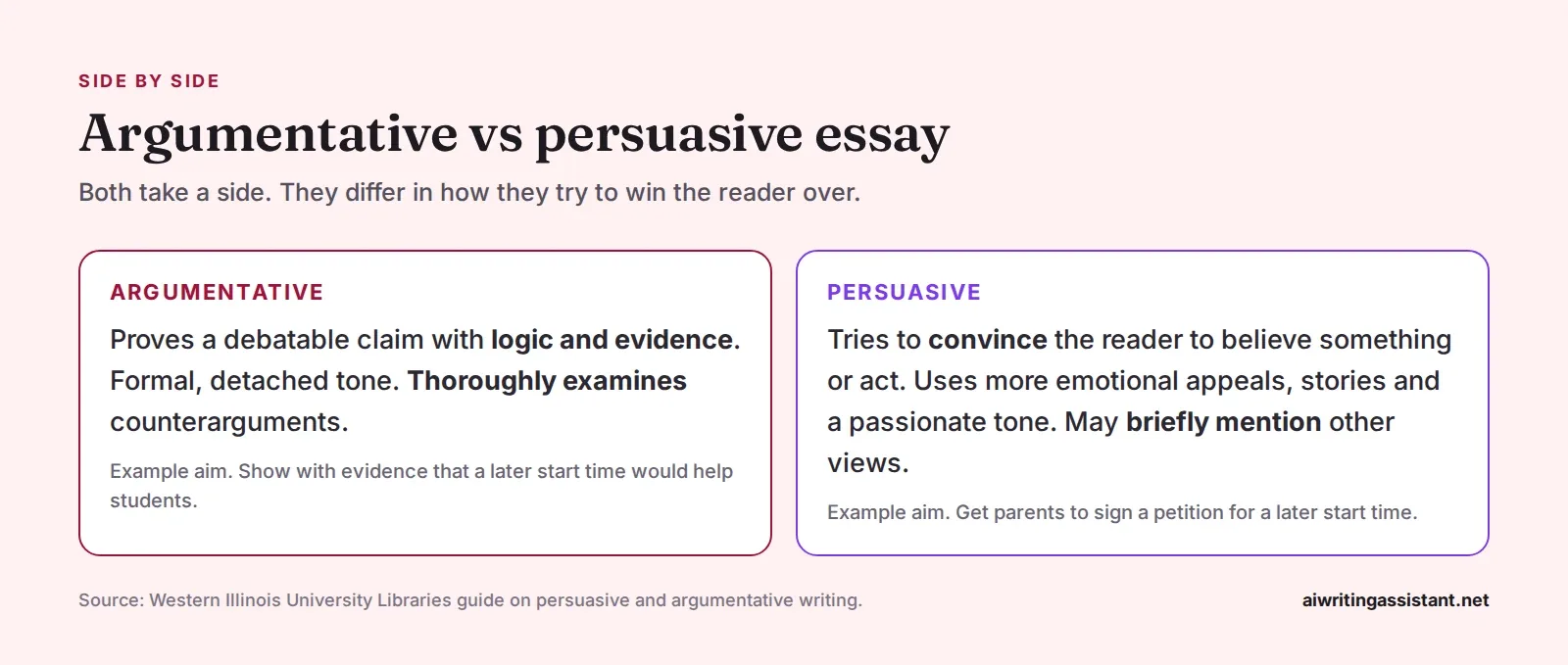
The biggest practical difference is how each handles the other side. The same guide says a persuasive essay "may briefly mention opposing views," and an argumentative essay "thoroughly examines and addresses counterarguments." The Common Core Appendix A draws a similar line between persuasion that uses emotional appeals and logical argument that convinces through reasonable claims and proof. For more on those appeals, see our guide to ethos, pathos and logos.
How to write an argumentative essay, step by step
- Read the prompt closely. Note whether it asks you to take a side, how long the essay should be, and what kind of sources count.
- Choose a debatable question. Reasonable people should be able to disagree. "Should our school start later?" works. "Is sleep important?" doesn't.
- Research before you decide. Read sources on both sides. Purdue says evidence can be "factual, logical, statistical, or anecdotal," and it should be accurate and current.
- Write a working thesis. State your position and your main reasons in one or two sentences. Our Thesis Statement Generator can give you a draft to rework.
- Outline the essay. Map each reason to a body paragraph and decide where the counterargument goes.
- Draft the body first. Each paragraph should focus on one idea and link its evidence back to the thesis.
- Answer the other side. Present the strongest objection fairly, then respond to it.
- Write the introduction and conclusion. It's easier once you know what the body actually proves.
- Revise. Check that every claim has evidence and every piece of evidence is explained.
Need more help with step four? Our guide on how to write a thesis statement covers the tests a strong thesis should pass.
Argumentative essay outline
This five-part outline follows the guidance on the Purdue OWL argumentative essay page and the classical argument structure. For longer papers, add more reasons or split a reason across two paragraphs.
| Section | What goes in it | Purpose |
|---|---|---|
| I. Introduction | Hook, background on the issue, why it matters, and your thesis | Purdue says the thesis belongs in the first paragraph |
| II. Reason 1 | Topic sentence, evidence, and your analysis of that evidence | Proves the first part of your thesis |
| III. Reason 2 | Topic sentence, evidence, and analysis | Proves the second part |
| IV. Counterargument and rebuttal | The strongest objection, stated fairly, then your response | Shows you've considered other views |
| V. Conclusion | Your thesis revisited in light of the evidence, and why it matters | Purdue says to add no new material here |
Some writers put the counterargument right after the introduction, especially when readers are likely to raise it first. Either spot works if the logic flows. The free Outline Generator can build a first version of this structure for your topic.
Worked example: thesis and outline
Here's a sample plan on a familiar debate. Mapleford High is fictional. Where the outline mentions evidence, you would cite real sources you've checked.
Mapleford High School should move its first bell from 7:30 to 8:30 a.m., because a later start would give students more time to sleep, make first-period classes more productive, and would not have to cut after-school activities.
- I. Introduction. Open with a scene of students waiting for a bus before sunrise. Explain the district debate. State the thesis.
- II. More sleep. Evidence from a health organization or sleep study on teen sleep needs. Explain how an extra hour in the morning connects to that evidence.
- III. Better first-period learning. Evidence from schools that changed their schedules, or teacher observations. Explain why alert students learn more.
- IV. Counterargument. Later dismissal could squeeze sports and part-time jobs. Rebuttal follows below.
- V. Conclusion. Revisit the thesis in light of the evidence and ask the board to run a one-year trial.
How to write the counterargument and rebuttal
Purdue says your essay should consider other points of view and explain why they "might not be well informed or up to date," rather than dismissing them. The UNC Writing Center gives you two honest moves. You can concede a point while keeping your position, or explain why the objection is mistaken.
A simple pattern works well. State the objection in its strongest form, acknowledge what's fair about it, then show why your position still holds.
Some parents worry that a later bell would push practices and part-time jobs into the evening. That concern is fair, since many students depend on both. Yet a one-hour shift does not have to cut these activities. Practices could move to the time slot after the new dismissal, and employers in Mapleford already hire for evening shifts. The schedule would change, but the opportunities would remain, while every student would gain an extra hour of rest on school mornings.
Classical, Toulmin and Rogerian structures
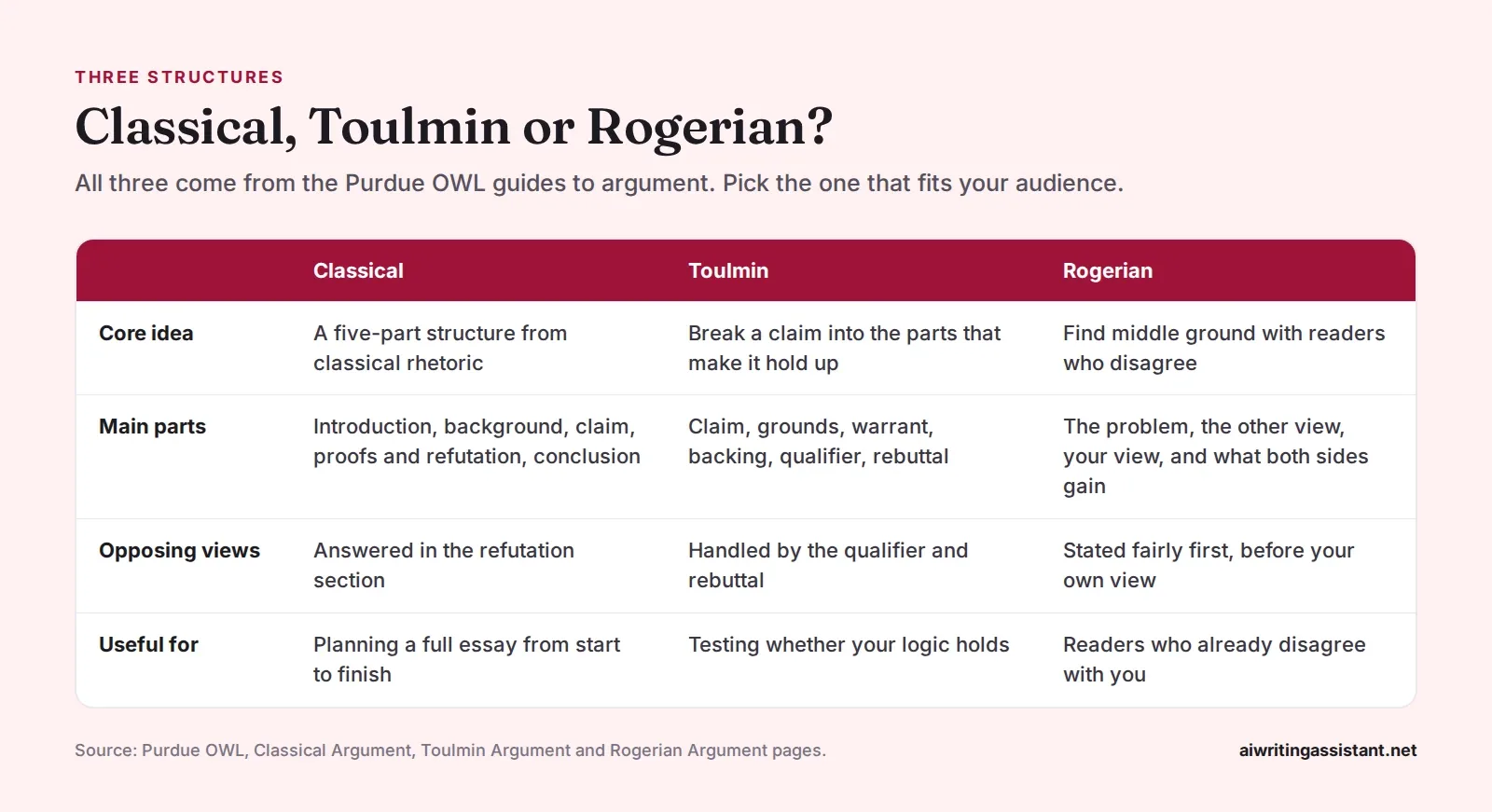
The outline above follows the classical shape, but two other models are worth knowing. All three are explained in the Purdue OWL guides.
Classical
The Purdue OWL classical argument page lists five parts. The exordium is the introduction or hook. The narratio gives background. The propositio and partitio state your claim and preview the argument. The confirmatio and refutatio give your proofs and answer opposing views. The peroratio is the conclusion and call to action. The outline above follows this pattern.
Toulmin
The Purdue OWL Toulmin page credits this method to the philosopher Stephen E. Toulmin. It's most useful for checking whether your argument actually holds. Here's how it maps onto the school start example.
| Part | What it means (Purdue OWL) | In the sample essay |
|---|---|---|
| Claim | The assertion you want to prove | Mapleford High should start at 8:30 a.m. |
| Grounds | The evidence and facts that support the claim | Sources on teen sleep and on schools that changed schedules |
| Warrant | The assumption that links the grounds to the claim | Students learn better when they are rested |
| Backing | Extra support for the warrant | Research on sleep and learning |
| Qualifier | Shows the claim may not hold everywhere | "For most students," "in most cases" |
| Rebuttal | Acknowledges another valid view | Concerns about sports and jobs, and the response |
Purdue uses a simple example. The claim is that a dog is nearby, the grounds are that we hear barking and howling, and the warrant is that dogs bark and howl. If you can't name the warrant for one of your own claims, the logic probably needs work.
Rogerian
The Purdue OWL Rogerian page says this approach was developed by the psychotherapist Carl Rogers and adapted to rhetoric by Young, Becker and Pike in 1970. Its goal is to "establish a middle ground." You introduce the problem, state the opposing position and when it's valid, give your position and when it's valid, and then show what the other side gains from your view. Purdue notes there is "no formalized structure" for it, so treat these as aims.
Introduction, body and conclusion tips
- Introduction. Purdue says the first paragraph needs "a clear, concise, and defined thesis statement," plus context and a reason readers should care.
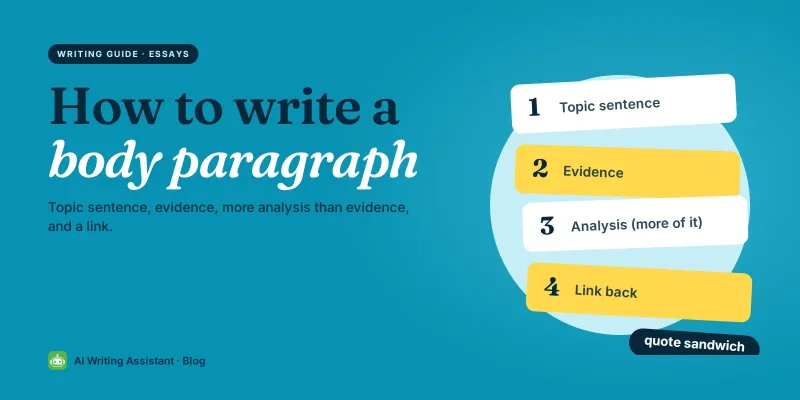
- Body paragraphs. One general idea each, with evidence and a clear link back to the thesis.
- Transitions. Purdue calls them "the mortar that holds the foundation of the essay together." Use them between reasons and before the rebuttal.
- Conclusion. Purdue says it "does not simply restate the thesis." Revisit it in light of what you proved, and add no new evidence.
Frequently asked questions
What is an argumentative essay?
An essay that investigates a topic, evaluates evidence and takes a clear position on it, as the Purdue OWL defines it.
What are the five parts of an argumentative essay outline?
A common outline has an introduction with a thesis, two body paragraphs with reasons and evidence, a counterargument and rebuttal, and a conclusion.
What are the six parts of the Toulmin model?
Claim, grounds, warrant, backing, qualifier and rebuttal.
Do I need a counterargument?
Yes. Purdue says the essay should consider differing views, and UNC suggests either conceding a point or explaining why the objection is mistaken.
How is an argumentative essay different from a persuasive essay?
Argumentative writing proves a claim with logic and evidence and fully addresses counterarguments. Persuasive writing leans more on emotional appeals.
What is a Rogerian argument?
An approach based on the work of Carl Rogers that looks for middle ground by showing you understand the other side before giving your view.
Should the conclusion restate the thesis?
Not word for word. Purdue says to readdress the thesis in light of the evidence and add no new material.

 Grammar Checker
 Paraphraser
 Summarizer
 AI Writer
 AI Humanizer
 Text Compare