
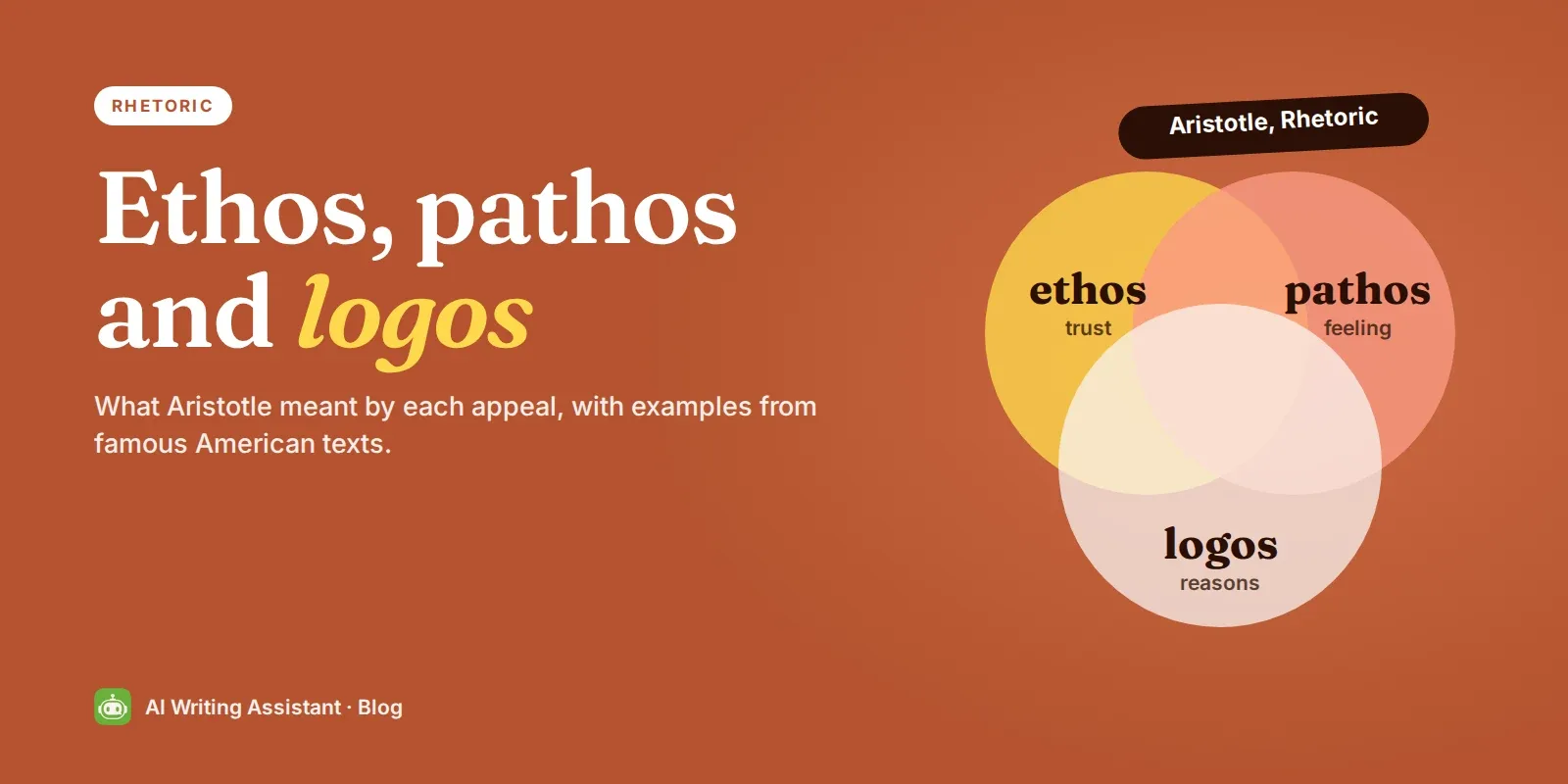
Every time you try to change someone's mind, you're using some mix of three tools. You ask them to trust you, you make them care, and you give them reasons. More than 2,300 years ago, Aristotle gave those tools names, and teachers still use them to analyze speeches, ads and essays.
Here's what ethos, pathos and logos mean, how to spot them, and how to use them in your own writing.
What are ethos, pathos and logos?
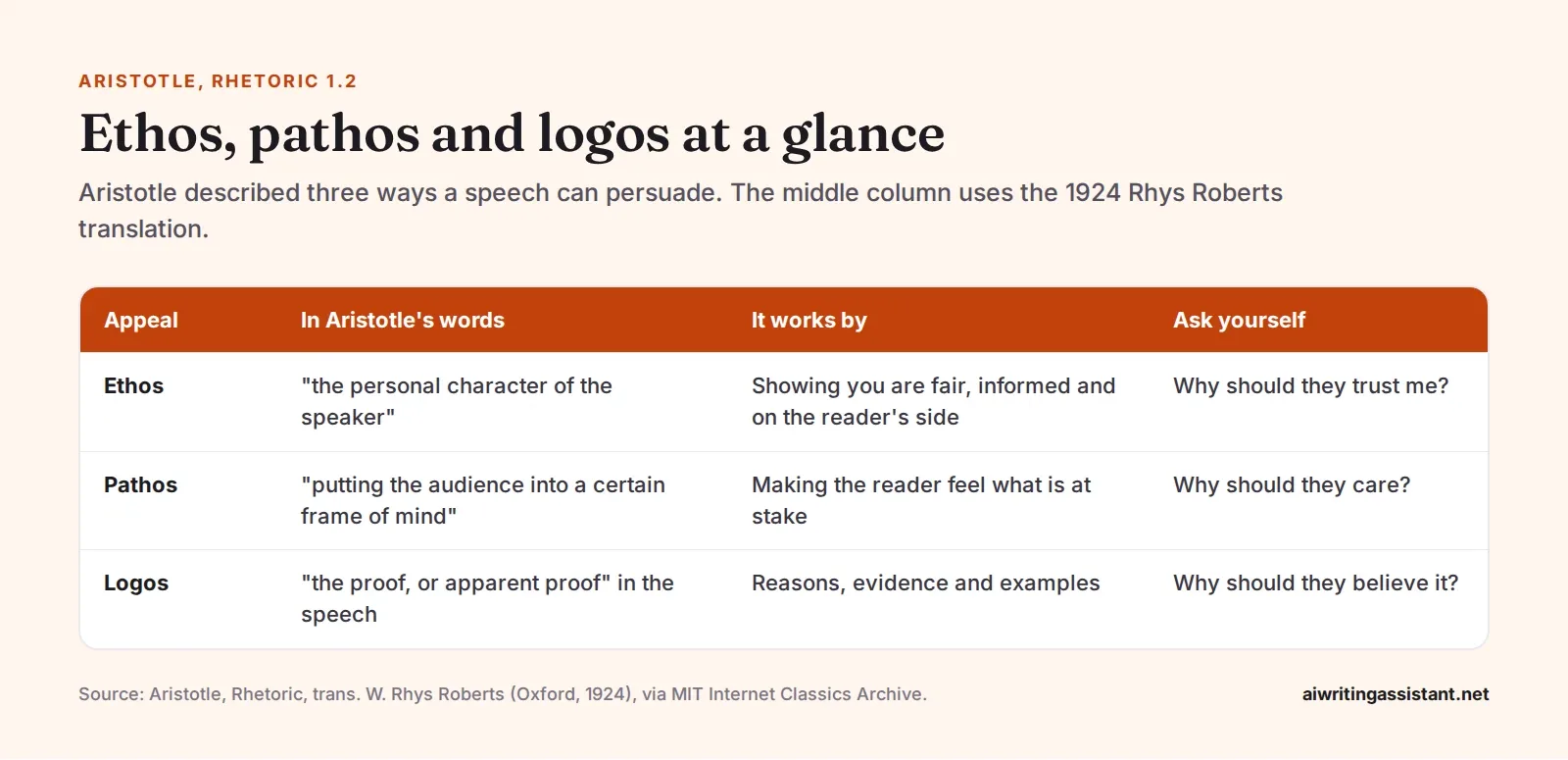
Ethos, pathos and logos are the three modes of persuasion Aristotle described in his Rhetoric. Ethos is persuasion through the speaker's character, the sense that they are credible and fair. Pathos is persuasion through the audience's emotions or frame of mind. Logos is persuasion through the argument itself, meaning its reasons, evidence and examples. Most good arguments use all three, with one leading.
Where the terms come from
In Book 1 of the Rhetoric, Aristotle defines rhetoric as "the faculty of observing in any given case the available means of persuasion." He then says that of the modes of persuasion "furnished by the spoken word there are three kinds." You can read the passage in the W. Rhys Roberts translation from 1924, which is free online.
Two details often get lost. First, Aristotle's word was pisteis, usually translated as proofs or means of persuasion. Calling them "appeals" came later. Second, the Stanford Encyclopedia of Philosophy points out that for Aristotle the core of logical persuasion was the enthymeme, a kind of shortened argument he called the "body of persuasion."
Ethos: why should they trust you?
Ethos depends, in the Rhys Roberts translation, "on the personal character of the speaker." Aristotle adds something surprising. Credibility should be "achieved by what the speaker says," not by what people already think of you. In other words, you earn ethos on the page.
He also rated it highly. Character, he wrote, "may almost be called the most effective means of persuasion."
- In an essay, represent the other side fairly before you answer it.
- In an email, mention the relevant experience in one line, then get to the point.
- In an ad, a dentist recommending a toothpaste, or a long track record ("Family run since 1952").
Today people often treat ethos as credentials or reputation. That's part of it, but Aristotle cared more about how the argument itself shows good sense and good faith.
Pathos: why should they care?
Pathos means putting the audience "into a certain frame of mind," because, as Aristotle noted, "our judgements when we are pleased and friendly are not the same" as when we are pained or hostile. Emotion changes how people weigh the same facts.
- In an essay, open with one real person affected by the problem.
- In a speech, a vivid story, a striking image or a question that stings.
- In an ad, a family reunion in a holiday commercial.
Pathos gets called manipulation, and it can be. But Aristotle treated emotion as a legitimate part of persuasion and spent much of Book 2 analyzing emotions such as anger, fear and pity. The problem is pathos with nothing behind it.
Logos: why should they believe it?
Logos is "the proof, or apparent proof, provided by the words of the speech itself." Aristotle named two main tools, the example and the enthymeme, a short argument that leaves one step for the audience to fill in.
- In an essay, data, quotations from sources, cause and effect, and comparisons.
- In a report, a chart that shows the trend you're describing.
- In an ad, "Saves you $200 a year on energy bills."
Logos isn't only statistics. A clear example or a well-chosen comparison counts too.
Ethos, pathos and logos examples
Famous American texts show all three. The labels below are our reading of the passages, not categories the authors used.
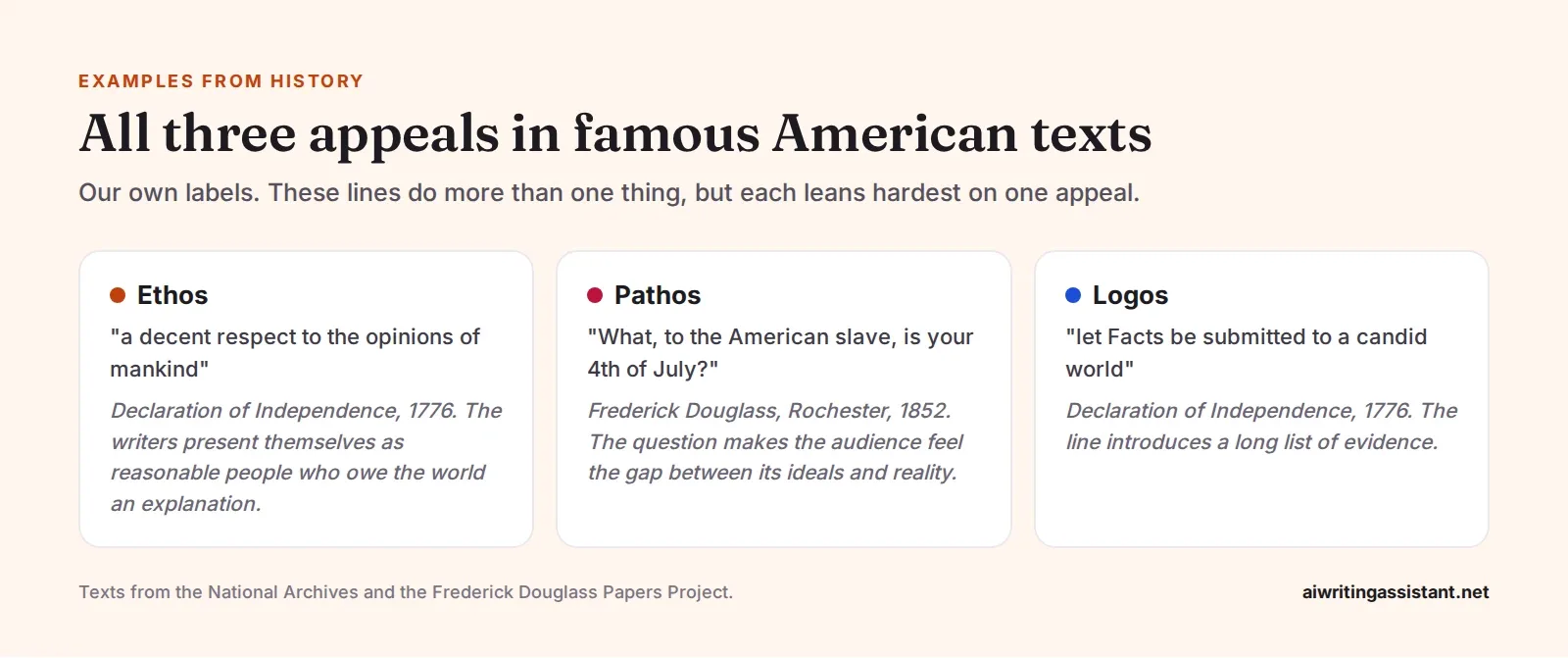
The Declaration of Independence builds ethos by saying the colonists owe "a decent respect to the opinions of mankind," then switches to logos with "let Facts be submitted to a candid world" and a long list of grievances. Frederick Douglass turned the July Fourth celebration into a question his audience couldn't look away from. Lincoln at Gettysburg used pathos when he said "from these honored dead we take increased devotion."
What about kairos?
Many classes add a fourth term, kairos, meaning the right time and place for an argument. The Purdue OWL lists it with the other three. It's a useful idea. A great argument made at the wrong moment usually fails.
Strictly, though, Aristotle named only three proofs. Kairos is a broader Greek idea. Scholars such as Kinneavy and Eskin (1994) argue it runs through the Rhetoric anyway, especially in how Aristotle handles emotion.
How to use ethos, pathos and logos in an essay
- Lead with logos in academic writing. Your thesis should rest on evidence and reasoning.
- Build ethos quietly. Cite good sources, define terms, and answer the strongest counterargument.
- Use pathos sparingly. One concrete story or image in the introduction or conclusion is usually enough.
- Check the balance. Too much pathos reads as manipulation. Too little can make a strong case feel cold.
- Match your audience. A policy memo needs more logos. A fundraising letter needs more pathos.
If you're writing an argument essay, our guides on thesis statements and introduction paragraphs show where these appeals fit.
Frequently asked questions
What do ethos, pathos and logos mean?
Ethos is persuasion through the speaker's character, pathos through the audience's emotions, and logos through reasons and evidence.
Who created ethos, pathos and logos?
Aristotle described them in his Rhetoric, written in the 4th century BC, as three modes of persuasion.
Which appeal is the strongest?
Aristotle wrote that character "may almost be called the most effective means of persuasion," but most arguments need all three.
Is pathos manipulative?
It can be when there's no evidence behind it. Aristotle treated emotion as a legitimate part of persuasion.
Is kairos the fourth appeal?
Many teachers add it, but Aristotle listed only three proofs. Kairos, the right timing, is a related Greek idea.
How do I identify ethos, pathos and logos in a text?
Ask what each part is doing. Building trust is ethos, stirring feeling is pathos, and giving reasons or evidence is logos.
Which appeal should I use most in an academic essay?
Logos, supported by ethos through careful sources and fair treatment of other views. Use pathos lightly.
 Grammar Checker
 Paraphraser
 Summarizer
 AI Writer
 AI Humanizer
 Text Compare