
You're 300 words short, it's late, and every point you wanted to make is already on the page. The temptation is to pad. But padding is easy to spot and it drags your grade down. The better fix is to go back into what you've written and develop it, because a short essay is usually an underdeveloped one.
How do you make an essay longer?
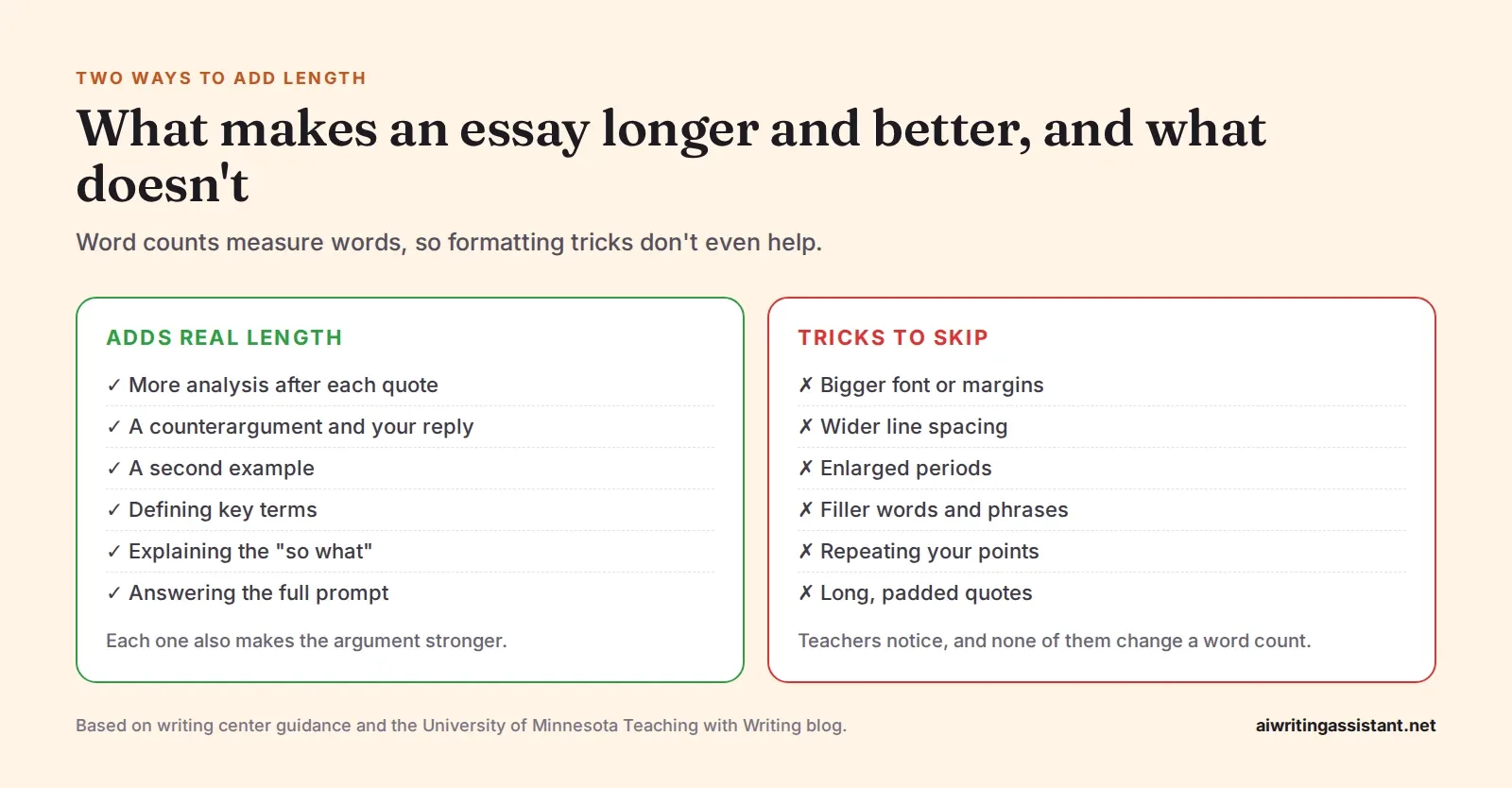
Develop what's already there. After each piece of evidence, add analysis that explains why it matters. Add a counterargument and your response. Use a second example where you only have one. Define key terms, explain the "so what" of each point, and check you've answered every part of the prompt. These add real words and make the argument stronger. Avoid changing fonts, margins or spacing, which don't change a word count and look like padding.
11 honest ways to make an essay longer
1. Reread the prompt
Highlight every question and instruction in the assignment. Short essays often skip a part, such as "compare," "evaluate" or "use two sources." Answering the missing piece can add a whole paragraph.
2. Add analysis after every piece of evidence
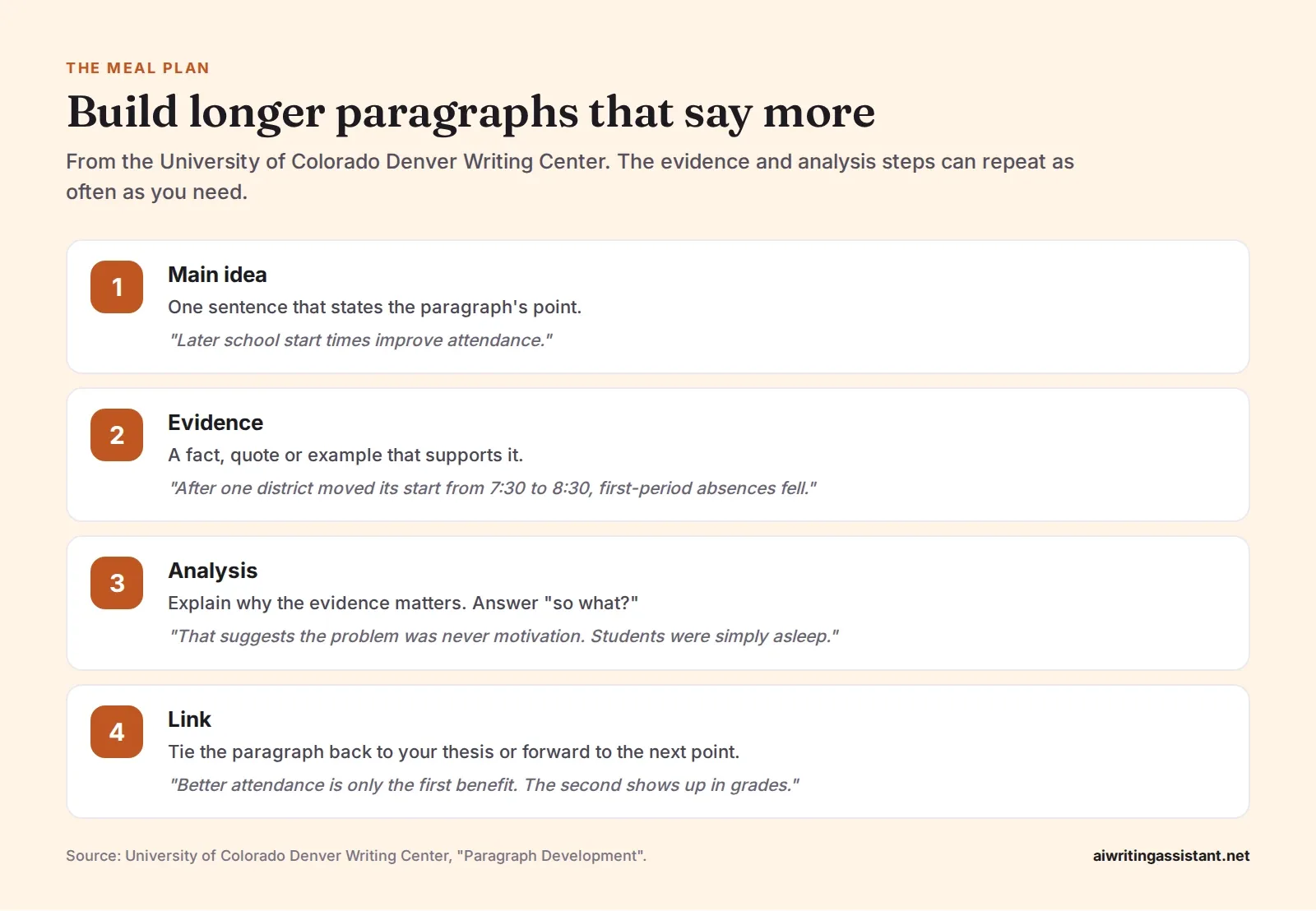
This is the biggest one. Students often drop in a quote and move on. After each quote or statistic, write two or three sentences explaining what it shows and why it matters. The University of Colorado Denver's MEAL plan says analysis "explains why the evidence is important" and notes that "the Evidence and Analysis steps can be repeated as many times as necessary."
3. Add a counterargument
The UNC Writing Center advises that you "anticipate and address counterarguments or objections." Describe the strongest objection fairly, then explain why your view still holds. This usually adds a full paragraph and makes the essay more convincing.
4. Use a second example
If a point rests on one example, find another. Two examples from different places, like a study and a real case, are much stronger than one.
5. Define your key terms
What exactly do you mean by "success," "fair" or "effective"? A sentence or two defining a slippery term helps the reader and adds substance.
6. Explain the "so what"
At the end of each body paragraph, add a sentence on why the point matters for your argument. Teachers love this, and it's often missing.
7. Add context
A short bit of background on the history, the setting or the debate helps readers who don't know the topic. Keep it relevant and brief.
8. Bring in another source
A new source can add evidence, a different angle, or an expert view. Paraphrase and cite it properly. Our guide to paraphrasing shows how.
9. Expand your introduction and conclusion
A thin introduction can use a stronger hook and a sentence of context before the thesis. A thin conclusion can do more than restate. See how to write a conclusion for the three moves.
10. Turn vague sentences into specific ones
"This had a big impact" can become "This cut costs by a third within a year, which let the company hire two more nurses." Specific detail is longer and better at the same time.
11. Ask someone to read it
A friend or a writing center tutor will find the places where they had questions. Each question is a sentence or two you haven't written yet.
Tricks to avoid
Teachers have seen every trick. Daniel Emery, writing on the University of Minnesota's Teaching with Writing blog, put it plainly. "Few instructors appreciate fiddling with line spacing, margins, and typefaces to make documents longer or shorter." He adds that nonstandard spacing "can negatively dispose a reader to the content."
- Bigger fonts, margins or line spacing. If the assignment has a word count, these change nothing. If it has a page count, they break the formatting rules.
- Enlarging periods and commas. A popular online trick. It doesn't change the word count either, and it's visible if anyone checks the formatting.
- Filler phrases. "Due to the fact that," "in order to," "it is important to note that." They add words and make you sound unsure.
- Repeating yourself. Saying the same point three ways is the fastest way to lose a reader.
- Long quotes. Quoting a whole paragraph to fill space shows less of your own thinking.
Standard essay formatting
If your assignment gives a page count, use standard formatting so your length is honest.
| Style | Font | Spacing | Margins |
|---|---|---|---|
| MLA 9 | A readable font, often 12-pt Times New Roman | Double-spaced throughout | 1 inch on all sides |
| APA 7 | 11-pt Calibri or Arial, 12-pt Times New Roman, or similar | Double-spaced | 1 inch on all sides |
Sources: Purdue OWL MLA guide and Purdue OWL APA guide. A double-spaced page with these settings usually holds roughly 250 to 300 words, depending on paragraphs and font. Our Words to Pages converter estimates it for your exact settings.
Frequently asked questions
How can I make my essay longer?
Add analysis after each piece of evidence, include a counterargument and your response, add a second example, define key terms, explain why each point matters, and make sure you've answered every part of the prompt.
How do I make my essay longer without adding fluff?
Develop your ideas rather than your wording. More explanation, more evidence and a counterargument add real content. Filler phrases and repetition don't.
Do teachers notice bigger fonts and margins?
Usually, yes. Instructors who write about it say they dislike formatting tricks, and if your assignment has a word count, those tricks don't change it anyway.
How many words is a page?
A double-spaced page in 12-point font with 1-inch margins usually holds about 250 to 300 words. Single-spaced, it's roughly double that.
Is it OK to use a tool to expand my essay?
Check your school's rules first. Tools can suggest fuller wording, but your ideas and final sentences should be your own.
What if I really have nothing more to say?
Reread the prompt, then ask "why?" and "so what?" after each point. If you still have nothing, you may need another source or a counterargument.
 Grammar Checker
 Paraphraser
 Summarizer
 AI Writer
 AI Humanizer
 Text Compare