
By the time you reach the conclusion, you're tired, you've said everything, and the temptation is to repeat it all once more and stop. That's why so many conclusions read like a shopping list. A good one is different. It's the paragraph where your reader finally sees why the whole essay mattered.
How do you write a conclusion?
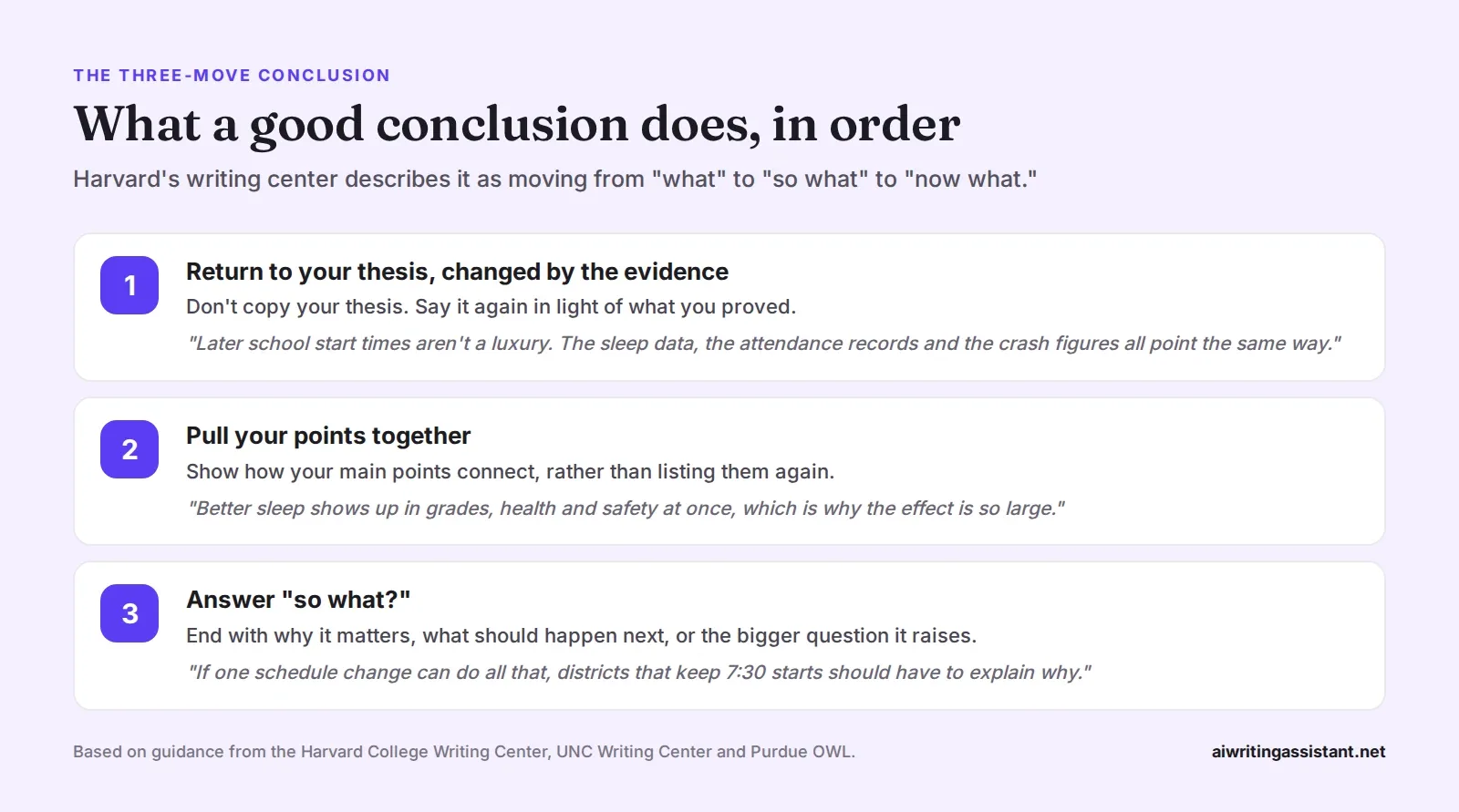
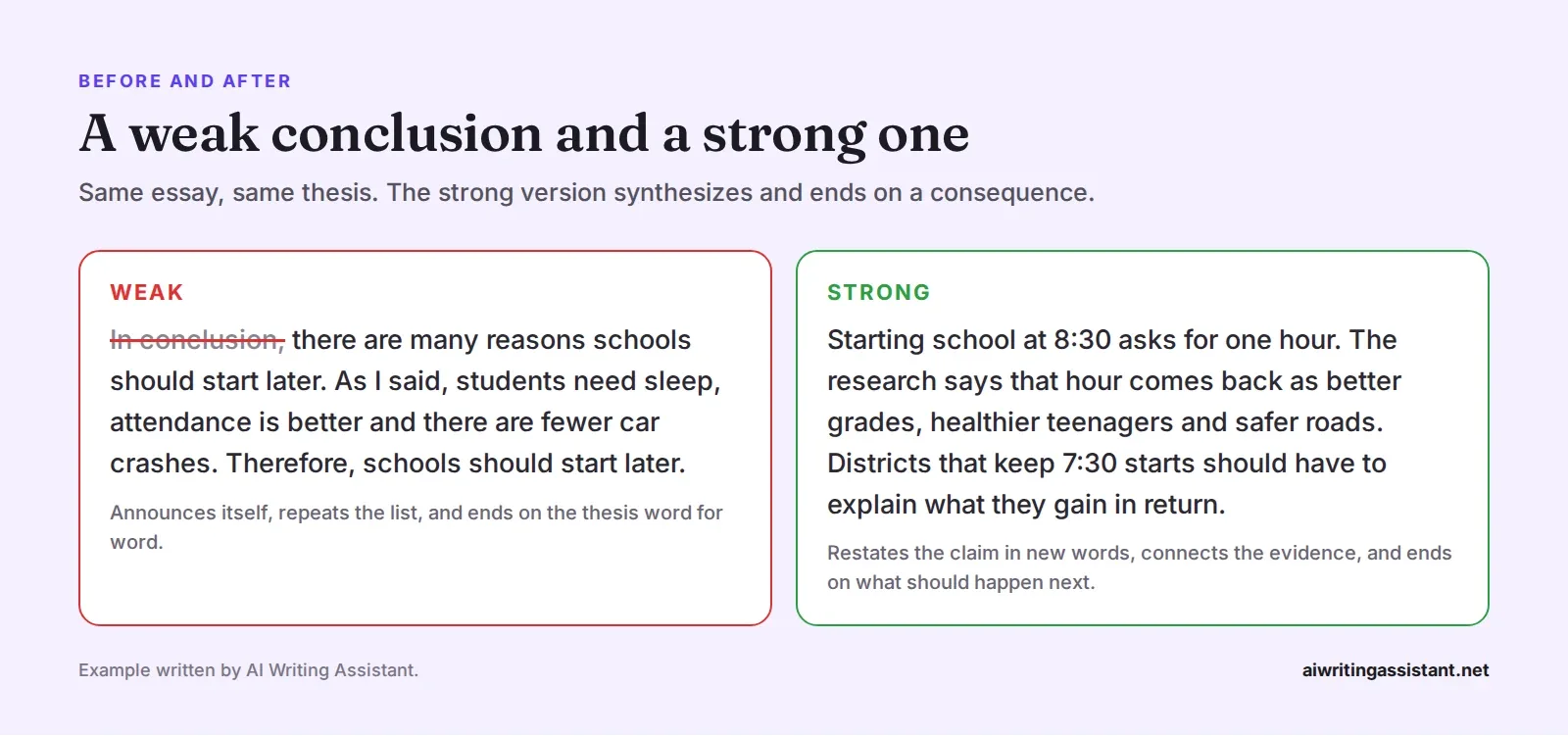
Write one short paragraph that does three jobs. First, return to your thesis, but restate it in new words and in light of the evidence you've given. Second, show how your main points fit together instead of listing them again. Third, answer "so what?" by ending on why it matters, what should happen next, or a bigger question it raises. Don't introduce new evidence, and don't start with "In conclusion."
Step 1: Return to your thesis, changed by the evidence
Your conclusion should remind readers of your main claim, but it shouldn't be a copy. The UNC Writing Center warns against "a rephrased thesis statement without any substantive changes." Purdue OWL says to readdress the thesis "in light of the evidence provided." In other words, say it again as someone who has now proved it.
Introduction: "Schools should start later because teenagers need more sleep."
Conclusion: "Later start times aren't a luxury. The sleep data, the attendance records and the crash figures all point the same way."
Step 2: Pull your points together
UNC calls this synthesizing rather than summarizing. Instead of "First I showed A, then B, then C," explain how A, B and C connect. Maybe they share a cause. Maybe together they reveal something none of them shows alone. This is where you show you understood your own argument.
Step 3: Answer "so what?"
This is the move most essays skip, and it's the one readers remember. The Harvard writing center frames it as "what," "so what," then "now what." Pick one way to end.
- A consequence. What happens if your argument is right, or ignored?
- A recommendation. What should someone do now?
- A bigger question. What does your essay open up for further study?
- An echo of your introduction. If you opened with a story or image, return to it and show how it looks different now.
- A sharp quotation. UNC suggests "a provocative insight or quotation," as long as it adds something rather than decorating.
What not to put in a conclusion
The UNC and Harvard writing centers list the same habits again and again.
- "In conclusion," "in summary," "in closing." UNC calls these "unnecessary, overused." Harvard calls them "fake transitions."
- New evidence. Quotations and statistics belong in the body. "Do not introduce any new information into the conclusion," says Purdue.
- A new idea or argument. If it's important, it needs its own paragraph earlier.
- Your thesis for the first time. If the reader only learns your point at the end, the essay was hard to follow.
- A full recap. Harvard warns against "a complete restatement of all that you have said."
- Apologies or big emotional appeals. "This is just my opinion" undercuts everything before it.
Conclusion examples for different essays
Argumentative essay
Research paper
Literary analysis
Personal essay
How long should a conclusion be?
For most school essays, one paragraph of roughly 5 to 7 sentences. A good rule of thumb is that it should be about the same length as your introduction. Long research papers may need two or three paragraphs, especially if you discuss limitations or future research. If your conclusion is longer than your body paragraphs, you're probably repeating yourself.
Frequently asked questions
How do you write a conclusion?
Restate your thesis in new words in light of your evidence, show how your main points connect, and end by answering "so what?" with a consequence, recommendation or question.
How do you start a conclusion paragraph?
Start by returning to your main claim in fresh words. Avoid "In conclusion." Openers like "Taken together," or a direct restatement of your claim work better.
Can you add new information in a conclusion?
No new evidence or arguments. You can mention a broader implication or a question for future study.
How long should a conclusion be?
Usually one paragraph of about 5 to 7 sentences, roughly the length of your introduction.
Should I restate my thesis in the conclusion?
Yes, but in new words and in light of the evidence you've given. Copying it word for word is a common mistake.
Is it bad to use "In conclusion"?
It's not wrong, but writing centers call it overused and unnecessary. Your reader can already see it's the end.
 Grammar Checker
 Paraphraser
 Summarizer
 AI Writer
 AI Humanizer
 Text Compare