
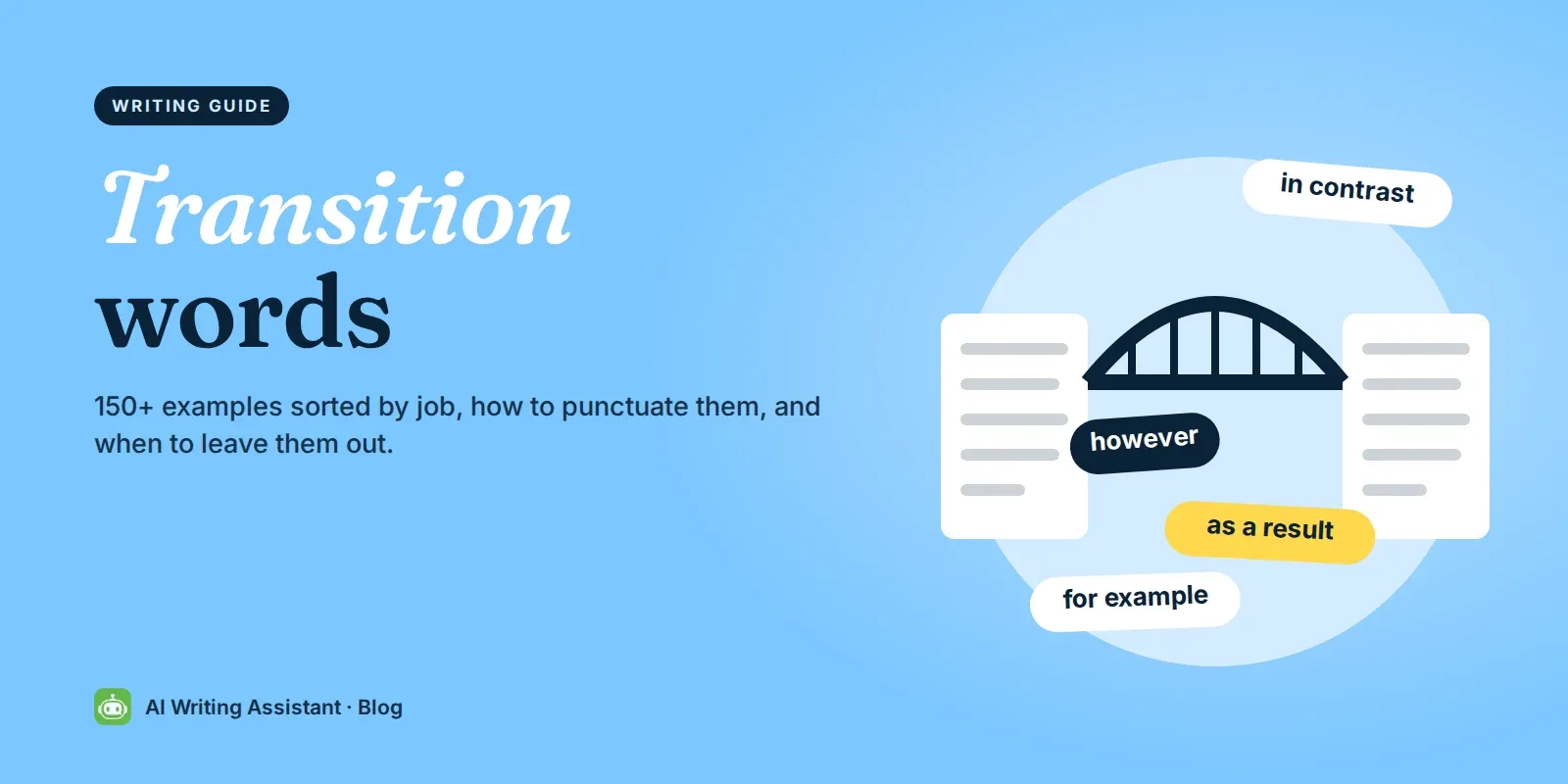
A transition word is a small signpost. "However" tells the reader to expect a turn. "For example" promises proof. "As a result" says the next sentence follows from the last one. Get them right and your writing reads like a path. Get them wrong, or use too many, and it reads like a list of instructions from a nervous tour guide.
What are transition words?
Transition words and phrases link one idea to the next and show how they relate. They tell the reader whether you're adding a point, contrasting it, giving an example, showing a cause, or wrapping up. Common examples include however, therefore, for example, in addition, meanwhile and in short. Purdue OWL calls them "like bridges between parts of your paper." They work between sentences and between paragraphs.
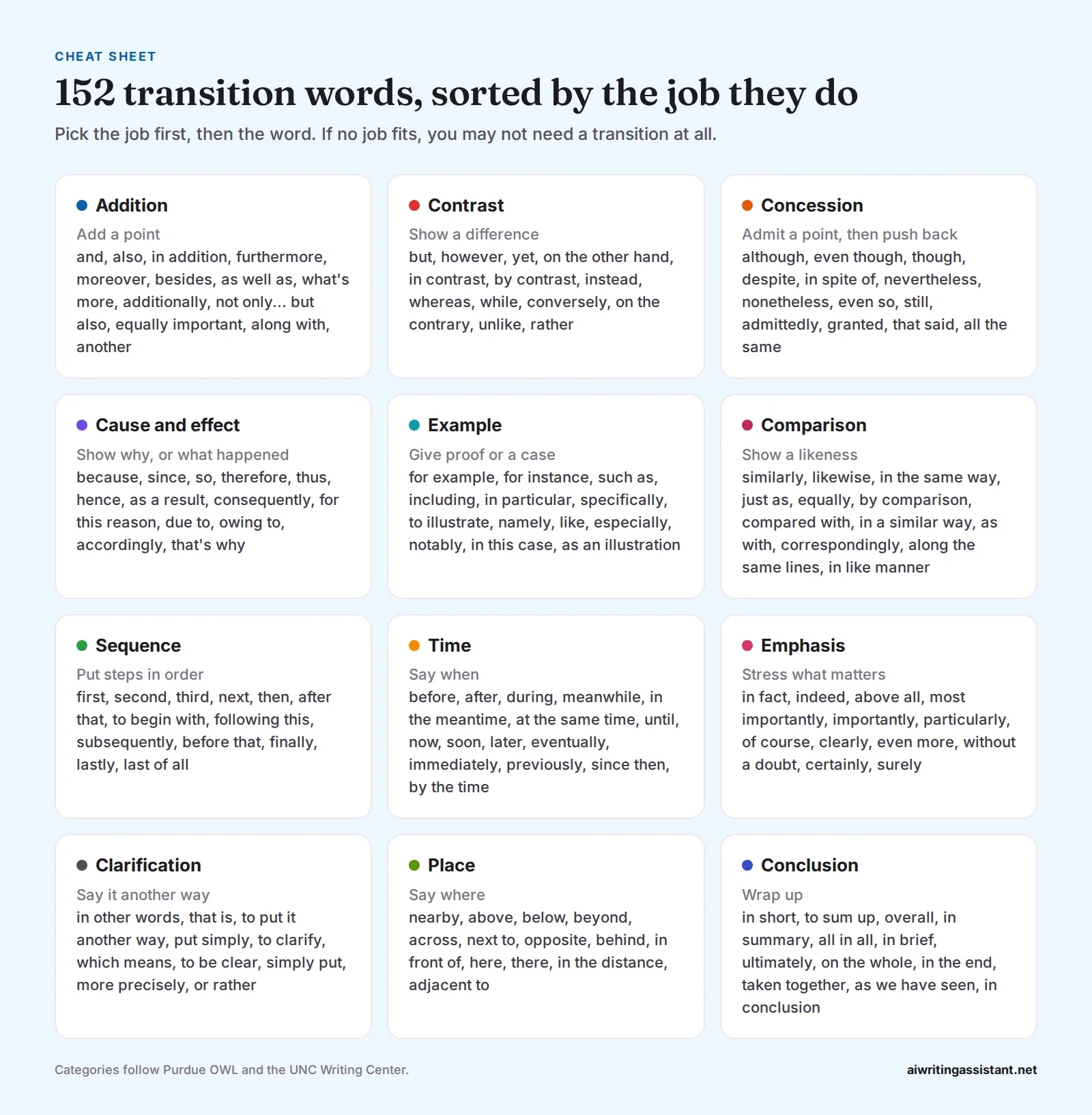
The full list: 152 transition words by purpose
Each group below is sorted by the job the word does. Start with the job, then pick the word that fits the tone of your writing.
Addition transition words
Use them to add a point. and, also, in addition, furthermore, moreover, besides, as well as, what's more, additionally, not only... but also, equally important, along with, another.
Contrast transition words
Use them to show a difference. but, however, yet, on the other hand, in contrast, by contrast, instead, whereas, while, conversely, on the contrary, unlike, rather.
Concession transition words
Use them to admit a point, then push back. although, even though, though, despite, in spite of, nevertheless, nonetheless, even so, still, admittedly, granted, that said, all the same.
Cause and effect transition words
Use them to show why, or what happened. because, since, so, therefore, thus, hence, as a result, consequently, for this reason, due to, owing to, accordingly, that's why.
Example transition words
Use them to give proof or a case. for example, for instance, such as, including, in particular, specifically, to illustrate, namely, like, especially, notably, in this case, as an illustration.
Comparison transition words
Use them to show a likeness. similarly, likewise, in the same way, just as, equally, by comparison, compared with, in a similar way, as with, correspondingly, along the same lines, in like manner.
Sequence transition words
Use them to put steps in order. first, second, third, next, then, after that, to begin with, following this, subsequently, before that, finally, lastly, last of all.
Time transition words
Use them to say when. before, after, during, meanwhile, in the meantime, at the same time, until, now, soon, later, eventually, immediately, previously, since then, by the time.
Emphasis transition words
Use them to stress what matters. in fact, indeed, above all, most importantly, importantly, particularly, of course, clearly, even more, without a doubt, certainly, surely.
Clarification transition words
Use them to say it another way. in other words, that is, to put it another way, put simply, to clarify, which means, to be clear, simply put, more precisely, or rather.
Place transition words
Use them to say where. nearby, above, below, beyond, across, next to, opposite, behind, in front of, here, there, in the distance, adjacent to.
Conclusion transition words
Use them to wrap up. in short, to sum up, overall, in summary, all in all, in brief, ultimately, on the whole, in the end, taken together, as we have seen, in conclusion.
Transition words with example sentences
| Job | Example sentence |
|---|---|
| Addition | The app is free. In addition, it works offline. |
| Contrast | Most people expected rain. Instead, the sun came out. |
| Concession | Although the plan was risky, it worked. |
| Cause and effect | The bridge closed for repairs. As a result, traffic doubled downtown. |
| Example | Some fruits keep for weeks, such as apples and oranges. |
| Comparison | Bees communicate by dancing. Similarly, some birds use movement to signal danger. |
| Sequence | First, preheat the oven. Next, mix the dry ingredients. |
| Time | She trained for months. Eventually, she ran the full marathon. |
| Emphasis | The test is optional. In fact, most students skip it. |
| Clarification | The project is on hold. In other words, nobody is working on it. |
| Conclusion | In short, the cheaper option costs more over five years. |
How to punctuate transition words
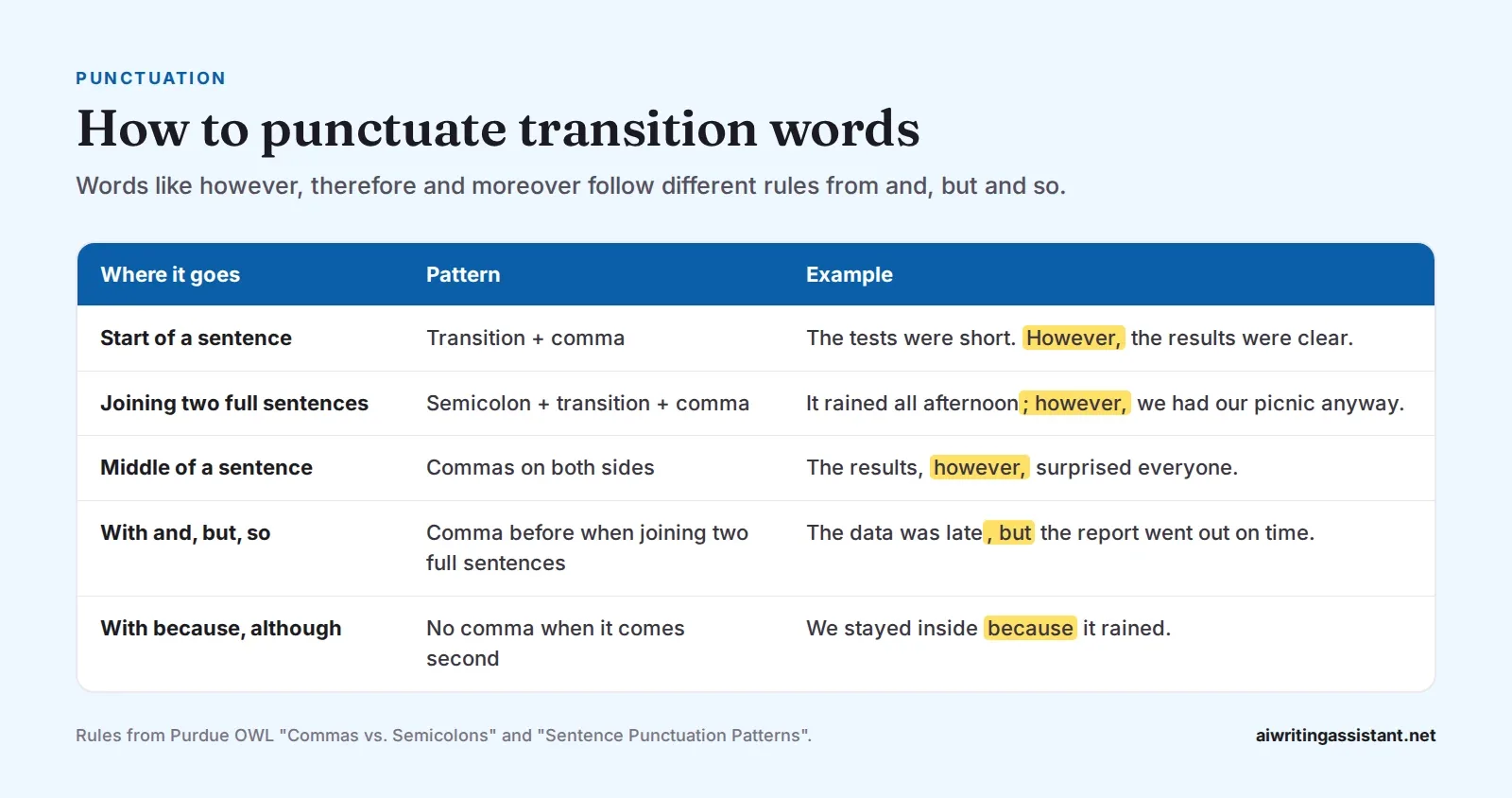
This is where most mistakes happen. Words like however, therefore and moreover (grammar books call them conjunctive adverbs) can't join two full sentences with just a comma. Small joining words like and, but and so can.
- At the start of a sentence, follow the transition with a comma. "However, the results were clear."
- Joining two complete sentences, use a semicolon before it and a comma after. Purdue OWL's example is "It rained heavily during the afternoon; however, we managed to have our picnic anyway." A full stop works just as well and is often easier to read.
- In the middle of a sentence, put commas on both sides. "The results, however, surprised everyone."
- With and, but and so, put a comma before them when they join two full sentences. "The data was late, but the report went out on time."
Do transition words really help readers?
Yes, but some kinds help far more than others. In a 2011 study of 8- and 10-year-olds, children read texts faster when they had the right connectives than when the connectives were missing or wrong. The researchers concluded that "connectives aid text processing."
A 2019 study of 794 Dutch teenagers added an important detail. Contrast words (like however) and cause words (like because) improved comprehension. Additive words (like moreover and in addition) actually reduced it. So the words that tell readers something about your logic help. The ones that just say "here's another thing" can get in the way.
How to use transition words well
- Fix the order first. The UNC Writing Center puts it bluntly. "Transitions cannot substitute for good organization." If you need a transition in every sentence, the ideas are probably in the wrong order.
- Match the word to the logic. Don't use "therefore" unless the next point really follows from the last. The Harvard writing center notes that "novice writers tend to add therefore and hence when they aren't sure how to transition."
- Vary them, but don't hunt for fancy ones. "But" and "so" are fine in most writing. "Notwithstanding" rarely is.
- Use more between paragraphs than within them. A paragraph's first sentence is where readers most need to know how it connects to the one before.
- Cut the empty ones. "Moreover" and "furthermore" at the start of every paragraph make writing sound stiff and, these days, a bit like a chatbot.
Transition words for essays
In academic writing, the most useful groups are contrast, concession and cause and effect, because essays are built on argument. Good essay transitions include however, in contrast, although, nevertheless, as a result, therefore, for example, and similarly. If your drafts lean on moreover and furthermore, our guide to edits that make writing sound like you shows what to use instead.
Skip "in conclusion" at the start of your last paragraph. Most writing centers advise against it because the reader can already see it's the end.
Frequently asked questions
What are transition words?
Transition words and phrases connect ideas and show how they relate, such as however (contrast), for example (example), as a result (cause and effect) and in short (conclusion).
What are some good transition words for essays?
However, in contrast, although, nevertheless, as a result, therefore, for example, for instance, similarly, in addition and in short are reliable choices in academic writing.
How do you punctuate "however"?
At the start of a sentence, put a comma after it. When it joins two complete sentences, use a semicolon or full stop before it and a comma after. In the middle of a sentence, put commas on both sides.
Can you start a sentence with "but" or "and"?
Yes. It's grammatically fine and common in good writing. Some teachers discourage it in formal essays, so check your assignment's style.
How many transition words should I use?
Use one when the link between ideas isn't obvious, especially at the start of a paragraph. If almost every sentence has one, cut back.
What's the difference between transition words and conjunctions?
Conjunctions like and, but and because join parts of a sentence. Transition words like however and therefore usually link separate sentences or paragraphs, and need different punctuation.
Is "in conclusion" a good transition?
It's correct but overused. Writing centers suggest ending with your strongest point instead of announcing that you're concluding.
 Grammar Checker
 Paraphraser
 Summarizer
 AI Writer
 AI Humanizer
 Text Compare