
Some sentences are easy to write once you've started them. The hard part is the first three words. That's what sentence starters are for. They're ready-made openings that tell the reader what's coming, like an example, a contrast, a piece of evidence or your own view.
Below are 202 sentence starters sorted by the job they do, with example sentences, a printable cheat sheet, and tips for not overdoing it.
What are sentence starters?
Sentence starters are words or short phrases used to begin a sentence, such as "For example," "This suggests that," or "On the other hand." They signal how the new sentence relates to the last one. Teachers use them to help students structure paragraphs, and experienced writers use them to keep an argument easy to follow. They overlap with transition words, but many are longer phrases that set up a full idea.
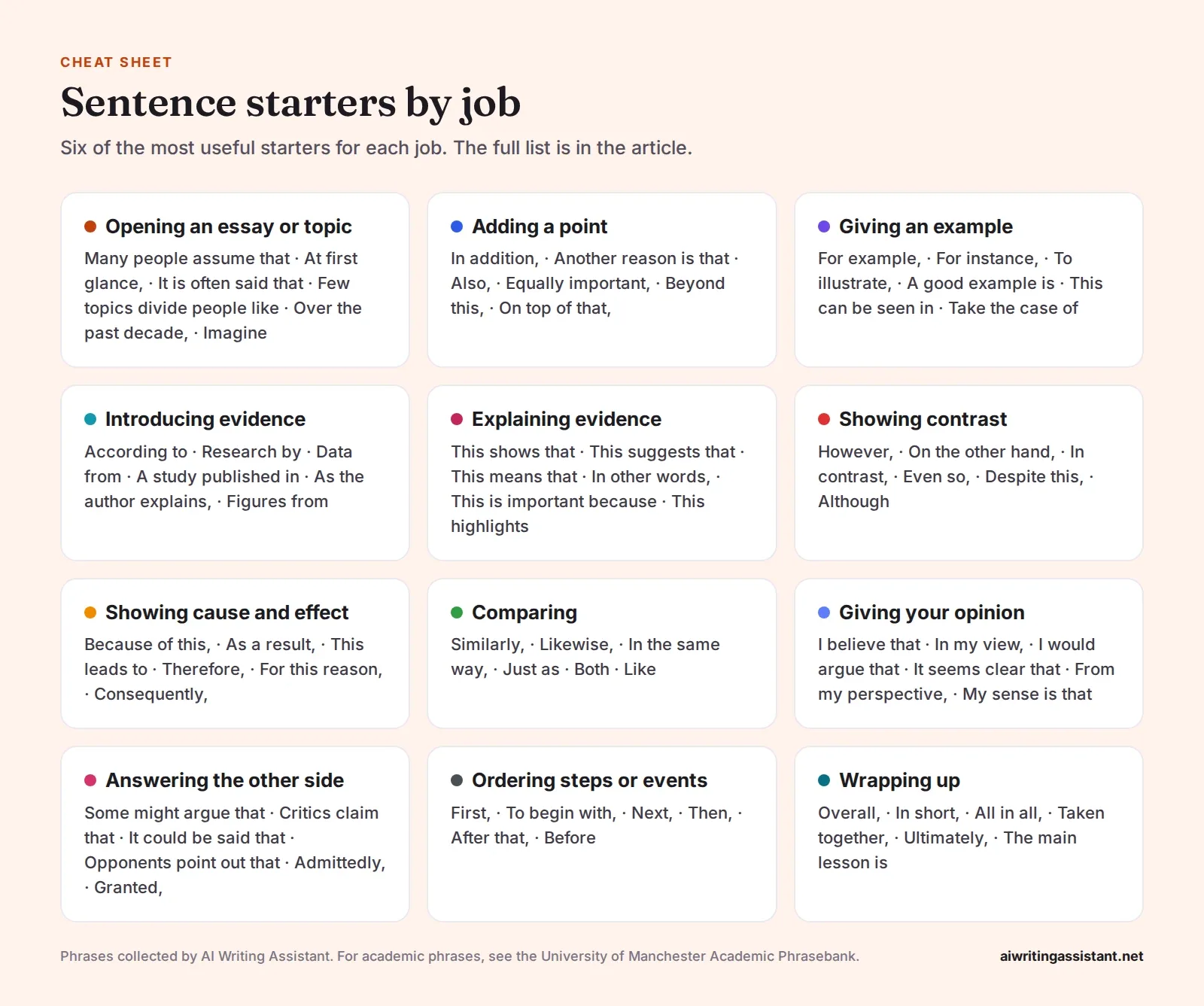
202 sentence starters, sorted by purpose
Opening an essay or topic
"Many people assume that", "At first glance,", "It is often said that", "Few topics divide people like", "Over the past decade,", "Imagine", "The question of", "One of the most debated issues in", "Most people have heard of", "When we think of", "There is growing interest in", "It may seem surprising, but", "In recent years,", "Consider the case of".
Adding a point
"In addition,", "Another reason is that", "Also,", "Equally important,", "Beyond this,", "On top of that,", "A further point is that", "Another example of this is", "Not only that, but", "What is more,", "Along with this,", "It is also true that", "Building on this,", "Plus,", "As well as this,".
Giving an example
"For example,", "For instance,", "To illustrate,", "A good example is", "This can be seen in", "Take the case of", "One example is", "A clear case of this is", "As shown by", "Consider", "In particular,", "Specifically,", "Such as", "Examples include", "Think of", "Look at".
Introducing evidence
"According to", "Research by", "Data from", "A study published in", "As the author explains,", "Figures from", "In the words of", "The results show that", "Recent surveys suggest", "Evidence from", "As reported by", "Statistics show", "In a recent interview,", "Experts at", "Researchers found that", "A report by".
Explaining evidence
"This shows that", "This suggests that", "This means that", "In other words,", "This is important because", "This highlights", "From this, we can see", "This proves that", "This reveals", "What this tells us is", "The key point here is", "This matters because", "It follows that", "This points to", "This implies that", "Put simply,".
Showing contrast
"However,", "On the other hand,", "In contrast,", "Even so,", "Despite this,", "Although", "While it is true that", "Unlike", "Instead,", "Nevertheless,", "At the same time,", "Yet", "That said,", "Conversely,", "But", "Still,".
Showing cause and effect
"Because of this,", "As a result,", "This leads to", "Therefore,", "For this reason,", "Consequently,", "Due to", "This is why", "The main cause of", "Since", "This resulted in", "Thanks to", "One effect of this is", "So", "This explains why".
Comparing
"Similarly,", "Likewise,", "In the same way,", "Just as", "Both", "Like", "Compared with", "In a similar way,", "This mirrors", "Equally,", "By comparison,", "This echoes", "Much like", "In the same vein,".
Giving your opinion
"I believe that", "In my view,", "I would argue that", "It seems clear that", "From my perspective,", "My sense is that", "I am convinced that", "It is fair to say that", "Personally,", "I disagree with", "I agree with", "The strongest argument is", "It strikes me that", "I would suggest that".
Answering the other side
"Some might argue that", "Critics claim that", "It could be said that", "Opponents point out that", "Admittedly,", "Granted,", "Although some believe", "A common objection is", "While this view has merit,", "This argument overlooks", "It is true that", "To be fair,", "Some readers may feel that".
Ordering steps or events
"First,", "To begin with,", "Next,", "Then,", "After that,", "Before", "Once", "Following this,", "Meanwhile,", "Later,", "Eventually,", "Finally,", "At the start,", "By the end,", "Second,".
Telling a story
"It all started when", "One morning,", "Without warning,", "Suddenly,", "Just as", "Little did I know", "The next day,", "Moments later,", "As soon as", "By the time", "That was when", "Looking back,", "At first,".
Persuading the reader
"Think about", "What if", "It is time to", "We cannot ignore", "Picture", "The truth is", "Surely", "Ask yourself", "There is no reason why", "Now is the moment to", "The evidence is clear:", "We all know".
Wrapping up
"Overall,", "In short,", "All in all,", "Taken together,", "Ultimately,", "The main lesson is", "What this shows is", "Looking ahead,", "Above all,", "The bigger picture is", "In the end,", "This leaves us with", "To sum up,".
Sentence starters with examples
| Job | Starter | Example sentence |
|---|---|---|
| Introducing evidence | According to | According to the city's 2025 survey, two in three residents walk to work at least once a week. |
| Explaining evidence | This suggests that | This suggests that the new bike lanes are being used for commuting, not just weekend rides. |
| Contrast | On the other hand, | On the other hand, shop owners on Main Street say they've lost parking. |
| Cause and effect | As a result, | As a result, the council is testing short-stay parking on side streets. |
| Answering the other side | Critics claim that | Critics claim that bike lanes slow down buses, but the route's timings haven't changed. |
| Opinion | I would argue that | I would argue that the lanes have done more good than harm so far. |
| Wrapping up | Taken together, | Taken together, the numbers show a city getting used to a new way of moving. |
Notice how the starters build an argument. Evidence, then what it means, then the other side, then your view. That pattern works for almost any body paragraph.
Sentence starters for essays
In academic writing, two groups do most of the work. Use evidence starters to bring in a source ("According to," "A study published in," "As the author explains,"). Then use explaining starters to show what it means ("This suggests that," "This is important because," "From this, we can see"). Teachers often say students quote well but forget to explain. A second starter after every quote fixes that.
For academic papers, the University of Manchester's Academic Phrasebank is the classic free resource. It was built by John Morley and groups phrases by section, such as introducing work, reporting results and writing conclusions.
Sentence starters for paragraphs
The first sentence of a paragraph is the topic sentence. It should tell the reader what the paragraph is about and how it links to the one before. Good paragraph openers include "Another reason is that," "A further point is that," "In contrast to this," and "This leads to the question of." Save the shorter ones like "Also" and "Then" for sentences inside a paragraph.
How to use sentence starters without sounding robotic
- Don't start every sentence with one. Two or three per paragraph is plenty. Most sentences can just start with the subject.
- Match the starter to the logic. "As a result" promises a consequence. If the next sentence isn't one, readers get lost. The Harvard writing center warns that just adding "therefore" or "moreover" doesn't create a real connection.
- Vary them. Three "Furthermore"s in one page will stand out. They're also one of the signs people associate with AI writing.
- Skip "In conclusion." The UNC Writing Center calls it "an unnecessary, overused phrase." Your reader can see it's the last paragraph.
- Use plain ones in informal writing. In emails and blog posts, "But," "So," and "Here's why" usually beat "Nevertheless" and "Consequently."
Frequently asked questions
What are good sentence starters?
Useful ones include "For example," "This suggests that," "According to," "On the other hand," "As a result," and "Taken together." The best choice depends on whether you're adding, contrasting, explaining or concluding.
What are good sentence starters for essays?
For bringing in sources, "According to" and "A study published in." For explaining them, "This suggests that" and "This is important because." For counterarguments, "Critics claim that" and "Admittedly."
How do you start a paragraph?
With a topic sentence that says what the paragraph is about and how it connects to the last one, such as "Another reason is that..." or "In contrast to this..."
Can I start a sentence with "And" or "But"?
Yes. It's grammatically correct and common in good writing. Some teachers prefer you avoid it in formal essays, so check the assignment.
What can I use instead of "In conclusion"?
Try "Taken together," "Overall," "Ultimately," or simply end with your strongest point without announcing it.
Are sentence starters the same as transition words?
They overlap. Transition words are usually single words or short phrases like however. Sentence starters are often longer phrases that set up a whole idea, like "This suggests that."
 Grammar Checker
 Paraphraser
 Summarizer
 AI Writer
 AI Humanizer
 Text Compare