
Most cover letters fail in the first two lines. They start with "My name is" or "I am writing to apply for," and the reader's eyes slide straight down to the signature. A good one does the opposite. It tells a busy person, fast, why you're worth a call.
Here's how to write one, step by step, with a full sample and the mistakes that get letters ignored.
How do you write a cover letter?
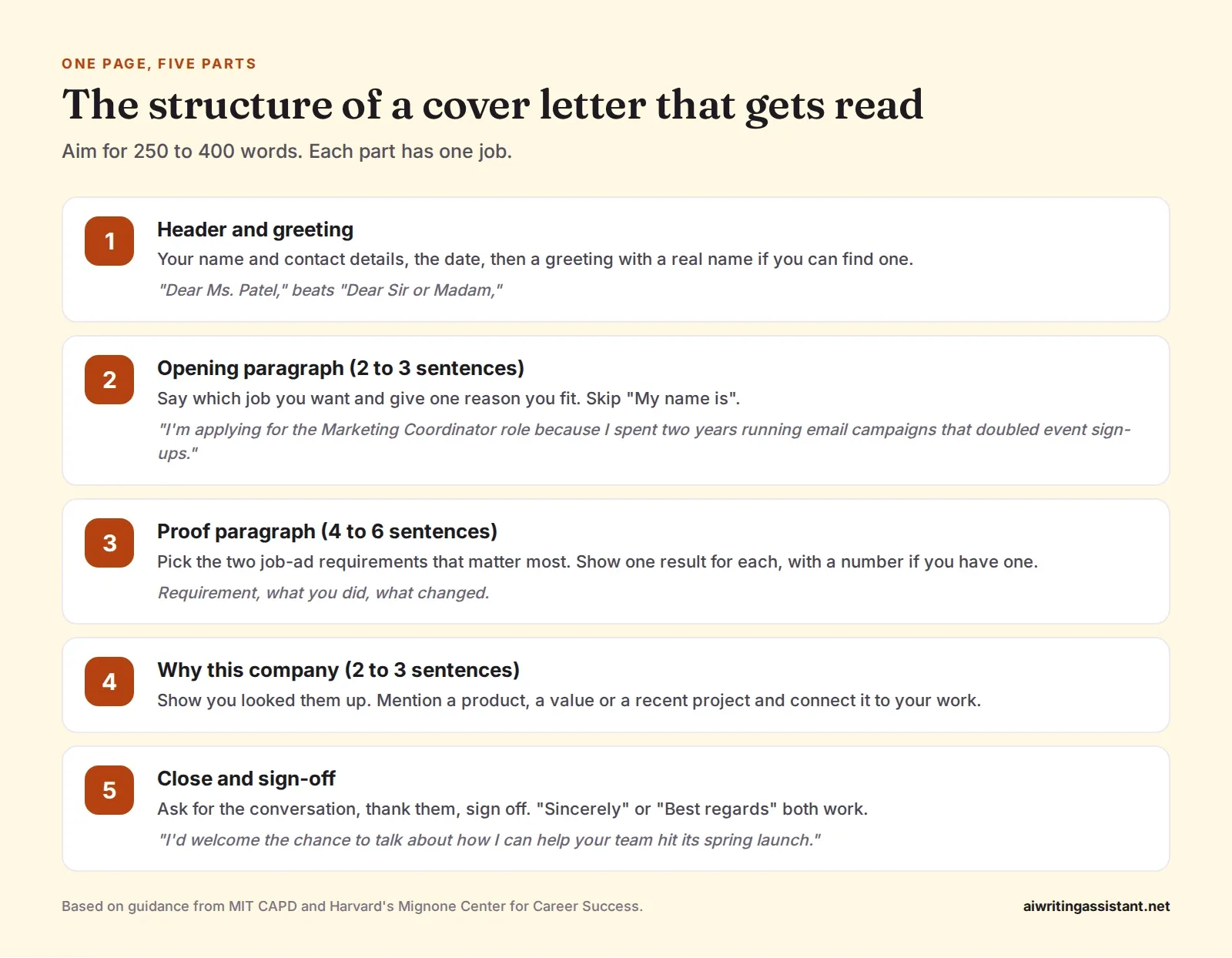
Write a one-page letter of three or four short paragraphs. Open by naming the job and one strong reason you fit. In the middle, take the two most important requirements from the job ad and show a real result for each. Then say why you want this company in particular, and close by asking for an interview. Keep it to roughly 250 to 400 words and write a fresh version for every application.
Step 1: Read the job ad like a checklist
Before you write a word, copy the job ad into a document and highlight every requirement. Then pick the two or three that seem to matter most. They're usually near the top, repeated, or written as "must have."
Those become the backbone of your letter. You're not trying to cover everything on your resume. You're showing the reader that you've solved the problems this job exists to solve.
Step 2: Find a name for the greeting
A real name shows effort. Check the job ad, the company's team page and LinkedIn for the hiring manager or team lead. If you can't find one, "Dear Hiring Manager" or "Dear Marketing Team" works fine. "To Whom It May Concern" is still correct, but it reads as dated in a job application.
Step 3: Write an opening that earns the next line
Your first sentence should name the job and give a reason to keep reading. Lead with your strongest fact, a mutual contact, or what genuinely draws you to the role.
| Weak opening | Stronger opening |
|---|---|
| "My name is Sam and I am writing to apply for the Marketing Coordinator position." | "I'm applying for the Marketing Coordinator role because I spent two years running email campaigns that doubled event sign-ups." |
| "I believe I would be a great fit for your company." | "Priya Shah on your design team suggested I apply. She thought my event marketing work fits your spring launch." |
| "I am a hard-working, passionate team player." | "I've bought Brightline's granola every week for three years, and I'd love to help more people find it." |
Step 4: Prove two requirements with results
This is the heart of the letter. For each requirement you picked, write what you did and what changed because of it. Numbers help, but they're not the only proof. "Our director stopped asking me for spreadsheets" says something real too.
Keep it to one or two examples. MIT's career office suggests "a couple of examples from your experience," and that's the right amount. Your resume holds the rest.
Step 5: Show you know the company
Two or three sentences are enough. Mention something specific, like a product, a recent launch, a value they talk about, or a problem you noticed, and connect it to what you can do. This is the part a generic letter can't fake, which is exactly why it works.
Step 6: Close by asking for the conversation
End with a clear, polite ask. "I'd welcome the chance to talk about how I can help with your spring launch" is better than "I hope to hear from you." Thank them, then sign off with "Best regards" or "Sincerely" and your full name.
A full cover letter example
Here's a complete letter that follows the structure. The applicant and company are made up, but every move in it is one you can copy.
Notice what it leaves out. There's no list of adjectives, no life story and no repeat of the resume. Each paragraph answers one question the hiring manager has.
How long should a cover letter be?
One page at most. MIT CAPD says a cover letter "should be no longer than one page with a font size between 10-12 points." A guide on the Harvard career site suggests three to four short paragraphs and 250 to 400 words. In a Resume Genius survey, hiring managers said they preferred letters of about 400 words. Shorter is fine if every line is doing work.
Do hiring managers actually read cover letters?
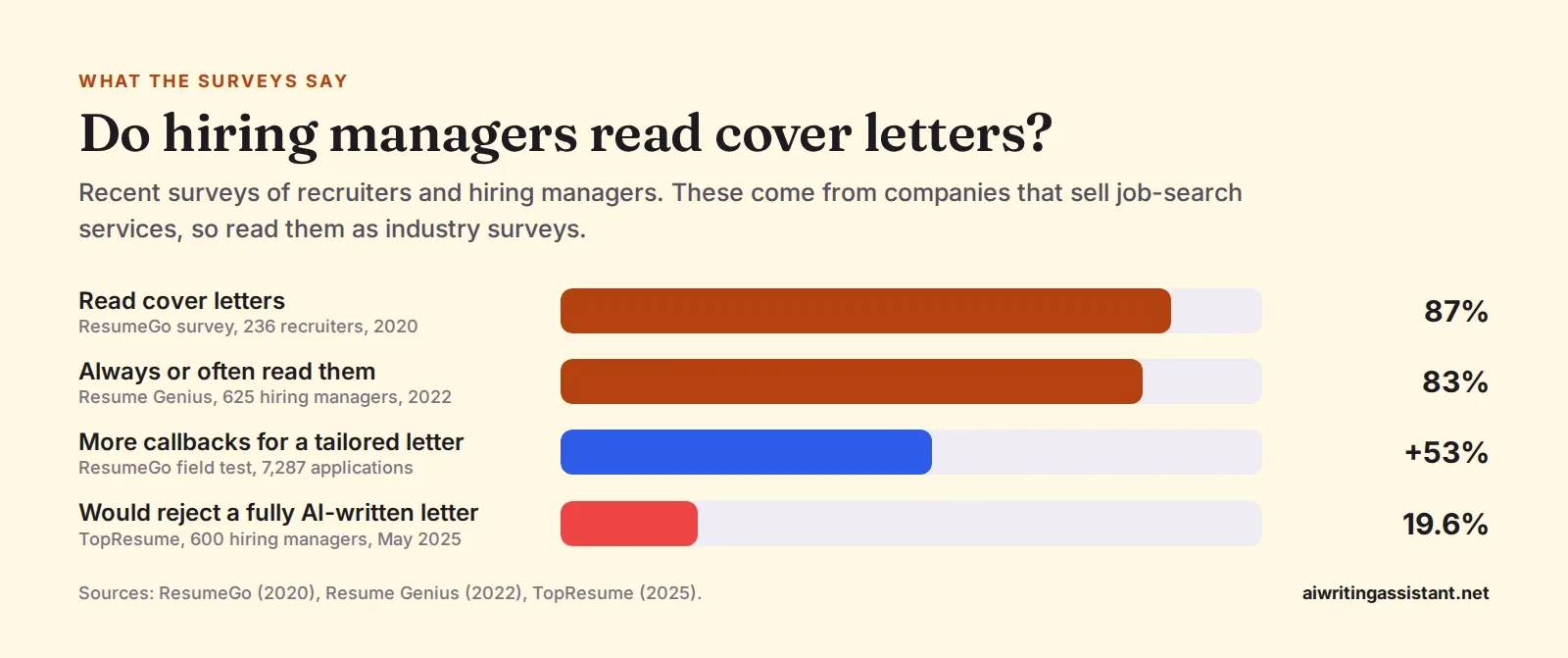
Most say they do. In ResumeGo's study, 87% of the 236 recruiters and hiring managers surveyed said they read cover letters, and 81% valued tailored ones more than generic ones. The same company sent 7,287 test applications, and those with a tailored cover letter got 53% more callbacks than applications without one.
A Resume Genius survey of 625 hiring managers found 83% read cover letters always or frequently, and 45% read them before the resume. Both companies sell job-search services, so treat the figures as industry surveys. Still, the direction is clear. Skipping the letter rarely helps.
Can you use AI to write a cover letter?
You can use it to help, but don't send what it gives you as is. In a TopResume survey from May 2025, 19.6% of 600 hiring managers said they would reject a resume or cover letter that was fully AI-generated, while 52% were fine with AI used for "proofreading or drafting support." The Harvard guide puts it plainly. Sending "a letter that's 100% AI-generated and unedited is a real risk."
A safe way to use it is to get a rough draft from your own notes, then rewrite every sentence with your real results and your reasons for wanting the job. Our free Cover Letter Generator drafts from the job ad and your CV, and our guide to editing AI text so it sounds like you covers the rewrite.
Common cover letter mistakes
- Repeating the resume. The letter should explain and connect, not list.
- Writing about what you want. "This role would help me grow" is about you. Turn it around to what you'll do for them.
- One letter for every job. If you could swap in another company's name without changing anything, it's too generic.
- Leaving in the wrong company name. It happens more than you'd think. Read the final version once just for names.
- Going over a page. Cut adjectives first, then the weakest example.
- Typos. One error in a one-page letter stands out. Read it aloud, then run a grammar check.
Frequently asked questions
How do I write a cover letter?
Write one page with three or four short paragraphs. Name the job and your strongest reason in the opening, prove two key requirements with real results, explain why you want this company, and ask for an interview in the close.
How long should a cover letter be?
No more than one page. Most career offices suggest three to four short paragraphs, roughly 250 to 400 words.
What should I put in the first sentence?
The job title and one strong reason you fit, such as a relevant result, a referral, or a real connection to the company. Avoid starting with "My name is".
Do hiring managers still read cover letters?
Most say they do. In a ResumeGo survey 87% of recruiters said they read them, and tailored letters got 53% more callbacks than no letter in its field test.
Is "To Whom It May Concern" OK in a cover letter?
It's grammatically fine but sounds dated. Try to find a name, or use "Dear Hiring Manager" or "Dear [Team] Team".
Can I use AI to write my cover letter?
Use it for a rough draft or to proofread, then rewrite it with your own results and reasons. About 1 in 5 hiring managers in a 2025 survey said they would reject a fully AI-generated letter.
Should a cover letter be the same for every job?
No. Tailor at least the opening, the two examples and the company paragraph for each application.
 Grammar Checker
 Paraphraser
 Summarizer
 AI Writer
 AI Humanizer
 Text Compare