
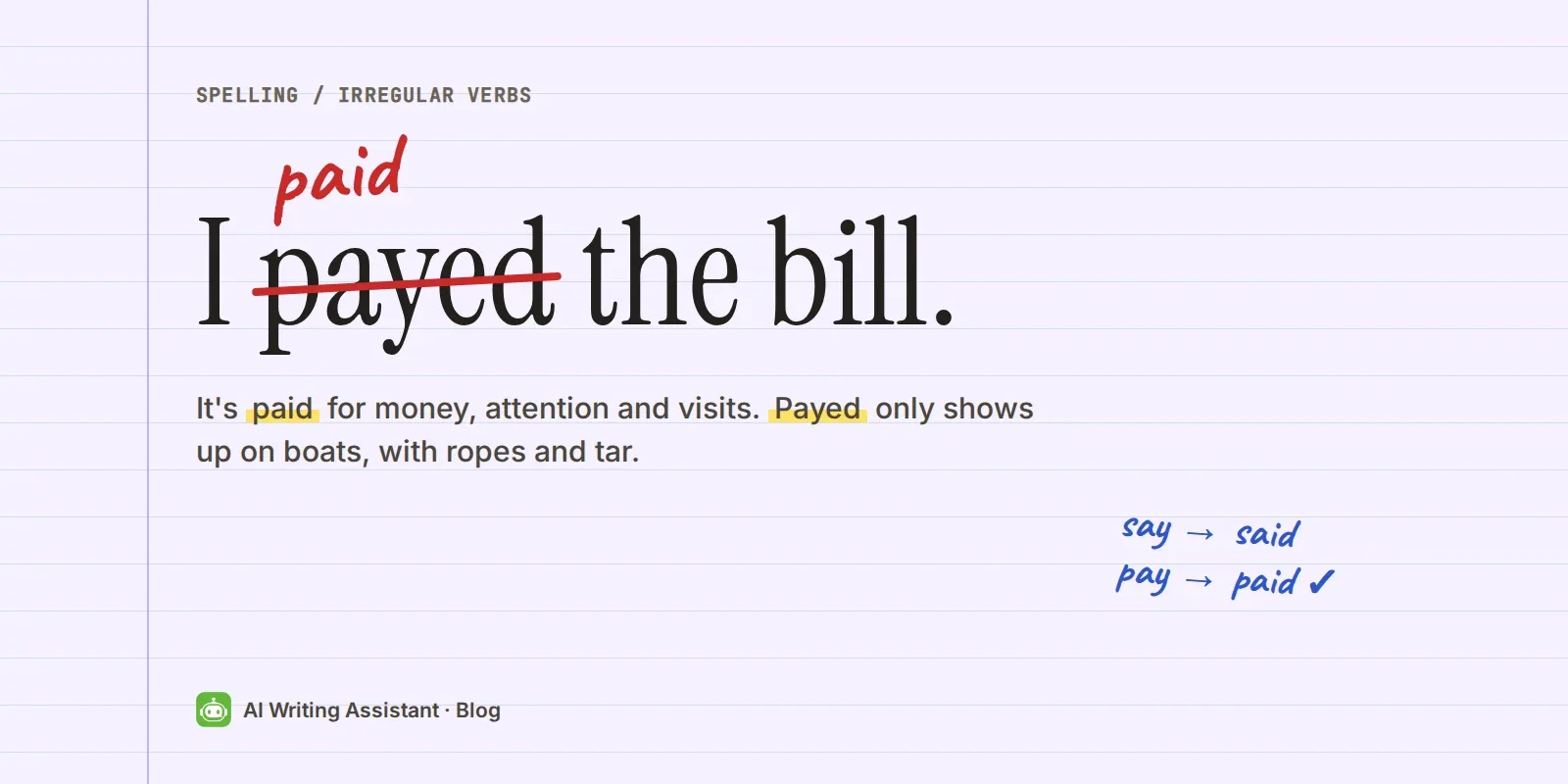
"Payed" looks right because English usually adds -ed to make the past tense. Play becomes played, stay becomes stayed. So why not pay and payed? Because pay is one of the old irregular verbs, and it has been "paid" for centuries.
Is it paid or payed?
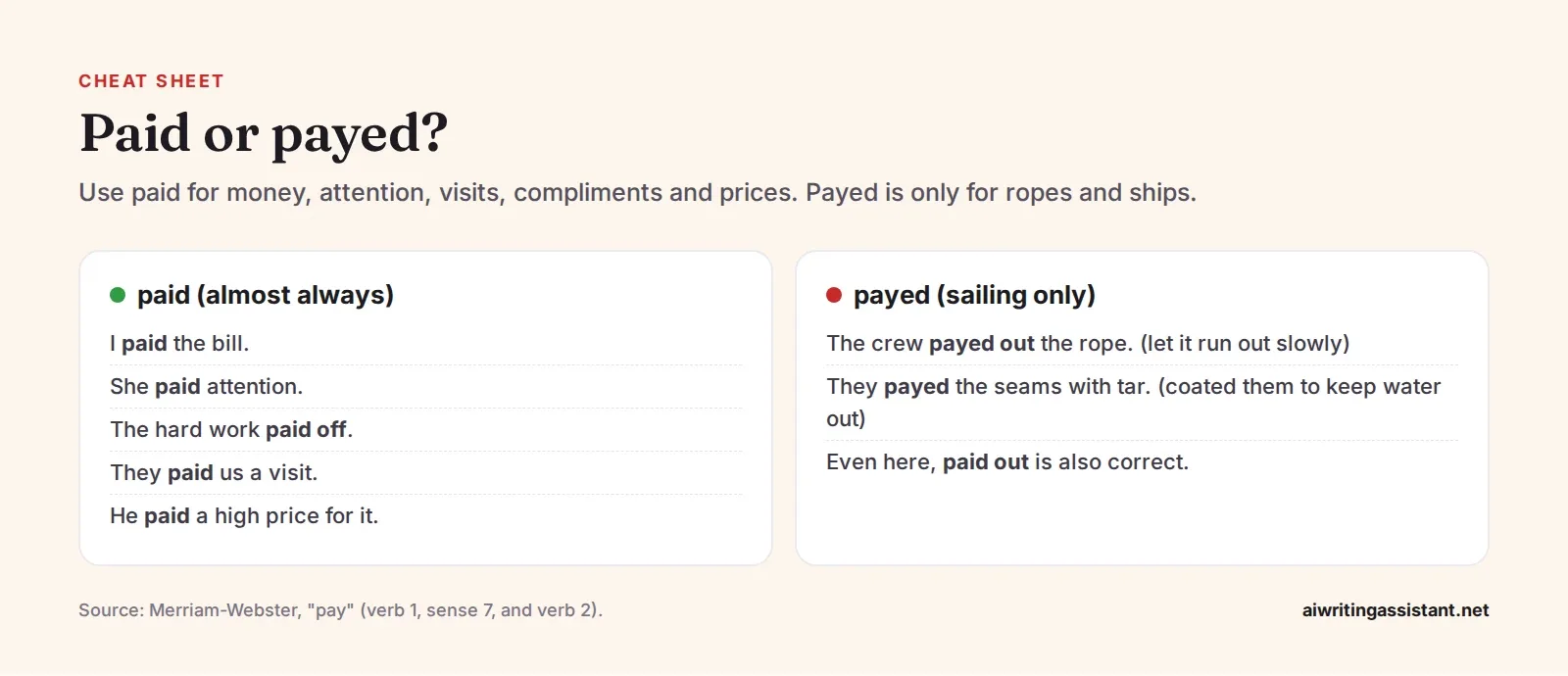
It's paid. "Paid" is the past tense and past participle of "pay" for money, attention, visits, compliments and consequences, as in "I paid the rent" or "Your hard work has paid off." "Payed" is only used in two specialist sailing senses, letting a rope run out ("they payed out the line") and coating a ship's seams with tar or pitch. If you're not writing about ropes or boats, use paid.
When "paid" is correct
Use paid every time "pay" means giving money, or any of its everyday extended meanings.
| Meaning | Example |
|---|---|
| Gave money | I paid $40 for the tickets. |
| Gave attention | Nobody paid attention to the warning. |
| Was worth it | All that practice paid off. |
| Visited | My cousins paid us a visit in June. |
| Suffered a cost | He paid a high price for the mistake. |
| Gave a compliment | She paid him a compliment on his speech. |
| Settled a debt | The loan is fully paid. |
When "payed" is correct
Merriam-Webster lists two meanings where "payed" is used.
- To let out a rope. One sense of "pay" means "to slacken (something, such as a rope) and allow to run out," used with out. Sailors may say "they payed out the anchor line." Merriam-Webster gives "paid out the rope" as its example, so paid is fine here too.
- To coat with tar. A separate verb, "pay," means "to coat with a waterproof composition." Its past tense is "payed," and it has been used since the 1600s for sealing a ship's seams.
These two verbs aren't even related. The money word comes through French from the Latin pacare, "to pacify," from pax, "peace." The tar word comes from the Latin picare, from pix, "pitch." They just ended up spelled the same.
Why people write "payed"
Because the regular rule says it should be. Most English verbs add -ed for the past tense, and similar-looking verbs like play, pray and stay follow it. Pay belongs to a small group that changed the y to i instead, along with say/said and lay/laid. Spell checkers sometimes miss "payed" too, because it's a real word in those sailing senses.
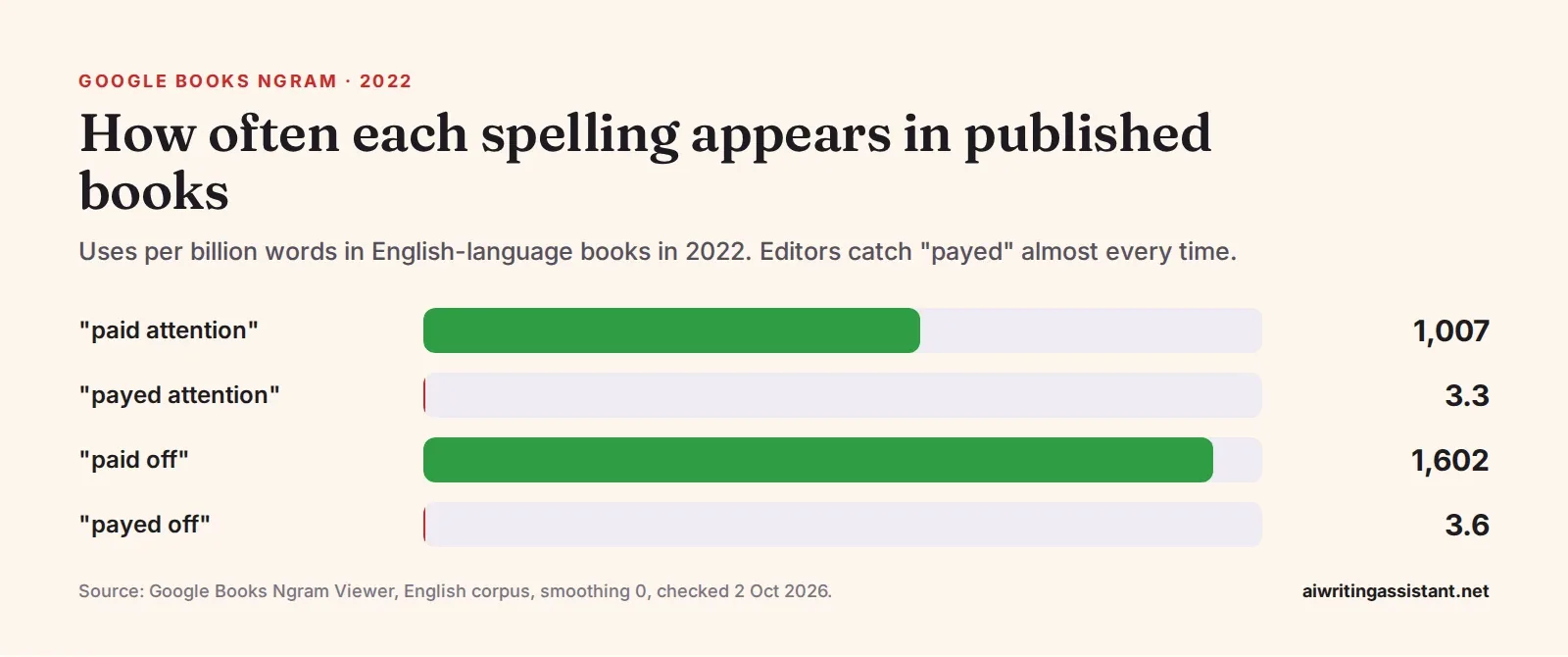
In edited books the mistake is rare. According to Google Books Ngram data, "paid attention" appeared about 1,007 times per billion words in 2022, against 3.3 for "payed attention." "Paid off" beat "payed off" by about 1,602 to 3.6.
Paid, payed and other forms of "pay"
| Form | Money meaning | Rope or tar meaning |
|---|---|---|
| Present | pay, pays | pay, pays |
| Past tense | paid | payed (or paid for ropes) |
| Past participle | paid | payed (or paid for ropes) |
| -ing form | paying | paying |
Frequently asked questions
Is it paid or payed?
Paid. It's the past tense of pay for money, attention, visits and everything else in everyday writing. Payed is only used in two sailing senses.
Is "payed" a real word?
Yes, but only for letting out a rope ("payed out the line") or coating a ship's seams with tar. In those senses it's correct.
Is it "paid attention" or "payed attention"?
Paid attention.
Is it "paid off" or "payed off"?
Paid off, as in "the effort paid off" or "the loan is paid off."
Why isn't the past tense of pay "payed"?
Pay is an irregular verb, like say (said) and lay (laid). It changed its y to i long ago, so the past tense is paid.
Is it "paid out" or "payed out" for a rope?
Both are used. Merriam-Webster lists payed for this sense and gives "paid out the rope" as an example.

 Grammar Checker
 Paraphraser
 Summarizer
 AI Writer
 AI Humanizer
 Text Compare