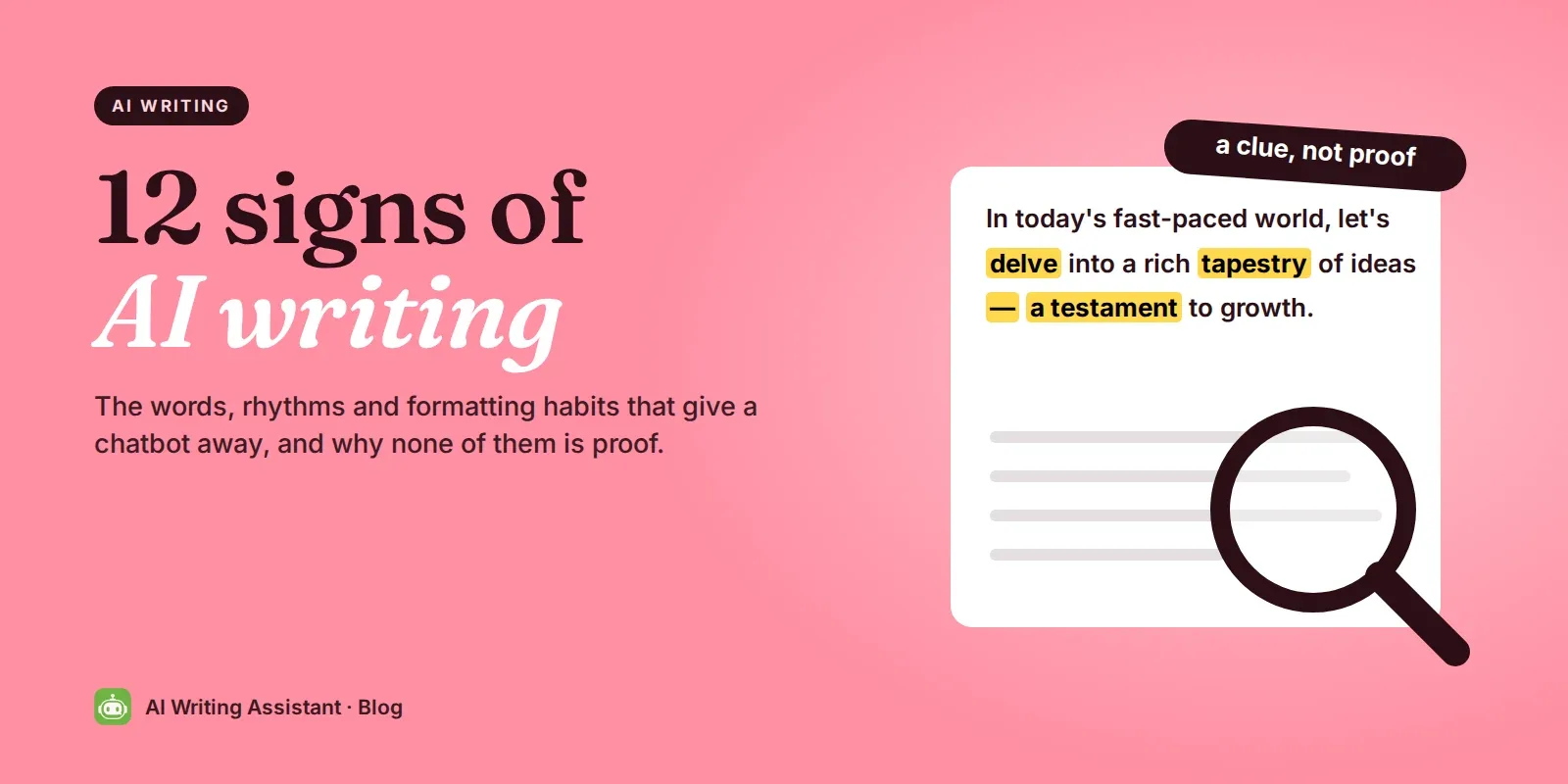
Read enough AI text and you start to feel it before you can explain it. Everything is "pivotal." Every list has three items. Every paragraph wraps up with a neat little moral. The writing isn't wrong, exactly. It's just a bit too smooth, and nobody is in it.
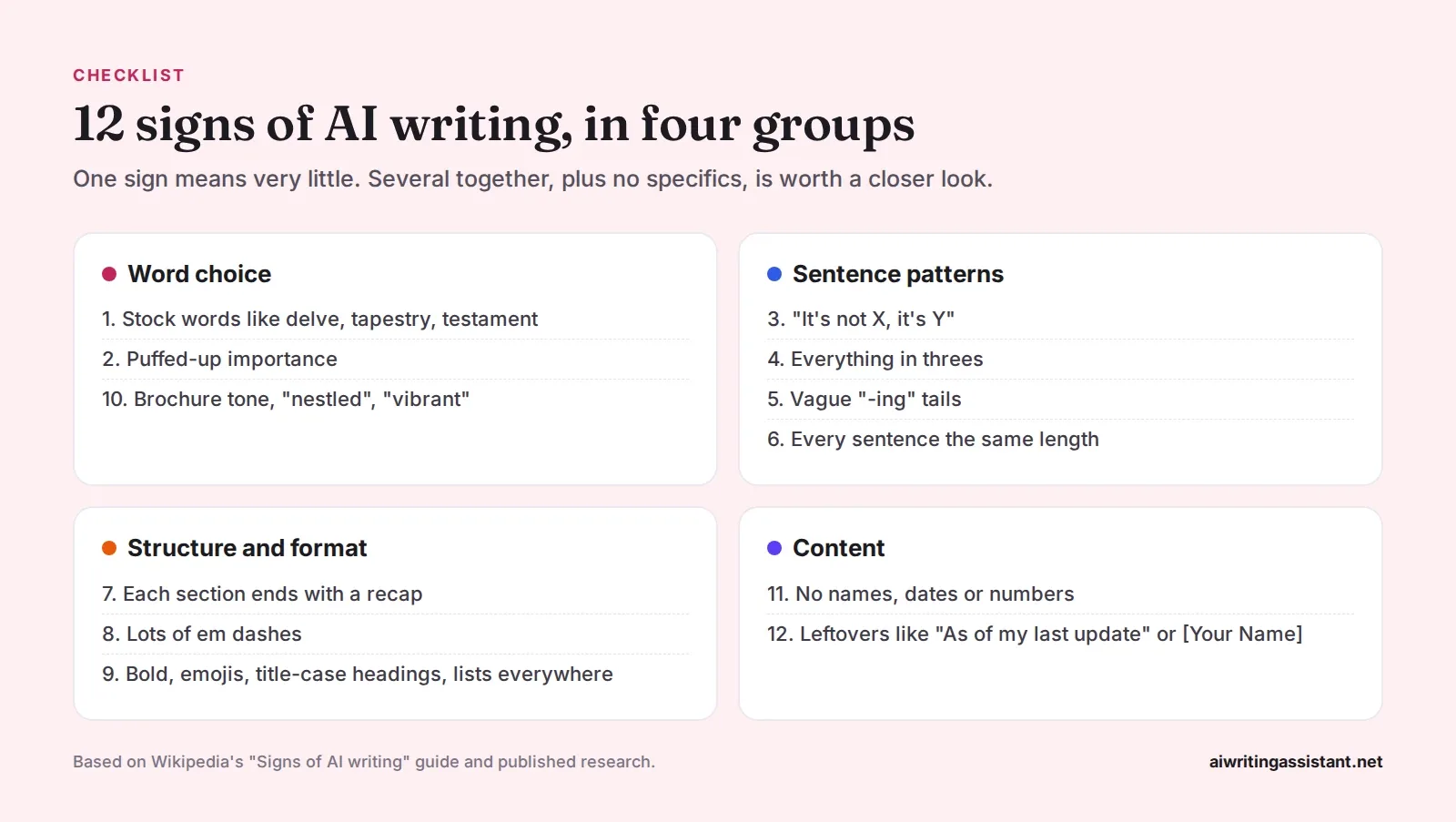
Below are the 12 signs that come up most, drawn from the Wikipedia "Signs of AI writing" guide (which its editors use to clean up chatbot text) and from research on how language models write. We'll also cover why none of them, alone, proves anything.
How can you tell if something was written by AI?
Look for a cluster of habits rather than a single clue. AI writing often uses the same favourite words (delve, underscore, tapestry, testament), inflates the importance of ordinary things, groups ideas in threes, ends sections with a summary, and keeps every sentence about the same length. It also tends to be vague, with few real names, numbers or first-hand details. Leftover phrases like "As of my last update" are the strongest single clue. Even then, a person could have written it, so ask about the writing process before you decide.
12 signs of AI writing
1. The same favourite words
Language models lean on a small set of words that sound thoughtful. Delve, tapestry, testament, underscore, pivotal, intricate, foster, showcase, crucial and landscape all show up far more than they used to.
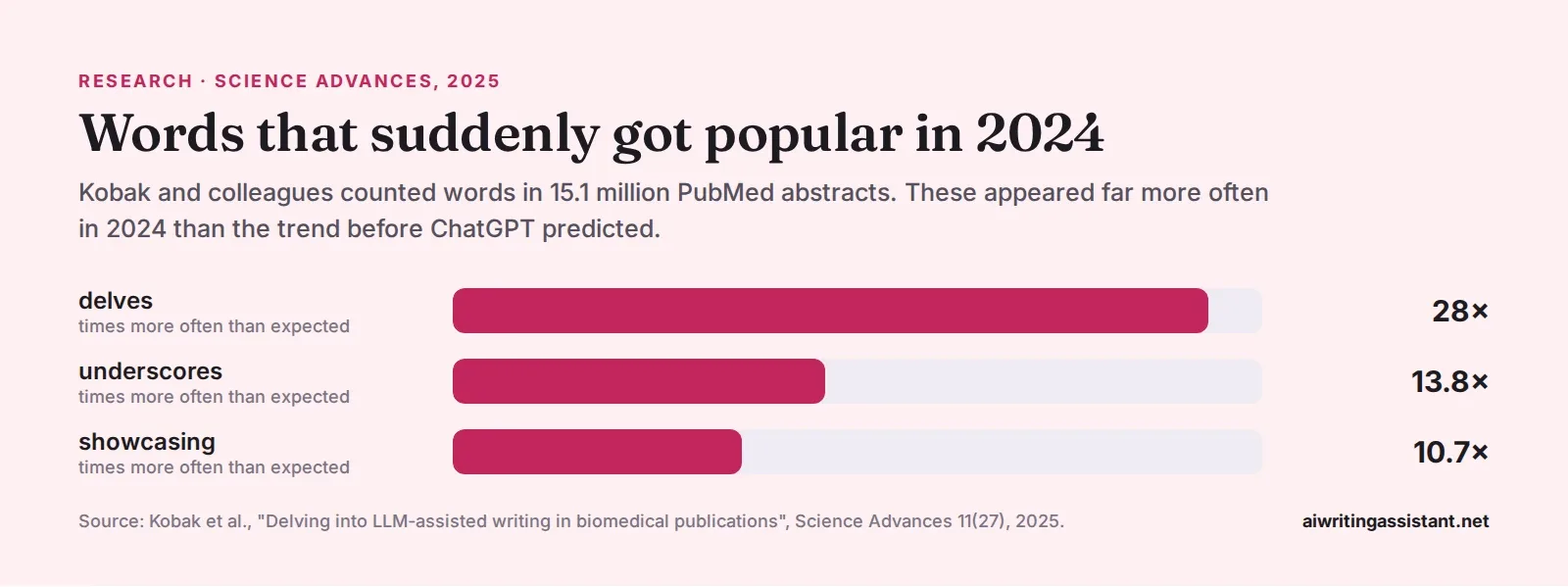
This isn't just a feeling. Kobak and colleagues studied 15.1 million biomedical abstracts and found "delves" appeared 28 times more often in 2024 than expected, with "underscores" at 13.8 times and "showcasing" at 10.7 times. From those excess words they estimated that at least 13.5% of 2024 abstracts were processed with a language model.
2. Everything is "pivotal"
AI text likes to tell you how important something is. A town "stands as a testament" to its history. A small policy change "marks a pivotal moment." A product "plays a crucial role." People do this in speeches. In ordinary writing it's a sign the writer had nothing specific to say.
3. "It's not X, it's Y"
"It's not just a tool, it's a partner." "This isn't about speed, it's about trust." One of these can be a nice line. Three in a page is a habit, and it's one of the patterns Wikipedia editors list.
4. Everything comes in threes
"Fast, reliable and secure." "Plan, create and grow." Lists of three sound complete, so models use them constantly, often with three adjectives that mean nearly the same thing.
5. Vague "-ing" tails
Watch for sentences that end with a loose comment, like "..., highlighting the importance of collaboration" or "..., reflecting a broader shift in attitudes." The tail sounds like analysis but adds no information.
6. Every sentence is the same length
Human writing has rhythm. A long sentence, then a short one. Then a fragment. AI drafts often run at a steady 15 to 25 words per sentence, paragraph after paragraph. Read it aloud and you'll hear the drone. This is also one of the main things AI detectors measure.
7. Each section ends with a summary
"Overall, these strategies can help you..." "In conclusion, it is clear that..." AI text often closes every section by restating it, even when the section was four lines long.
8. A lot of em dashes
The long dash has become a famous tell, enough to spawn memes. Models use it to bolt clauses together. Plenty of good human writers love it too, so this one is weak alone. It matters when it appears in almost every paragraph alongside the other signs.
9. Formatting that looks like a slide deck
Chatbot answers are built for a chat window, and the formatting often comes along when people paste them. Look for headings in Title Case, bold words scattered through paragraphs, emojis in headings, bullet lists where a sentence would do, and stray markdown such as double asterisks. The Wikipedia guide lists all of these.
10. Brochure tone
Travel and product writing from a model slides into advertising copy. Villages are "nestled," cities are "vibrant," views are "breathtaking" and experiences are "unforgettable." Real reviews tend to complain about something.
11. No specifics
This is the most useful sign, and the hardest to fake. AI text says "many experts agree" instead of naming one, "recent studies show" without a study, and "a significant increase" without a number. A model can't know your Tuesday meeting, your teacher's comment or what went wrong in your experiment, so it writes around them.
12. Leftovers from the chat
Sometimes the giveaway is literal. "As of my last update." "I hope this helps!" "Certainly! Here's a revised version." A placeholder like [Your Name] or [Company]. Citations to papers that don't exist. These are the closest thing to proof, because a person rarely types them by accident.
Why none of these signs is proof
Every sign above also appears in human writing. Formal reports, school essays written to a template, marketing copy and second-language writing all share some of them. That's why AI detectors flag honest writers too.
And people are worse at spotting AI than they think. In a 2023 study in PNAS, about 4,600 participants judged whether texts were written by people or AI and were right only 50 to 52% of the time. They relied on cues like first-person pronouns and mentions of family, which AI can copy easily.
There is a twist. A 2025 study found that people who use ChatGPT a lot for their own writing got much better at it. A panel of five of them, voting together, misclassified only 1 of 300 articles. Experience helps. A gut feeling from one quick read doesn't.
What to do if you suspect AI writing
- Count the signs. One stock word means nothing. Six signs and no specifics is worth a question.
- Ask for the process. Drafts, notes and version history tell you more than the text itself.
- Talk about the content. Ask the writer why they made a choice or what a passage means. People can explain their own reasoning.
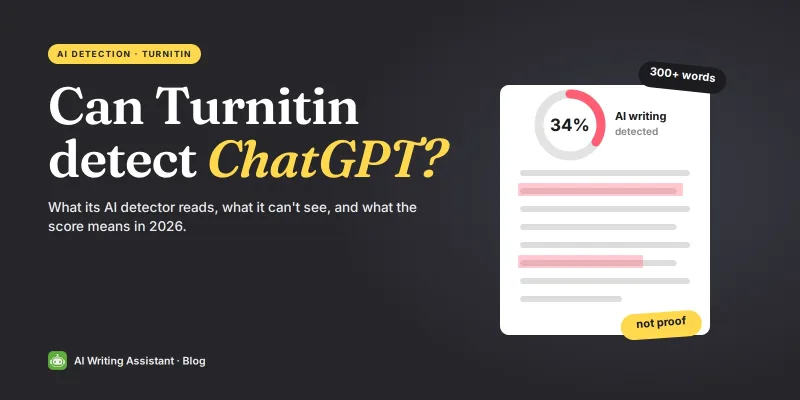
- Use a detector as one more input. Pick one that shows a range and the sentences behind the score. Our guide to AI detector accuracy shows why one score isn't enough.
- Check the rules. Many schools and workplaces allow AI for some tasks. The question is often whether it was disclosed.
If you're on the other side and your own drafts sound like this, our guide on how to humanize AI text walks through nine edits that fix most of these habits.
Frequently asked questions
What are the signs of AI writing?
Common signs are stock words like delve and tapestry, inflated importance, "not X but Y" constructions, ideas grouped in threes, vague "-ing" phrases, same-length sentences, summary endings, heavy em dash use, slide-deck formatting, brochure tone, a lack of specifics, and chat leftovers like "As of my last update".
How can you tell if something is written by AI?
Look for several signs together, especially vague claims with no names, numbers or dates. Then ask about the writing process. No single sign proves AI was used.
What words does AI use the most?
Research on 2024 scientific abstracts found big jumps in words like delves (28 times more than expected), underscores and showcasing. Others often listed include tapestry, testament, pivotal, intricate, foster and crucial.
Is using em dashes a sign of AI?
It can be one sign when it appears with others, but many human writers use em dashes heavily. On its own it means very little.
Can people tell AI writing from human writing?
Not reliably by instinct. A 2023 PNAS study found readers were right only 50 to 52% of the time. Frequent ChatGPT users did much better in a 2025 study.
Can AI detectors tell for sure?
No. Detectors estimate how AI-like a text reads and make mistakes both ways. Use them as one input, with drafts and a conversation.
 Grammar Checker
 Paraphraser
 Summarizer
 AI Writer
 AI Humanizer
 Text Compare