
A thesis statement is the most important sentence in your essay, and it's often the last one you get right. Teachers circle it, graders look for it first, and every paragraph after it has to earn its place by supporting it. The good news is that there's a method, and it works for almost any essay.
What is a thesis statement?
A thesis statement is a sentence, sometimes two, that states the main claim of your essay and how you'll support it. The UNC Writing Center calls it "a road map for the paper." the Harvard writing center calls it "the central claim in your essay." It usually comes at the end of your first paragraph, so the reader knows exactly what you're going to prove before the evidence starts.
How to write a thesis statement in 4 steps
1. Turn the prompt into a question
If your assignment says "Discuss the effects of remote work," rewrite it as a question you can answer. "Has remote work been good for employees?" Now you have something to take a side on.
2. Answer it in one sentence
Write a plain answer, even a rough one. "Remote work has been good for most employees." This is a working thesis. It doesn't need to be pretty yet.
3. Add "because"
Ask yourself why your answer is true and add the main reasons. "Remote work has been good for most employees because it cuts commuting time and gives them more control over their day." The "because" turns a claim into a plan for your body paragraphs.
4. Narrow it and test it
Now make it specific enough to prove in the space you have. "Most employees" and "good" are too vague. Who, exactly? Good how? "For office workers with long commutes, remote work has improved well-being because it returns hours of travel time each week and lets them schedule focused work." Then run it through the tests below.
Thesis statement formulas you can use
Formulas aren't a substitute for thinking, but they're a good way to get unstuck. Fill in the brackets, then rewrite it in your own words.
| Formula | Example |
|---|---|
| [Claim] because [reason 1] and [reason 2]. | Schools should start later because teenagers need more sleep and attendance improves when classes begin after 8:30. |
| Although [opposing view], [your claim] because [reason]. | Although electric cars cost more upfront, they're cheaper for most drivers over five years because fuel and repairs cost far less. |
| By [doing X], [subject] [shows/creates] [effect]. | By telling the story through a child's eyes, the novel shows how adults hide fear behind routine. |
| [Subject] is [characteristic], as shown by [A], [B] and [C]. | Lincoln was a careful political strategist, as shown by his cabinet choices, his timing on emancipation and his 1864 campaign. |
Thesis statement examples, weak and strong
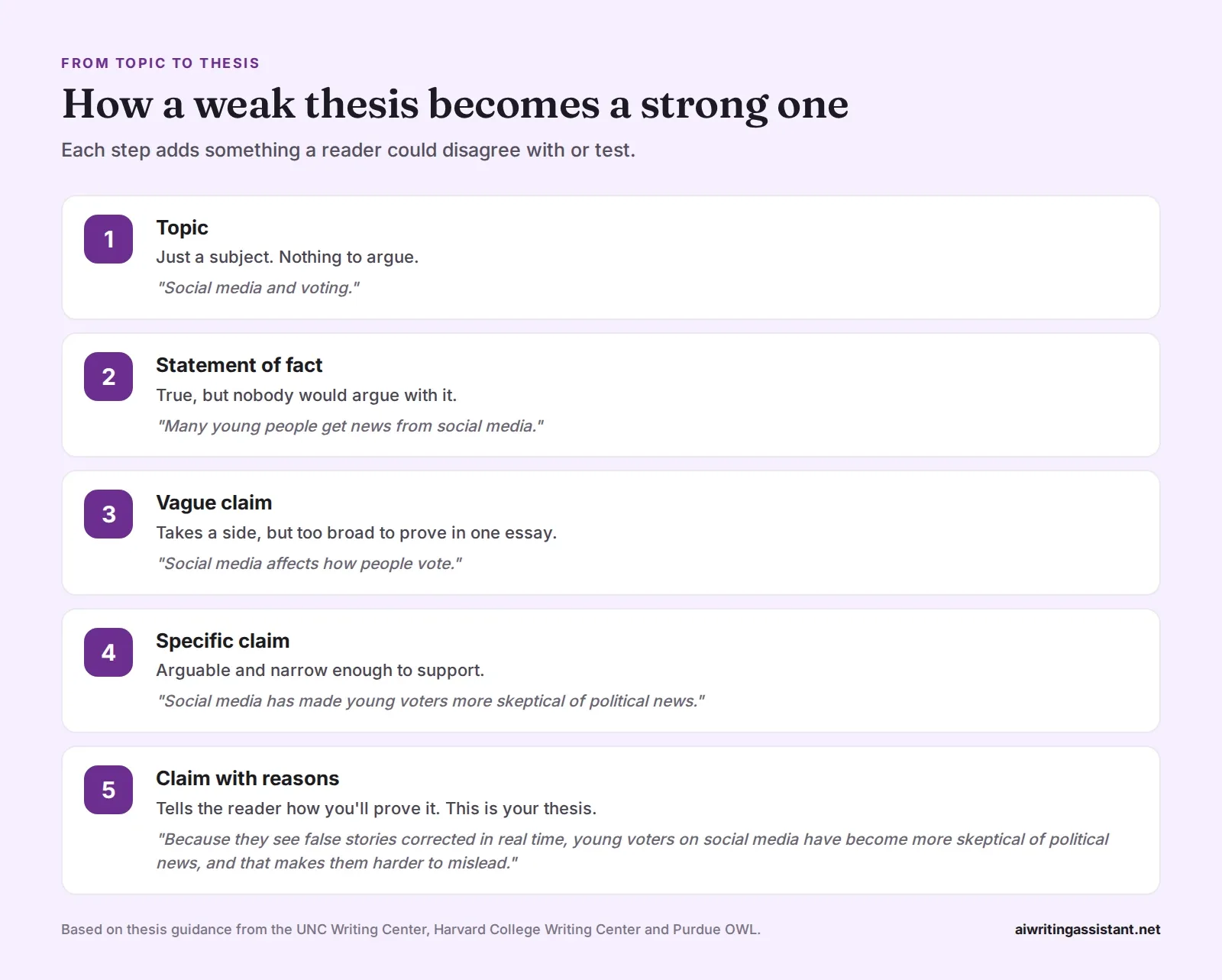
Here's how weak theses become strong ones across different kinds of essays.
| Essay type | Weak | Strong |
|---|---|---|
| Argumentative | Social media has positive and negative effects. | Social media should verify the ages of users under 16 because current self-reporting lets young children reach content their parents can't see. |
| Analytical | The Great Gatsby is about the American Dream. | In The Great Gatsby, Fitzgerald uses the green light to show that the American Dream depends on wanting something more than having it. |
| Expository | Photosynthesis is important. | Photosynthesis turns sunlight into chemical energy in two stages, and each stage happens in a different part of the chloroplast. |
| Compare and contrast | Cats and dogs are different pets. | Dogs suit owners who want an active routine, while cats suit people with long workdays, because the two animals need very different amounts of attention. |
The UNC Writing Center gives its own before-and-after. Weak: "Social media impacts public awareness in both positive and negative ways." Strong: "Because not every voice on social media is reliable, people have become much more critical consumers of information, and thus, more informed voters." The strong version picks a side and gives a reason.
How to test your thesis
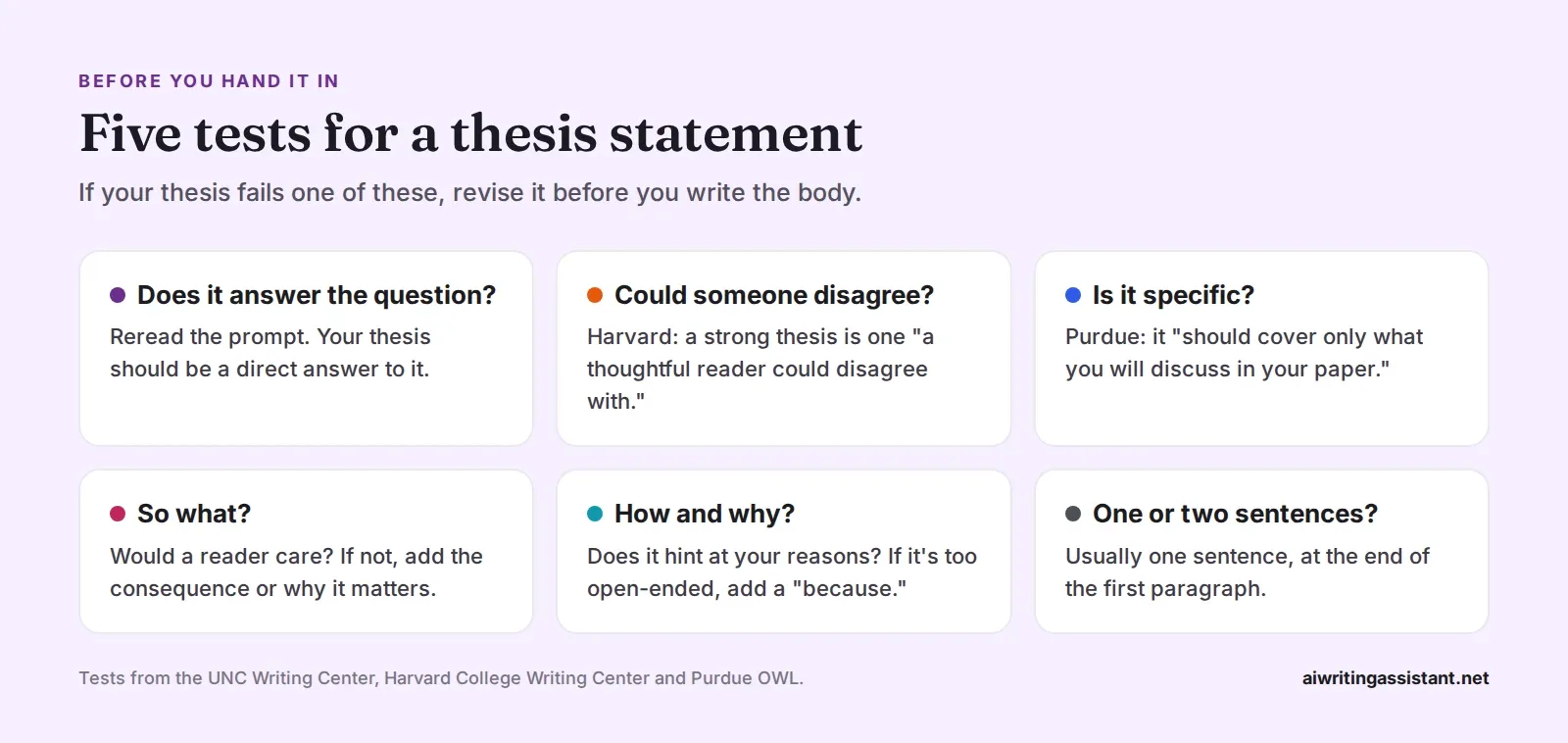
- Is it arguable? Purdue OWL says the thesis "must be something that people could reasonably have differing opinions on." A fact like "Pollution is bad" fails.
- Is it specific? "The narrower the thesis the more effective your argument will be," says Purdue. If you'd need a book to prove it, narrow it.
- Does it pass "so what?" UNC suggests asking why a reader should care. If you can't answer, add the consequence.
- Does it pass "how and why?" If a reader would immediately ask how or why, your thesis is too open. Add your reasons.
Where does the thesis go, and how long is it?
In most school essays, the thesis is the last sentence of the introduction. Purdue OWL says it "usually appears at the end of the first paragraph." It's usually one sentence. For a long research paper, two sentences are fine. If yours runs to three, it's probably trying to do too much.
Common thesis mistakes
- Announcing instead of arguing. "In this essay I will discuss..." tells the reader your topic, not your claim.
- Stating a fact. If everyone agrees with it, there's nothing to prove.
- Being too broad. "Technology has changed the world" could take a library to support.
- Listing too many reasons. Two or three is plenty. Each one becomes a body section.
- Never revising it. Your argument often changes as you write. Go back and update the thesis to match what you actually proved.
Once your thesis is set, the rest of the essay gets easier. Our guide to transition words helps connect each body paragraph back to it.
Frequently asked questions
What is a thesis statement?
It's the sentence, or two, that states the main claim of your essay and how you'll support it. It usually comes at the end of the introduction.
How do you write a thesis statement?
Turn the prompt into a question, answer it in one sentence, add "because" with your main reasons, then narrow it until it's specific and arguable.
How long should a thesis statement be?
Usually one sentence. Two is fine for longer papers. If it needs three, it's probably too broad.
Where does the thesis statement go?
Most often at the end of the first paragraph, so the reader knows your claim before the evidence starts.
What makes a thesis statement strong?
It answers the question, takes a position someone could disagree with, is specific enough to prove, and hints at your reasons.
Can a thesis statement be a question?
No. A question can lead into it, but the thesis itself should be your answer.
Can I change my thesis after writing the essay?
Yes, and you usually should. Revise it to match the argument your body paragraphs actually make.
 Grammar Checker
 Paraphraser
 Summarizer
 AI Writer
 AI Humanizer
 Text Compare