
An outline is the cheapest place to fix an essay. Moving a heading takes a second, while moving three paragraphs in a finished draft can take an evening. This guide covers the main outline formats, the two rules that keep an outline tidy, a complete sample, and a revision trick called reverse outlining.
How do you write an outline?
Start with your thesis or main purpose. List every idea you might include, then group related ideas into a few main points and put them in a logical order. Under each main point, add subpoints and the evidence or examples that support them. Label the levels with Roman numerals, capital letters, numbers and lowercase letters, and check that every divided point has at least two parts and that headings at the same level are worded the same way.
What is an outline?
The Indiana University Writing Tutorial Services guide calls an outline "a kind of graphic scheme of the organization of your paper." It shows the main points, how they relate to each other, and which details belong where. You can see at a glance whether a section is thin, whether two points overlap, or whether the order makes sense.
Outlines aren't only for essays. They work for research papers, speeches, reports and long emails. Some teachers ask you to hand one in, and in that case follow their format exactly.
Types of outlines
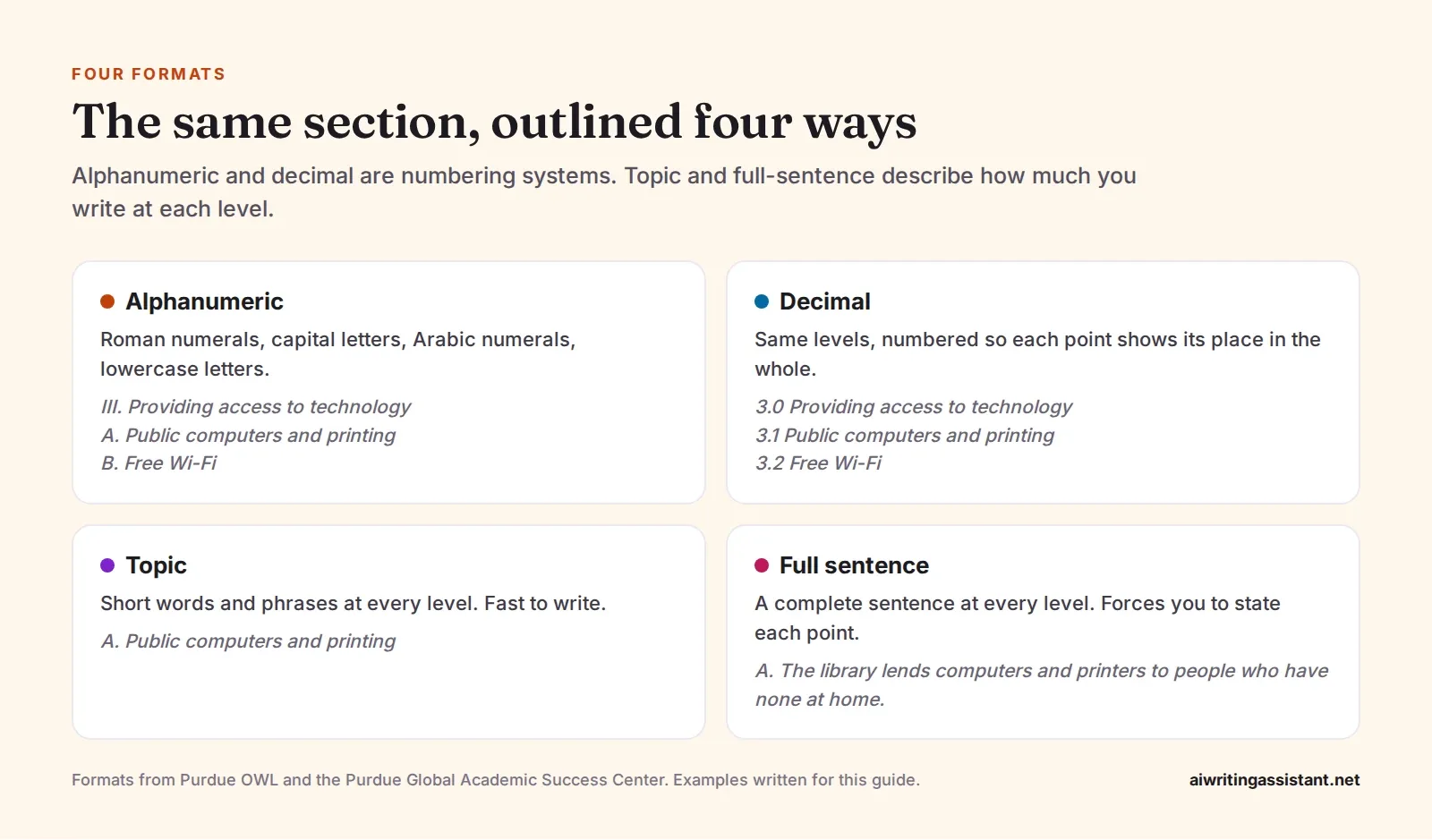
There are two separate choices to make. The first is the numbering system, alphanumeric or decimal. The second is how much you write at each level, topic phrases or full sentences.
| Type | What it looks like | Good for |
|---|---|---|
| Alphanumeric | I., A., 1., a., (1), (a) | Most essays and school assignments |
| Decimal | 1.0, 1.1, 1.1.1 | Scientific papers, or any plan where you want to see how each point fits the whole |
| Topic | Short words and phrases at each level | Early planning and fast organizing |
| Full sentence | A complete sentence at every level | Detailed plans and assignments that require it |
Alphanumeric outline
The Purdue OWL types of outlines page lists the order as Roman numerals, capitalized letters, Arabic numerals and lowercase letters. Indiana extends it with (1) and (a) for deeper levels. The Purdue Global Academic Success Center says this alphanumeric outline "is the most common type."
Decimal outline
Purdue OWL says the decimal outline is "similar in format to the alphanumeric outline," but its numbering shows how each level relates to the whole. Point 2.3.1 sits under 2.3, which sits under 2.0. Indiana notes that in scientific papers "a decimal system is also commonly used."
Topic outline vs full-sentence outline
Purdue Global describes a topic outline as headings formed "with words and phrases rather than complete sentences." A full-sentence outline uses a complete sentence for every point. The University of Minnesota Crookston Writing Center explains the tradeoff. A topic outline helps you organize "quickly without going into details," while a sentence outline helps you "crystallize ideas" by stating each paragraph's point.
A practical approach is to start with a topic outline, then turn it into full sentences once the order is settled. Those sentences often become your topic sentences.
How to write an outline, step by step
- Check the assignment. Note the length, the format your teacher wants, and whether the outline is graded.
- Write a working thesis. One or two sentences on what the paper will argue or explain. Our guide on writing a thesis statement can help.
- Brainstorm. List every idea, fact and example you might use, in any order.
- Group ideas into main points. These become your Roman numerals. A five-paragraph essay has three, one for each body paragraph, and longer papers have more.
- Put the main points in order. Try chronological, most to least important, simple to complex, or problem then solution.
- Add subpoints and evidence. Under each main point, list the reasons, examples and sources that support it.
- Check the two rules. Every divided point has at least two subpoints, and headings at the same level are parallel.
- Decide on the level of detail. Keep it as a topic outline or expand it into full sentences.
If you're stuck at the blank page, the free Outline Generator builds a first structure from your topic that you can reorder and fill with your own points.
The division rule and parallel structure
If you have an A, you need a B
Indiana states the division rule plainly. "Whenever a point is subdivided, there are at least two subpoints." Purdue Global says the same about every level. If there is an I there should be a II, and if there is an A there should be a B. The logic is simple. You can't divide something into one part.
| Breaks the rule | Fixed |
|---|---|
| II. Lending books and media A. Print books for all ages | II. Lending books and media A. Print books for all ages B. Audiobooks and films |
| III. Providing access to technology A. Free Wi-Fi | III. Providing free Wi-Fi (merge the single subpoint into the heading) |
As the second row shows, there are two fixes. Add a second subpoint, or fold the lone subpoint into its heading.
Keep headings parallel
Indiana says that in topic outlines, ideas should appear "in the same grammatical form." If one main point starts with a verb ending in -ing, the others at that level should too. The same goes for noun phrases. If II is a noun phrase, III and IV should be noun phrases too.
| Not parallel | Parallel |
|---|---|
| II. Lending books III. Access to technology IV. Libraries are good places to meet | II. Lending books and media III. Providing access to technology IV. Offering shared public space |
Sample essay outline
Here's a complete outline for a short informative essay about public libraries, in alphanumeric topic format. Notice that every divided point has at least two parts and that the main points II to IV all start with the same kind of word.
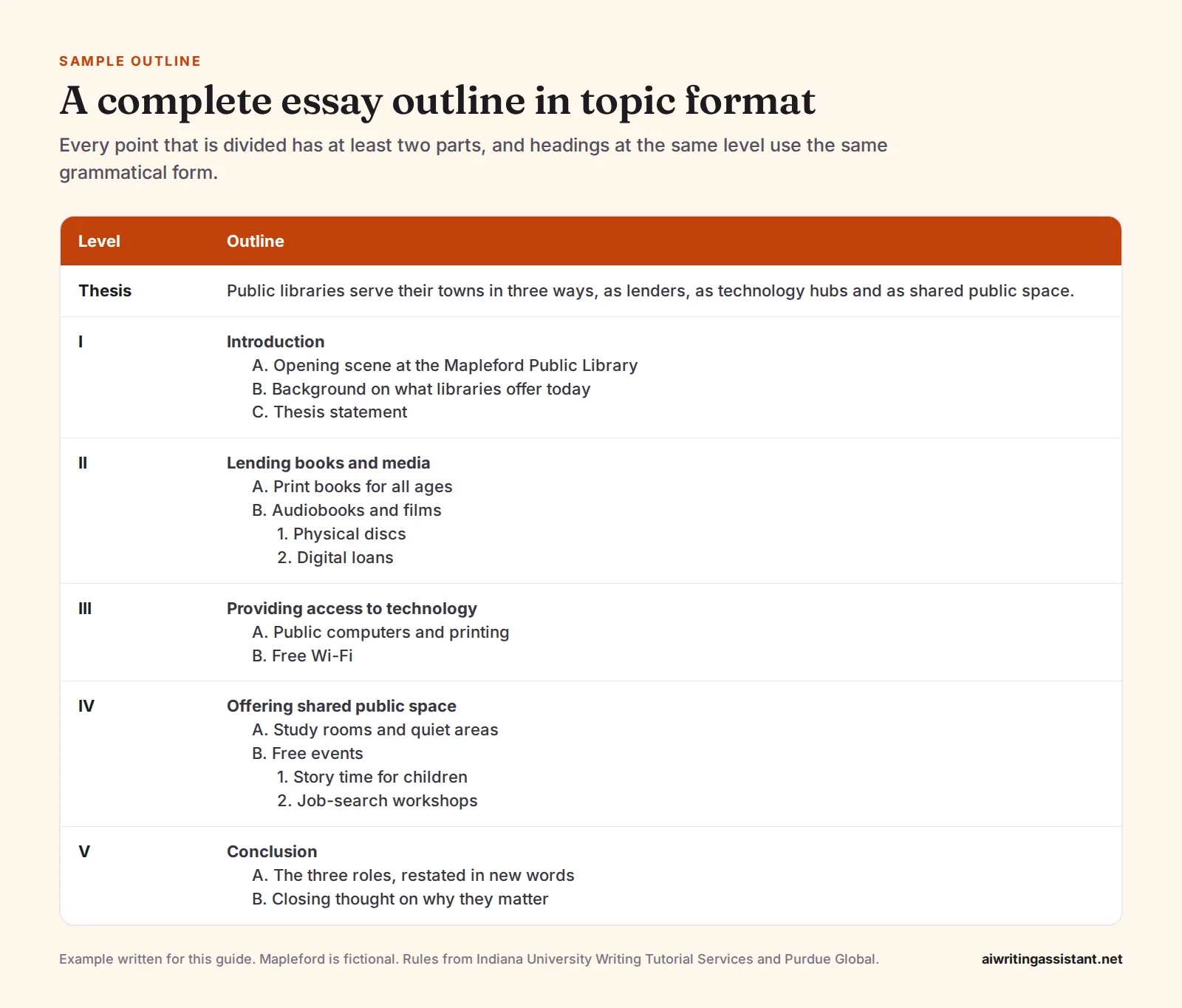
To turn this into a full-sentence outline, rewrite each line as a claim. "B. Free Wi-Fi" might become "B. Free Wi-Fi lets residents apply for jobs and do homework without a home connection."
Reverse outlining: outline after you draft
A reverse outline works backward. The Brandeis University Writing Program describes it as "a process whereby you take away the supporting writing," leaving only the main points. It's one of the fastest ways to find structural problems in a finished draft.
- Open a new document or take a blank page.
- Read each paragraph and write down its main idea in a few words. Work through the whole paper.
- Number the list.
- Revise, expanding or condensing for concision and clarity.
Frequently asked questions
What order do outline symbols go in?
I., A., 1., a., then (1) and (a), according to Indiana University Writing Tutorial Services.
If I have an A, do I need a B?
Yes. Every point you divide needs at least two subpoints. Otherwise, fold the single subpoint into its heading.
What is a decimal outline?
An outline with the same levels as an alphanumeric one, numbered 1.0, 1.1, 1.1.1 and so on. It's common in scientific papers.
Should I write a topic outline or a sentence outline?
Topic outlines are faster for organizing. Sentence outlines make you state each point clearly, so many writers start with topics and expand later.
What is a reverse outline?
An outline made after drafting, listing the main idea of each paragraph to check structure and focus.
Do outline headings need parallel structure?
Yes. Headings at the same level should use the same grammatical form.
How many main points should an outline have?
It depends on the length of the paper. A five-paragraph essay has three body points, and longer papers need more.

 Grammar Checker
 Paraphraser
 Summarizer
 AI Writer
 AI Humanizer
 Text Compare