
Comparison is one of the most common college assignments, and one of the easiest to do badly. The typical weak draft spends three paragraphs on one subject, three on the other, and ends with "As you can see, they have similarities and differences."
This guide shows how to plan, choose a structure, and write a thesis that gives the comparison a point.
How do you write a compare and contrast essay?
Choose two subjects with enough in common to compare, then list their similarities and differences in a chart. Pick the two to four points that matter most and write a thesis that argues what the comparison reveals. Organize the body either by subject, discussing one subject fully and then the other, or point by point, comparing both subjects on each point in turn. Finish with a conclusion that explains why the comparison matters.
What is a compare and contrast essay?
The UNC Writing Center explains it simply. You discuss how things are "similar to (this is the comparison) and/or different from (this is the contrast)" one another. Notice the "and/or." Some assignments want both, and others focus on one side. UNC suggests looking for cue words such as "compare, contrast, similarities, and differences" in the prompt.
At a deeper level, a comparison is an argument. The Harvard Gen Ed writing guide says comparative essays "make an argument about the relationship between two or more texts" or subjects.
Step-by-step
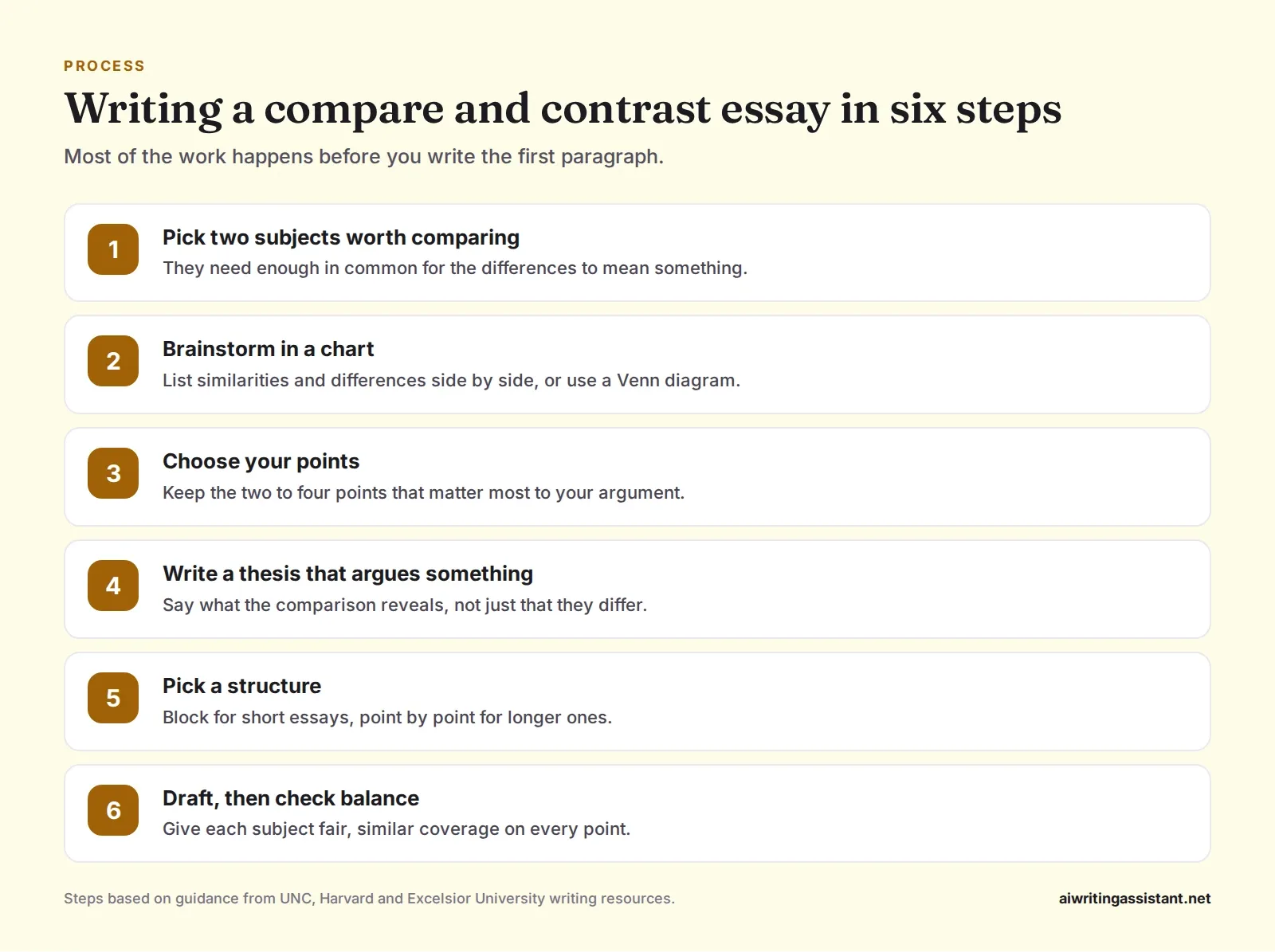
1. Choose subjects that belong together
The subjects need a shared category so the differences mean something. Two poems on the same theme, two approaches to the same problem, or two historical leaders facing similar crises all work. The Excelsior University writing lab uses online versus in-person classes as an example of a pair with enough in common.
2. Brainstorm in a chart
UNC suggests that "Making a Venn diagram or a chart can help" you sort ideas. A simple chart works well.
| Point | Online classes | In-person classes |
|---|---|---|
| Cost | Often lower, no commuting | Tuition plus travel and housing |
| Flexibility | Study any time, from anywhere | Fixed times and places |
| Interaction | Mostly written, often delayed | Immediate, face to face |
| Self-discipline needed | High | Moderate, schedule provides structure |
3. Write a thesis that argues something
UNC warns against theses like "Thing A and Thing B are similar in many ways but different in others." That's true of almost any two things. A strong thesis says what the comparison reveals.
| Weak thesis | Stronger thesis |
|---|---|
| Online and in-person classes have advantages and disadvantages. | Online classes beat in-person ones on cost and flexibility, but they fall short for students who rely on immediate feedback to stay motivated. |
| The two poems are both about death but are different. | Both poems treat death calmly, but one sees it as an ending and the other as a journey, and that difference shapes every image. |
Our guide on writing a thesis statement has more tests you can apply.
Block vs point-by-point structure
There are two main ways to organize the body, according to UNC and Boston University.
- Block (subject by subject). Discuss everything about subject A, then everything about subject B. UNC cautions that this can turn your paper into "a list of points" if you don't connect the halves.
- Point by point. Take each point in turn and discuss both subjects together. This keeps the comparison front and center.
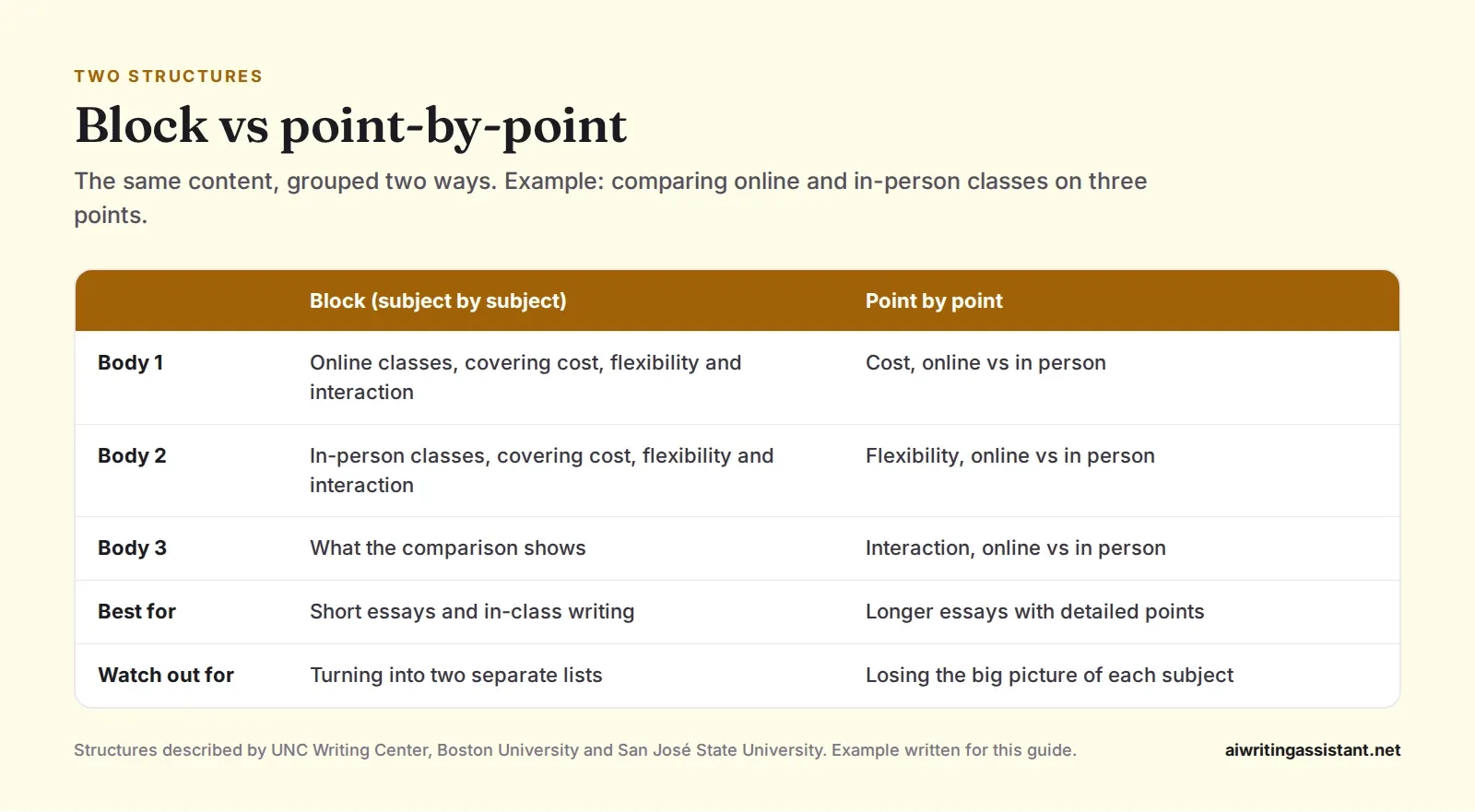
Which one should you use? The San José State University Writing Center says block is "most effective when used on short essays, such as in-class papers," and point by point is "most effective when used on longer essays." Excelsior also describes a mixed approach, alternating on some points and then using blocks for the ones that need depth.
Compare and contrast essay outline
Point-by-point outline
- Introduction. Hook, introduce both subjects, thesis.
- Point 1. How subject A and subject B compare on the first point.
- Point 2. Both subjects on the second point.
- Point 3. Both subjects on the third point.
- Conclusion. What the comparison shows and why it matters.
Block outline
- Introduction. Hook, introduce both subjects, thesis.
- Subject A. Points 1, 2 and 3.
- Subject B. Points 1, 2 and 3, in the same order, with clear references back to subject A.
- Conclusion. Bring the two together and explain what the comparison reveals.
Transitions that help
Comparison essays lean on transitions more than most. A few reliable ones are listed below. For a longer list, see our guide to transition words.
| To show similarity | To show difference |
|---|---|
| similarly, likewise, in the same way, both | however, in contrast, on the other hand, whereas |
| just as, equally, also, like | unlike, while, but, instead |
Mistakes to avoid
- A thesis that only says they're similar and different. Argue what the comparison shows.
- Unequal coverage. If subject A gets three paragraphs and subject B gets one, readers notice.
- Points that don't match. In block structure, discuss the same points in the same order for both subjects.
- Only listing facts. Explain why each similarity or difference matters.
- A conclusion that repeats the introduction. End with the insight the comparison earned.
Need a skeleton to start from? The free Outline Generator builds a structure you can fill with your own points.
Frequently asked questions
What are the two ways to organize a compare and contrast essay?
Block, also called subject by subject, and point by point. Some writers combine the two.
Which structure is better?
Block often works for short essays, and point by point for longer ones, according to the San José State University Writing Center.
What makes a good compare and contrast thesis?
One that argues what the comparison reveals, rather than just saying the subjects are similar and different.
How many paragraphs is a compare and contrast essay?
There's no fixed number. A short essay might have five paragraphs, while longer essays use one paragraph or section per point.
Do I have to cover both similarities and differences?
Not always. Check the assignment, since some prompts ask only for similarities or only for differences.
How do I brainstorm a compare and contrast essay?
Use a Venn diagram or a two-column chart to list similarities and differences, then keep the points that matter most.
Can I compare more than two things?
Yes, but it gets harder to keep balanced. Point by point often works better for three or more subjects.
 Grammar Checker
 Paraphraser
 Summarizer
 AI Writer
 AI Humanizer
 Text Compare