
Paragraphs are the unit readers actually think in. They skim the first line, decide whether the point is worth their time, and either read on or jump ahead. A well-built paragraph makes that decision easy.
This guide covers the structure, two models teachers use, a worked example, and how long a paragraph should be.
How do you write a paragraph?
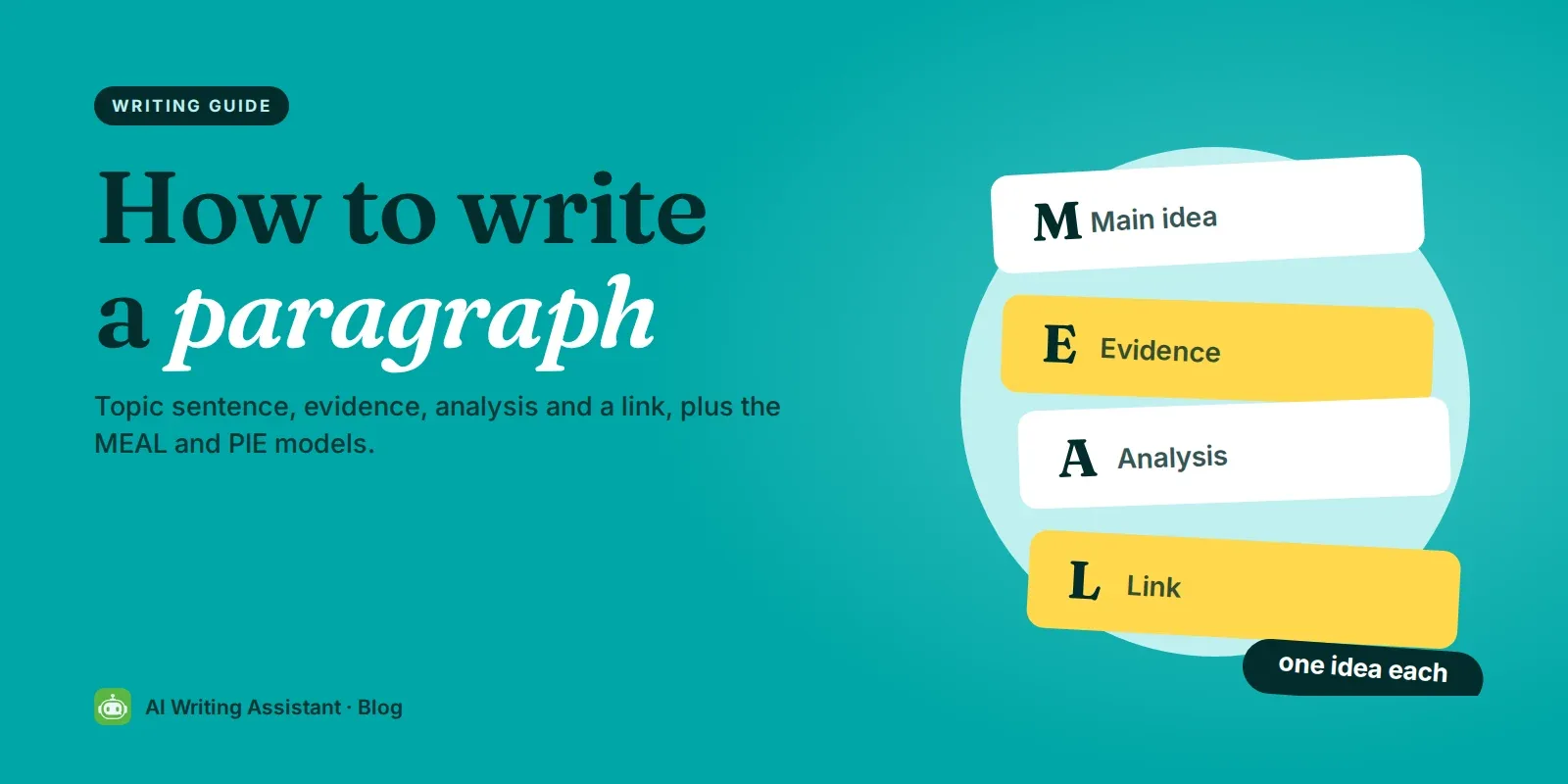
Begin with a topic sentence that states the paragraph's main idea. Follow it with evidence, such as a fact, example or quotation. Then explain how that evidence supports the idea, because the explanation is what turns information into an argument. Finish with a sentence that links back to your larger point or leads into the next paragraph. Keep everything in the paragraph about that one idea.
What makes a paragraph a paragraph?
It isn't length. The UNC Writing Center says that "the unity and coherence of ideas among sentences is what constitutes a paragraph." It also notes that length and appearance do not determine whether a section counts as a paragraph.
That's the single most useful rule. One paragraph, one idea. The Purdue OWL makes the same point and warns that very short paragraphs are often underdeveloped.
The four parts of a strong paragraph
1. Topic sentence
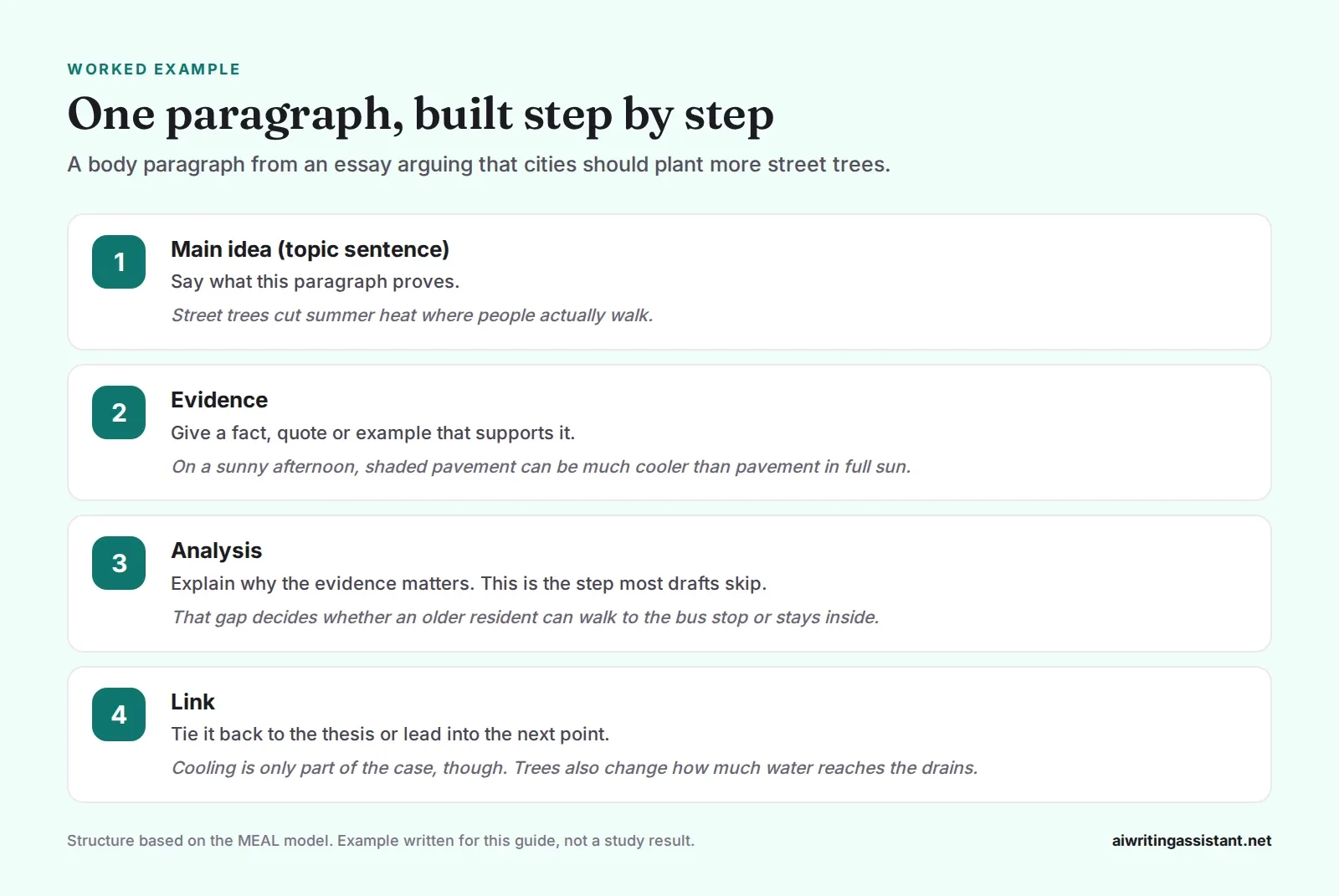
The topic sentence tells the reader what the paragraph is about and what you're claiming. The Indiana University Writing Tutorial Services guide says it's often best to put the topic sentence at the very beginning. Readers who skim will get your point even if they read nothing else.
A good topic sentence is a small claim, not just a topic. "Street trees" is a topic. "Street trees cut summer heat where people actually walk" is a claim the paragraph can prove.
2. Evidence
Next, give the reader a reason to believe you. In an essay this might be a quotation from a text, a statistic, an example or a result. In an email or report it might be a number, a date or a short story from your own work.
3. Analysis
This is where most first drafts fall short. After the evidence, explain what it means and why it supports your idea. The Bristol Community College PIE handout calls this the Explanation and frames it as answering "so what?" If you deleted your analysis sentences, would the paragraph still make your point? If yes, they're probably too thin.
4. Link or transition
End by connecting the paragraph to your thesis or to the next idea. In the Duke Writing Studio version of MEAL, the L stands for "Link back to the larger claim." A sentence like this keeps a long essay from feeling like a list of separate points. Our guide to transition words has options for every kind of link.
MEAL vs PIE: which paragraph model should you use?
They describe the same thing. MEAL has four parts and PIE has three, since PIE has no separate link step. The Texas Tech writing center adds that the main idea can take one or two sentences.
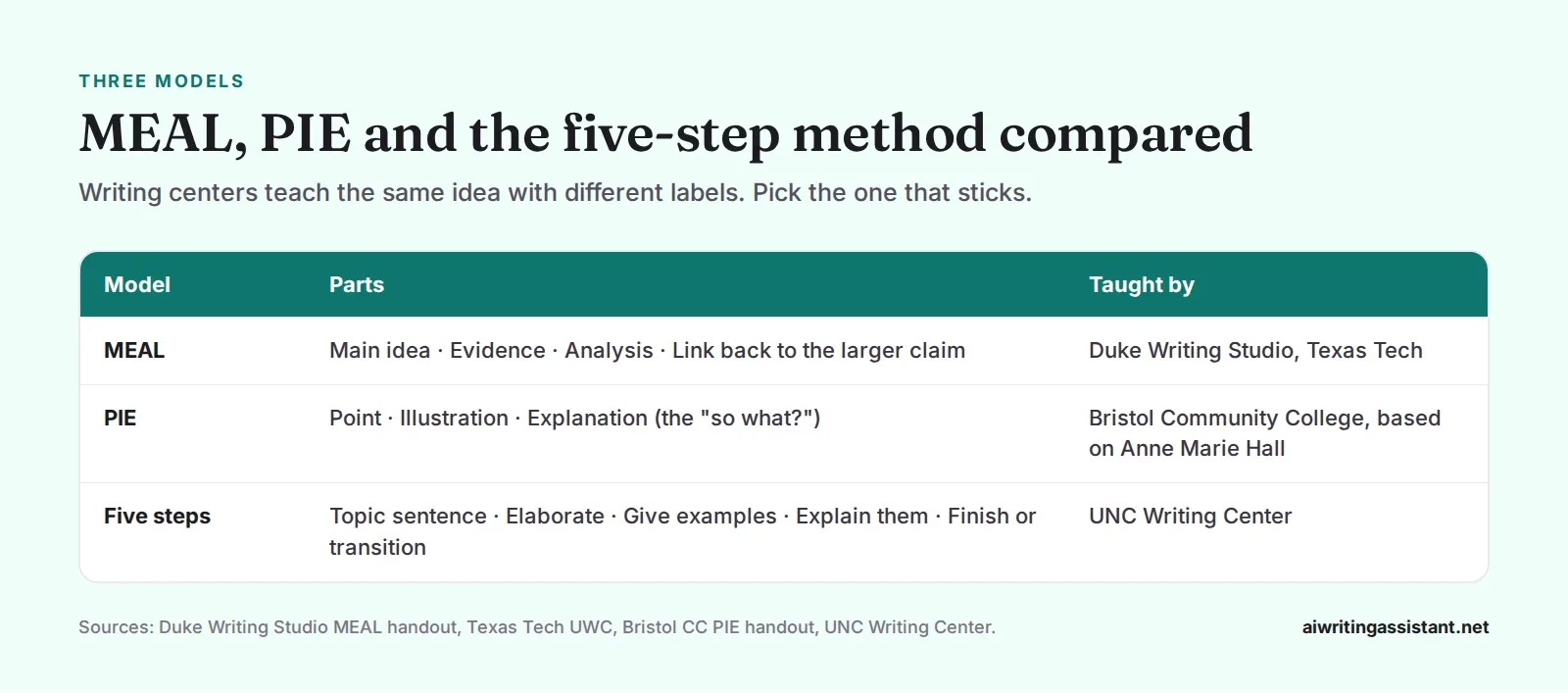
Use whichever your teacher uses. If you're choosing for yourself, MEAL is easier to check because each letter is one job.
Paragraph example
Here's the finished paragraph from the steps above, written out in full.
Street trees cut summer heat where people actually walk. On a sunny afternoon, shaded pavement can be much cooler than pavement in full sun. That gap decides whether an older resident can walk to the bus stop or stays inside, which makes tree cover a public health question as much as a design one. Cooling is only part of the case, though. Trees also change how much rain reaches the drains.
How long should a paragraph be?
There's no required number of sentences. UNC lists the idea that every paragraph needs five sentences among common student misconceptions. In our experience, many academic paragraphs land around four to eight sentences, because that's roughly how long it takes to state, support and explain one point.
Very short paragraphs are a warning sign in essays. Indiana University says a paragraph that is "very short (only one or two sentences, perhaps)" may be underdeveloped. On the web and in emails, shorter paragraphs are normal because people read on phones.
| Type of writing | Rough guide (our suggestion) | Why |
|---|---|---|
| Academic essay | About 4 to 8 sentences | Each point needs evidence and analysis |
| Blog post or article | 2 to 4 sentences | Readers skim on small screens |
| 1 to 3 sentences | Each paragraph should be one ask or one update | |
| News story | 1 to 2 sentences | Newspaper columns are narrow |
Want to check? Our free Word Counter shows the number of sentences and paragraphs in your draft.
When to start a new paragraph
- You move to a new main idea or a new reason.
- You switch from one side of an argument to the other.
- You change time or place in a story.
- A new person starts speaking in dialogue.
- The paragraph has grown so long that the main idea is getting lost.
Common paragraph problems and fixes
| Problem | Fix |
|---|---|
| No topic sentence | Write one sentence that says what the paragraph proves, and move it to the front. |
| Two ideas in one paragraph | Split it. Each half usually needs its own evidence anyway. |
| Evidence with no explanation | Add one or two sentences that answer "so what?" |
| Ends abruptly | Add a link back to the thesis or a bridge to the next paragraph. |
| Every sentence starts the same way | Vary the openings. See our list of sentence starters. |
Need a starting point? The free Paragraph Generator drafts a paragraph on any topic for you to rework. Check your course rules before using AI-written text in schoolwork.
Frequently asked questions
What are the parts of a paragraph?
A topic sentence, supporting evidence, analysis that explains the evidence, and a closing or linking sentence.
How many sentences are in a paragraph?
There's no fixed number. Unity matters more than length, though many academic paragraphs land around four to eight sentences.
What is the MEAL paragraph structure?
Main idea, Evidence, Analysis and Link back to the larger claim, as taught in the Duke Writing Studio handout.
What is a PIE paragraph?
Point, Illustration and Explanation. The explanation answers "so what?" about the evidence.
Where should the topic sentence go?
Usually at the very beginning, so readers know the point right away.
Is a one-sentence paragraph wrong?
Not always. It can work for emphasis or online, but in an essay it usually means the idea needs more support.
When should I start a new paragraph?
When you start a new main idea, switch sides in an argument, change scene, or start new dialogue.
 Grammar Checker
 Paraphraser
 Summarizer
 AI Writer
 AI Humanizer
 Text Compare