
The first paragraph of an essay is the one you rewrite the most. It's also the one your reader judges fastest. The good news is that a solid introduction follows a pattern you can learn in an afternoon, and it doesn't need a clever opening line to work.
Below is the structure, a worked example, a few ways to open, and the habits that make teachers groan.
How do you write an introduction paragraph?
Start with something specific that leads into your topic, such as an example, a short scene, a fact or a question. Then give the reader one or two sentences of context so they know what's at stake. End the paragraph with your thesis, the one-sentence claim the rest of the essay will prove. Keep it to about a tenth of your word count, and write or revise it after the body, when you know exactly what you're arguing.
What an introduction has to do
The UNC Writing Center calls the introduction "an important road map for the rest of your paper." In practice that means three things. The reader should know what the essay is about, why it's worth reading, and what you're going to argue.
In most academic essays the third part is your thesis. UNC says it usually appears near the start of the paper, "most often, at the end of the first paragraph." Readers expect it there, so putting it there makes their job easier.
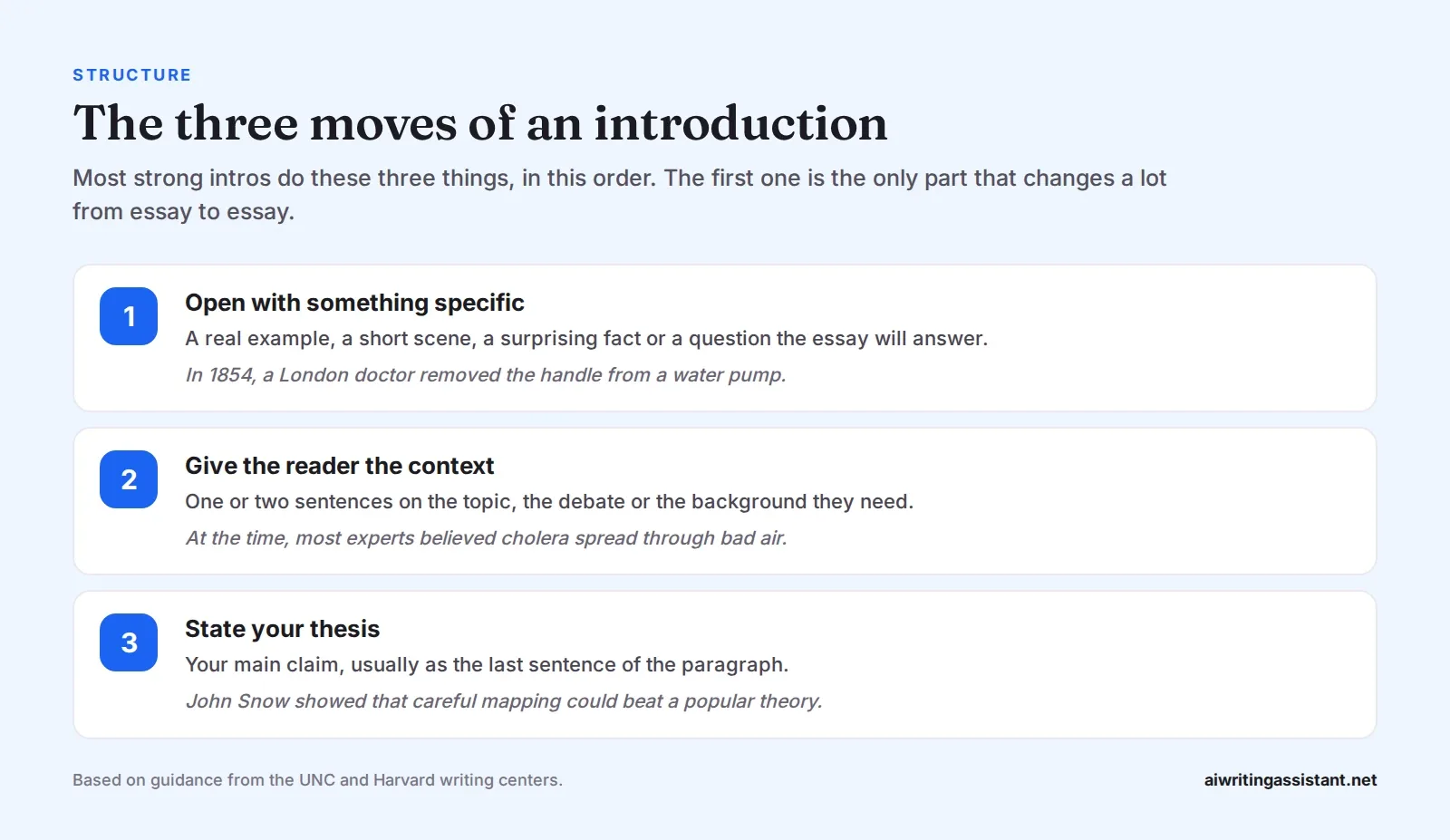
Step 1: Open with something specific
UNC suggests a few reliable ways in. You can use an intriguing example, a provocative quotation, a puzzling scenario or a thought-provoking question. All four share one quality. They're concrete, so the reader has something to picture straight away.
You don't need fireworks. The Harvard College Writing Center guide on introductions says plainly that you don't have to hook readers with a dramatic promise. What matters more is showing why the question you're asking is interesting. If you want more options for that first line, our guide to writing a hook has seven kinds with examples.
Step 2: Give the context
Next, bring the reader up to speed. This might be a sentence on the debate you're joining, the text you're analyzing or the problem you're solving. Keep it short. Background that runs for a whole paragraph belongs in the body.
Step 3: State your thesis
Finish with the claim. A good thesis is specific enough that someone could disagree with it. "Social media affects teenagers" is too broad to argue. "Removing like counts would reduce the pressure teenagers feel to post" gives the essay a job. Our thesis statement guide walks through tests you can run on yours.
Introduction paragraph example
Here's a short introduction for a history essay, with each move labeled.
| Move | Sentence |
|---|---|
| Specific opening | In September 1854, a London doctor persuaded local officials to remove the handle from a water pump on Broad Street. |
| Context | Most experts at the time believed cholera spread through foul air, and few took a map of deaths seriously as evidence. |
| Thesis | John Snow's investigation shows how careful data collection can overturn a popular theory, even before anyone can explain why the data looks the way it does. |
Notice what isn't there. There's no "Since the dawn of time," no dictionary definition, and no list of every point the essay will cover. Each sentence moves the reader one step closer to the claim.
How long should an introduction be?
There's no fixed sentence count. Several university guides use about 10% of the total as a rule of thumb. Swansea University suggests aiming for an introduction of around 10% of your word count, and the University of Derby gives the same figure while calling it "not a precise rule."
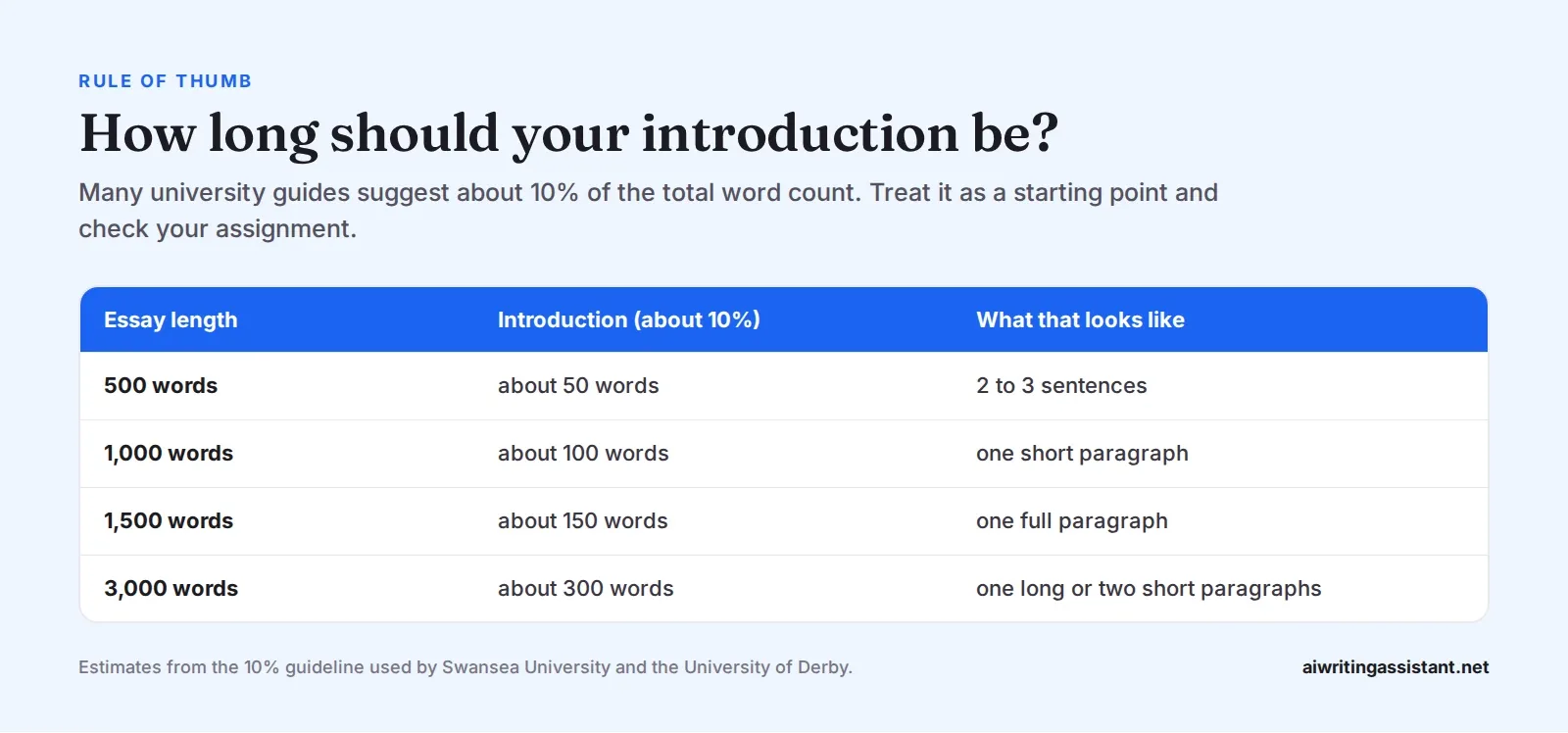
Longer papers can take more room. Harvard notes that in some courses it may be acceptable to write a two-paragraph or longer introduction. If you're not sure, check the assignment or ask.
Want to see where your draft stands? Paste it into our Word Counter and compare the intro to the total.
Should you write the introduction first or last?
The UNC advice is short. "Try writing your introduction last." It sounds backwards, but it saves time. Your argument often sharpens while you write the body, and an introduction written first ends up promising an essay you didn't write.
A practical middle ground is to write a rough working thesis first, draft the body, then come back and build the real introduction around the thesis you ended up proving.
Common mistakes in introductions
- Starting too broad. "Throughout history, people have..." tells the reader nothing. Both UNC and Harvard warn against openers like this.
- Opening with a dictionary definition. UNC points out that anyone can look a word up, and Harvard advises against it too.
- Hiding the thesis. If the claim is in the middle of the paragraph or the second page, readers may miss it.
- Announcing instead of arguing. "In this essay I will discuss..." describes the essay without saying anything. Replace it with the claim itself.
- Copying the conclusion. The intro and conclusion shouldn't repeat each other word for word. See our guide on how to write a conclusion for how they differ.
A quick checklist before you hand it in
- Does the first sentence say something specific?
- Would a reader know the topic and why it matters after three sentences?
- Is your thesis the last sentence, and could someone disagree with it?
- Is the paragraph roughly a tenth of the total length?
- Does it match what the body actually argues?
Stuck on a first draft? Our free Paragraph Generator can give you a rough version to react to. Rewrite it in your own words before you use it, and check your course rules on AI help.
Frequently asked questions
How do you start an introduction paragraph?
Start with something specific, such as an example, a short scenario, a quotation or a question, then lead into your topic and end with your thesis.
How long should an introduction paragraph be?
A common guide is about 10% of the total word count, so around 100 words for a 1,000-word essay. Longer papers can have longer introductions.
Where does the thesis go in an introduction?
Usually at the end of the first paragraph. That's where readers expect it.
Do I need a hook in my introduction?
Not necessarily. The Harvard College Writing Center says you don't need a dramatic hook. Explaining why your question matters works just as well.
Should I write the introduction first?
Many writers draft it last, once they know their argument. You can start with a working thesis and rewrite the intro at the end.
Can I start an essay with a dictionary definition?
It's best avoided. Writing centers at UNC and Harvard both advise against it because it rarely tells the reader anything new.
What should not be in an introduction?
Avoid sweeping openers like "Since the dawn of time," long background that belongs in the body, and a list announcing every point you'll make.
 Grammar Checker
 Paraphraser
 Summarizer
 AI Writer
 AI Humanizer
 Text Compare