
Readers decide fast whether to keep going. On the web, Nielsen Norman Group found that people have time to read at most about 28% of the words on a page, and their eye-tracking shows the first lines get the most attention. In an essay, your teacher has to read on. But even a grader forms an impression in the first two sentences. That's what a hook is for.
What is a hook in writing?
A hook is the opening sentence, or two, of an essay, article or speech. Its job is to catch the reader's interest and lead them toward your main point. Common hooks are a question, a surprising fact, a short anecdote, a vivid scene, a bold claim, a quotation or a contradiction. The best hooks are specific and connect directly to your thesis, so the reader feels pulled forward rather than distracted.
How to write a hook in 4 steps
- Know your point first. Write your thesis statement before your hook. A hook has to point somewhere.
- Know your reader. A college admissions reader wants you. A science teacher wants a clear question. A blog reader wants to know what's in it for them.
- Pick a type that fits. A personal essay suits a story or scene. An argument suits a bold claim, a statistic or a contradiction.
- Connect it to the thesis. In the next sentence or two, show how the hook leads into your point. The UNC Writing Center suggests you "try writing your introduction last," once you know where the essay ends up.
7 types of hooks, with examples
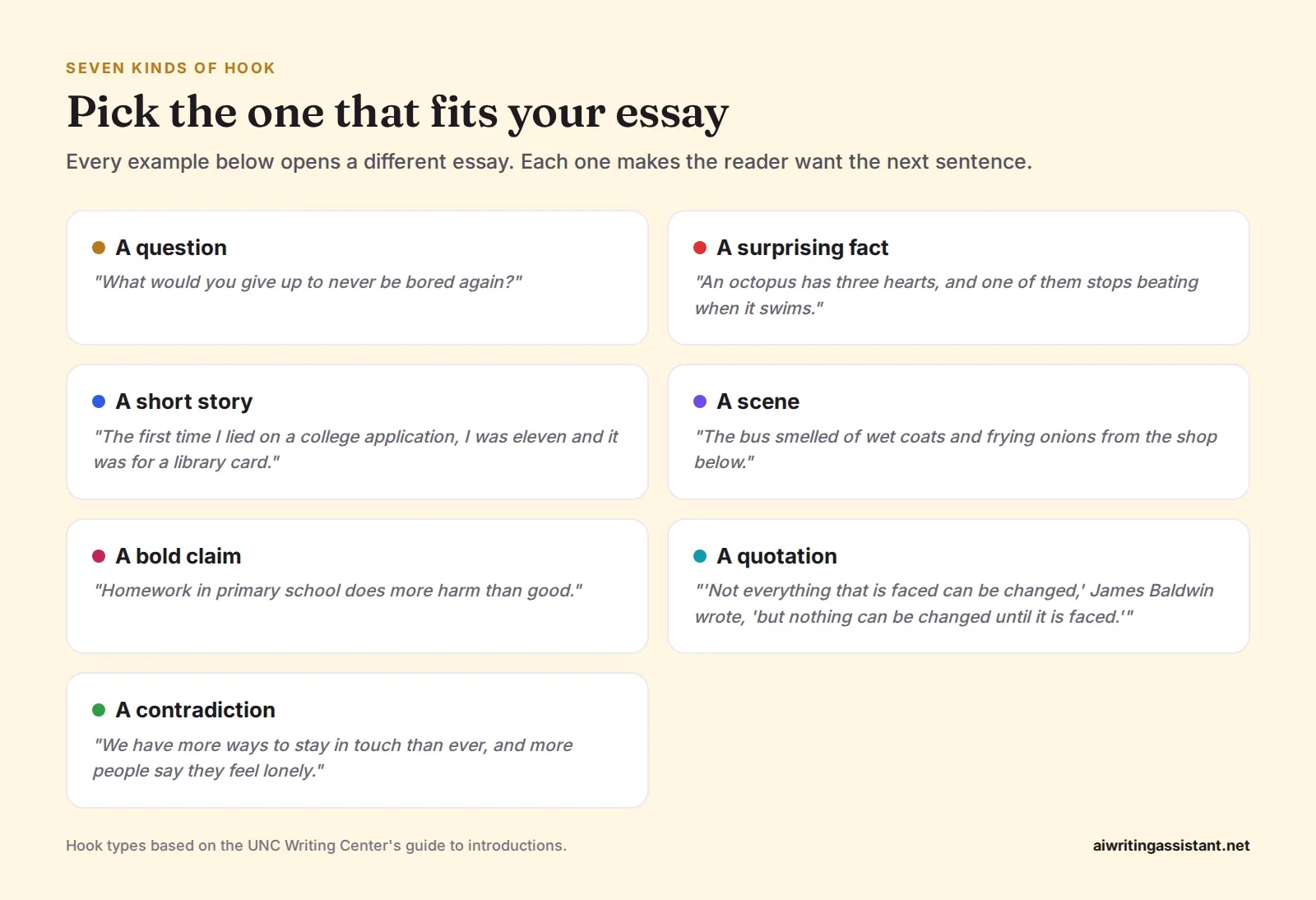
UNC's guide to introductions lists "an intriguing example," "a provocative quotation," "a puzzling scenario," "a vivid and perhaps unexpected anecdote," and "a thought-provoking question." Here are seven, with what each is good for.
1. A question
Ask something the reader actually wants answered, then answer it in your essay. Avoid yes/no questions with obvious answers. "Have you ever been tired?" invites a shrug. "What would you give up to never be bored again?" invites thought.
2. A surprising fact or statistic
A number works when it's unexpected and relevant. Always use a real, sourced figure and cite it. A made-up or outdated statistic is worse than no hook at all.
3. A short story
One or two sentences from a real moment. This is the strongest hook for personal essays and college applications, because nobody else has your story. Start in the middle of the action.
4. A scene
Put the reader somewhere. Use one or two concrete details, like a smell, a sound or an object. Scenes suit narrative essays, travel writing and feature articles.
5. A bold claim
State your position in its sharpest form. "Homework in primary school does more harm than good." This suits argumentative essays, as long as the rest of the essay can back it up.
6. A quotation
Use one only if it says something you couldn't, and connect it to your point straight away. Avoid famous quotes everyone has heard, and check the quote is real. Misattributed quotations are everywhere online.
7. A contradiction
Present two facts or ideas that seem to clash. The reader wants to know how they fit together, which is exactly what your essay explains.
Hooks to avoid
The UNC and Harvard writing centers warn against the same openings.
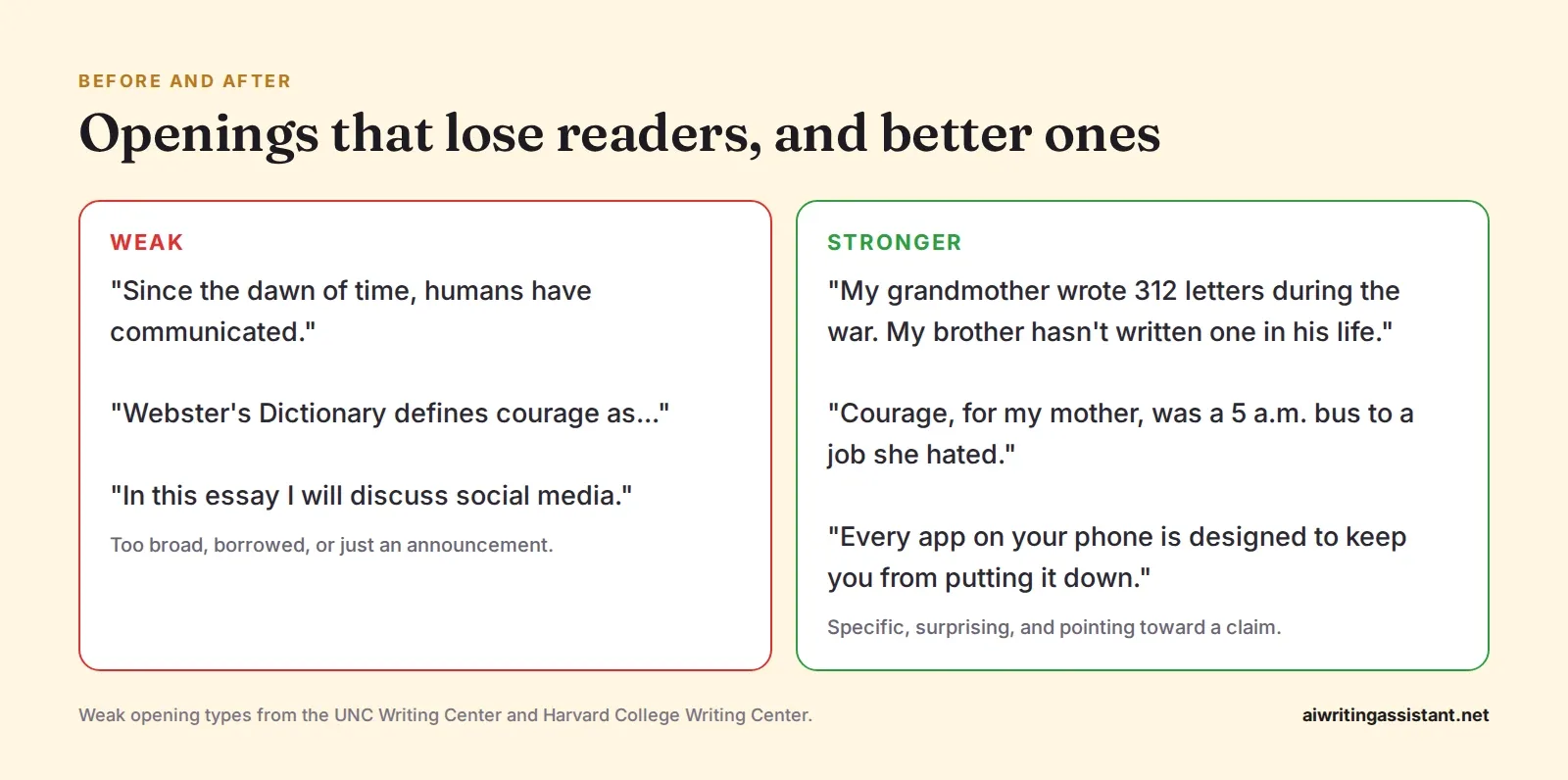
- "Since the dawn of time..." UNC calls this the "Dawn of Man" introduction, made of "broad, sweeping statements."
- Dictionary definitions. "Webster's Dictionary defines..." is on UNC's list of introductions to avoid.
- Restating the prompt. The reader already knows the question.
- Announcing. "In this essay I will discuss..." tells the reader nothing about why they should care.
- Shock for its own sake. A dramatic line that has nothing to do with your point feels like a trick.
There's one more useful warning from the Harvard writing center. "You don't have to 'hook' your readers with a dramatic promise... or an exciting fact." In academic writing, a clear, interesting question can be the best hook of all.
Hooks for different kinds of writing
| Writing | Best hook types | Example |
|---|---|---|
| Argumentative essay | Bold claim, statistic, contradiction | "Most cities lose money on free parking, and drivers pay for it anyway." |
| College or personal essay | Short story, scene | "I learned to cook because my father couldn't." |
| Literary analysis | Question, quotation from the text | "Why does the narrator never tell us her name?" |
| Research paper | Question, surprising finding | "Why do some patients recover faster from the same surgery?" |
| Blog post | Question, problem the reader has | "You have a 1,500-word limit and 2,100 words. Here's what to cut." |
| Speech | Story, question to the audience | "Raise your hand if you've ever pretended to understand a meeting." |
Frequently asked questions
What is a hook in an essay?
The first sentence or two, written to catch the reader's interest and lead into your thesis.
How do you write a good hook?
Decide on your main point first, pick a hook type that suits your essay and reader, make it specific, and connect it to your thesis within the next sentence or two.
What are the types of hooks?
A question, a surprising fact or statistic, a short story, a scene, a bold claim, a quotation, and a contradiction.
What is a good hook for an argumentative essay?
A bold claim, a surprising and sourced statistic, or a contradiction that your argument resolves.
How long should a hook be?
Usually one or two sentences. If it takes a paragraph, it's becoming the introduction.
Can a hook be a question?
Yes, if it's a real question the reader wants answered. Avoid yes/no questions with obvious answers.
What hooks should I avoid?
Sweeping "since the dawn of time" openings, dictionary definitions, restating the prompt, and "In this essay I will..."
 Grammar Checker
 Paraphraser
 Summarizer
 AI Writer
 AI Humanizer
 Text Compare