
Paraphrasing sounds simple. Say it in your own words. But most students who get flagged for plagiarism didn't copy and paste. They paraphrased badly, keeping the source's sentences and swapping a few words. The fix isn't a bigger vocabulary. It's a different method.
What is paraphrasing?
Purdue OWL defines a paraphrase as "your own rendition of essential information and ideas expressed by someone else, presented in a new form." It keeps the meaning of the original but changes both the words and the sentence structure. A paraphrase is usually a little shorter than the original. A summary is much shorter and covers only the main points. A quotation matches the source word for word.
How do you paraphrase?
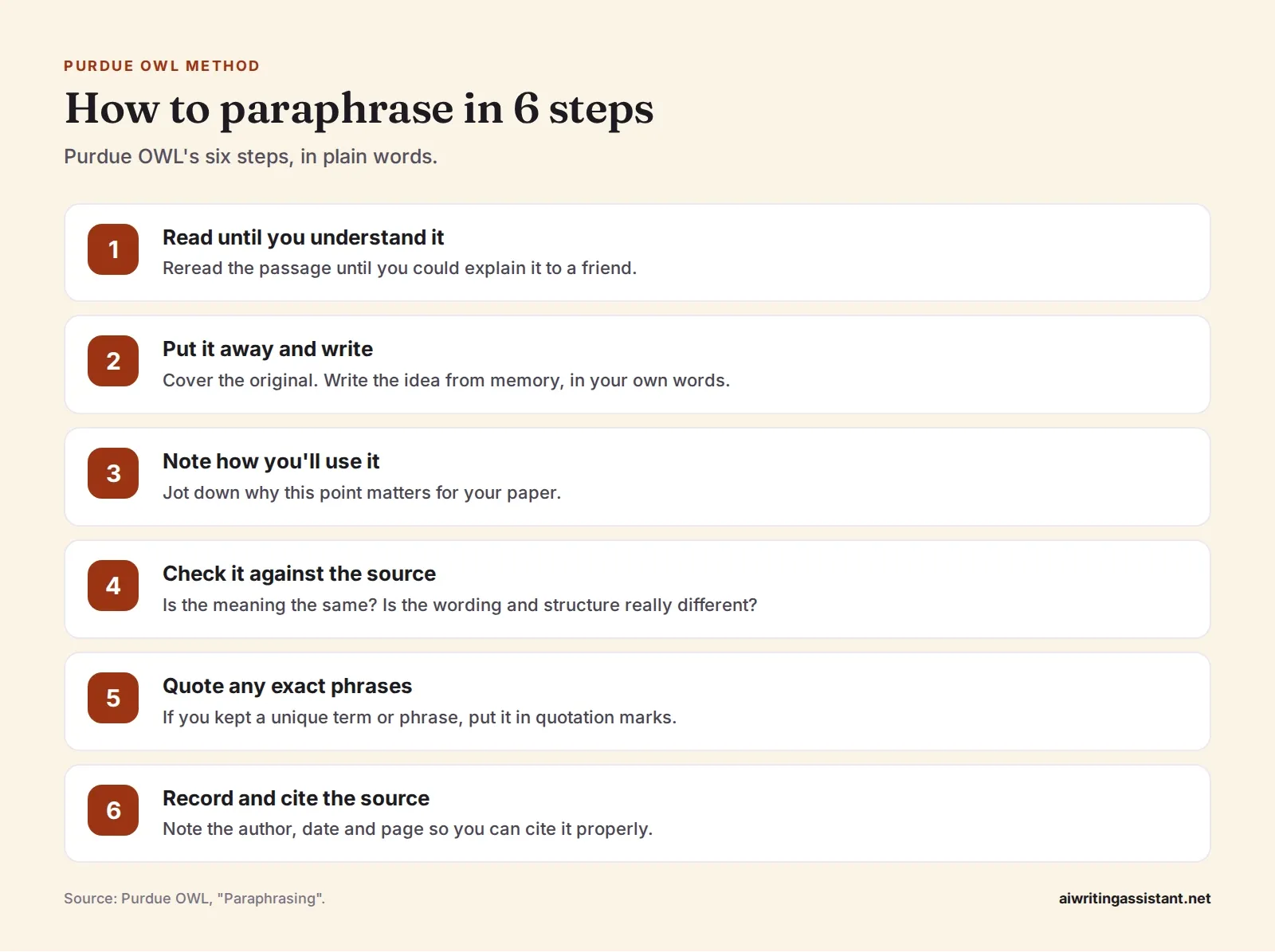
Read the passage until you fully understand it. Then put it away and write the idea from memory, in your own words and your own sentence structure. Compare your version with the original to make sure the meaning is the same and the wording is really different. Put any exact phrases you kept in quotation marks, and cite the source with the author, date and page number.
Three ways to paraphrase
The UW-Madison Writing Center suggests three methods. Use whichever suits the passage.
- Look away, then write. Read the passage, look away and write it from memory. This works best because you can't copy what you can't see.
- Take notes first. Jot down key ideas as short notes, then write your paraphrase from the notes a day later.
- Change the structure, then the words. If you must work with the source in front of you, first rebuild the sentence (start with a different part, split or join sentences), then change the wording. Keep technical terms that have no real synonym.
Paraphrasing examples
Here's an original passage, written for this example.
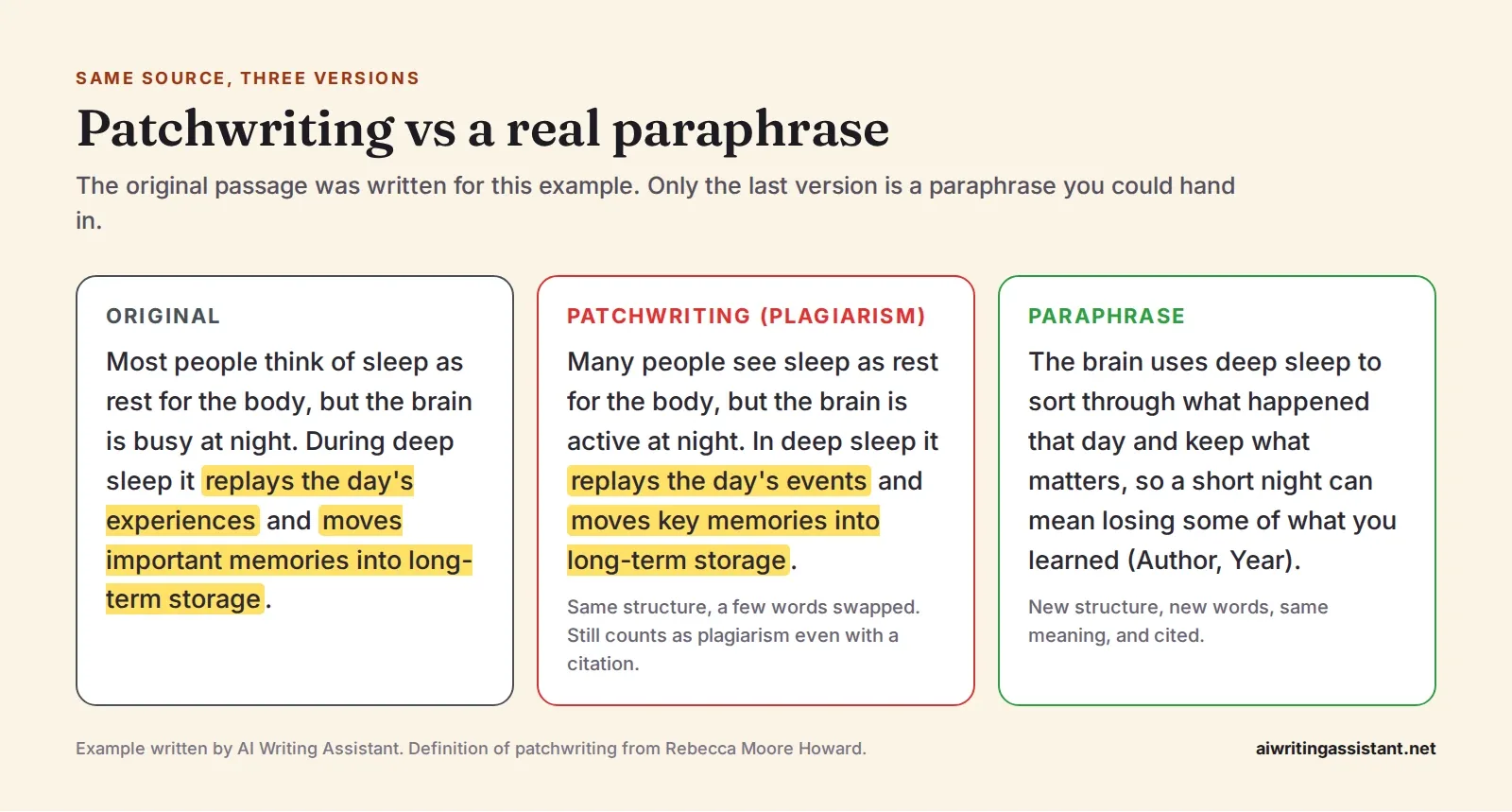
Most people think of sleep as rest for the body, but the brain is busy at night. During deep sleep it replays the day's experiences and moves important memories into long-term storage. When sleep is cut short, that process is interrupted, and people remember less of what they learned the day before.
Patchwriting (not OK): "Many people view sleep as rest for the body, but the brain is active at night. In deep sleep it replays the day's events and transfers key memories into long-term storage."
Paraphrase (OK): "Sleep isn't only physical rest. The brain uses deep sleep to sort through the day and keep what matters, so cutting a night short can mean forgetting part of what you learned (Author, Year)."
Summary (also OK): "Deep sleep helps the brain store new memories (Author, Year)."
What is patchwriting, and why is it plagiarism?
Patchwriting is the term writing scholar Rebecca Moore Howard coined in 1993 for "copying from a source text and then deleting some words, altering grammatical structures, or plugging in one-for-one synonym-substitutes." Merriam-Webster notes that in academic settings it's "considered an offense equal to that of plagiarism."
Howard also pointed out that patchwriting is often a stage in learning, not cheating. It's fine in your notes or a first draft. It just can't be in the version you hand in. The test is simple. If you could lay your sentence on top of the source and see the same skeleton, rewrite it.
How to cite a paraphrase
- APA: name the author and year, as in (Walker, 2017). APA doesn't require a page number for a paraphrase but encourages one when it helps the reader find the passage in a long work.
- MLA: MLA says that if you paraphrase a specific part of a work that has page numbers, the "location marker must be included," as in (Walker 112).
- Chicago: use a footnote with the page number, as you would for a quotation.
Need the full reference too? Our Citation Generator formats it in APA, MLA, Chicago and thousands of other styles.
Paraphrase, summarize or quote?
| Use | When | Length |
|---|---|---|
| Quote | The exact wording matters, such as a definition, a striking phrase or a claim you'll analyze | Same as the original |
| Paraphrase | You need the detail of one passage but in a form that fits your writing | About the same or a little shorter |
| Summarize | You only need the main idea of a longer section or whole source | Much shorter |
Most good essays use far more paraphrase and summary than quotation. Quotes should be the exceptions you choose on purpose.
Can you use a paraphrasing tool?
It depends on your school and your assignment. Some universities treat it as a breach when it's not allowed. The University of Sydney lists "using generative AI such as chatbots, paraphrasing tools or translation tools in an assessment where their use has been prohibited" as a breach of academic integrity. Turnitin also added detection in July 2024 for text "that may have been further modified using an AI paraphrasing tool."
Where tools are allowed, use them like a thesaurus with opinions. Write your own paraphrase first, then compare it with a tool's version to spot a clearer word or a tighter structure. Never paste in a source and hand in the result. That's still someone else's idea, and you still need to cite it.
Frequently asked questions
How do you paraphrase?
Read the passage until you understand it, put it away, write the idea from memory in your own words and structure, check it against the original, and cite the source.
Do you need to cite a paraphrase?
Yes. A paraphrase uses someone else's idea, so it always needs a citation, even though the words are yours.
What is patchwriting?
Copying a source's sentence structure and swapping in synonyms or deleting words. In academic work it's treated as plagiarism, even with a citation.
How is paraphrasing different from summarizing?
A paraphrase restates one passage in detail and is about the same length. A summary keeps only the main points and is much shorter.
How many words do you need to change to paraphrase?
There's no word count rule. You need to change the structure and wording so the result is genuinely yours, while keeping the meaning.
Do you need page numbers for a paraphrase?
MLA requires a page number when you paraphrase a specific passage from a paged source. APA encourages one but doesn't require it.
Is using a paraphrasing tool cheating?
It depends on your school's rules. Some ban it in assessments. Where it's allowed, use it to check your own wording, and always cite the original source.
 Grammar Checker
 Paraphraser
 Summarizer
 AI Writer
 AI Humanizer
 Text Compare