
A summary is the skill behind almost everything else in school and work. Reading notes, literature reviews, meeting recaps, the "what this article says" part of an essay. The trick is deciding what to leave out, and that's harder than it sounds.
How do you write a summary?
Read the text at least twice and find its main idea. Separate the major points from the minor details and examples. Write one sentence stating the main idea in your own words, then add a sentence or two for each key point. Leave out your opinion, examples and repetition. Name the author and title near the start. Finally, check your summary against the original for accuracy and to make sure you haven't copied phrases.
How to write a summary in 8 steps
These steps follow the Troy University Writing Center's guide, with tips from Texas A&M and Randolph Community College.
- Read for the big picture. Read the whole text once without taking notes. What's it about, and why was it written?
- Read again and mark the key points. Texas A&M suggests reading at least twice and highlighting the thesis.
- Separate major from minor. Examples, stories and statistics usually support a point. Keep the point, drop most of the support.
- Break it into stages. Most texts move through a few sections or steps of thought. Note one line for each.
- Write the main idea in one sentence. Use your own words. This becomes your first or second sentence.
- Summarize each stage. One or two sentences per stage is usually enough.
- Cut and connect. Remove anything a reader doesn't need, then add transitions so it reads smoothly.
- Check it. Would someone who hasn't read the original understand it? Is every claim accurate? Are any phrases copied?
Summary example
Here's a short article, written for this example, and a summary of it.
Four-day work weeks have moved from a fringe idea to a serious experiment. In a large trial in the UK, dozens of companies cut working hours by about a fifth while keeping pay the same. Most chose to keep the shorter week after the trial ended. Managers reported that meetings got shorter and staff found ways to protect focused time. Employees said they slept better and felt less burned out. Not every company found it easy. Businesses with customers who expect five-day service, such as shops and support desks, had to stagger shifts, which took careful planning. Critics also point out that the companies taking part chose to sign up, so they may have been unusually ready for the change. Still, the results have pushed more employers to ask a question that would have sounded odd a decade ago. If people can do the same work in four days, why insist on five?
Notice what the summary keeps and drops. It keeps the claim, the main evidence and the two main objections. It drops the "decade ago" question and the detail about sleep, because they support points already made. It doesn't say whether the writer of the summary likes four-day weeks.
How long should a summary be?
It depends on the purpose, and writing guides don't agree on one number.
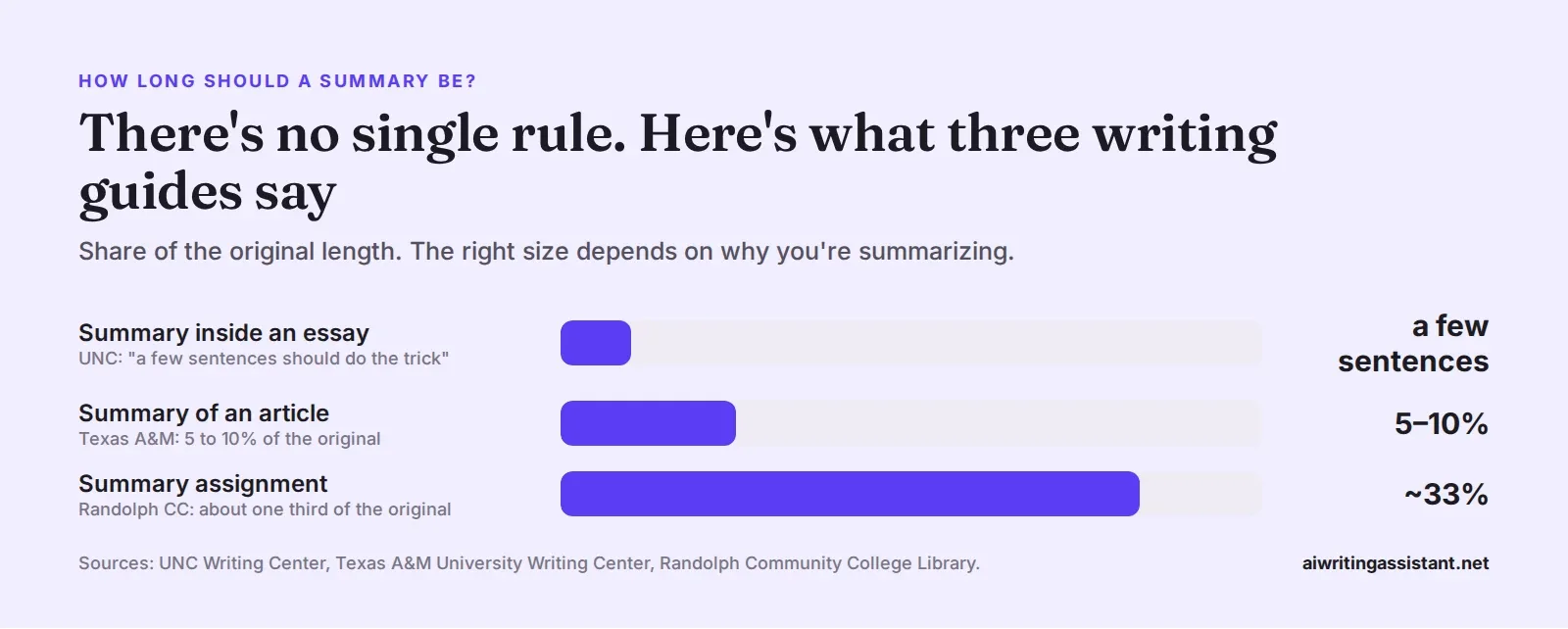
- Inside an essay: keep it short. The UNC Writing Center says "a few sentences should do the trick," because most of your paper should be your own argument.
- Summarizing an article: Texas A&M's rule of thumb is 5 to 10% of the original length.
- A summary assignment: Randolph Community College suggests about one third of the original.
Summary vs paraphrase vs abstract
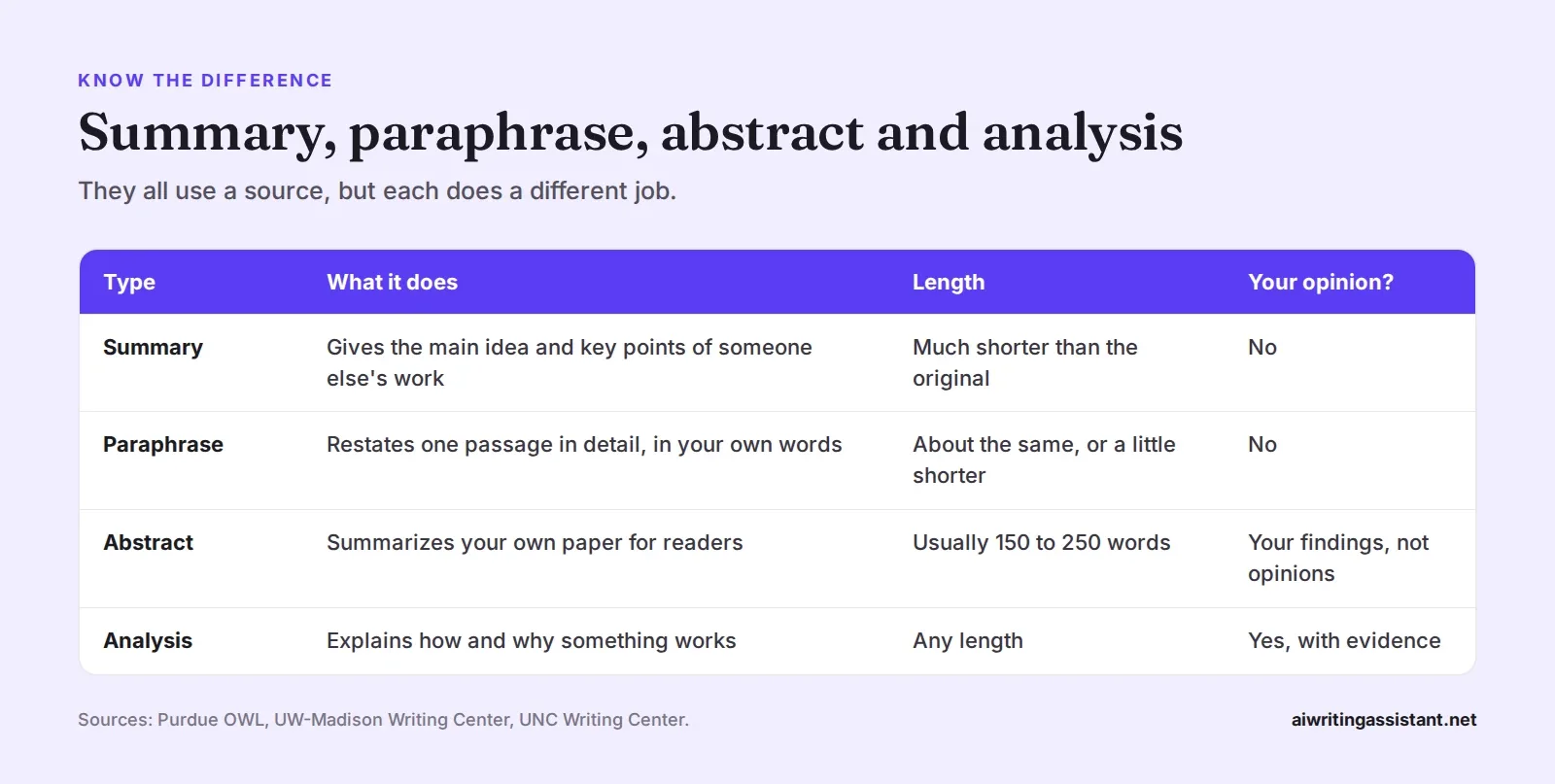
These get mixed up a lot. Purdue OWL explains that a paraphrase restates one passage and is "usually shorter than the original," while a summary covers only the main points and is "significantly shorter." An abstract is a summary of your own paper. UW-Madison describes it as "usually about a paragraph (c. 6-7 sentences, 150-250 words) long." If you're restating a single passage, see our guide to paraphrasing.
Mistakes to avoid
- Adding your opinion. Texas A&M's advice is to "avoid giving your own opinions" and keep a neutral tone. Randolph adds, "do not critique or analyze."
- Following the original line by line. That leads to a shrunken copy, not a summary. Work from your notes on the stages.
- Keeping the examples. One telling example is fine. Five is a retelling.
- Copying phrases. Use your own words, and put any phrase you must keep in quotation marks.
- Forgetting the source. Name the author and title, as in "In 'The Short Week', Lee argues that..." and cite it in the style your teacher uses.
Words for introducing a summary
Use a reporting verb that matches what the author is doing. Argues, claims, explains, describes, suggests, reports, shows, outlines, warns, concludes. "Lee argues that..." tells the reader you're summarizing a position. "The report shows that..." signals evidence.
Frequently asked questions
How do you write a summary?
Read the text twice, find the main idea, separate key points from details, write the main idea in one sentence, add a sentence for each key point, and check it against the original. Keep your opinion out.
How long should a summary be?
It depends on the purpose. A few sentences inside an essay, around 5 to 10% of the original for an article summary, or up to a third for a summary assignment.
What should a summary include?
The author and title, the main idea, and the key supporting points, in your own words.
Should a summary include my opinion?
No. A summary should be neutral. Save your views for analysis or a response paragraph.
What is the difference between a summary and a paraphrase?
A summary gives only the main points and is much shorter. A paraphrase restates one passage in detail at about the same length.
How do you start a summary?
Name the author, title and main idea in the first sentence, as in "In 'The Short Week', Lee argues that four-day weeks are now a serious option."
 Grammar Checker
 Paraphraser
 Summarizer
 AI Writer
 AI Humanizer
 Text Compare