
Paraphrasing rules are easy to state and hard to apply. The fastest way to learn them is to see the same passage done badly and done well. Below are five worked examples from public-domain books and speeches, each with a patchwrite to avoid and a cited paraphrase you can model.
What is an example of paraphrasing?
Take Frederick Douglass, who wrote in 1845 that he was astonished to find Northerners who spoke of the singing of enslaved people "as evidence of their contentment and happiness." A paraphrase would be "Douglass found that many people in the North read the songs of enslaved people as proof that they were happy, a belief he calls the worst possible misreading (Douglass, 1845)." It keeps his meaning, uses new words and a new structure, and names the source.
What makes a paraphrase good?
The Purdue OWL defines a paraphrase as your own version of someone else's ideas, "presented in a new form." The US Office of Research Integrity adds three conditions in its 28 guidelines for ethical writing. You use your own words and "our own syntactical structure" (guideline 4), you always identify the source (guideline 5), and you keep "the exact meaning" of the original (guideline 6).
The trap is patchwriting. Merriam-Webster describes it as copying a passage and then deleting words, changing grammar, or "plugging in one-for-one synonym-substitutes." Rebecca Moore Howard coined the term in the early 1990s. Miguel Roig, in a guide published by ORI, calls inappropriate paraphrasing "the most common form of plagiarism," and the UNC Writing Center says paraphrasing "does NOT mean changing a word or two."
Five paraphrasing examples, bad and good
Each example shows the original, a patchwrite that fails, and a paraphrase that works. The paraphrases are written for this guide. In-text citations use APA author-date style.
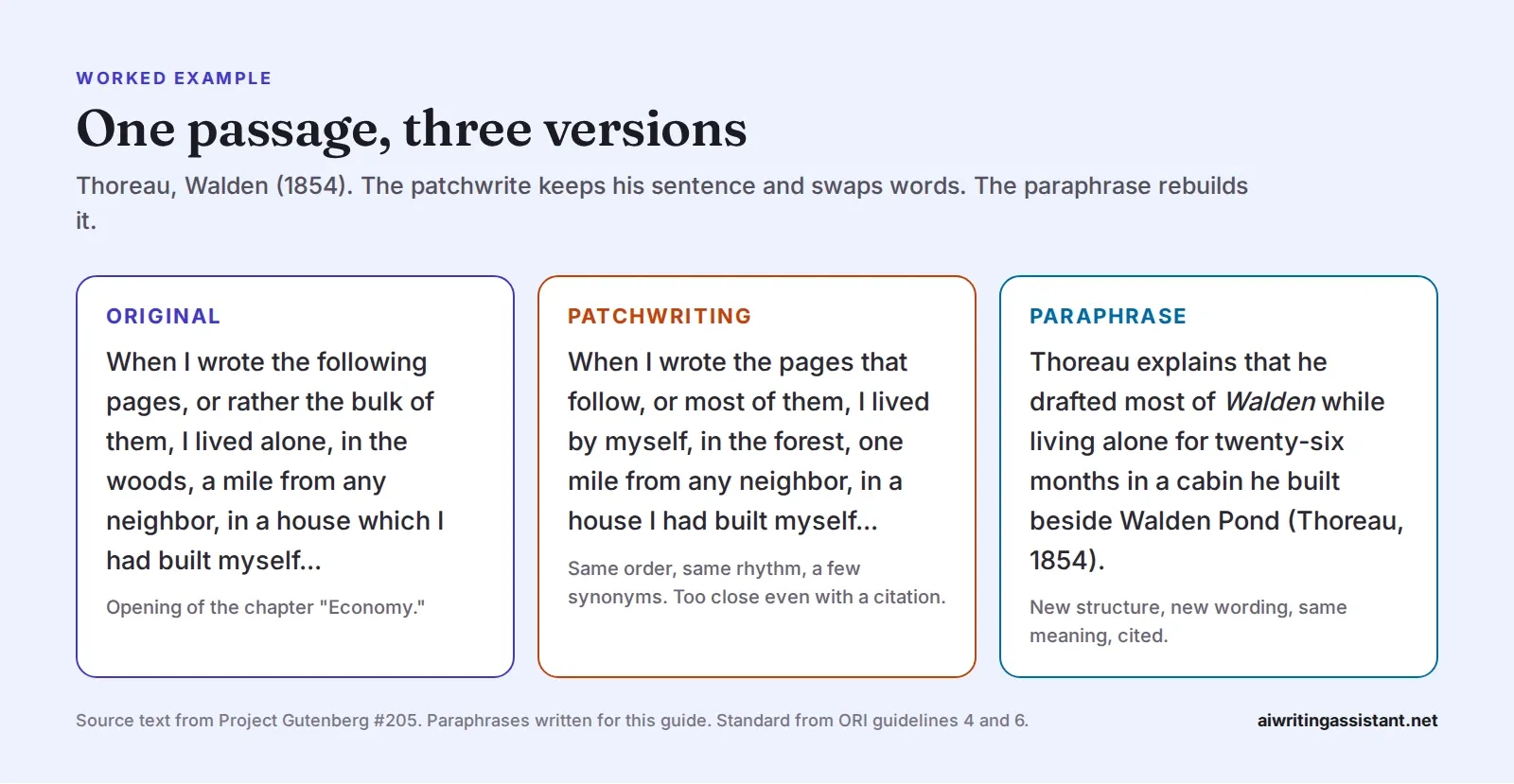
1. Thoreau, Walden (1854)
When I wrote the following pages, or rather the bulk of them, I lived alone, in the woods, a mile from any neighbor, in a house which I had built myself, on the shore of Walden Pond, in Concord, Massachusetts, and earned my living by the labor of my hands only. I lived there two years and two months.
- Patchwriting. When I wrote the pages that follow, or most of them, I lived by myself, in the forest, one mile from any neighbor, in a house I built myself, on the edge of Walden Pond, in Concord, Massachusetts, and made my living by the work of my hands alone.
- Paraphrase. Thoreau explains that he drafted most of Walden while living alone for twenty-six months in a cabin he built beside Walden Pond, near Concord, Massachusetts. He supported himself only through manual work (Thoreau, 1854).
- Why it works. The patchwrite follows the original clause by clause. The paraphrase switches to third person, merges the details into two short sentences and turns "two years and two months" into a single number. Place names stay, because they have no real synonym.
2. Darwin, On the Origin of Species (1859)
When on board H.M.S. 'Beagle,' as naturalist, I was much struck with certain facts in the distribution of the inhabitants of South America, and in the geological relations of the present to the past inhabitants of that continent.
- Patchwriting. While aboard H.M.S. Beagle as a naturalist, I was very struck by some facts in the distribution of the inhabitants of South America, and in the geological relationships of the current to the former inhabitants of that continent.
- Paraphrase. Darwin recalls that two patterns in South America caught his attention while he served as naturalist on HMS Beagle. One was where its living species were found. The other was how they related to earlier species in the continent's geological record (Darwin, 1859).
- Why it works. The patchwrite keeps strings like "in the distribution of the inhabitants of South America," which is far more than four matching words. The paraphrase splits one long sentence into three and names the two "facts" plainly.
3. Douglass, Narrative of the Life (1845)
I have often been utterly astonished, since I came to the north, to find persons who could speak of the singing, among slaves, as evidence of their contentment and happiness. It is impossible to conceive of a greater mistake.
- Patchwriting. Since I came north, I have often been completely amazed to find people who could talk about the singing among slaves as proof of their contentment and joy. It is impossible to imagine a bigger mistake.
- Paraphrase. Douglass found that many people in the North read the songs of enslaved people as proof that they were happy, a belief he calls the worst possible misreading (Douglass, 1845).
- Why it works. The patchwrite is a synonym swap (astonished to amazed, evidence to proof, conceive to imagine). The paraphrase combines two sentences into one, moves the focus to what Northerners believed, and turns "a greater mistake" into a judgment in new words.
4. Wollstonecraft, A Vindication of the Rights of Woman (1792)
Strengthen the female mind by enlarging it, and there will be an end to blind obedience.
- Patchwriting. Strengthen the female mind by expanding it, and blind obedience will come to an end.
- Paraphrase. Wollstonecraft argues that if women received a broader education, they would stop obeying others without thinking (Wollstonecraft, 1792).
- Why it works. The patchwrite keeps the command form and the phrase "Strengthen the female mind." The paraphrase turns the command into a statement about her argument, and replaces the metaphor of "enlarging" the mind with what she means by it.
5. Lincoln, Gettysburg Address (1863)
Four score and seven years ago our fathers brought forth, upon this continent, a new nation, conceived in liberty, and dedicated to the proposition that "all men are created equal." Now we are engaged in a great civil war, testing whether that nation, or any nation so conceived, and so dedicated, can long endure.
- Patchwriting. Eighty-seven years ago our forefathers created, on this continent, a new nation, born in liberty, and devoted to the idea that all men are created equal. Now we are involved in a huge civil war, testing whether that nation, or any nation like it, can last long.
- Paraphrase. Lincoln reminds his listeners that the United States was founded 87 years earlier on the principles of freedom and equality. He presents the Civil War as a test of whether any country built on those principles can survive (Lincoln, 1863).
- Why it works. The patchwrite also drops the quotation marks around "all men are created equal," which is borrowed wording. If you keep a famous phrase, put it in quotation marks. Lincoln wrote several copies of the speech with small differences, so name the one you used.
How do you paraphrase without plagiarizing?
The Purdue OWL suggests a simple routine. It also notes that paraphrasing "helps you control the temptation to quote too much."
- Reread the passage until you understand it.
- Set the original aside and write your version from memory.
- Check your version against the original for meaning and wording.
- Put quotation marks around any unique phrase you kept.
- Record the source, including the page if there is one.
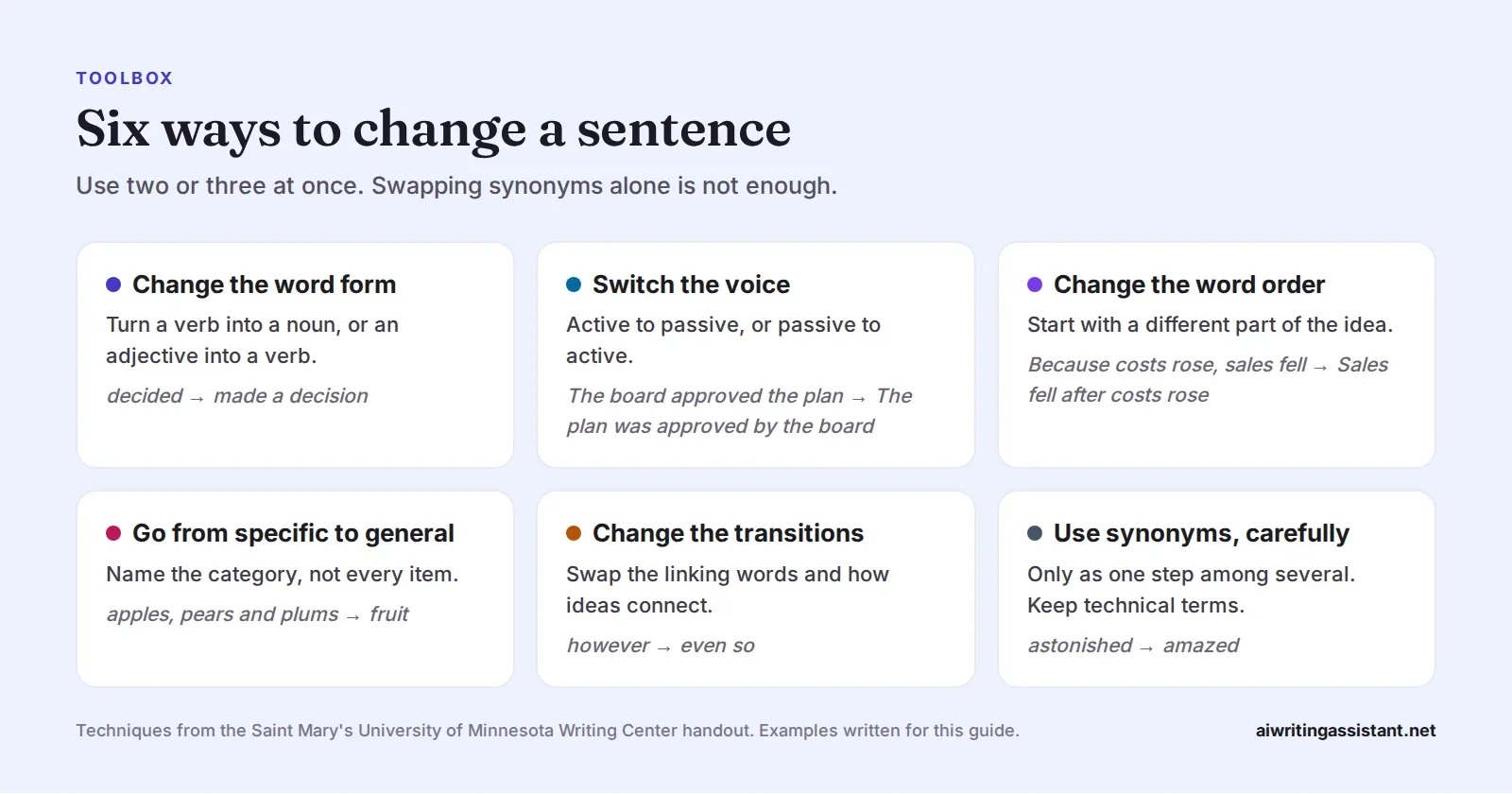
While you rewrite, mix the techniques from the Saint Mary's University of Minnesota Writing Center handout below. RMIT Learning Lab adds a check you can apply in seconds. Aim for "no more than 4 words in a row" that match the source.
How do you cite a paraphrase in APA and MLA?
Every paraphrase needs a citation, in every style. A paraphrase in your own words is still someone else's idea.
| Style | In-text format | Page number? |
|---|---|---|
| APA 7 | (Douglass, 1845) or Douglass (1845) found that... | Encouraged, not required. Add it if it helps readers find the passage in a longer work. |
| MLA 9 | (Douglass) or Douglass argues that... | Include it when you paraphrase a specific part of a work that has page numbers. |
For APA, the ABAC library guide and Purdue OWL both note that a page number for a paraphrase is encouraged rather than required. For MLA, the MLA Style Center says to give the location "when a specific part of a work is quoted or paraphrased" and the work has page numbers. Ebook texts like the Gutenberg editions above often have none. When you summarize a whole work, MLA says page numbers "are not normally needed." Build the full reference entry with our free Citation Generator.
Paraphrase vs summary vs quote
All three need a citation. They differ in length and in how close you stay to the wording. The Purdue OWL overview sets out the difference.
| Quote | Paraphrase | Summary | |
|---|---|---|---|
| Wording | The exact words, in quotation marks | Your own words and sentence structure | Your own words |
| Length | Same as the source | Usually a little shorter than the original | Much shorter, main points only |
| Covers | A short passage | One passage, all its ideas | A long passage or a whole work |
| Best for | Memorable wording or exact definitions | Ideas you need in detail | The big picture of a source |
A one-line summary of the Lincoln passage might be "Lincoln framed the Civil War as a test of the nation's founding ideals (Lincoln, 1863)." For more on condensing, read how to write a summary, and for the full method see how to paraphrase.
Can a paraphrasing tool help?
A rewriting tool can suggest new sentence shapes and word choices when you're stuck. It can't understand the source for you, and it can't add the citation. Always check the result against the original for meaning, and cite the author.
Frequently asked questions
What is a paraphrase?
A restatement of someone else's idea in your own words and your own sentence structure, with the meaning kept and the source cited.
Do I need to cite a paraphrase?
Yes. APA, MLA and the ORI guidelines all require you to name the source of a paraphrased idea.
What is patchwriting?
Copying a passage and then deleting words or swapping in synonyms while keeping the original structure. Rebecca Moore Howard coined the term in the early 1990s.
Is changing a few words enough?
No. ORI says changing only a word or two, or keeping the sentence structure, is inappropriate paraphrasing.
How many words can match the source?
RMIT Learning Lab suggests no more than four words in a row. Put anything longer in quotation marks.
Do I need a page number for an APA paraphrase?
APA encourages one, especially for long works, but doesn't require it.
Is a paraphrase shorter than the original?
Usually a little shorter, according to the Purdue OWL. If it is much shorter and keeps only the main points, it is a summary.
 Grammar Checker
 Paraphraser
 Summarizer
 AI Writer
 AI Humanizer
 Text Compare