
A narrative essay is the one school assignment where you're allowed, even expected, to tell a story. That freedom trips people up. Without the usual thesis-and-evidence structure, drafts tend to turn into a list of things that happened.
This guide shows how to choose a story, structure it, bring it to life with detail, and end with meaning.
How do you write a narrative essay?
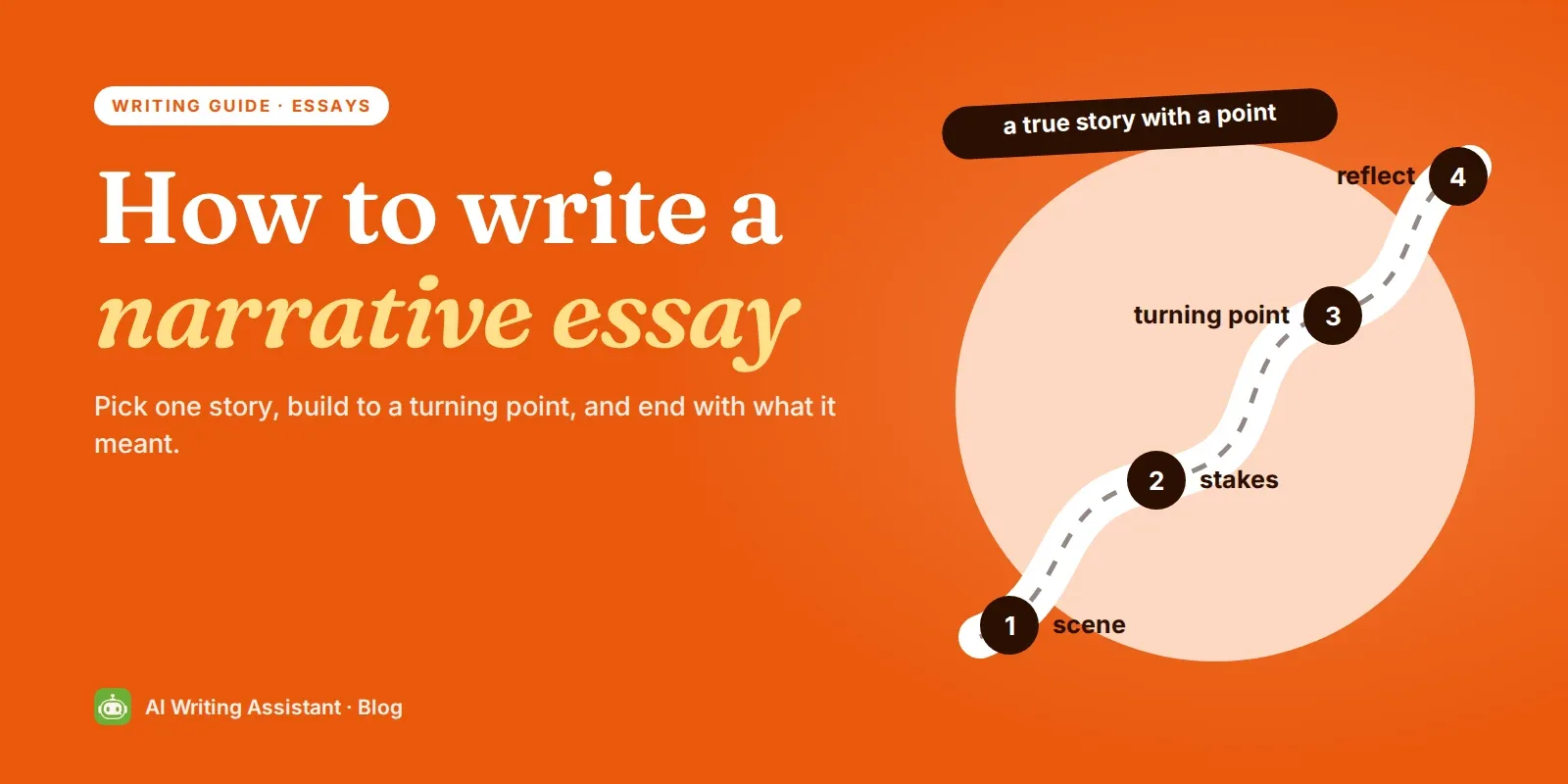
Pick one specific experience that changed you or taught you something. Open in the middle of the action with a concrete detail, then set up who you were and what was at stake. Tell the key moments in order, using sensory details and a little dialogue, and build to a turning point. End by reflecting on what the experience means to you now. That reflection works as your thesis, so make it clear and specific.
What is a narrative essay?
The Howe Writing Center at Miami University defines a narrative as a spoken or written account of connected events, in other words a story. A narrative essay uses that story to say something.
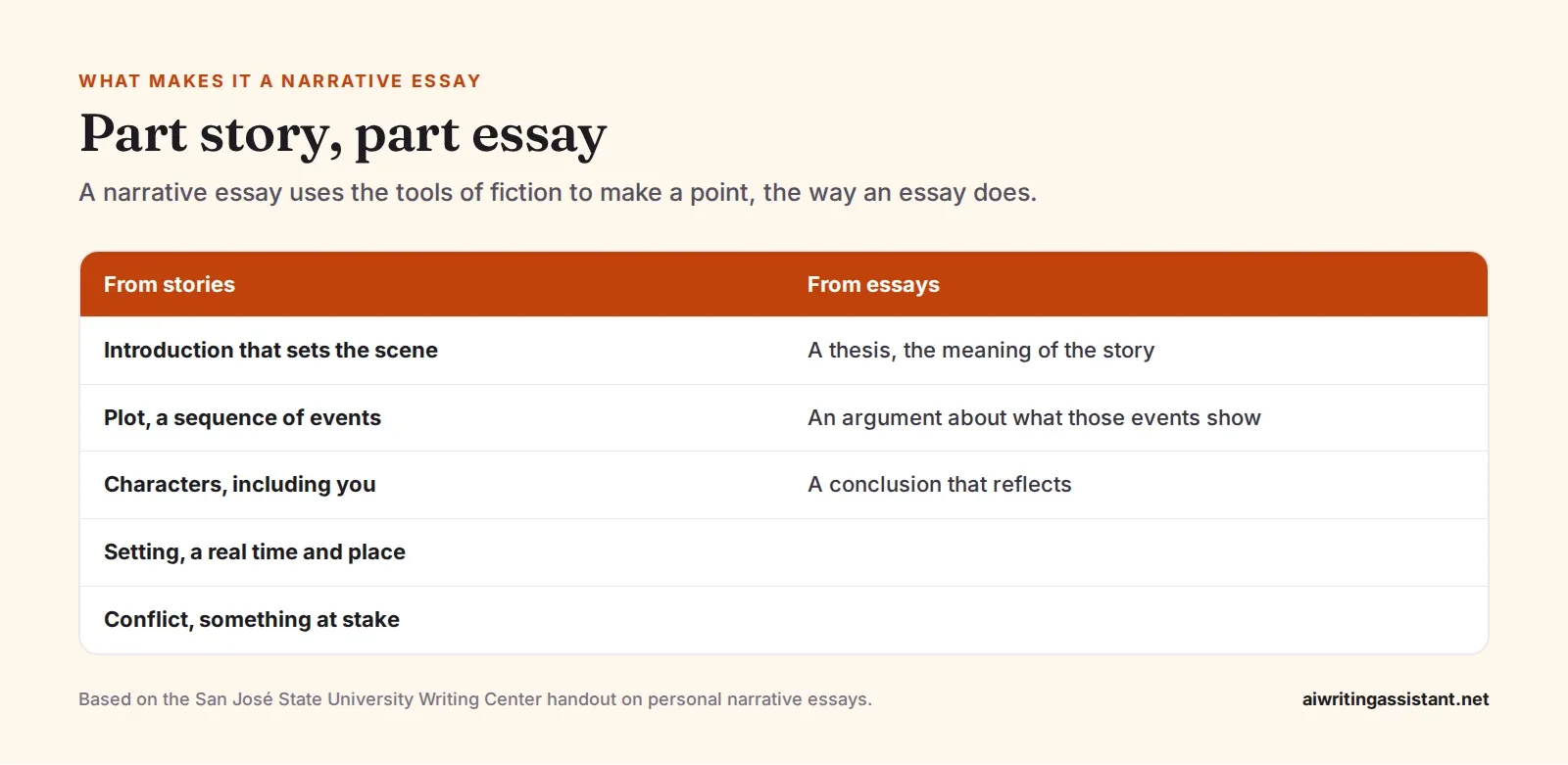
The San José State University Writing Center describes a personal narrative as a story you choose to share that shows your understanding of yourself, others or society. It combines story elements with essay elements. In the handout's words, it "also uses the components of argument, thesis, and conclusion."
Does a narrative essay need a thesis?
Yes, though it may not look like one. SJSU puts it in one line. "Your thesis articulates that meaning succinctly." The Purdue OWL also stresses that a narrative essay should make a point.
Your thesis might appear in the introduction, or it might arrive near the end as a reflection. Either way, a reader should be able to say in one sentence what the story was about.
Step 1: Choose the right story
Small is better than big. "My trip to Spain" is a travel log. "The afternoon I got lost in Seville and had to ask a stranger for help in terrible Spanish" is a narrative. Look for moments with these features.
- Something changed, inside you or around you.
- There was tension or a decision to make.
- You remember specific details, such as sounds, words people said and what the weather was like.
- You can say what it meant, even if you're still working it out.
Miami suggests checking that your story covers the five W's, which are who, what, when, where and why.
Step 2: Structure it around a turning point
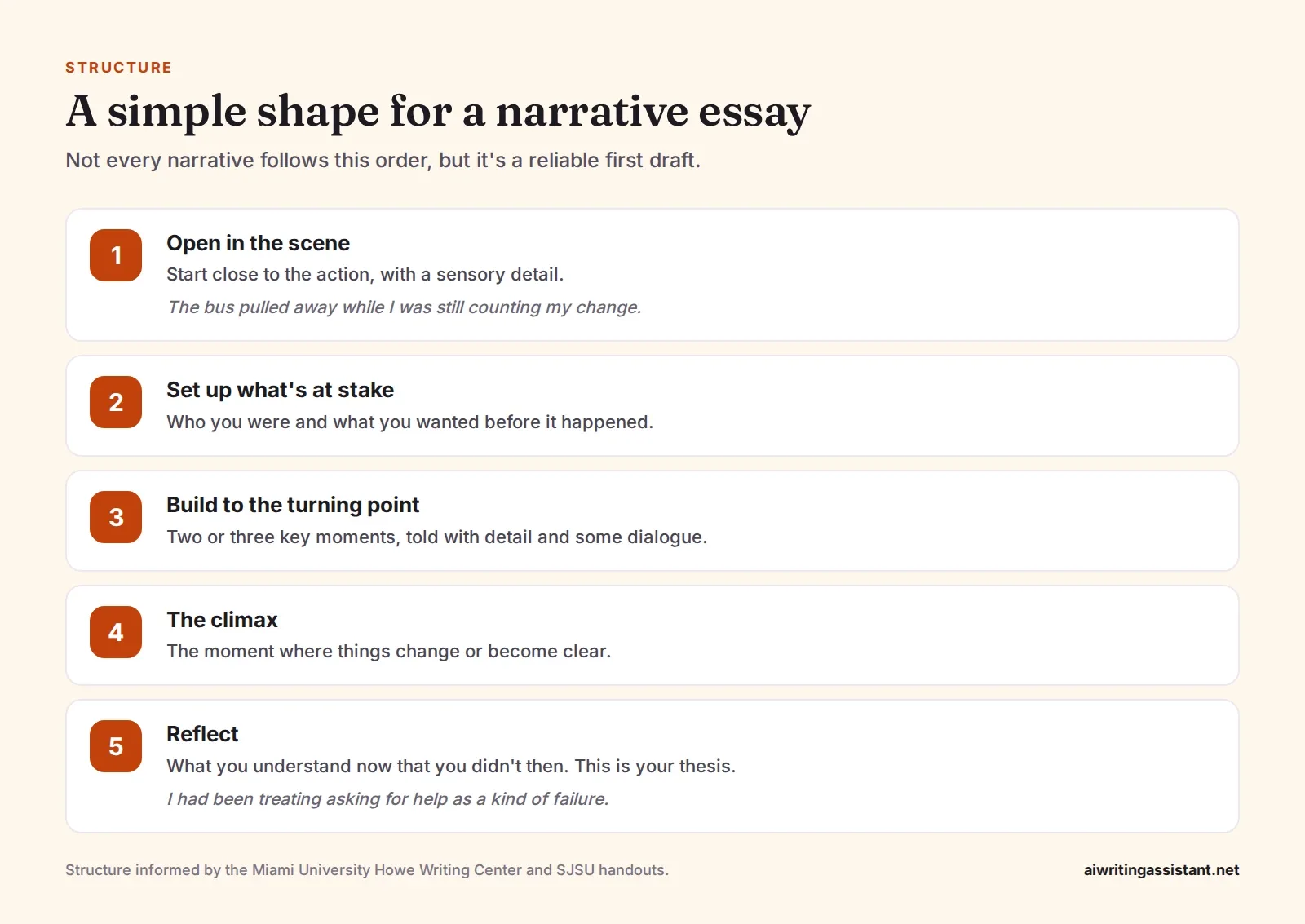
Miami advises that the introduction sets the scene and "quite often starts in the middle of the action." It also recommends including "a moment (the climax) when your ending is revealed." Everything before that moment builds toward it.
If you're stuck on the opening line, our guide to writing a hook includes anecdote and scene openings that suit narratives well.
Step 3: Show, don't (only) tell
Showing means giving readers the details so they draw the conclusion themselves. The Vanderbilt Writing Studio describes it as writing "as if projecting images onto a reader's mental movie screen." Its advice is to "Turn the abstract into the concrete."
| Telling | Showing |
|---|---|
| I was nervous before my speech. | My note cards were damp by the time they called my name. |
| My grandfather was strict. | My grandfather checked the clock every time I came through the door, even at four in the afternoon. |
| The city was crowded. | I walked sideways for three blocks just to keep moving. |
Showing doesn't mean fancy. Vanderbilt notes that "Description doesn't have to be flowery." And you can still tell sometimes. A quick sentence of summary moves the story along between important scenes.
Step 4: Use dialogue where it counts
A few lines of real speech can do more than a paragraph of explanation. Miami asks writers to check, "Is there dialogue at important moments?" Keep dialogue short, put each new speaker in a new paragraph, and only quote lines that reveal character or move the story.
Step 5: Reflect at the end
The ending is where a narrative becomes an essay. Don't just say what happened next. Say what you understand now. Compare the two endings below.
| Weak ending | Stronger ending |
|---|---|
| In the end, I made it home and everything was fine. | I made it home two hours late, but what stayed with me was how easily a stranger had helped, and how long I'd have waited before asking. |
| That experience taught me a valuable lesson. | I'd been treating asking for help as a kind of failure. That afternoon it felt more like a skill I hadn't practiced. |
For more on endings, see our guide on how to write a conclusion.
Can you use "I" in a narrative essay?
Yes. The Purdue OWL notes that first person is welcome in narrative essays, though you shouldn't lean on it in every sentence. Vary your sentence openings so the essay isn't a long list of "I did, I saw, I felt."
Draft the story first, find the meaning second
If you don't know what your story means yet, that's normal. The Excelsior University Online Writing Lab notes that it can be easier to write the story first and then go back to find the thesis. Write the whole thing, read it, and ask what it's really about. Then revise the opening and ending around that answer.
How long is a narrative essay?
It depends on the assignment. There's no standard length. For college applications, the Common App personal essay, which is often a narrative, has a 650-word limit. Our guide to writing a college essay covers that format.
Track length as you go with the free Word Counter.
Frequently asked questions
What is a narrative essay?
A true story, usually from your own experience, told to make a point about yourself, others or the world.
Does a narrative essay need a thesis?
Yes. The thesis is the meaning of the story, and it often appears in the introduction or in the reflection at the end.
Can I use "I" in a narrative essay?
Yes. First person is normal in narrative essays, as long as it isn't overused.
How do you start a narrative essay?
Start in the middle of the action with a specific detail or moment, then fill in the background.
What does "show, don't tell" mean?
Using specific details and actions so readers see the scene and draw conclusions, instead of being told what to feel.
Should a narrative essay have dialogue?
A little, at important moments. Short lines of real speech can reveal character quickly.
How long is a narrative essay?
It depends on the assignment. For the Common App, the limit is 650 words.
 Grammar Checker
 Paraphraser
 Summarizer
 AI Writer
 AI Humanizer
 Text Compare