

Emailing a professor feels high-stakes the first time. You want to sound polite without sounding stiff, and you want an answer, not a reply that says "see the syllabus."
The good news is that university writing centers agree on almost everything. Here's the format, a template and examples for the emails students send most.
How do you write an email to a professor?
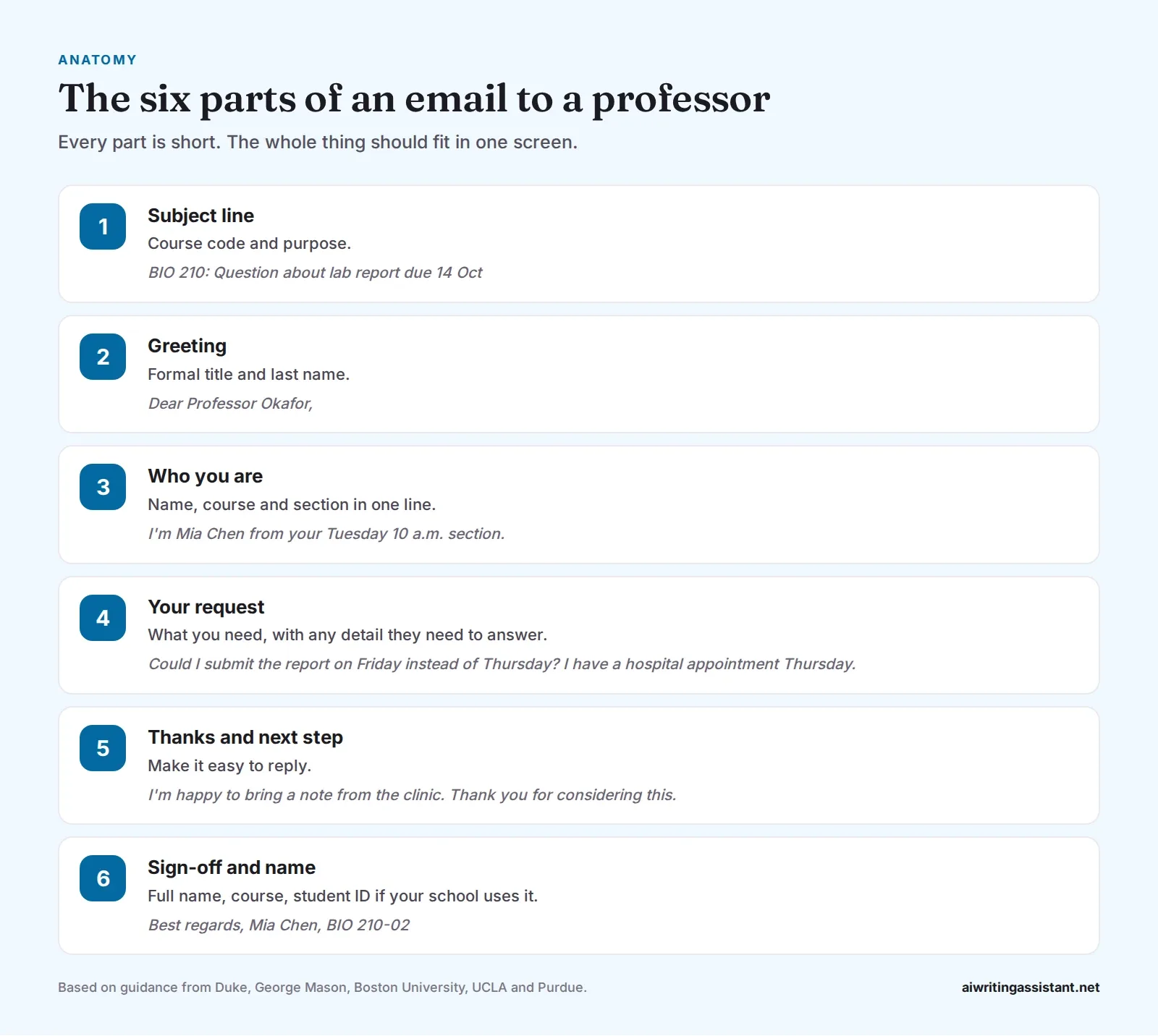
Write a subject line with your course code and a short purpose. Greet them formally as "Dear Professor [Last name]." In the first sentence, say your name and which class and section you're in. State your question or request clearly, with only the details they need to answer, and suggest a next step. Thank them, then sign off with "Best regards" or "Thank you" and your full name. Keep the whole email short enough to read without scrolling.
1. Write a specific subject line
The George Mason University Writing Center says "A good subject line tells your recipient what your email is about." Include the course. The Boston University College of Communication writing center suggests writing the course number or name in the subject line, and RMIT warns that emails with no subject line may be ignored because they look like spam.
| Weak | Better |
|---|---|
| Question | ENG 102: Question about essay 2 citation format |
| Help!! | HIST 230: Request to meet about midterm grade |
| (no subject) | CHEM 101 Lab 4: Missing data file |
| Absence | PSY 110, Sec 3: Absence on 12 Oct (medical) |
2. Use the right greeting
The Duke Academic Resource Center says "'Dear Professor X' works best." GMU suggests "Professor [Lastname]" or "Dr. [Lastname]," and no first names. Not every instructor holds a doctorate, so "Professor" is the safe default unless the syllabus says otherwise.
Duke also notes that "In your first email, it is better to be formal than informal." RMIT advises against opening with "Hey." If a professor signs their replies with a first name and invites you to use it, you can follow their lead.
3. Say who you are
Professors teach many students across several sections. Duke suggests mentioning your year and which class you're in. Purdue advising adds your preferred name and major. One sentence is enough.
I'm Jordan Lee, a second-year student in your Monday and Wednesday section of ECON 201.
4. Make one clear request
Put the question or request near the top. Include the details they need to answer without writing back to you, such as the assignment name, the date, or the exact part you're stuck on. If there are two unrelated questions, consider two short emails.
Length matters. The UCLA Graduate Writing Center suggests keeping an email to "about the size of an email window." BU puts it more simply. Keep your message "short and sweet."
5. Close politely
Thank them for their time and make the next step easy, such as offering two times you could meet. University pages at Purdue and the University of New Mexico suggest closings like "Best regards," "Sincerely" or "Thank you," followed by your name. Our guide on how to end an email has more options.
Email to a professor template
Subject: [Course code]: [Short purpose]
Dear Professor [Last name],
I'm [Your name], a [year] student in your [course name and section].
[One or two sentences with your question or request, including any detail they need.]
[Optional: what you've already tried, or a suggested next step, such as two times you're free.]
Thank you for your time.
Best regards,
[Full name]
[Course and section, student ID if required]
Examples for common situations
Asking for an extension
Subject: HIST 230: Extension request for research paper
Dear Professor Ruiz,
I'm Sam Patel from your Tuesday/Thursday section. I've had the flu since Monday and have a doctor's note. Would it be possible to submit the research paper on Monday 19 Oct instead of Friday 16 Oct? I've finished the outline and about half the draft.
Thank you for considering this.
Best regards,
Sam Patel
Asking a question about an assignment
Subject: ENG 102: Question about essay 2 sources
Dear Professor Kim,
I'm Ana Silva in section 4. The essay 2 prompt asks for three scholarly sources. Would a peer-reviewed article from a government health agency count as one of them? I checked the syllabus and the assignment page but couldn't find the answer.
Thank you,
Ana Silva
Asking to meet
Subject: PSY 110: Request to meet about my midterm
Dear Dr. Okafor,
I'm Jordan Lee from your 9 a.m. section. I'd like to understand where I lost marks on the midterm so I can prepare better for the final. I can't make Wednesday office hours because of a lab. Would Thursday at 2 p.m. or Friday at 11 a.m. work?
Best regards,
Jordan Lee
When to send it, and when to follow up
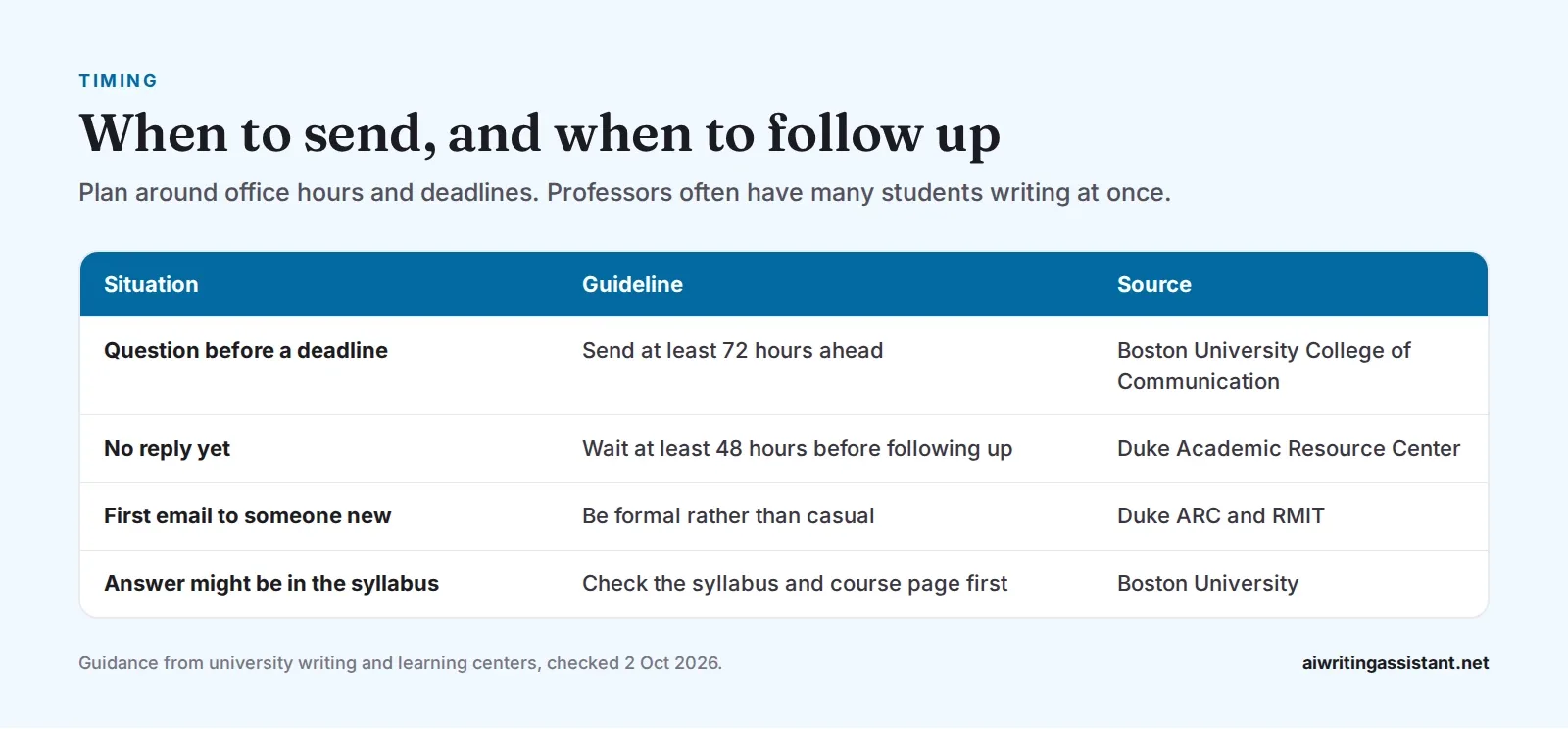
BU advises checking the syllabus first and emailing well before deadlines, allowing 72 hours for a response. If you don't hear back, Duke says to "Wait at least 48 hours to send a follow-up to a professor." Reply in the same thread and keep it brief.
Do professors actually answer? In a 2015 field experiment reported by ScienceDaily, researchers emailed 6,548 professors at 259 US universities, posing as prospective doctoral students asking to meet. 67% replied within a week. The study also found that white male senders got replies at higher rates, a reminder that response gaps aren't always about the email. See our guide to follow-up emails if you're waiting.
Mistakes to avoid
- No subject line or a vague one. It may be filtered or ignored.
- "Hey" or a first name in a first email.
- Asking what's in the syllabus. Check first, and say you checked.
- Writing at the last minute. A request sent the night before a deadline is hard to grant.
- Text-message style. Skip "u," "pls" and strings of emojis.
- Long backstory. Give the reason in one or two sentences.
Frequently asked questions
How do you start an email to a professor?
With "Dear Professor [Last name]," followed by one sentence saying who you are and which class you're in.
Should I use "Dr." or "Professor"?
"Professor [Last name]" is the safe default. Use "Dr." if you know they hold a doctorate or the syllabus uses it.
What should the subject line say?
The course code and a short purpose, such as "BIO 210: Question about lab 3."
How long should an email to a professor be?
Short enough to read without scrolling, usually one short paragraph plus a greeting and sign-off.
How long should I wait for a reply?
At least 48 hours before following up, and longer over weekends.
Can I email a professor on the weekend?
Yes, but don't expect a reply before Monday. Avoid weekend emails about urgent Monday deadlines.
How do I end an email to a professor?
Thank them, then sign off with "Best regards" or "Thank you" and your full name and course.
 Grammar Checker
 Paraphraser
 Summarizer
 AI Writer
 AI Humanizer
 Text Compare