
You sent the email. You checked twice. Nothing. Silence is awkward, and it's tempting to either give up or send "Just following up!" every two days.
There's a better middle. Here's when to follow up, what the research says actually works, and templates you can adapt.
How do you write a follow-up email after no response?
Wait a reasonable time first, usually about a week for networking or job emails and two days for a professor. Reply in the same thread so the reader has context. Open by restating your request in one sentence, add anything new that helps, and make the reply easy, for example a yes or no question or two time options. Keep it under 100 words, stay friendly, and don't apologize or guilt the reader.
Do follow-up emails actually work?
Yes, and there's solid evidence. In a field experiment with 24,651 scientists, Sauermann and Roach (2013) found that the first email and each of three reminders raised the response rate by 9.6, 7.7, 5.6 and 4.9 percentage points. Every reminder helped. Each helped a little less.
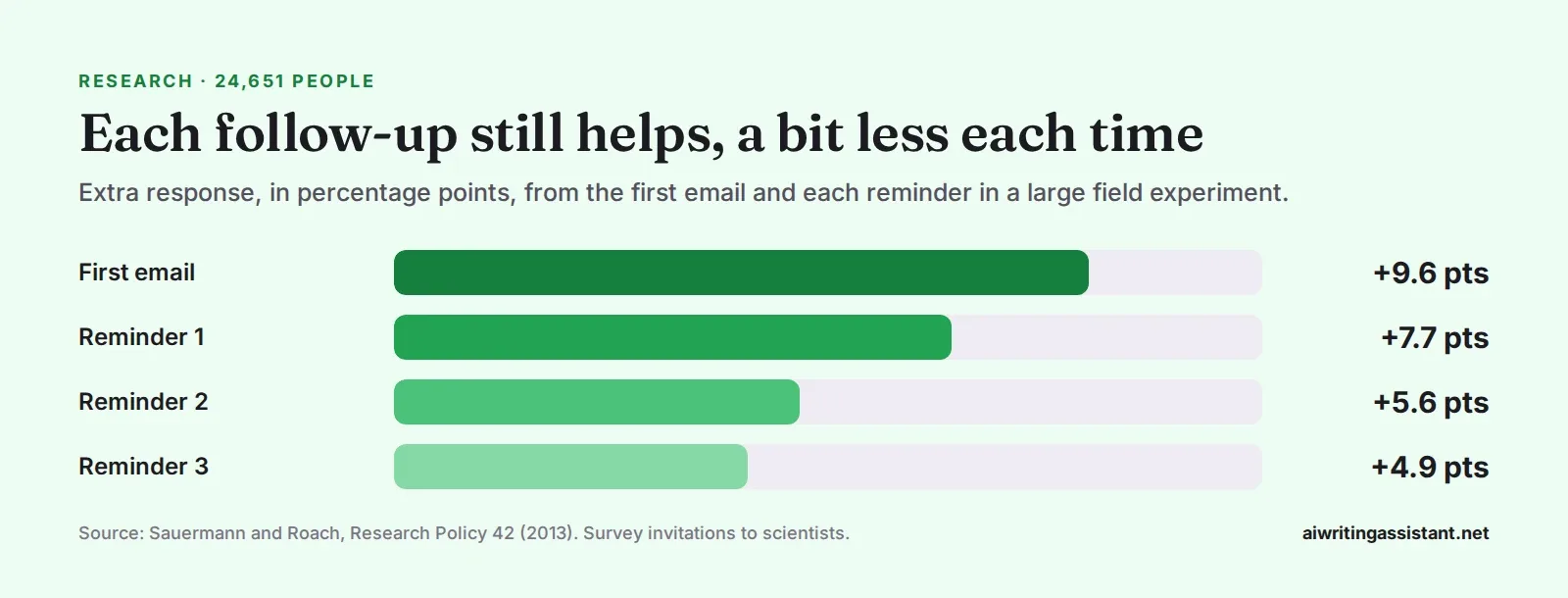
Two more findings from that study are useful. Waiting anywhere from 7 to 21 days between reminders made no significant difference. And reminders with new wording increased the odds of a response by 36% compared with resending the same text.
The context matters. These were survey invitations, not sales emails or job applications. But the same pattern, where each extra contact helps a little less, shows up in other research too.
How long should you wait before following up?
Most replies come fast or not at all. A study of two million email users found that more than 90% of replies happened within a day, and half came within 47 minutes. So if a few days have passed, your email was probably buried, not rejected.
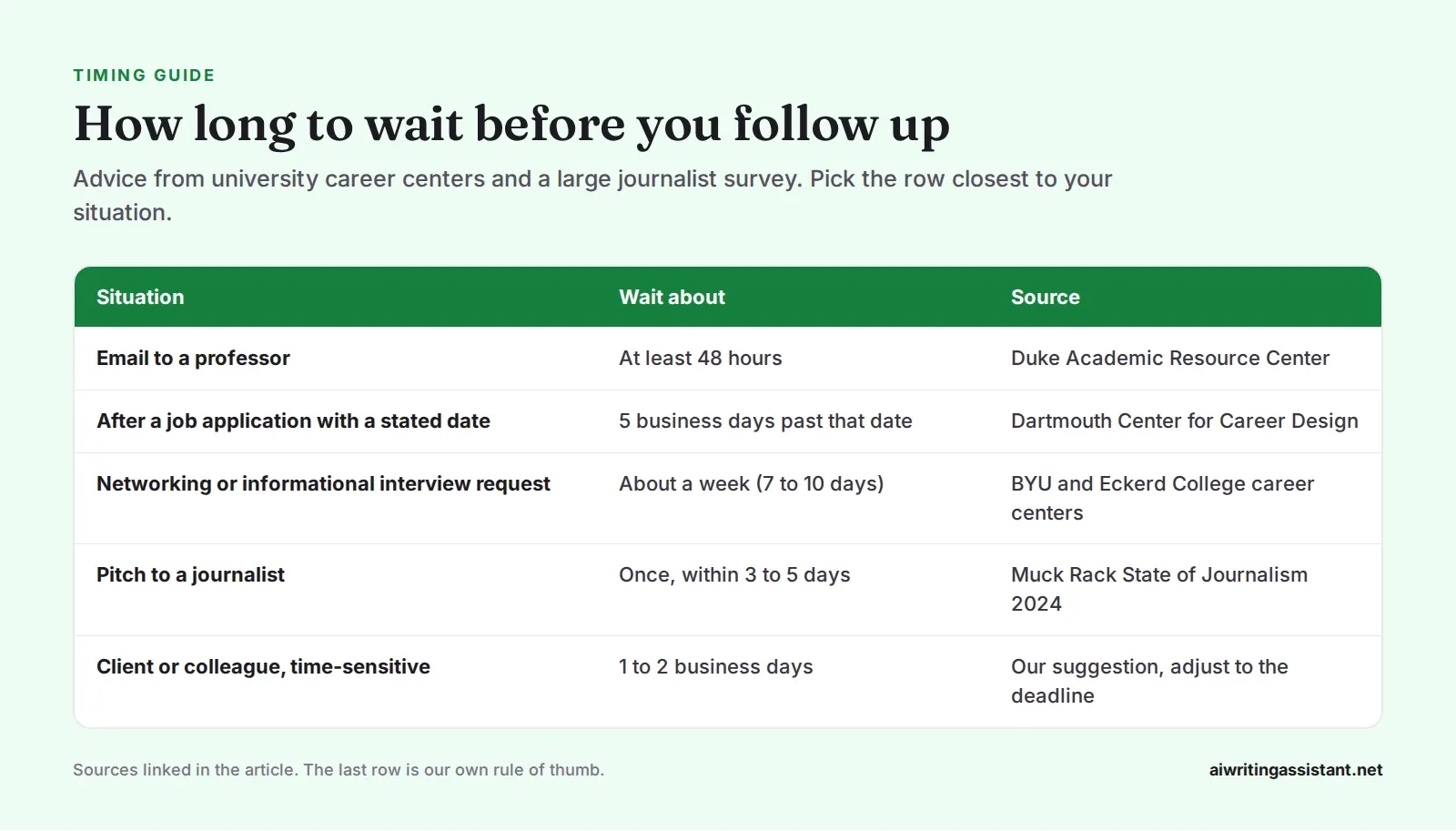
Career centers give similar numbers. BYU suggests a reminder about a week after the original email. Dartmouth says to follow up on a job if you hear nothing within five business days of the date you were given. For professors, Duke advises waiting at least 48 hours.
How to write the follow-up
- Reply in the same thread. The reader sees the original request without searching.
- Lead with the ask. "Following up on my question about the March invoice" tells them everything in one line.
- Add something new if you can. A short update, a useful link or a smaller version of the request gives them a reason to answer now.
- Make it easy to reply. Ask a yes or no question, or offer two specific times.
- Stay warm. Assume they're busy. Skip "per my last email" and "as I already mentioned."
- Set a gentle deadline when it matters. "If I don't hear back by Friday, I'll go ahead with option A."
Follow-up email templates
After a job application
Subject: Re: Marketing Coordinator application
Hi Ms. Alvarez,
I applied for the Marketing Coordinator role on 3 March and wanted to check whether you've had a chance to review applications. I'm still very interested, and since applying I've finished the campaign report I mentioned, which I'm happy to share. Is there anything else I can send to help?
Best regards,
Jordan Lee
After a networking request
Subject: Re: Quick question about your work in UX research
Hi Sam,
I know your inbox is busy, so I'll keep this short. Would you have 15 minutes next week for a call about getting into UX research? Tuesday or Thursday afternoon both work for me, or I can send three questions by email instead if that's easier.
Thanks,
Priya
To a client or colleague
Subject: Re: Logo files for the 12 May launch
Hi Daniel,
Checking in on the logo files. To keep the 12 May launch on track, we'd need them by Wednesday. If the final versions aren't ready, the drafts are fine for now. Could you send whichever is easiest?
Thanks,
Mia
The final follow-up
Subject: Re: Partnership idea
Hi Alex,
I haven't heard back, so I'll assume the timing isn't right and won't keep filling your inbox. If things change, I'd still be glad to talk. Thanks for considering it.
Best,
Chris
How many follow-ups is too many?
For most situations, one or two. BYU suggests one or two follow-ups and then moving on. Journalists are stricter. In the Muck Rack State of Journalism 2024 survey, reported by PR Daily, 51% said to follow up only once. The final note above is a polite way to end the thread without burning the relationship.
Mistakes that make follow-ups fail
- Following up too soon. Two hours after a non-urgent email feels like pressure.
- Guilt or sarcasm. "I guess you didn't see this" or "Per my last three emails" makes people less likely to reply.
- A new thread with no context. The reader has to dig for what you're asking.
- A bigger ask the second time. Make the follow-up easier to answer, not harder.
- Copy-pasting the first email. The research above suggests fresh wording works better.
There's also a dedicated follow-up email generator, and our guide on how to end an email covers closing lines that get replies.
Frequently asked questions
How long should I wait to follow up on an email?
About a week for networking or job emails, at least 48 hours for a professor, and less if there's a real deadline.
How many follow-up emails should I send?
Usually one or two. After that, send a short final note and move on.
Do follow-up emails work?
Yes. In a field experiment with 24,651 people, each reminder raised the response rate, by 9.6 to 4.9 percentage points.
Should I resend the same email?
Better not. In the same study, reminders with new wording raised the odds of a response by 36%.
Should I follow up in the same thread?
Usually yes, so the reader can see your original message without searching for it.
How do you politely say you haven't heard back?
Try "I wanted to check in on my email from Tuesday" and restate the request in one line.
Is it rude to follow up?
No. Most people appreciate a reminder, as long as it's spaced out, short and friendly.
 Grammar Checker
 Paraphraser
 Summarizer
 AI Writer
 AI Humanizer
 Text Compare