
A press release has one job. Make it easy for a busy journalist to see the news, check the facts and write a story. That's why the format is so rigid. Editors know exactly where to look for each piece of information.
This guide covers the structure, how to write each part, a full example, and the mistakes that send releases straight to the trash.
How do you write a press release?
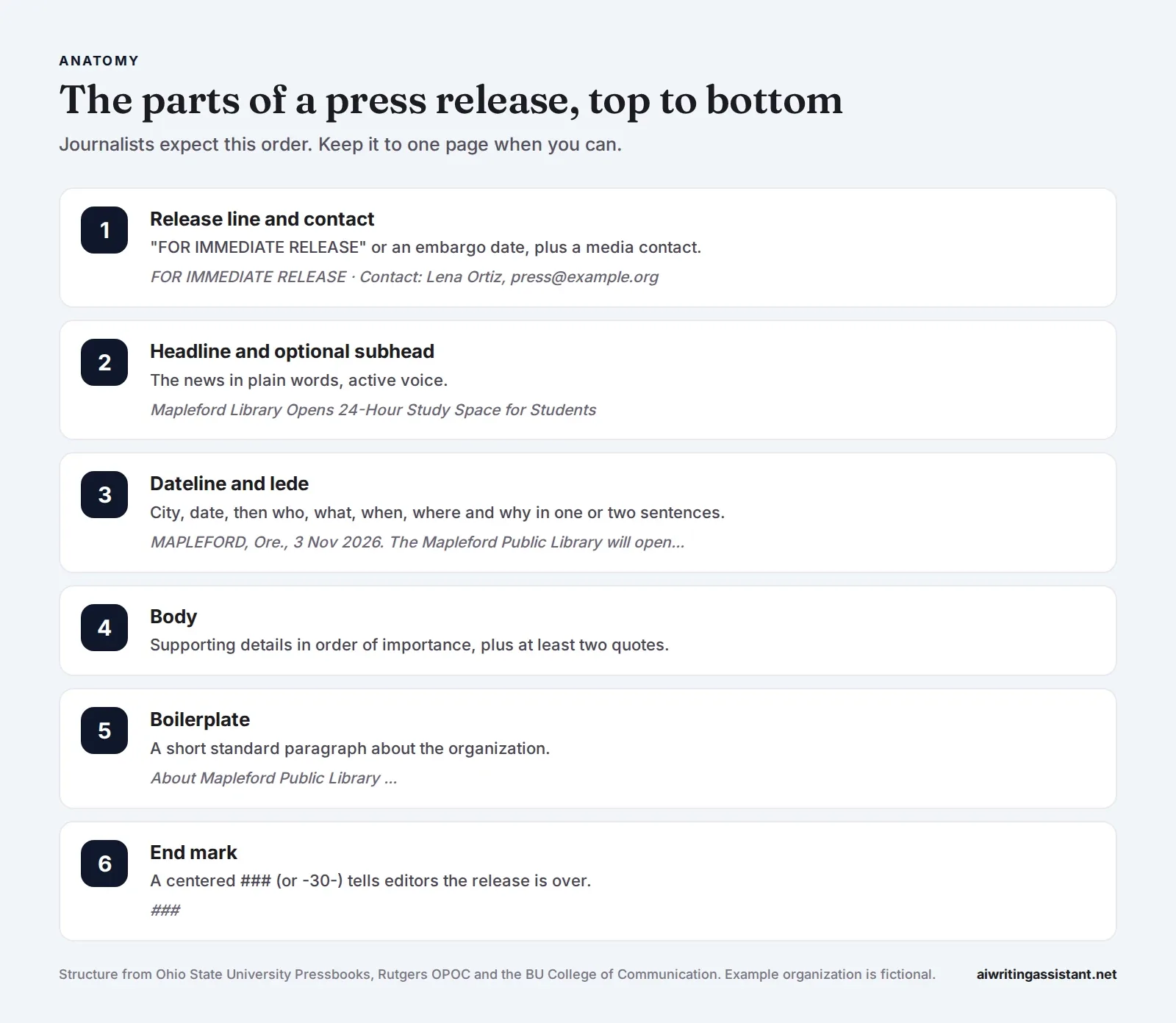
Start with "For Immediate Release" or an embargo date and a media contact. Write a clear headline that states the news. Open the body with a dateline (city and date), then a lede that covers who, what, when, where and why in one or two sentences. Add supporting details in order of importance and at least two short quotes. Finish with a boilerplate paragraph about your organization and end with ###. Keep it to one page if you can.
The structure of a press release
University guides agree on the order. The Ohio State University Pressbooks chapter on press releases lists a headline, an optional subheadline, a dateline, a summary lead, at least two quotes and a boilerplate, ending with ### or -30-.
1. Release line and contact
At the top, write "FOR IMMEDIATE RELEASE" if the news can be published now, or "EMBARGOED UNTIL [date and time]" if it can't. Include one media contact with a name, email and phone number. If a journalist has a question, they shouldn't have to hunt.
2. Headline
State the news in plain words. Use an active verb and leave out hype.
| Weak | Better |
|---|---|
| Exciting News From Mapleford Library! | Mapleford Library Opens 24-Hour Study Space for Students |
| Acme Announces Revolutionary Partnership | Acme and City College Launch Free Coding Course for Adults |
3. Dateline and lede
The dateline gives the city and date the news comes from. A real example from a 2026 release by the PR company Cision opens with "CHICAGO, May 13, 2026 /PRNewswire/." The wire service name appears when a release goes out through a distribution service.
The lede is the first sentence or two after the dateline. Rutgers advises conveying the whole story in one sentence covering who, what, where, when and how. The BU College of Communication writing center calls the lede the most critical part of the release. If a journalist reads nothing else, they should still have the story.
4. Body and quotes
Write the rest in order of importance, the inverted pyramid. Each paragraph should be less essential than the one before it, so an editor can cut from the bottom without losing the news. Ohio State recommends at least two quotes, typically one from your organization and one from a partner, customer or expert.
Make quotes sound like a person talking. "We're thrilled to announce this exciting milestone" adds nothing. "Students told us the library closed just when they needed it most" gives a journalist something to use.
5. Boilerplate
The boilerplate is a short "About us" paragraph that goes at the bottom of every release, according to BU. Keep it to three or four sentences covering who you are, what you do and where to learn more.
6. End mark
Rutgers explains that "Usually a centered ### lets journalists know that this is the end." Some organizations use -30- instead. If the release runs past one page, Ohio State suggests writing "more" at the bottom of the first page.
How long should a press release be?
Short. Ohio State says one page at most, and Rutgers says "Keep it to one or two pages." If you need more room, link to a press kit or fact sheet instead of stretching the release.
Use AP style for numbers, dates and titles if you're sending to news outlets, as Rutgers recommends. Our free Word Counter helps you keep the release tight.
Do journalists still read press releases?
Yes. In the 2025 Cision State of the Media survey of more than 3,000 journalists, 72% said press releases were the most useful resource PR teams provide. The 2026 edition, with 1,899 journalists, found that 66% rely on PR content, including releases, for story ideas.
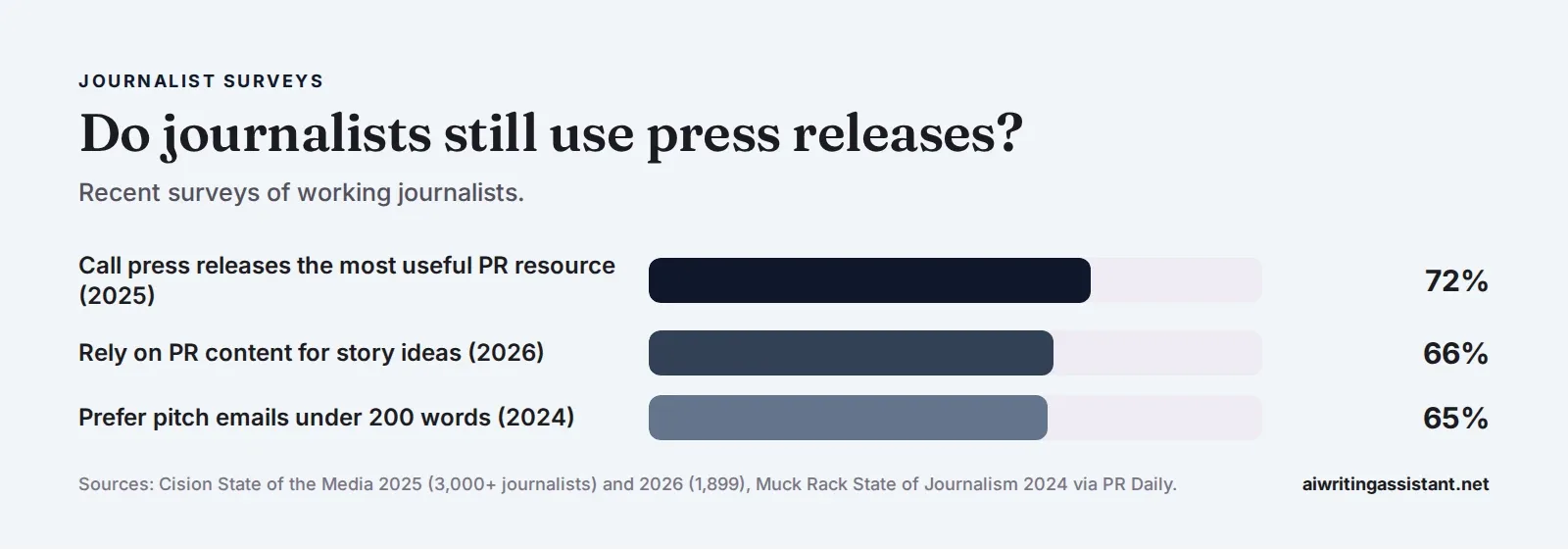
The email you send with the release matters too. In the Muck Rack State of Journalism 2024 survey, reported by PR Daily, 65% of journalists said they prefer pitches under 200 words. Put a two-line summary in the email body and attach or paste the release below it.
Press release example
FOR IMMEDIATE RELEASE
Media contact: Lena Ortiz, Communications Manager, press@maplefordlibrary.example, (555) 010-0142
Mapleford Library Opens 24-Hour Study Space for Students
Free space with Wi-Fi, quiet rooms and security staff opens 3 November
MAPLEFORD, Ore., 20 Oct 2026. The Mapleford Public Library will open a 24-hour study space on 3 November, giving students a free, safe place to work through the night during exam season.
The space, on the library's ground floor, will have 80 seats, six bookable quiet rooms, Wi-Fi and security staff on site overnight. Entry requires a free library card.
"Students told us the library closed just when they needed it most," said Director Amir Haddad. "This is our answer."
"Many of our students work during the day and study at night," said Dr. Jo Kim, dean of students at Mapleford Community College. "Having a safe place open at 2 a.m. will make a real difference."
The study space is funded by a city grant and will run through June 2027, when the library will review usage.
About Mapleford Public Library
Mapleford Public Library serves 300,000 residents through eight branches. Learn more at maplefordlibrary.example.
###
Press release mistakes to avoid
- Burying the news in the third paragraph.
- Hype words such as "revolutionary," "game-changing" or "world-class" with nothing to back them.
- Quotes that say nothing. If a quote could appear in any release, cut it.
- No contact details, or a contact who doesn't answer.
- Too long. Three pages of detail usually means the news isn't clear yet.
- Attachments only. Paste the text into the email as well, so the journalist can read it right away.
For the email that goes with it, see our guide on writing a professional email.
Frequently asked questions
What are the parts of a press release?
A release line, contact, headline, dateline, lede, body with quotes, boilerplate and an end mark such as ###.
What does ### mean at the end of a press release?
It tells journalists the release has ended. Some organizations use -30- instead.
How long should a press release be?
One page if possible and no more than two, according to university communication guides.
What is a boilerplate in a press release?
A short, standard "About us" paragraph at the bottom that describes the organization.
What is the inverted pyramid?
Putting the most important information first and less important details later, so editors can cut from the bottom.
How many quotes should a press release have?
Usually at least two, often one from your organization and one from a partner or expert.
Do journalists still read press releases?
Yes. In a 2025 survey of 3,000+ journalists, 72% called press releases the most useful resource PR teams provide.
 Grammar Checker
 Paraphraser
 Summarizer
 AI Writer
 AI Humanizer
 Text Compare