
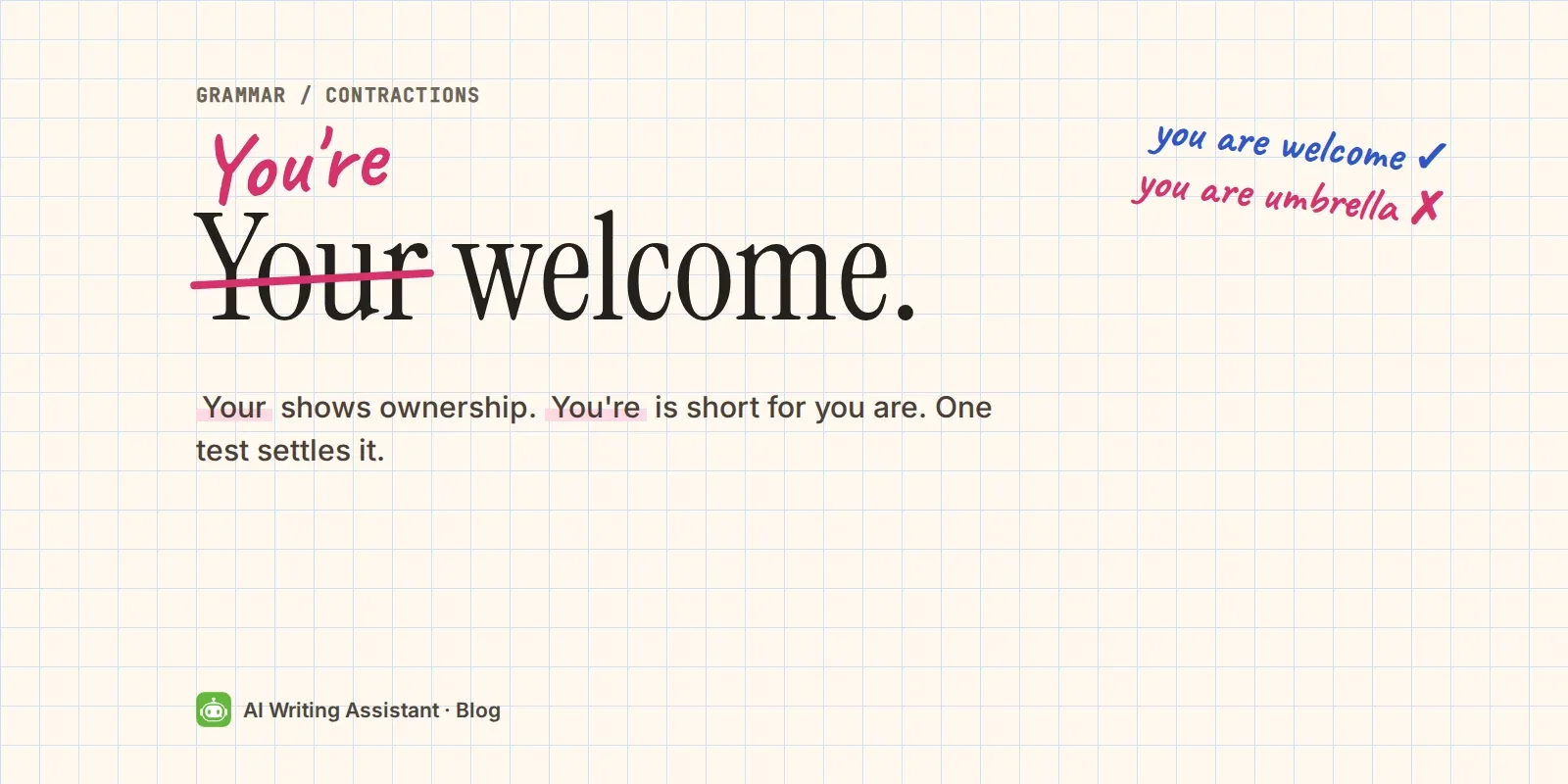
Your and you're often sound the same, so it's no surprise they get swapped in texts, emails and comments. The fix takes about two seconds once you know the test.
What is the difference between your and you're?
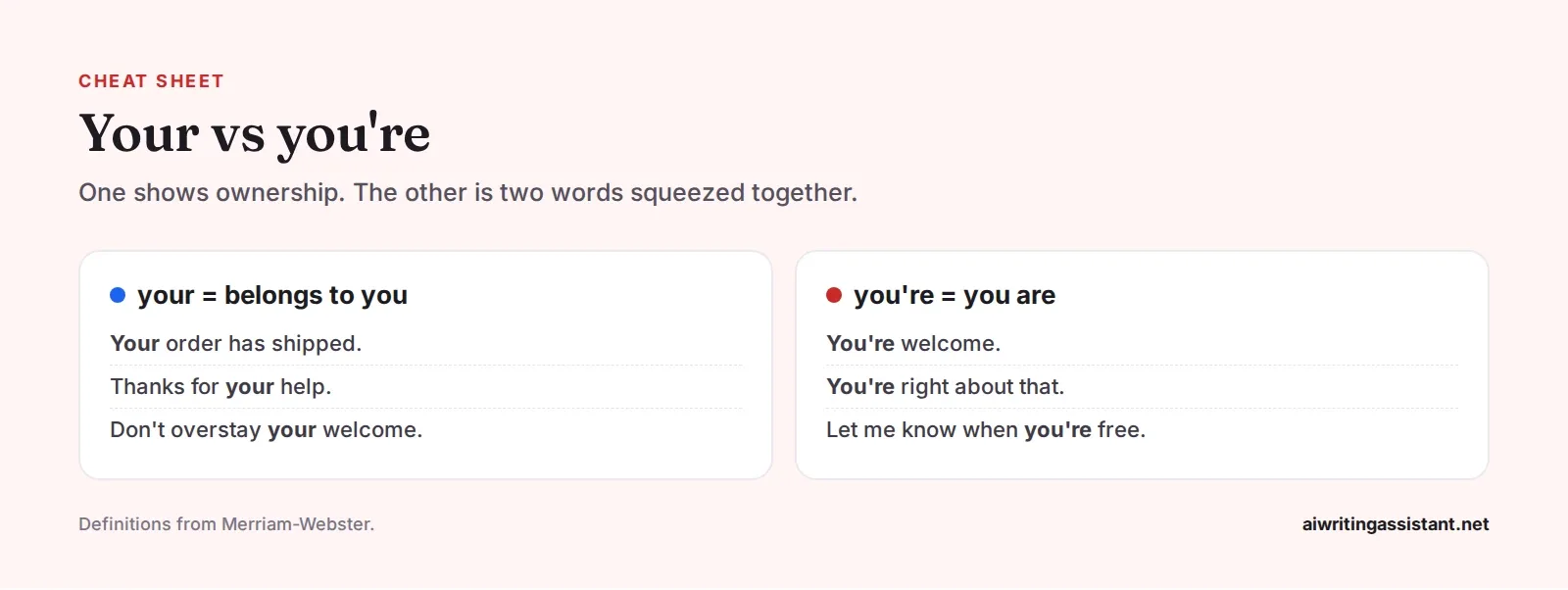
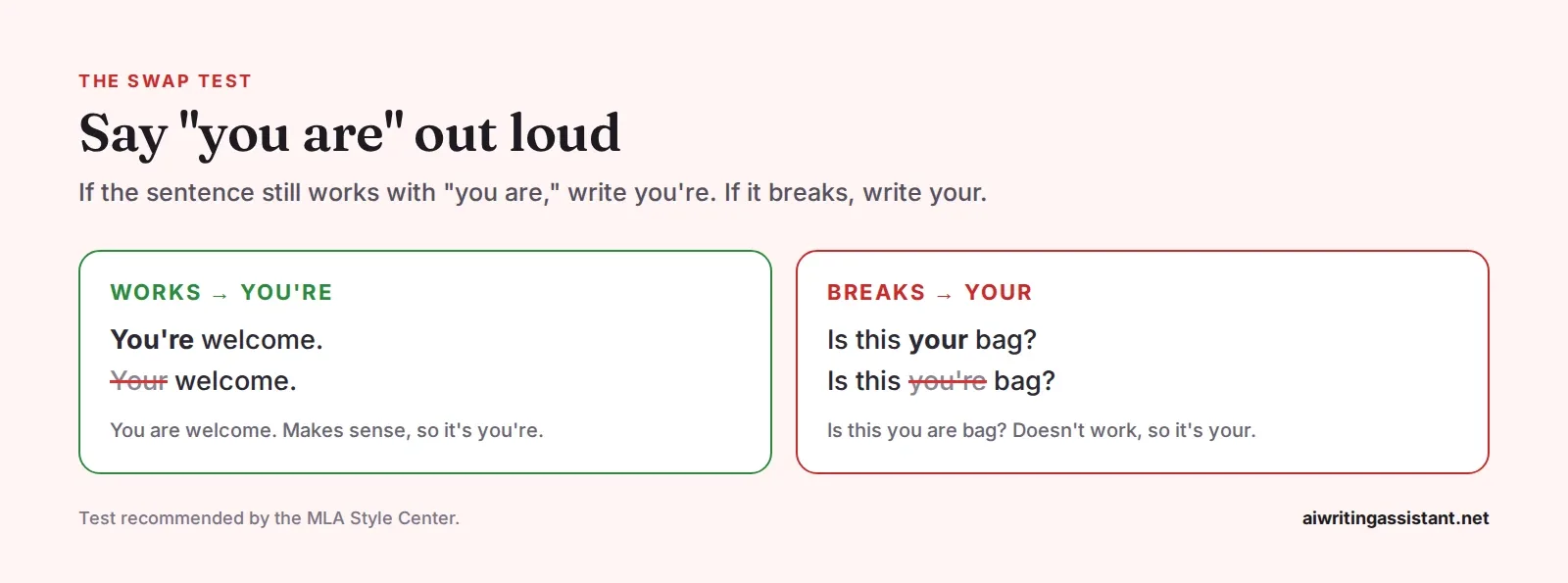
Your is possessive. It shows that something belongs to or relates to the person you're talking to, as in "your coat" or "your idea." You're is a contraction of "you are," as in "you're welcome" or "you're next." To decide, replace the word with "you are." If the sentence still makes sense, use you're. If it doesn't, use your.
When to use your
Merriam-Webster defines your as "of or relating to you or yourself or yourselves especially as possessor." It comes from the Old English word eower, according to Etymonline.
- Is this your seat?
- Thanks for your patience.
- Wash your hands before dinner.
Your also has a casual sense meaning "a typical one," as in "your average commuter." Merriam-Webster lists this use too.
When to use you're
You're is short for "you are." Merriam-Webster dates it to around 1590. The apostrophe replaces the "a" in "are."
- You're welcome.
- I think you're right.
- Call me when you're home.
The "you are" test
The MLA Style Center recommends a simple check. Swap in "you are." If the sentence still works, write you're. If it doesn't, write your. The MLA example is "Your umbrella is on the table." Try "You are umbrella is on the table" and it falls apart, so your is right.
Is it "your welcome" or "you're welcome"?
When someone thanks you, the reply is you're welcome, meaning "you are welcome." Merriam-Webster notes that welcome is "used in the phrase you're welcome as a reply to an expression of thanks." Etymonline says this reply is recorded by 1907.
"Your welcome" isn't always wrong, though. In phrases where welcome is a noun, your is correct.
- Don't overstay your welcome. (Merriam-Webster lists "overstay one's welcome.")
- Thank you for your welcome last weekend. (the welcome you gave us)
- Did you get your welcome email? (the welcome email sent to you)
Your vs you're in common phrases
| Correct | Why |
|---|---|
| You're welcome | You are welcome |
| You're right | You are right |
| See you when you're back | When you are back |
| Your call | The decision belongs to you |
| Mind your own business | The business belongs to you |
| At your earliest convenience | Your convenience |
| You're the best | You are the best |
Why do people mix up your and you're?
Mostly because they sound alike in fast speech. The Oxford Learner's Dictionaries list the same weak pronunciation for both. Typing on a phone makes it worse, since autocorrect tends to accept whichever one you start.
Spell check won't help either, because both are real words. In a large national study of college writing, Lunsford and Lunsford (2008) ranked spelling errors, including homonyms like these, fifth among the 20 most common errors.
Practice sentences
| Sentence | Answer |
|---|---|
| ___ going to love this. | You're (you are going) |
| Is that ___ dog? | Your (the dog belongs to you) |
| I hope ___ feeling better. | You're (you are feeling) |
| Send me ___ address. | Your |
| ___ welcome to join us. | You're (you are welcome to join) |
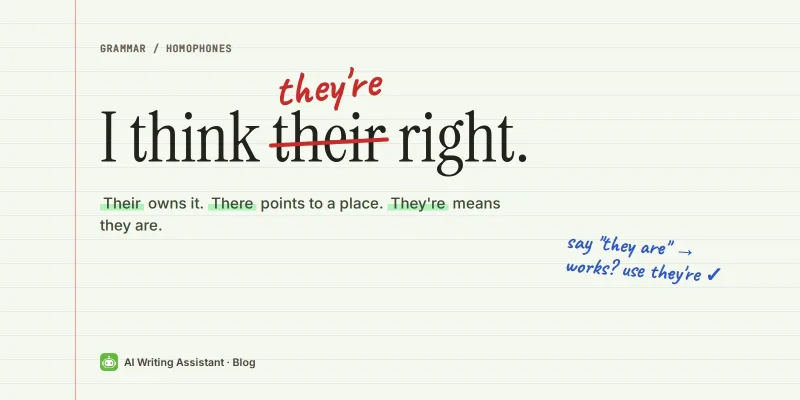
More confusing pairs are covered in our guides to their, there and they're and former vs latter.
Frequently asked questions
What is the difference between your and you're?
Your shows possession, as in "your car." You're means "you are," as in "you're late."
Is it "your welcome" or "you're welcome"?
As a reply to thanks, it's "you're welcome," because it means "you are welcome."
Is "your welcome" ever correct?
Yes, when welcome is a noun, as in "don't overstay your welcome" or "your welcome email."
How can I remember which one to use?
Say "you are" in its place. If the sentence still makes sense, write you're.
Is it "your right" or "you're right"?
When you mean someone is correct, it's "you're right." "Your right" means a right that belongs to you, as in "your right to vote."
Is "your" a pronoun?
Dictionaries label it differently. Merriam-Webster calls it an adjective, and Oxford Learner's calls it a determiner. Either way, it shows possession.
Why doesn't spell check catch your and you're?
Both are spelled correctly, so a basic spell checker sees no error. A grammar checker that reads context can catch it.
 Grammar Checker
 Paraphraser
 Summarizer
 AI Writer
 AI Humanizer
 Text Compare