
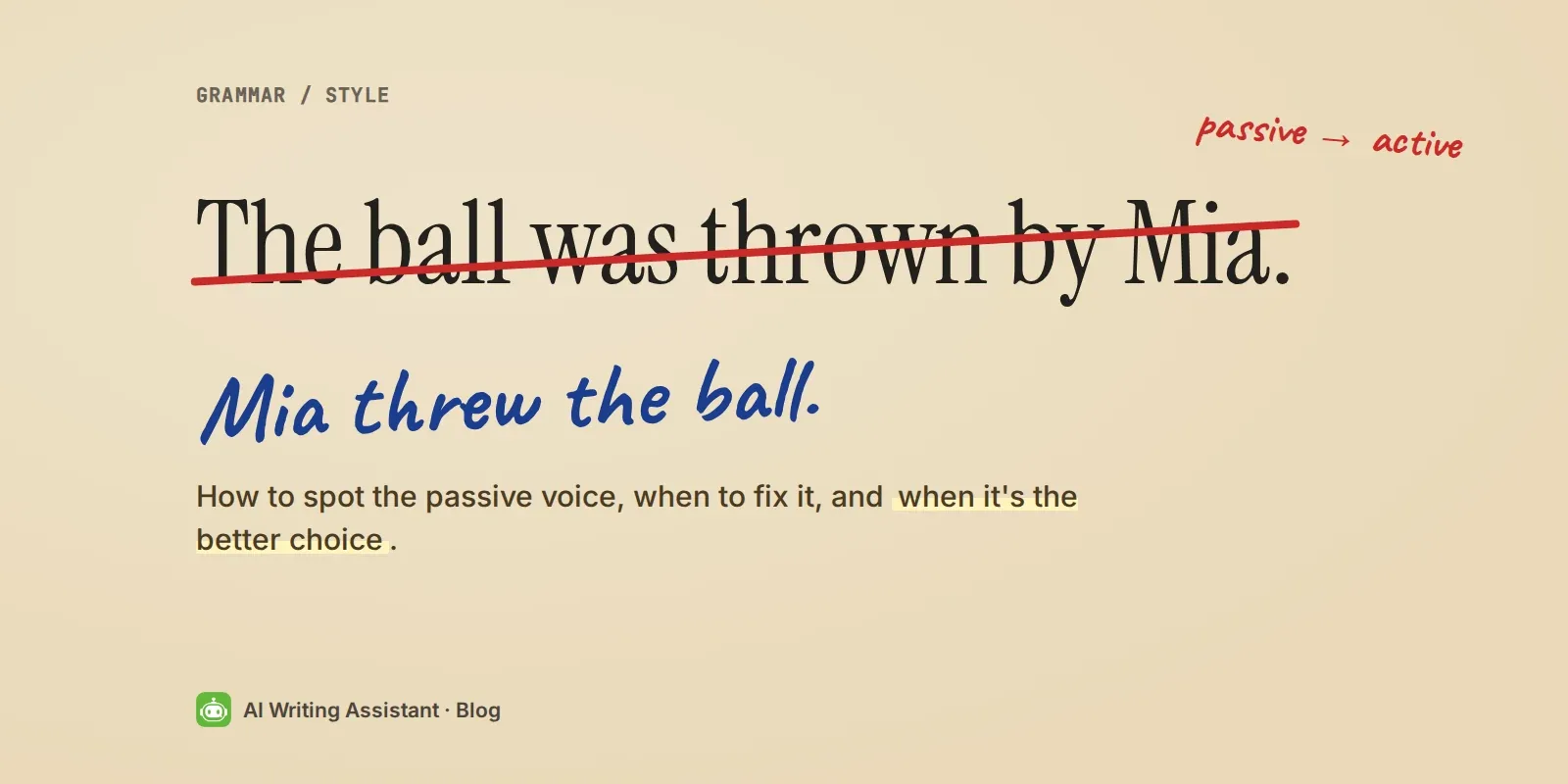
Few writing rules get repeated as often as "avoid the passive voice." Teachers circle it, grammar checkers underline it, and a lot of people end up afraid of the word "was." But the passive isn't wrong. It's a tool, and once you know what it does, you can decide when to use it.
What is active vs passive voice?
Voice describes whether the subject of a sentence does the action or receives it. In the active voice, the subject acts. "The committee approved the plan." In the passive voice, the subject is acted on, and the doer moves to a "by" phrase or disappears. "The plan was approved (by the committee)." Both are correct English. Active is usually shorter and clearer. Passive is useful when the doer is unknown, obvious or less important than what happened.
How to identify passive voice
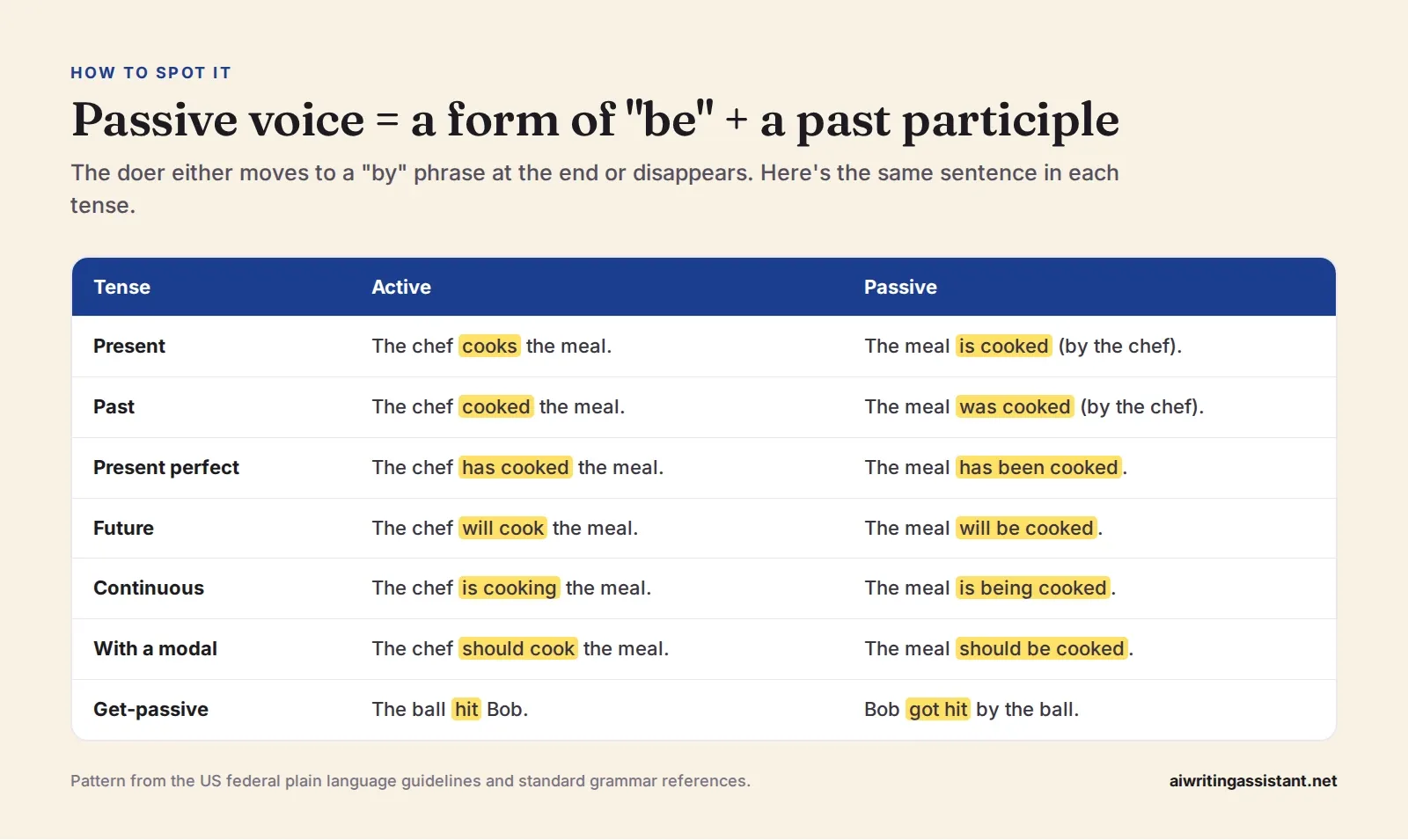
The US federal plain language guidelines give a simple test. A passive sentence has two parts in the verb.
- A form of the verb "be": am, is, are, was, were, be, being or been.
- A past participle: usually ending in -ed or -en, like approved, written, taken or stolen.
If both are there and the subject is receiving the action, it's passive. Their example pair is "The company polluted the lake" (active) and "The lake was polluted by the company" (passive).
Things that look passive but aren't
Linguist Geoffrey Pullum has shown that many sentences labeled passive, even in famous style guides, aren't. These are all active.
- "She is tired." Tired works as an adjective here. Nobody "tired" her.
- "He was walking home." That's the past continuous. He's still the one walking.
- "There were problems." No action is being done to anyone.
- "The door is open." Open is an adjective, describing the door.
Why most style guides prefer active voice
- It's clearer about who does what. The plain language guidelines say "Active voice makes it clear who should do what." That matters in instructions, contracts and policies.
- It's usually shorter. The passive adds "was" or "been" and often a "by" phrase.
- APA prefers it. APA Style encourages using the active voice in academic writing (section 4.13 of the 7th edition).
- The classics say so. "Use the active voice" is one of the rules in William Strunk's The Elements of Style. George Orwell's 1946 essay says "Never use the passive where you can use the active."
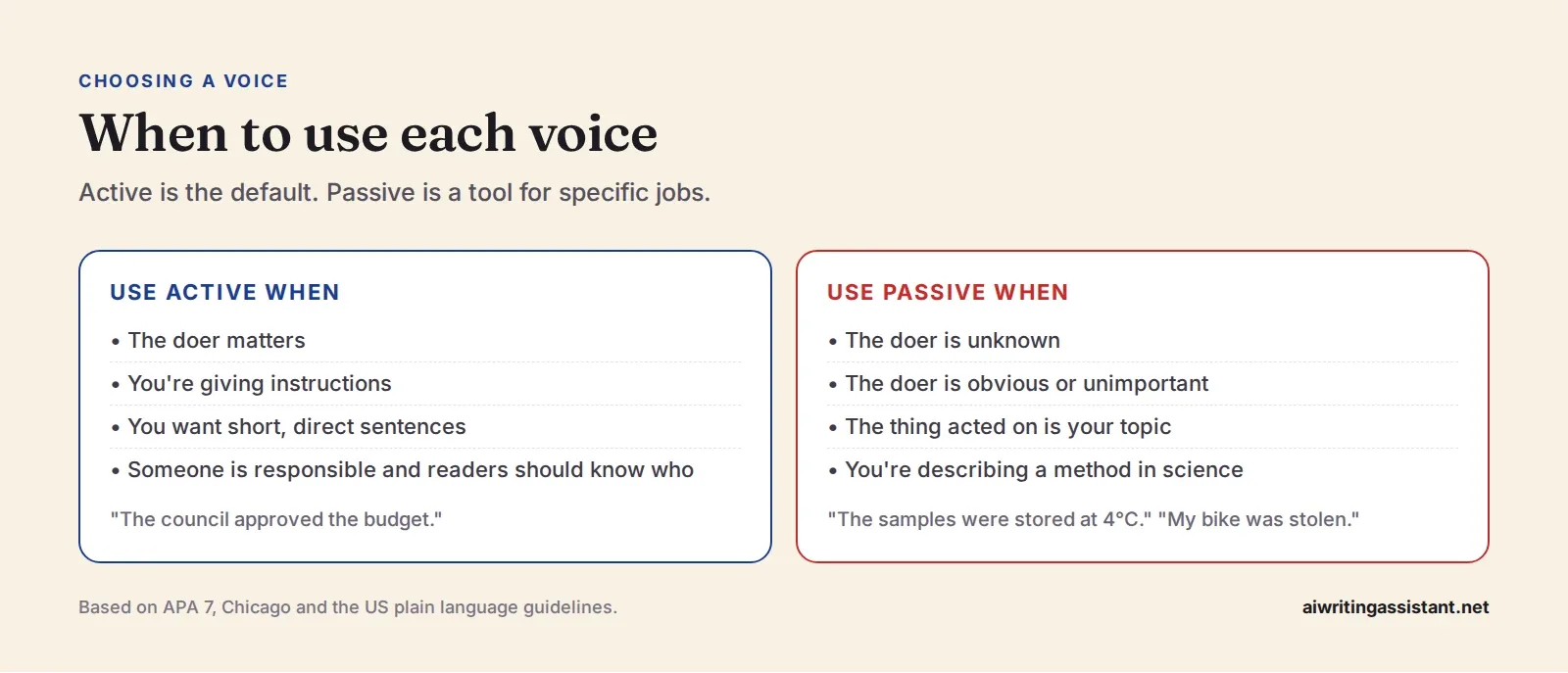
When passive voice is the better choice
The same sources leave room for the passive. Strunk himself wrote that it is "frequently convenient and sometimes necessary." Orwell's last rule was "Break any of these rules sooner than say anything outright barbarous."
- The doer is unknown. "My bike was stolen." You don't know who stole it.
- The doer is obvious. "He was arrested." It was the police.
- The thing acted on is your topic. In a report about a bridge, "The bridge was built in 1932" keeps the bridge at the front.
- Scientific methods. "The samples were heated to 80°C" keeps attention on the procedure, though many journals now accept "we heated the samples."
- Keeping a paragraph flowing. Psychologist Fernanda Ferreira argued in a 2021 paper that the passive helps keep the same topic at the start of each sentence, and that forcing everything into the active can "distort the writer's message."
How to change passive voice to active
- Find the doer. Look for the "by" phrase, or ask who did the action.
- Make the doer the subject. Move it to the front.
- Change the verb. Drop the form of "be" and use the main verb in the right tense.
| Passive | Active |
|---|---|
| The report was written by the intern. | The intern wrote the report. |
| Mistakes were made in the budget. | The finance team made mistakes in the budget. |
| Your application has been received. | We have received your application. |
| The rules will be explained at the meeting. | The manager will explain the rules at the meeting. |
Pullum makes a fair point in his paper "Fear and loathing of the English passive." He found that about 26% of the transitive verbs in Orwell's own anti-passive essay are passive, compared with roughly 17% in typical prose. Good writers use the passive all the time. They just use it on purpose.
Frequently asked questions
What is the difference between active and passive voice?
In the active voice the subject does the action ("Mia threw the ball"). In the passive voice the subject receives it ("The ball was thrown by Mia").
How do you identify passive voice?
Look for a form of "be" (is, was, were, been) plus a past participle (thrown, written, made), with the subject receiving the action. Try adding "by zombies" after the verb.
Is passive voice wrong?
No. It's grammatically correct. Style guides prefer active because it's usually clearer, but passive is better when the doer is unknown, obvious or unimportant.
Why do teachers say to avoid passive voice?
Because active sentences are usually shorter and make it clear who did what. Overusing the passive can make writing vague and wordy.
Should I use passive voice in scientific writing?
It's common in methods sections. Many journals and APA now also accept the active voice with "we," so check your journal's or teacher's guidelines.
How do you change passive voice to active?
Find who did the action, make them the subject, and use the main verb without "be." "The report was written by Sam" becomes "Sam wrote the report."
Is "I was born" passive voice?
Yes, technically. It's a passive with no doer named, and it's the natural way to say it in English.
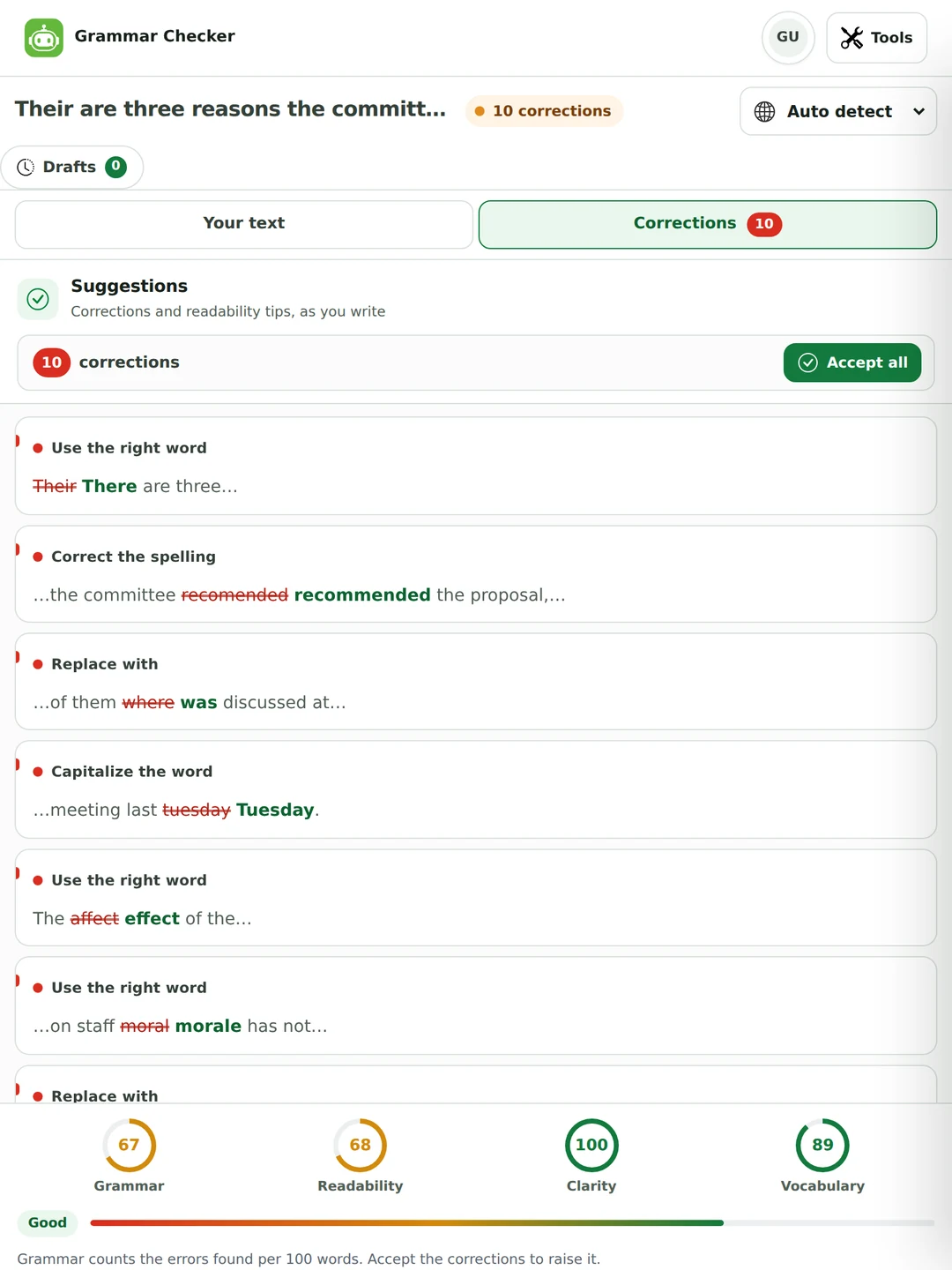
 Grammar Checker
 Paraphraser
 Summarizer
 AI Writer
 AI Humanizer
 Text Compare