
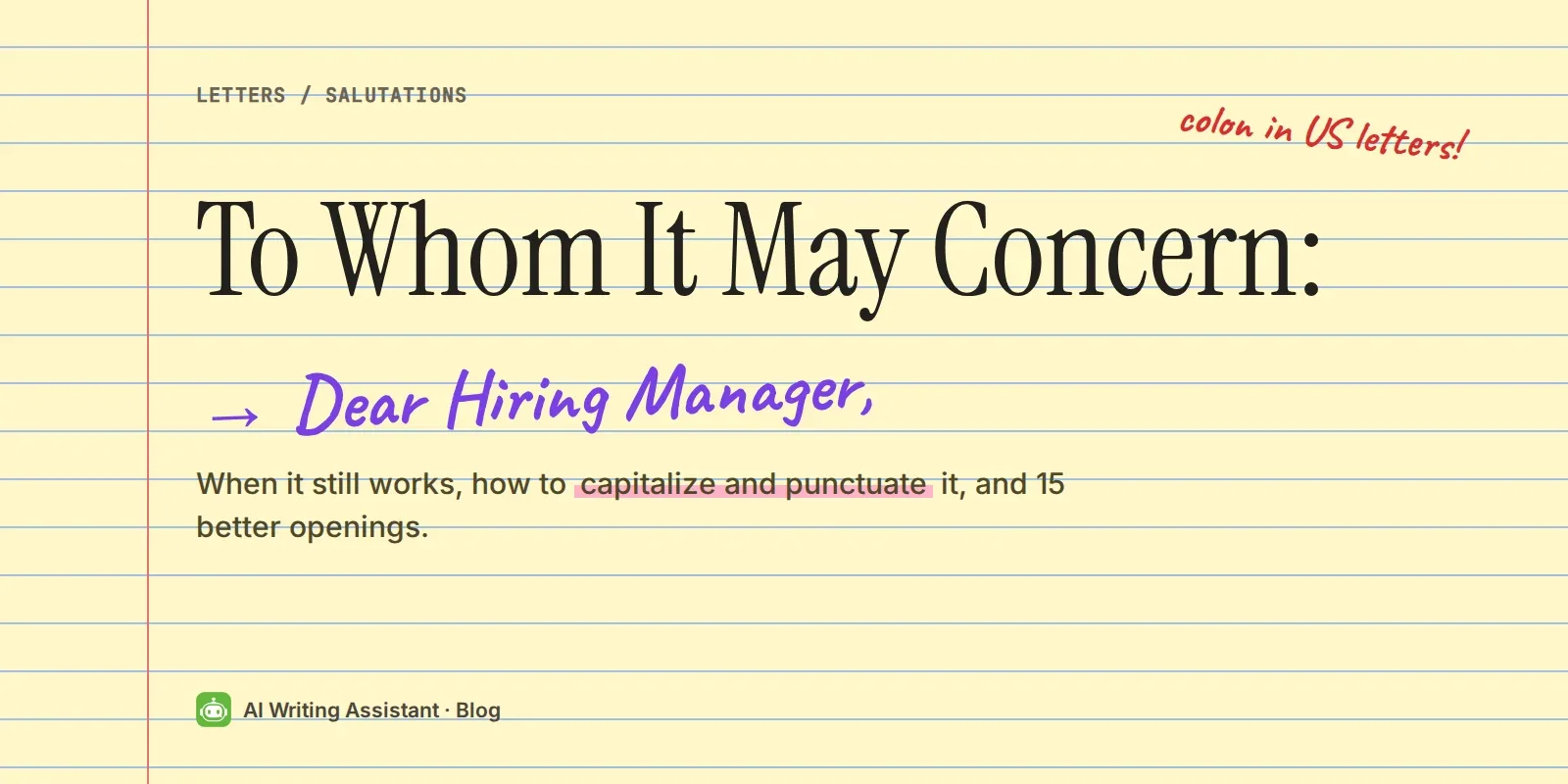
"To Whom It May Concern" is the stiff old suit of letter greetings. It always fits, it's never wrong, and it rarely makes a great impression. Knowing when to use it, and what to use instead, makes your letters feel like they were written to a person.
What does "To Whom It May Concern" mean?
It's a formal salutation used at the start of a letter "when you do not know the name of the person," as the Longman Dictionary puts it. It means "to whoever this letter is relevant to." Dictionary.com dates the phrase to the second half of the 1800s, when it was common in references and official notices.
How to write "To Whom It May Concern" correctly
Capitalization
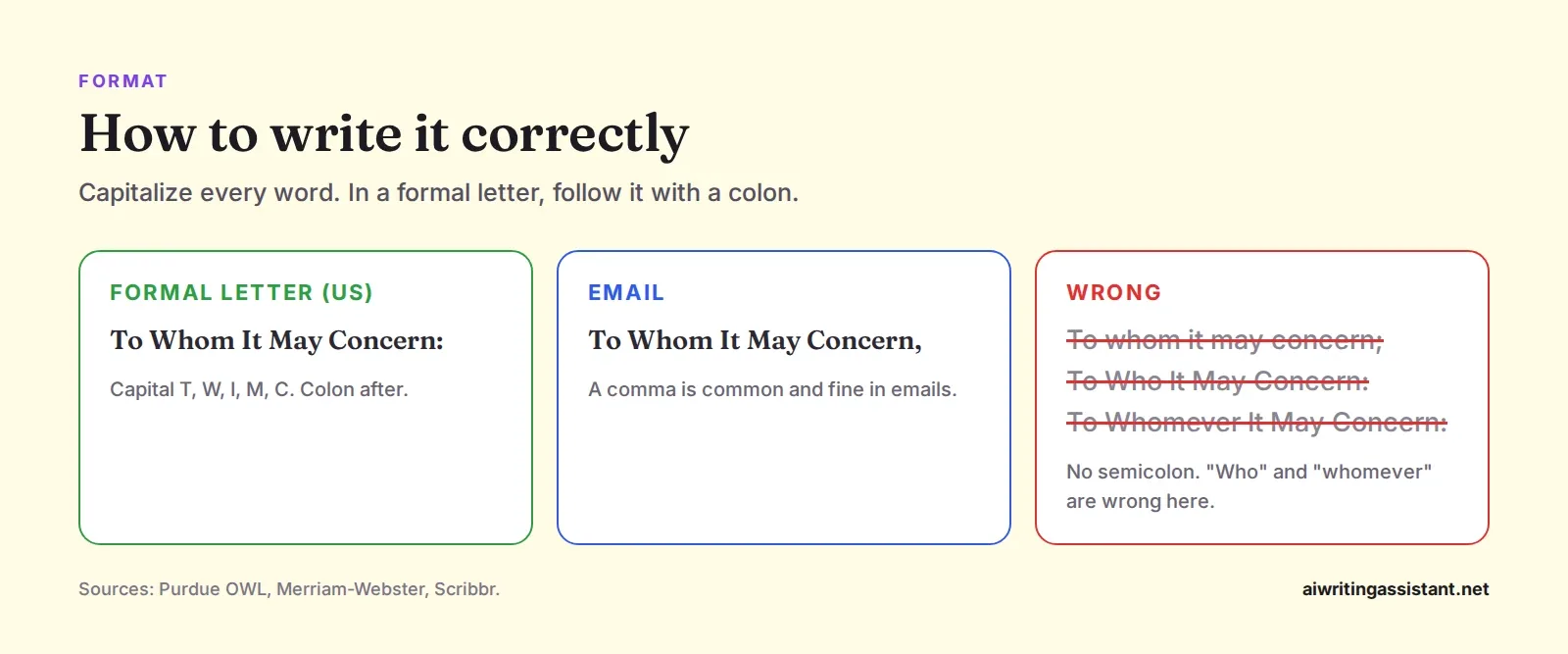
Capitalize every word, To Whom It May Concern. It works like a title or a name in the greeting line. Writing "To whom it may concern" in lowercase is a common slip in emails.
Punctuation
In a formal letter, put a colon after it. Purdue OWL advises a colon after the salutation in business letters, "never a comma." In emails, a comma is common and perfectly acceptable. Never use a semicolon.
Spacing
Put it on its own line, then leave one blank line before the first paragraph.
Is it "whom" or "who"?
It's whom. Merriam-Webster defines whom as the "objective case of who," which means it's used for the person something happens to. In this phrase, "it" (the letter) is the subject and the reader is the object of "concern." The letter concerns them. So "whom" is right, and "To Who It May Concern" is a mistake.
"To Whomever It May Concern" is also wrong. "Whomever" means "any person at all," which doesn't fit the fixed phrase. Stick with "whom."
When is "To Whom It May Concern" still OK?
It's the right choice when you really can't know who will read the letter.
- Reference or recommendation letters that the person will send to several employers or schools.
- Formal complaints sent to a company in general, when there's no named contact.
- Letters of introduction or interest sent to several organizations.
- Official requests to an office or agency, such as a records request, when no name is listed.
- Letters that will be kept on file, like a proof-of-employment letter a former employee may show to a landlord or bank.
When should you avoid it?
In a cover letter or a first email to someone you could find, it can look like you didn't try. Most career advisers suggest a name or at least a job title. That said, it may matter less than people fear. In a 2020 Resume Companion survey of more than 1,000 US hiring managers, 83% said "To Whom It May Concern" would have little or no impact on their decision to interview someone. The survey came from a company that sells resume tools, and its method isn't published, but it's a useful reality check.
So it won't sink you. A specific greeting is just a small, free way to look more prepared.
15 alternatives to "To Whom It May Concern"
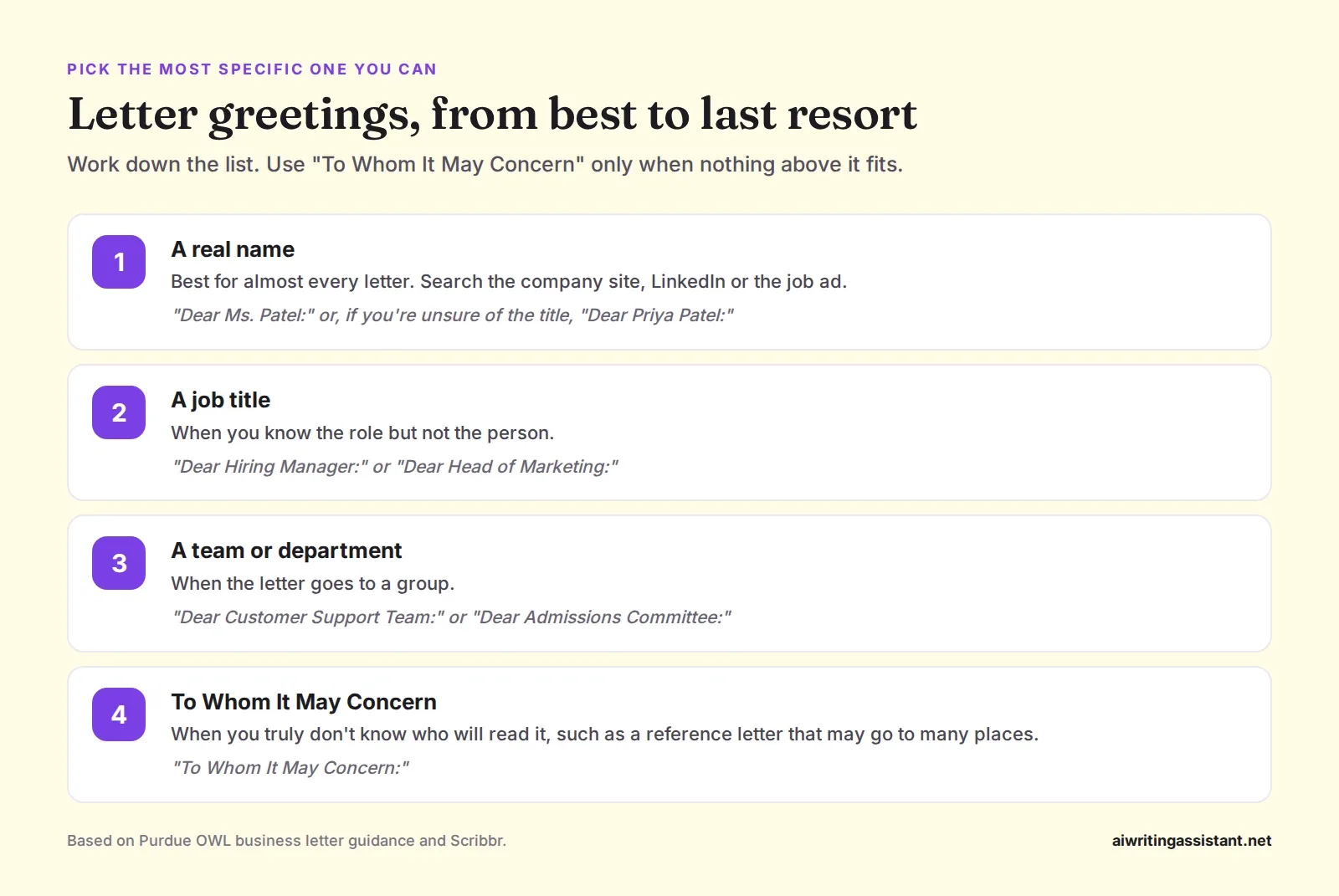
| Situation | Better greeting |
|---|---|
| You know the name | Dear Ms. Patel: / Dear Dr. Chen: / Dear Alex Morgan: |
| Job application, no name | Dear Hiring Manager: / Dear Recruiting Team: |
| You know the role | Dear Head of Marketing: / Dear Office Manager: |
| A department | Dear Customer Support Team: / Dear Billing Department: |
| School or university | Dear Admissions Committee: / Dear Scholarship Committee: |
| A group of readers | Dear Colleagues: / Dear Selection Panel: |
| Informal email to a team | Hello Marketing Team, / Hi everyone, |
| Very formal, unknown reader | Dear Sir or Madam: (dated, but still seen in British English) |
Example letter using "To Whom It May Concern"
This is a good use of the phrase. Jordan will send the letter to many employers, so there's no single reader to name.
Frequently asked questions
Is "To Whom It May Concern" capitalized?
Yes. Capitalize every word, as in To Whom It May Concern.
What punctuation goes after "To Whom It May Concern"?
A colon in a formal letter. A comma is fine in an email. Don't use a semicolon.
Is it "To Whom" or "To Who It May Concern"?
"To Whom." Whom is the object form, and the reader is the object of "concern." "To Who It May Concern" is incorrect.
Is "To Whom It May Concern" outdated?
It's formal and a little old-fashioned, but still correct. It's best for reference letters and formal letters to an unknown reader.
Can I use "To Whom It May Concern" in a cover letter?
You can, but a name or "Dear Hiring Manager" usually looks more prepared. A 2020 survey found most hiring managers said it had little or no effect, though.
What can I say instead of "To Whom It May Concern"?
Dear Hiring Manager, Dear [Team] Team, Dear [Job Title], Dear Admissions Committee, or the person's full name.
Can I use "To Whom It May Concern" in an email?
Yes, for formal emails to an unknown reader, like a general inquiry. Follow it with a comma. For most emails, "Hello" plus the team name sounds friendlier.
 Grammar Checker
 Paraphraser
 Summarizer
 AI Writer
 AI Humanizer
 Text Compare