
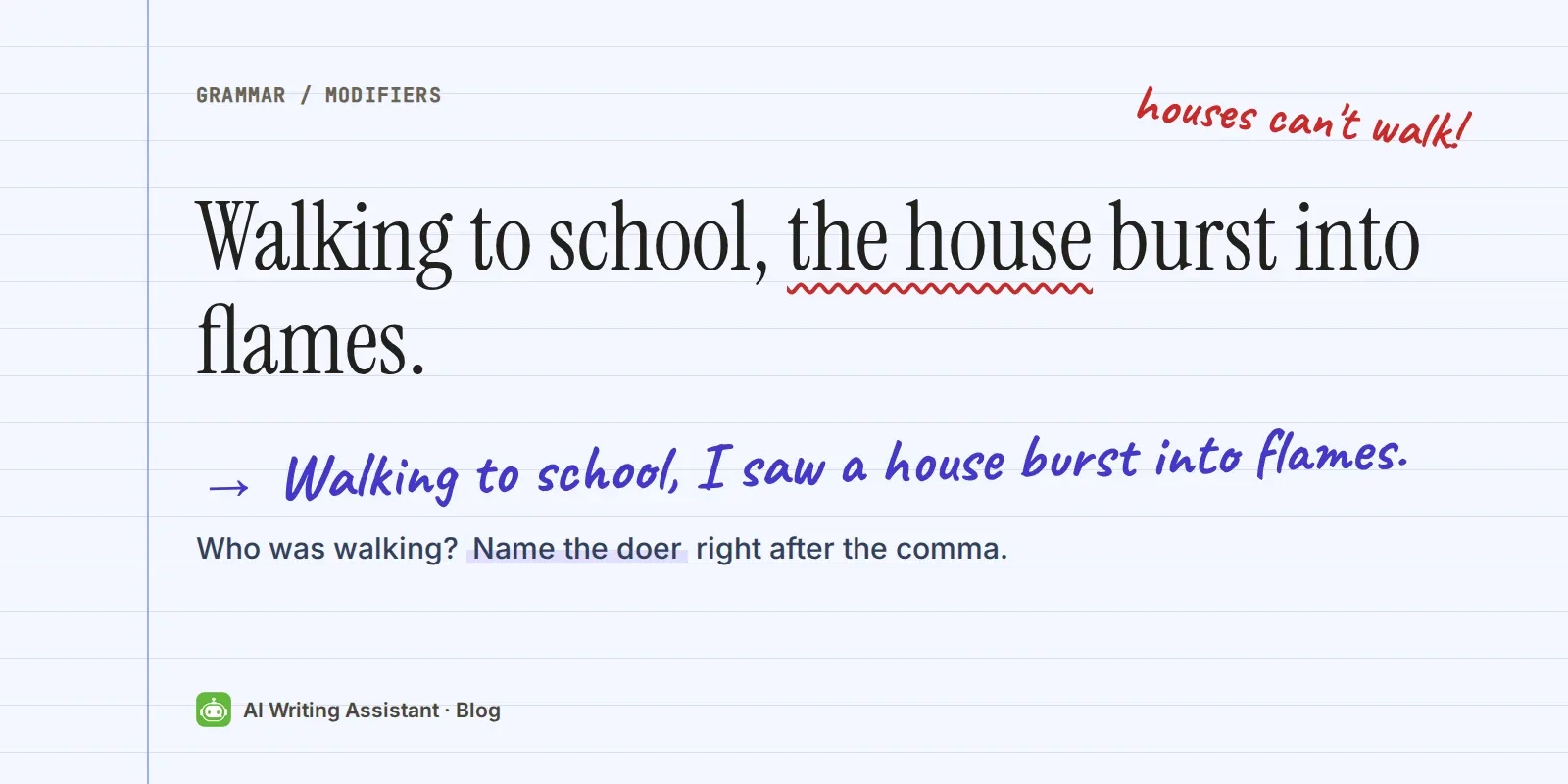
Dangling modifiers make readers picture odd things, like a house walking to school or a courtyard looking out of a window. They're easy to write because you know who you mean. The sentence just forgets to say it.
What is a dangling modifier?
A dangling modifier is a word or phrase that describes a word that isn't clearly stated in the sentence. The Purdue OWL uses that definition. In "Walking to school today, a house burst into flames," nobody in the sentence is walking, so the phrase grabs the nearest noun, the house. You fix it by naming the doer, as in "Walking to school today, I saw a house burst into flames."
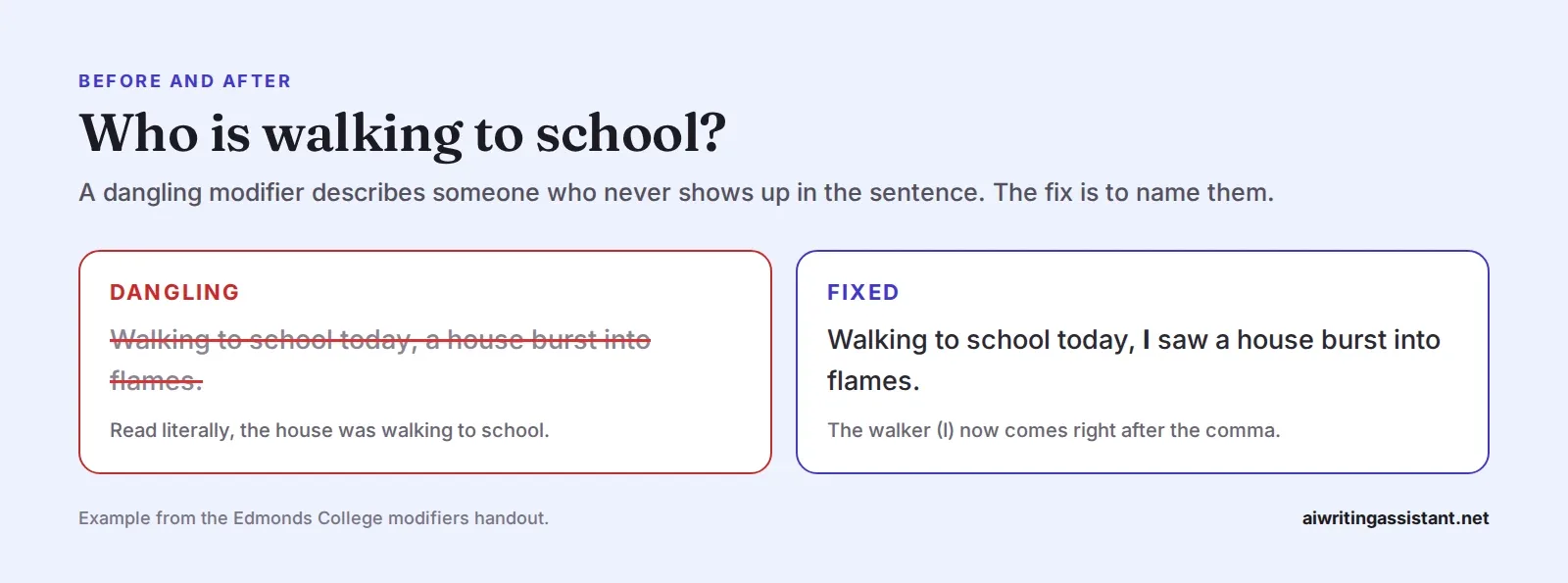
The Australian Government Style Manual puts it another way. A dangler is an opening phrase whose implied subject is different from the subject of the main clause. Its rule of thumb is simple. Follow an introductory phrase with the noun it describes.
Dangling vs misplaced modifiers
These two get mixed up a lot, but the problem is different. The Utah Valley University Writing Center explains it well. A misplaced modifier is "placed too far away" from the word it describes. A dangling modifier happens when the word being modified is missing altogether.
| Type | What's wrong | Example | Fix |
|---|---|---|---|
| Dangling | The word it describes is missing | Walking to school today, a house burst into flames. | Walking to school today, I saw a house burst into flames. |
| Misplaced | The word it describes is there, but too far away | We took our cat to the veterinarian with an injured paw. | We took our cat with an injured paw to the veterinarian. |
| Squinting | It could describe the words before or after it | People who exercise often can increase their energy levels. | People who often exercise can increase their energy levels. Or, for the other meaning, People who exercise can often increase their energy levels. |
The cat and house examples come from the UVU and Edmonds College handouts. The Edmonds handout puts the dangler test neatly. With a dangler, there's nothing in the sentence the phrase can actually modify. A misplaced modifier only needs to move. A dangler needs a new word.
What is a dangling participle?
A dangling participle is a dangler built on a participle, an -ing or -ed verb form such as "walking," "having finished" or "relieved." Merriam-Webster also lists "hanging participle" as another name for it.
The Merriam-Webster entry for dangle gives the grammar sense as a word that occurs "without having a normally expected syntactic relation" to the rest of the sentence. Its own example is "Climbing the mountain the cabin came into view." The cabin wasn't climbing.
Infinitive phrases can dangle too. "To get a good grade, the essay must be proofread" has no one trying to get the grade. "To get a good grade, you must proofread the essay" fixes it.
How to fix a dangling modifier
The Purdue OWL lists three fixes. The first two do most of the work.
- Name the doer right after the phrase. Make the person or thing doing the action the subject of the main clause. "After reading the original study, the article remains unconvincing" becomes "After reading the original study, I find the article unconvincing."
- Turn the phrase into a clause. Add a subject and a verb to the opening phrase so it names the doer itself. "After I read the original study, the article remained unconvincing."
- Combine the two parts. Merge the phrase and the main clause into one sentence with a clear subject. "I read the original study and still find the article unconvincing."
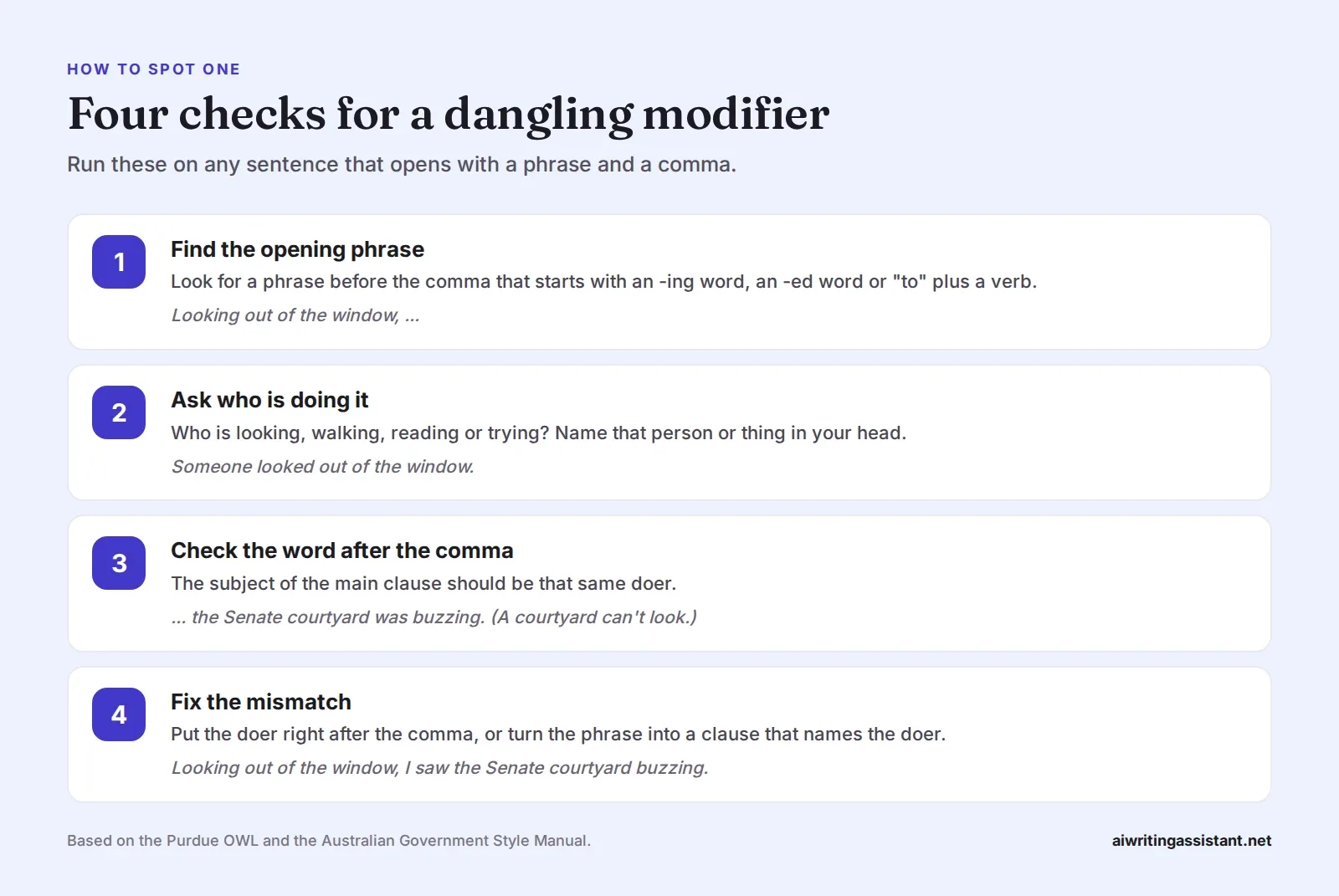
Dangling modifier examples, before and after
Each of these has an opening phrase with no doer, or the wrong one. Read the "before" column literally and you'll see the problem.
| Before (dangling) | After (fixed) |
|---|---|
| Walking to school today, a house burst into flames. | Walking to school today, I saw a house burst into flames. |
| After reading the original study, the article remains unconvincing. | After reading the original study, I find the article unconvincing. |
| Relieved of your responsibilities at your job, your home should be a place to relax. | Relieved of your responsibilities at your job, you should be able to relax at home. |
| Looking out of the window, the Senate courtyard was buzzing with activity. | Looking out of the window, I saw the Senate courtyard buzzing with activity. |
| Fertilized in the spring, the farmers were disappointed. | The farmers were disappointed in the crops fertilized in the spring. |
| Oozing slowly across the floor, Marvin watched the salad dressing. | Marvin watched the salad dressing oozing slowly across the floor. |
| Climbing the mountain the cabin came into view. | Climbing the mountain, we saw the cabin come into view. |
| To get a good grade, the essay must be proofread. | To get a good grade, you must proofread the essay. |
| After finishing the report, the coffee was cold. | After finishing the report, Jordan Lee found the coffee cold. |
| Born in Mapleford, the town library was her second home. | Born in Mapleford, Ana Ruiz treated the town library as her second home. |
The first seven "before" sentences come from the Purdue OWL, the Edmonds handout, the Australian style manual, the Chicago Shop Talk post and Merriam-Webster. The last three are made up for this guide. Notice that the Chicago fix for the farmers moves words around rather than adding new ones. That post says "moving things around a bit" usually solves it.
Did Shakespeare write a dangling modifier?
Arguably, yes. In Act 1, Scene 5 of Hamlet, the Ghost describes his own death. You can check the line in the Project Gutenberg text of Hamlet.
'Tis given out that, sleeping in my orchard, / A serpent stung me.
Read with modern rules, the serpent was the one sleeping in the orchard. Nobody watching the play gets confused, of course. The meaning is obvious from context, which is exactly why some writers on usage say danglers aren't always a problem.
Are dangling modifiers always wrong?
Not every dangler is a mistake. The Australian Government Style Manual accepts them in two cases. One is when the implied subject is a generic "I," "you," "we" or "one." The other is when the main clause starts with "it" or "there," as in "Considering the timeframe, it is an impressive result." Even so, the manual's advice is to rewrite when in doubt.
There's a longer history too. A BYU linguistics student paper quotes a 1994 usage dictionary from Merriam-Webster (often shortened to MWDEU, pages 314 to 315). According to that quotation, the construction is "both common and of considerable historical and literary background" and goes back to Chaucer. The same paper quotes MWDEU citing Boswell's line "Happening to meet Sir Adam Ferguson, I presented him to Dr. Johnson." It also cites a 1935 article in American Speech that called "general enough" participles, such as "assuming," unobjectionable.
So for school and work writing, treat danglers as errors to fix. Phrases with a generic subject, like "considering" or "assuming," are the usual exceptions, and only when the sentence is still clear.
How common are dangling modifiers in student writing?
Less common than they used to be. In the 1986 Connors and Lunsford study of 3,000 student papers, "dangling or misplaced modifier" ranked 19th of 20 error types, with 577 instances. When Lunsford and Lunsford repeated the study with 877 papers in 2006, danglers fell out of the top 20. The authors wrote that they were surprised by "the small number of dangling modifiers" they found. Their results are in the 2008 College Composition and Communication article.
Practice quiz
Decide whether each sentence has a dangling modifier. Answers are in the right column.
| Sentence | Answer |
|---|---|
| 1. Running for the bus, my bag fell open. | Dangling. Fix: Running for the bus, I felt my bag fall open. |
| 2. Having finished the exam, Priya left early. | Correct. Priya finished the exam. |
| 3. To save money, the heating was turned off. | Dangling. Fix: To save money, we turned off the heating. |
| 4. Tired after the long drive, the hotel bed looked perfect. | Dangling. Fix: Tired after the long drive, Sam thought the hotel bed looked perfect. |
| 5. Considering the weather, it was a good turnout. | Accepted. The main clause starts with "it," one of the style manual exceptions. |
If a sentence still feels awkward after the fix, our Paraphrasing Tool can suggest another way to word it. For another common sentence-level error, see our guide to the sentence fragment.
Frequently asked questions
What is a dangling modifier?
A word or phrase that describes something not clearly named in the sentence, such as "Walking to school, a house burst into flames."
What is the difference between a dangling and a misplaced modifier?
A misplaced modifier's target word is in the sentence but too far away. A dangling modifier's target word is missing.
What is a dangling participle?
A dangling modifier built on an -ing or -ed verb form. Merriam-Webster also calls it a hanging participle.
How do you fix a dangling modifier?
Put the doer right after the opening phrase, or turn the phrase into a clause that names the doer.
Are dangling modifiers always wrong?
Not always. Set phrases with a generic subject or a main clause starting with "it" or "there" are often accepted, but rewrite anything that could confuse a reader.
Is there a dangling modifier in Hamlet?
Arguably, yes. "Sleeping in my orchard, / A serpent stung me" literally says the serpent was sleeping.
Are dangling modifiers a common error?
They ranked 19th in a 1986 study of student papers but dropped out of the top 20 in a 2006 repeat study.

 Grammar Checker
 Paraphraser
 Summarizer
 AI Writer
 AI Humanizer
 Text Compare