
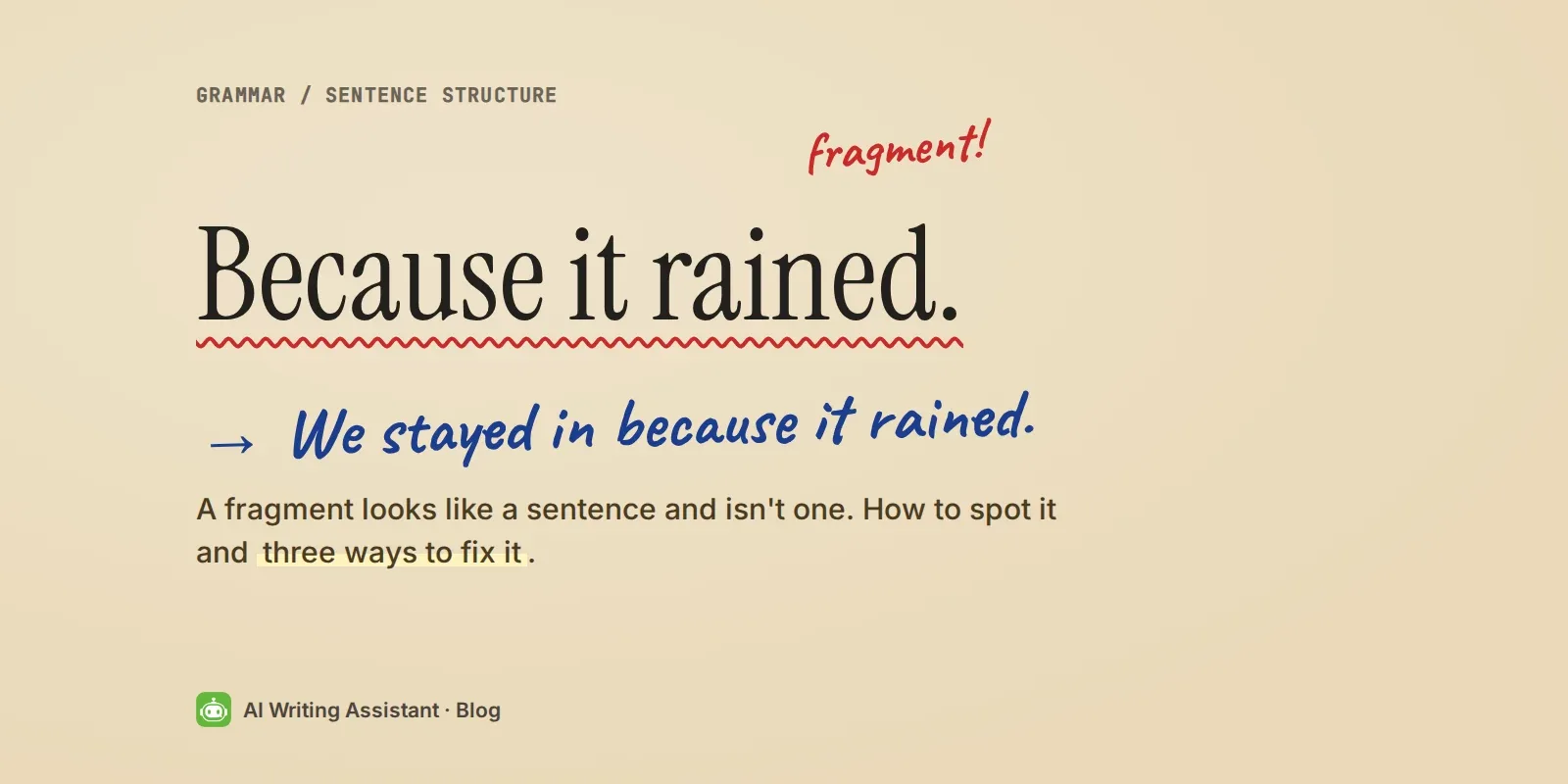
Sentence fragments are sneaky because they often look fine. "Because I was tired." has a capital letter, a subject, a verb and a period. It still isn't a sentence.
Here's how to spot fragments, three ways to fix them, and when breaking the rule is fine.
What is a sentence fragment?
A sentence fragment is an incomplete sentence, a word group that starts with a capital letter and ends with a period but can't stand on its own. It might be missing a subject ("Ran to the bus."), missing a verb ("The man in the blue coat."), or be a dependent clause that relies on another sentence ("Because it was raining."). To fix one, join it to a nearby sentence or add the missing part.
Merriam-Webster defines a sentence fragment as a word, phrase or clause that "lacks the grammatical structure usually found in the sentences" of formal writing. The Purdue OWL and the UNC Writing Center both describe fragments simply as incomplete sentences.
Three common types of fragment
1. Dependent clause fragments
These start with a subordinating word such as because, although, when, while, if, since or unless. They have a subject and a verb, but they depend on another clause to make sense.
Because the store was closed.→ We went home because the store was closed.Although she studied all night.→ Although she studied all night, she felt unprepared.
This is the type that surprises people. The Chicago Manual of Style notes that a word group with a subject and a verb is still a fragment "if it's dependent on another clause." UNC suggests scanning your writing for subordinating conjunctions to catch them.
2. Missing subject
Opened the window and let in some air.→ Sam opened the window and let in some air.Hoping for good news.→ We were hoping for good news.
3. Missing verb
The teacher with the red folder.→ The teacher with the red folder called my name.A long day of meetings.→ It was a long day of meetings.
How to find fragments in your writing
- Read each sentence on its own, out of order, starting from the end. Fragments are easier to hear without the sentence before them.
- Check for a subject and a verb. The UW–Madison Writing Center suggests making sure each sentence contains a grammatically complete and independent thought.
- Circle subordinating words at the start of sentences, such as because, although, when, if, since and while.
- Watch for "-ing" starts like "Running late." or "Hoping to finish." These often lack a proper verb.
- Check example phrases that begin with "for example," "such as" or "especially."
How to fix a sentence fragment
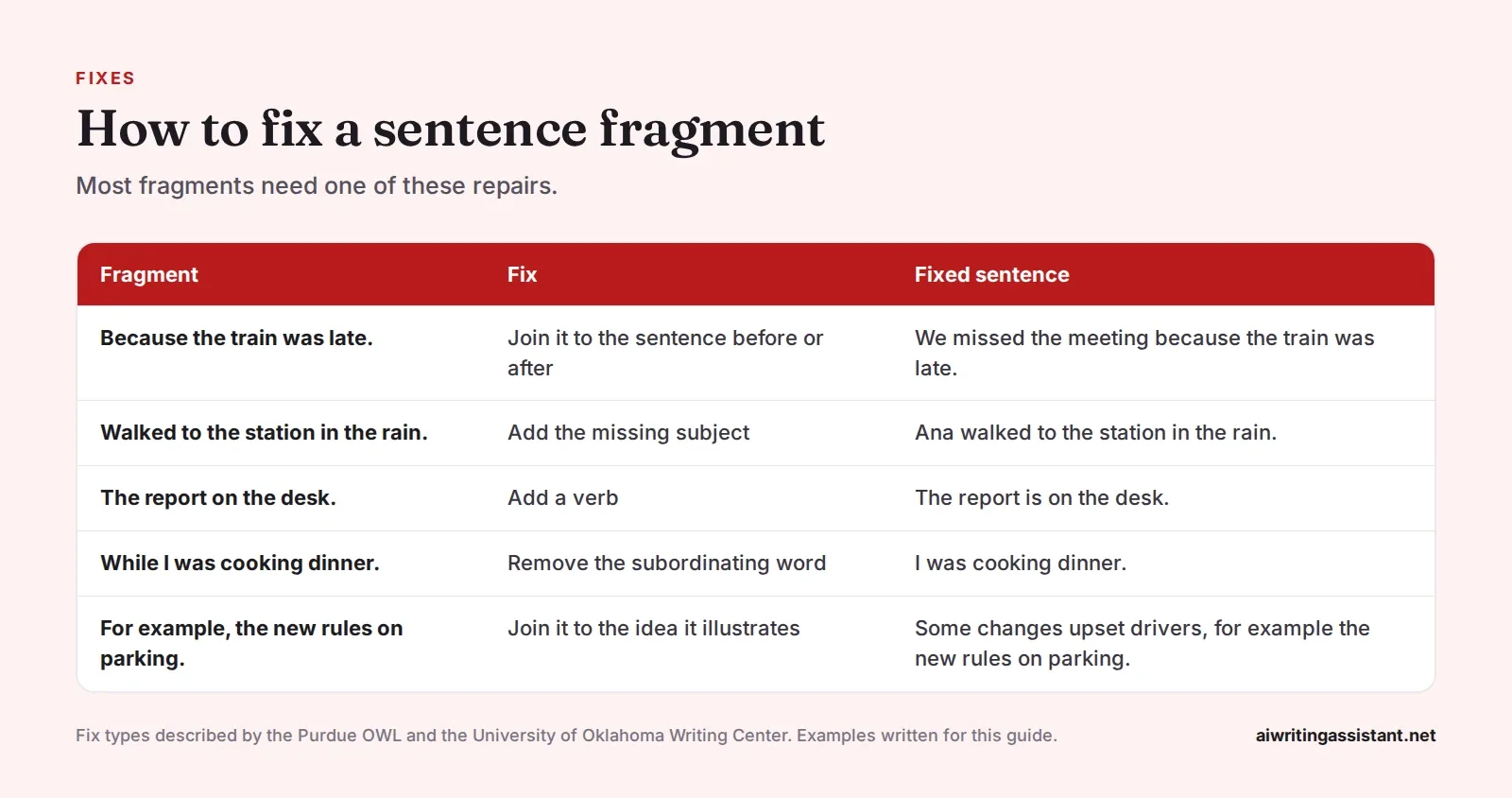
The Purdue OWL notes that the easiest fix is often to remove the period between the fragment and the main clause. When that doesn't work, add what's missing or remove the word that makes the clause dependent.
Are sentence fragments ever okay?
Yes. Writers use them on purpose all the time, especially in fiction, ads, speeches and informal writing. The University of Oklahoma Writing Center says that "Sometimes writers choose to use sentence fragments as a stylistic choice."
The Chicago Manual of Style goes further. It says people who insist fragments are always wrong are mistaken, noting that fragments "are found in the very best of classic English prose."
We need a new plan. Fast.
Not because the old one failed. Because the market moved.
The difference is control. An intentional fragment is short, clear and placed for effect. An accidental one is usually a clause that drifted away from its sentence. In formal academic writing, avoid fragments unless your instructor or style guide allows them.
Can you start a sentence with "because"?
Yes, as long as the sentence is complete. Chicago is clear on this. "Because I was late, they towed my car" is a full sentence. The myth that you can't start with "because" probably comes from teachers steering students away from fragments like "Because I was late."
How common are fragments?
Less common than you might think. In a national study of 877 first-year college papers, Lunsford and Lunsford (2008) ranked sentence fragments 20th of the 20 most frequent errors, at 2.4% of all errors. Using the wrong word was the most common error, at 13.7%.
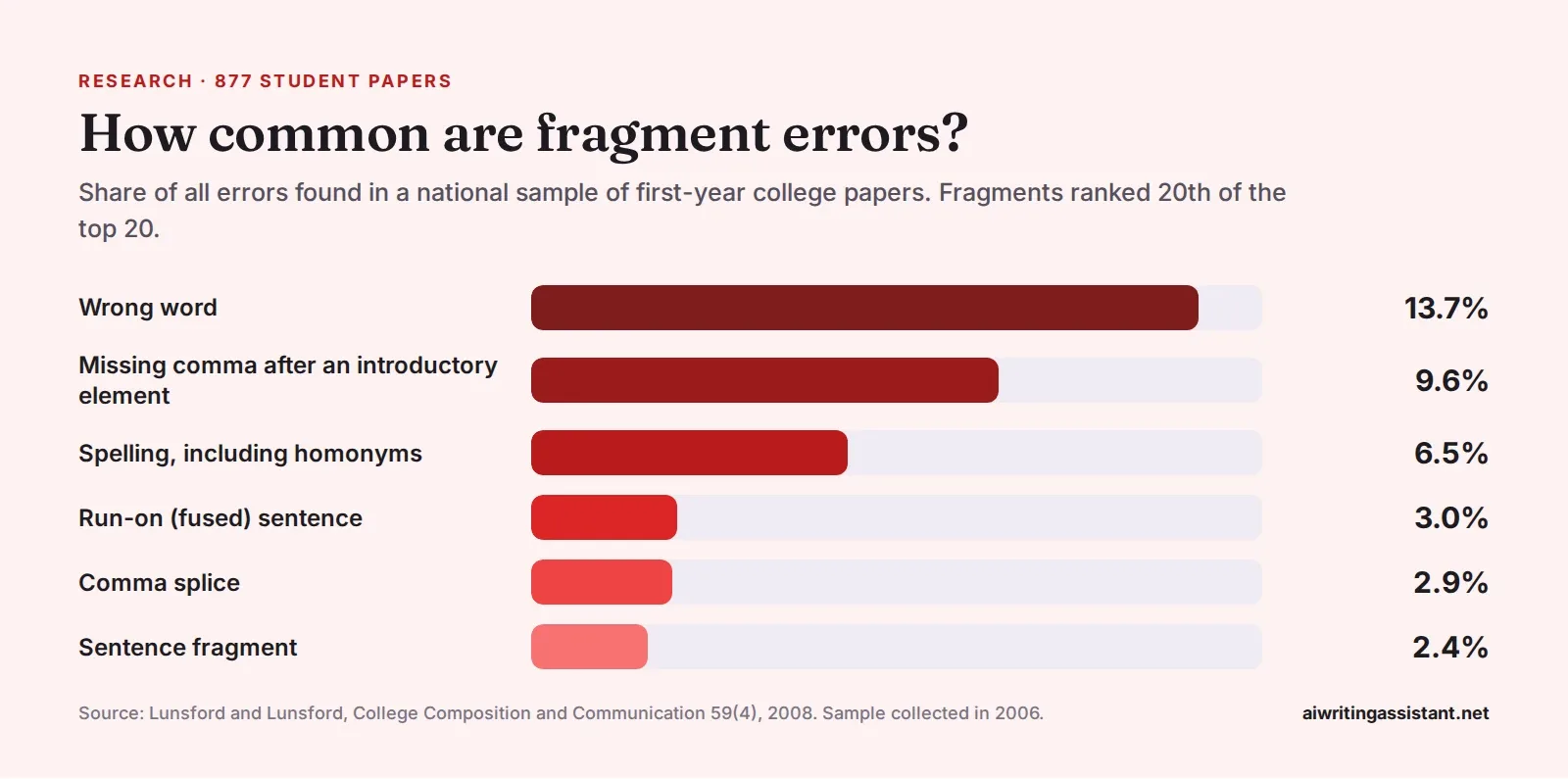
Run-on sentences and comma splices, the opposite problem, were slightly more common. A run-on joins two sentences without proper punctuation. A fragment breaks a sentence in half.
For more sentence-level fixes, see our guides on active vs passive voice and sentence starters.
Frequently asked questions
What is a sentence fragment?
An incomplete sentence, a group of words punctuated as a sentence that is missing a subject, a verb or an independent clause.
What is an example of a sentence fragment?
"Because the bus was late." It has a subject and a verb but depends on another clause to make sense.
How do you fix a sentence fragment?
Join it to a nearby sentence, add the missing subject or verb, or remove the subordinating word.
Can a sentence fragment have a subject and a verb?
Yes. If it starts with a word like "because" or "although," it still depends on another clause.
Are sentence fragments ever acceptable?
Yes, as a deliberate style choice in fiction, ads and informal writing. Avoid them in formal academic writing.
Can I start a sentence with "because"?
Yes, as long as the sentence is complete, as in "Because I was late, I missed the start."
What is the difference between a fragment and a run-on?
A fragment is less than a full sentence. A run-on joins two or more sentences without correct punctuation.
 Grammar Checker
 Paraphraser
 Summarizer
 AI Writer
 AI Humanizer
 Text Compare