
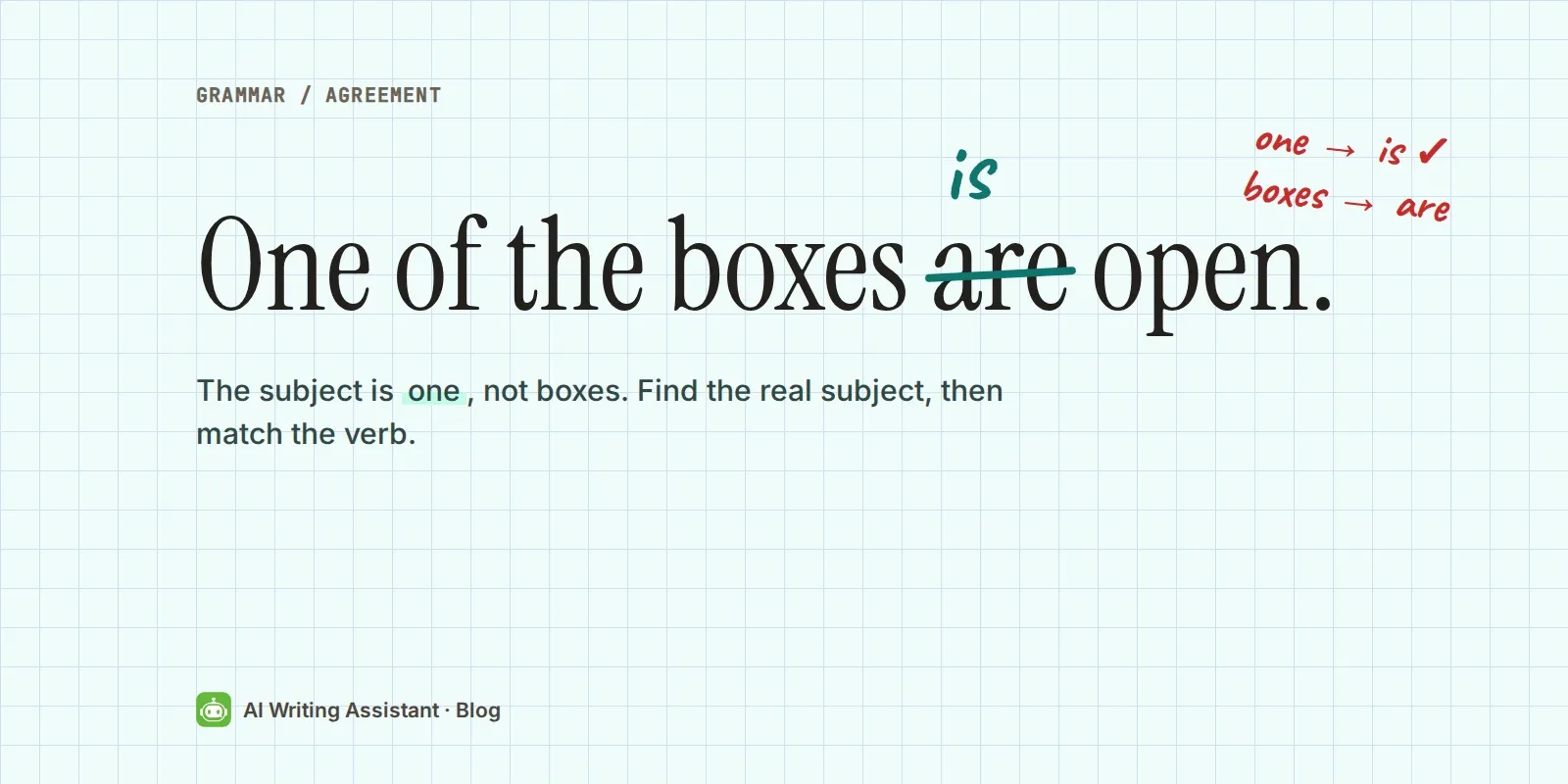
Most agreement errors happen when something gets between the subject and the verb, or when the subject is a tricky word like "everyone," "team" or "none." This guide covers the core rule, then every tricky case with an example you can copy.
What is subject verb agreement?
Subject-verb agreement is the rule that a verb must match its subject in number (singular or plural) and person. The George Mason University Writing Center states it this way. A singular subject takes a singular verb ("The dog barks"), and a plural subject takes a plural verb ("The dogs bark"). In the present tense, a third-person singular subject usually takes a verb ending in -s, so "she writes" but "they write."
The core rule
Find the subject, decide whether it's singular or plural, and pick the matching verb. That's it. The tricky part is that the -s works backwards from nouns. A plural noun usually adds -s, while a singular verb adds -s.
- The student writes every morning. (singular)
- The students write every morning. (plural)
- He has a question. They have a question.
- The report is late. The reports are late.
Tricky cases, one by one
Compound subjects joined by "and"
Two subjects joined by "and" are usually plural. GMU gives "Matt and Lisa often write in the morning," and the Purdue OWL gives "She and her friends are at the fair." GMU notes two exceptions. If the parts form a single unit, use a singular verb ("Macaroni and cheese is on the menu"). If "each" or "every" comes first, also use a singular verb ("Every student and teacher has a locker").
Subjects joined by "or" or "nor"
Two singular subjects joined by "or" take a singular verb, as in the Purdue example "The book or the pen is in the drawer." When one part is singular and one is plural, the verb agrees with the part nearer to it. The IUP Writing Center example is "Neither your peers nor your teacher has the final say about your paper."
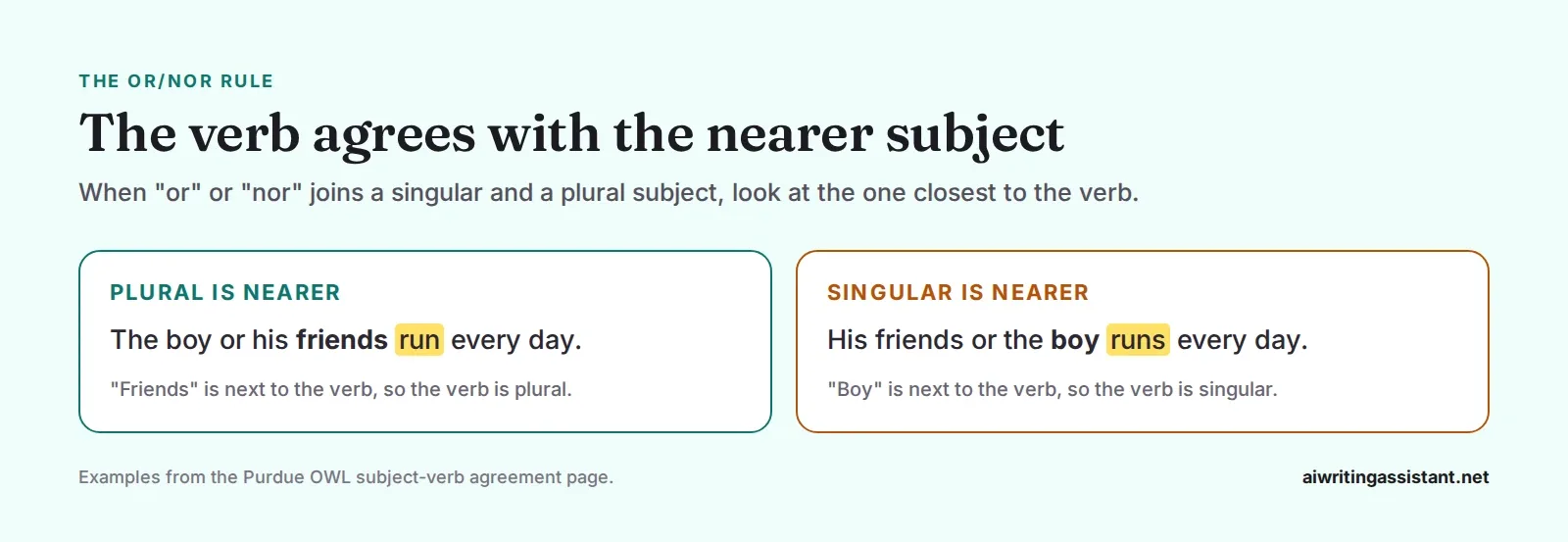
If the result sounds awkward, reword it. The MLA Style Center calls the nearer-subject rule "a common practice" and suggests sentences like "Either the teacher is mistaken or the students are."
Indefinite pronouns
Purdue lists each, each one, either, neither, everyone, everybody, anybody, anyone, nobody, somebody, someone and no one as singular. So "Everybody knows Mr. Jones" and "Each of these hot dogs is juicy."
"Some" and "all" depend on the noun that follows. The SIUC Writing Center gives "Some of the books are missing" but "Some of the oil is gone." "None" can go either way. The Chicago Manual of Style Q&A says it can mean "not one" or "not any," so context decides. An MLA quiz accepts both "None of us is going" and "None of us are going."
Collective nouns in US and UK English
In American English, collective nouns such as group, team, committee, class and family are usually singular. Purdue gives "The team runs during practice" and "The family has a long history." GMU adds that you treat them as singular "unless the meaning is clearly plural."
British English is more flexible. The Britannica Dictionary entry for team notes that "Our team is losing" in US English matches "Our team are losing" in British English. The Cambridge Dictionary marks team as taking a singular or plural verb in its British entry. The MLA Style Center also allows a plural verb when members act separately ("The team are in disagreement"), though it suggests "team members" if that sounds odd.
"There is" and "there are"
"There" is never the subject. The verb agrees with the noun that follows it. Write "There is a question" and "There are many questions." In speech, people often say "there's two options," but in formal writing use "there are two options."
Phrases between the subject and the verb
Words that come between the subject and verb don't change the subject. Purdue says expressions like with, together with, including, accompanied by, in addition to and as well "do not change the number of the subject."
- The President, accompanied by his wife, is traveling to India. (Purdue)
- The school board, as well as the stakeholders, was pleased with the plans. (LMU library guide)
- One of the boxes is open. (Purdue)
Amounts, titles and special nouns
An amount of money, time or distance is treated as one thing. Purdue gives "Five dollars is a lot of money," but "Dollars are often used instead of rubles in Russia," where you mean the bills themselves. Titles of works and company names are singular too, as in the GMU example "Lost Cities describes the discoveries." Purdue also lists news, civics and mathematics as singular ("The news is on at six") and scissors and trousers as plural ("These scissors are dull").
"A number of" vs "the number of"
"The number" is singular. "A number" means "several" and is plural. The MLA quiz gives "The number of immigrant deportations continues to rise" and "A number of doctors agree." The LMU guide adds "The number of teenagers reading books is declining."
Singular "they"
When "they" refers to one person, it still takes a plural verb. A 2017 Chicago Shop Talk post says singular they, "like singular you," takes a plural verb, as in "they have a degree in molecular biology." The Walden University Writing Center gives the same advice. Merriam-Webster says these pronouns "are now widely accepted." So write "Alex said they are running late," never "they is."
Subject-verb agreement rules at a glance
| Subject | Verb | Example |
|---|---|---|
| Two nouns joined by "and" | Plural | She and her friends are at the fair. |
| "Each" or "every" before the subject | Singular | Every student and teacher has a locker. |
| Singular "or/nor" plural | Matches the nearer one | Neither the students nor the teacher is ready. |
| Each, everyone, nobody, someone | Singular | Everyone has a copy. |
| Some, all, none | Depends on the noun or meaning | Some of the oil is gone. Some of the books are missing. |
| Team, family, committee (US) | Usually singular | The committee meets on Friday. |
| There is / there are | Matches the noun after it | There are two options. |
| Subject + "as well as" phrase | Matches the first subject | The coach, as well as the players, was late. |
| Amount of money or time | Singular | Five dollars is enough. |
| The number of | Singular | The number of applicants is rising. |
| A number of | Plural | A number of applicants are waiting. |
| Singular they | Plural | They are my lab partner. |
How to check agreement in your own writing
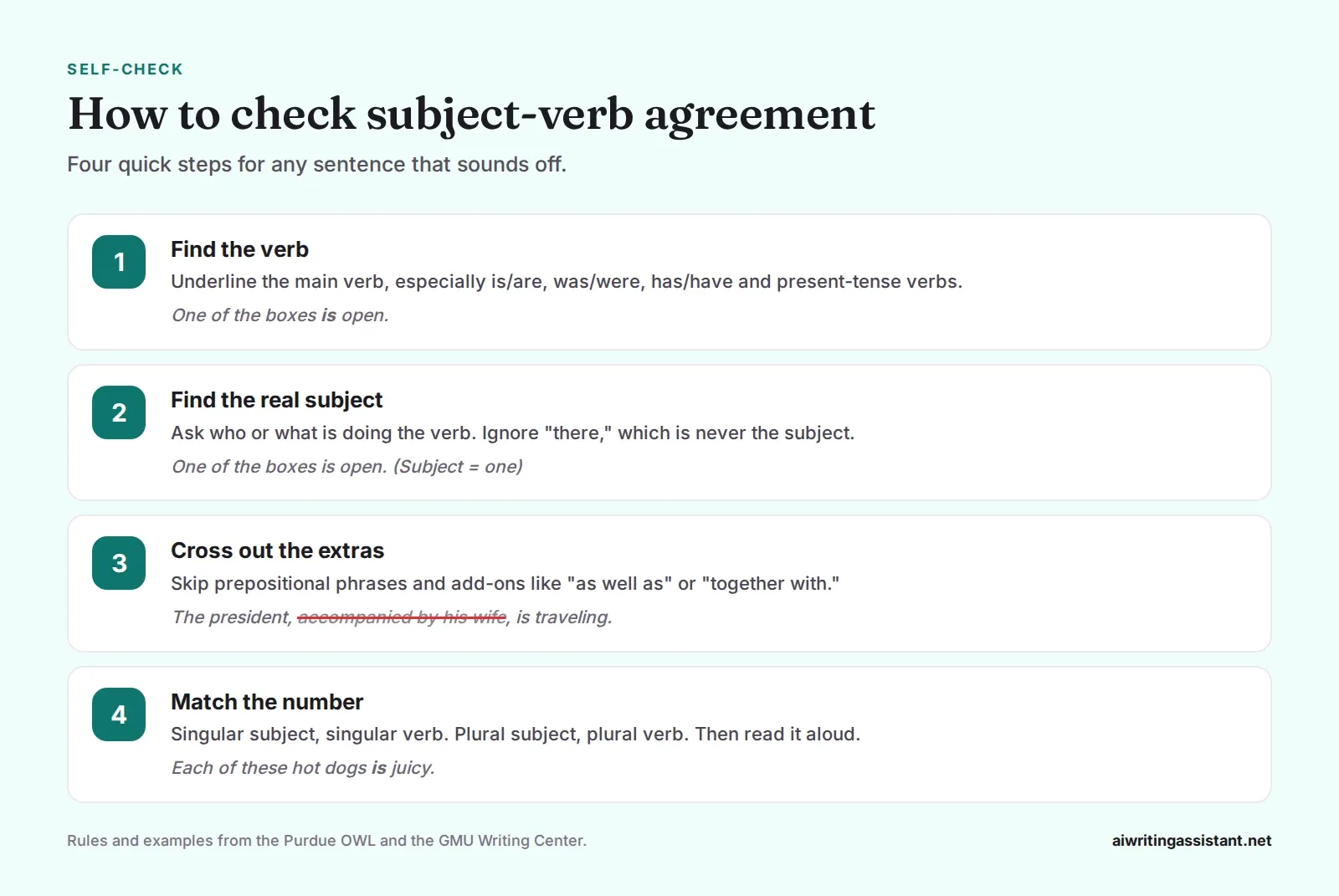
Reading aloud catches a lot, but your ear can fool you when the nearest noun is plural. "The list of items are on the desk" sounds fine until you cross out "of items" and hear "the list are."
How common are agreement errors?
They used to be among the most common errors teachers marked. In the 1986 Connors and Lunsford study, which sampled 3,000 papers from more than 21,000 sent in by 300 teachers, "subject-verb agreement" ranked 14th of 20, with 909 instances. Teachers marked 58% of them.
When Lunsford and Lunsford repeated the study in 2006 with 877 papers, subject-verb agreement was no longer in the top 20. The only agreement error on the new list was "lack of pronoun-antecedent agreement," at 17th. The full tables are in their 2008 College Composition and Communication article.
Practice quiz
Pick the correct verb. Answers are in the right column.
| Sentence | Answer |
|---|---|
| 1. Neither the manager nor the interns (was / were) told. | were (interns is nearer) |
| 2. Each of the reports (has / have) a summary. | has (each is singular) |
| 3. There (is / are) three reasons for the delay. | are (three reasons) |
| 4. The teacher, together with her students, (is / are) on the trip. | is (teacher is the subject) |
| 5. The number of late payments (has / have) dropped. | has (the number) |
| 6. Ten miles (is / are) a long way to walk. | is (an amount) |
| 7. My cousin said they (was / were) coming. | were (singular they) |
For more sentence-level grammar, see our guides to sentence fragments and active vs passive voice. If a fixed sentence still reads awkwardly, try the Paraphrasing Tool.
Frequently asked questions
What is the basic rule of subject-verb agreement?
A singular subject takes a singular verb and a plural subject takes a plural verb.
Is it "neither the students nor the teacher is" or "are"?
Is. With "nor," the verb agrees with the nearer subject, which is "teacher."
Is "everyone" singular or plural?
Singular. Write "everyone is," not "everyone are."
Is "none" singular or plural?
Either. Chicago and MLA accept both, depending on whether you mean "not one" or "not any."
Is it "the team is" or "the team are"?
US English normally uses "is." British English often allows "are" when you think of the members.
Is "there's two options" correct?
Not in formal writing. The verb agrees with what follows "there," so write "there are two options."
Do I write "they is" for one person?
No. Singular they takes a plural verb, so write "they are."

 Grammar Checker
 Paraphraser
 Summarizer
 AI Writer
 AI Humanizer
 Text Compare