If you're applying to college, you've probably wondered whether admissions officers can tell if ChatGPT helped with your essay, and whether they even check. The honest answer is more interesting than a yes or no. Colleges care a lot, most don't say how they check, and the rules differ more than you'd think.
Do colleges check for AI?
Many do, in different ways. For application essays, most colleges don't publish whether they use AI detection software, but the Common App and many schools treat AI-written essays as fraud, and readers look for essays that don't sound like the applicant. For coursework, many colleges use the Turnitin AI detector, though some, including Vanderbilt and Michigan State, have turned it off because of false positives. Most schools allow AI for grammar and spelling checks and ban AI-written content.
Do colleges check application essays for AI?
Here's what's known for sure.
- The Common App treats it as fraud. Its fraud policy, as quoted on Yale's admissions site, covers submitting "the substantive content or output of an artificial intelligence platform, technology, or algorithm" as your own work. Reports date the AI wording to 2023.
- Colleges rarely say whether they use detectors. We couldn't find a reliable count of how many admissions offices run essays through AI detection software. Treat any number you see online with care.
- Readers compare your essay with the rest of your file. Admissions officers read your short answers, recommendations, and sometimes graded writing or interview notes. An essay that sounds nothing like the rest stands out to a person, with or without software.
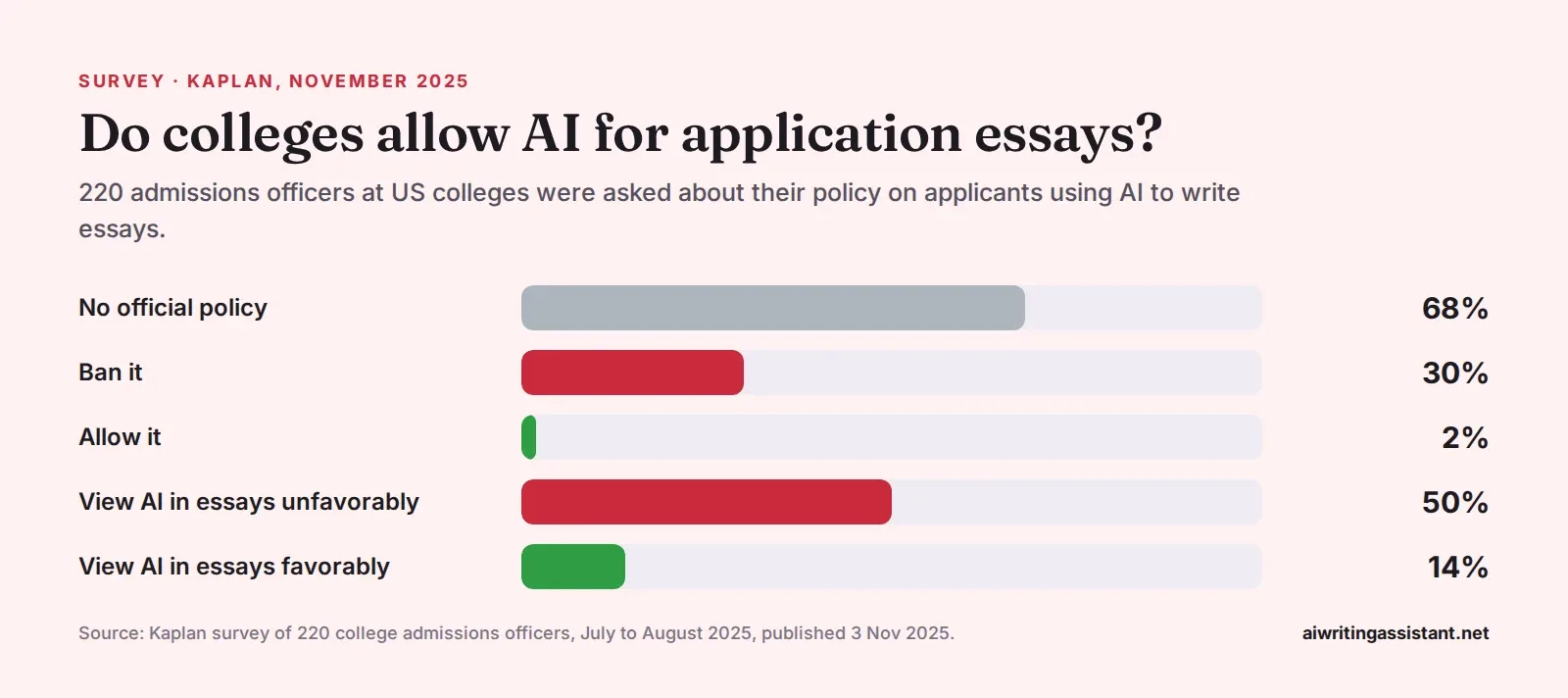
- Many colleges still have no written policy. In a Kaplan survey published in November 2025, 68% of 220 admissions officers said their college had no official policy on applicants using AI to write essays. 30% banned it and 2% allowed it. Half viewed AI use in essays unfavorably.
What colleges allow and ban
The schools that have published rules mostly draw the line in the same place. Help with polishing is fine. Help with writing is not.
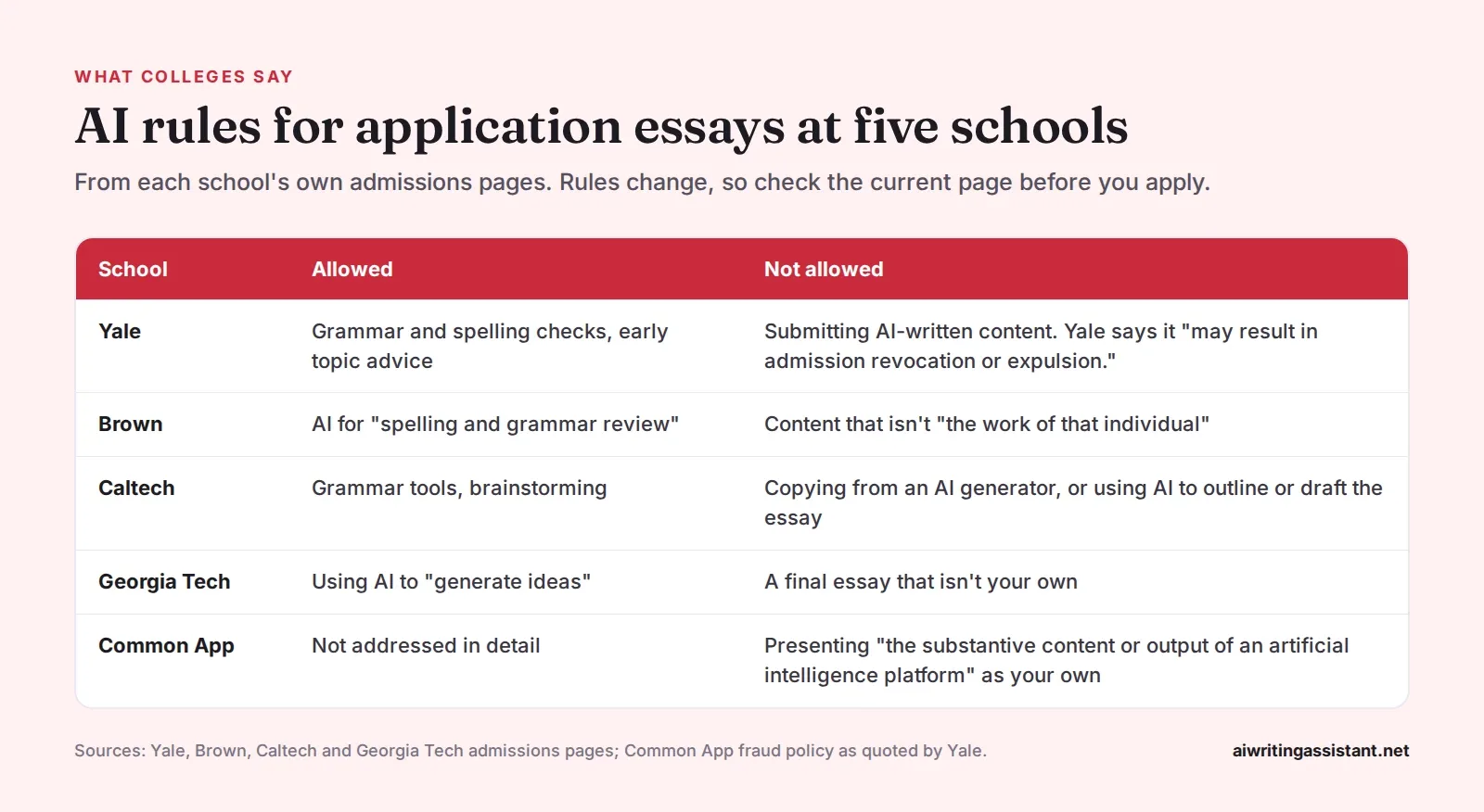
Caltech's guidelines offer a simple test. Ask whether it would be ethical to have a trusted adult do the same task for you. A parent pointing out a typo is fine. A parent writing your opening paragraph is not. Georgia Tech's admissions blog put it this way in 2023. AI can help you "generate ideas, but your ultimate submission should be your own."
Do colleges use AI detectors for coursework?
Many do, and some have stopped. Turnitin is the most common tool, and its AI detector is switched on at many colleges. In its first year, Turnitin said it reviewed over 200 million papers and found about 11% had at least 20% AI writing, and about 3% had at least 80%. Those are the Turnitin figures from April 2024.
Other schools have turned the feature off.
- Vanderbilt disabled it in August 2023. It noted that a 1% false positive rate across its 75,000 papers a year would mean about 750 students wrongly flagged.
- Michigan State, Northwestern and UT Austin also chose not to use it, The Register reported in September 2023. Michigan State's help page still says the detector "is not currently available at MSU."
- Curtin University in Australia switched AI detection off from 1 January 2026, while keeping plagiarism matching.
For more on how Turnitin works and its limits, see can Turnitin detect ChatGPT. For why detectors flag honest writing, see why your writing gets flagged as AI.
Can admissions officers tell if you used AI?
Not with certainty, and software can't either. But experienced readers notice essays that feel generic. The common signs of AI writing include polished but vague sentences, big words like "pivotal" and "testament," and no small details only you would know. A college essay is supposed to be full of exactly those details, which is why AI-written ones often feel empty next to real ones.
The bigger risk isn't detection. It's that an AI-written essay is usually a weaker essay. It sounds like everyone else's.
How to use AI on your application safely
- Read each college's policy. Search the admissions site for "AI" or "artificial intelligence." Rules differ.
- Write the draft yourself. Start with your own memories and notes.
- Use AI only for allowed tasks. Typically that means spelling and grammar checks, or brainstorming questions to ask yourself.
- Keep your drafts. Version history in Google Docs or Word shows your essay growing over time. It's useful if anyone ever asks.
- Read it aloud. If it doesn't sound like you talking, rewrite it until it does.
Frequently asked questions
Do colleges check for AI in application essays?
Many colleges treat AI-written essays as fraud, and readers look for essays that don't match the rest of an application. Most don't say publicly whether they use AI detection software.
Does the Common App check for AI?
The Common App's fraud policy covers submitting the substantive content or output of an AI platform as your own work. It hasn't published details of any detection software it uses.
Can I use ChatGPT for my college essay?
Check each school's policy. Most that publish rules allow AI for grammar and spelling checks or brainstorming, and ban AI-written drafts.
What AI detector do colleges use?
For coursework, Turnitin is the most common. Some colleges, including Vanderbilt and Michigan State, have switched its AI detector off.
Can Grammarly get my college essay flagged?
Spelling and grammar fixes are usually allowed and rarely change a detector score much. Accepting whole-sentence AI rewrites is different and may break a college's rules.
What happens if a college finds out I used AI?
Under policies like Yale's, submitting AI-written content may lead to admission being revoked or, after enrollment, expulsion.
 Grammar Checker
 Paraphraser
 Summarizer
 AI Writer
 AI Humanizer
 Text Compare