
Most people who want to write a poem stop at the first question. What should it be about? Then they reach for a big word like love or loss and end up with lines that sound like a greeting card.
Poems work better small. This guide walks through a simple process, the forms worth knowing, how line breaks work, and how to revise.
How do you write a poem?
Choose one specific subject, such as a single object, moment or memory, and write down every concrete detail you notice. Find the image that carries the feeling, then shape the words into lines, breaking each line where you want the reader to pause. Decide whether to use a form like a haiku or sonnet, or free verse with no set rhyme or meter. Read it aloud, cut words that explain instead of show, and revise after a break.
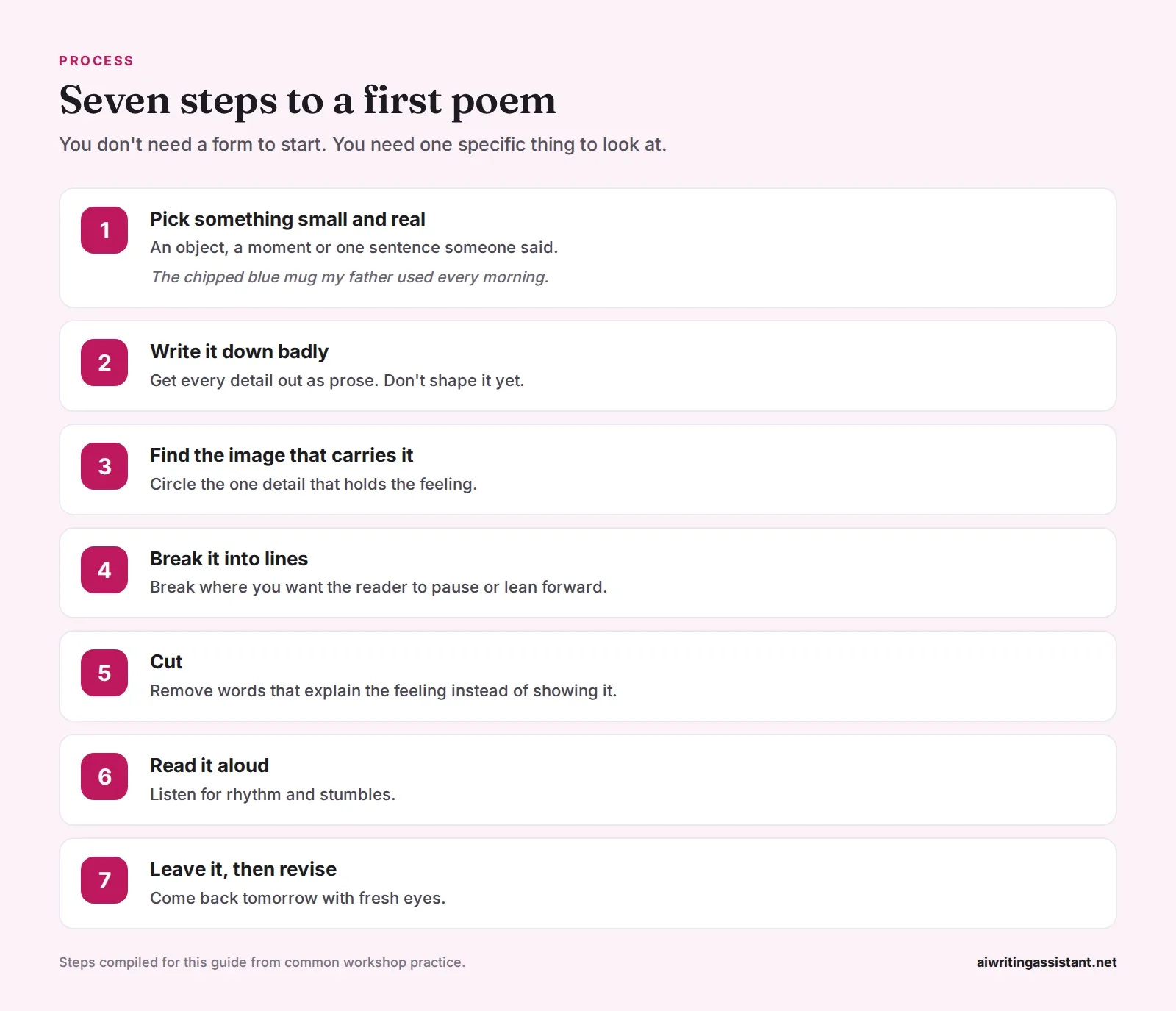
1. Start with something specific
Abstract words like grief, freedom and beauty don't give a reader anything to see. A detail does. Instead of "I miss my father," try the mug he used, the sound of his keys, the way he folded a newspaper. Let the reader feel the missing person through the object.
Wordsworth described poetry as coming from "emotion recollected in tranquillity," in his 1800 preface to Lyrical Ballads. The feeling comes first, but the writing happens when you can look back at it clearly.
2. Decide on a form, or don't
You can write in a traditional form or in free verse. Both are real poetry.
Free verse is poetry that is "not dictated by an established form or meter," according to the Academy of American Poets. It still has structure. Poets.org notes it "uses the graphic line to differentiate itself from prose."
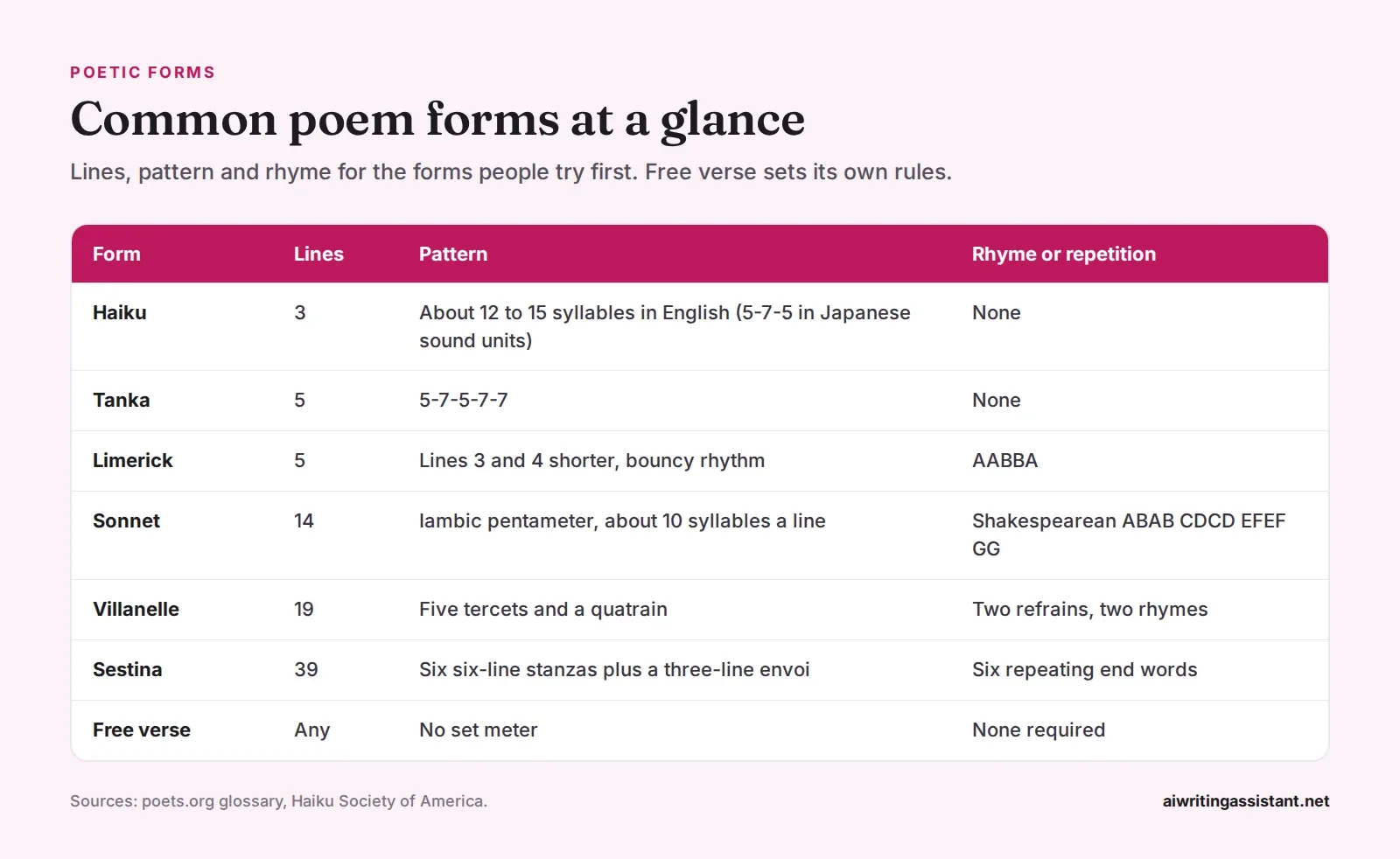
Fixed forms give you rules to push against, which some writers find freeing. A sonnet is "a fourteen-line poem traditionally written in iambic pentameter." A villanelle has 19 lines and two repeating refrains. A tanka has five lines.
A note on haiku and 5-7-5
Most people learn that a haiku has 5, 7 and 5 syllables. That pattern counts Japanese sound units, which are shorter than English syllables. The Haiku Society of America says a traditional 17-unit haiku comes out to "about a 12 to 15 syllable poem in English." The Haiku Foundation describes English haiku as "three unrhymed lines of seventeen or fewer syllables." What matters more than the count is a single, sharp moment, often tied to nature or a season.
3. Break your lines on purpose
Line breaks are what make a poem look and sound like a poem. You have two basic choices.
- End-stopped lines finish at a natural pause or punctuation. They feel settled. In a 2014 essay for the Poetry Foundation, Rebecca Hazelton wrote that "An end-stopped line offers completion and, potentially, reassurance."
- Enjambment is the "running-over of a sentence or phrase from one poetic line to the next." It creates suspense and pulls the reader forward.
Try the same words broken two ways and read both aloud.
| End-stopped | Enjambed |
|---|---|
| My father's mug is chipped. It sits beside the sink. No one uses it now. | My father's mug is chipped beside the sink. No one uses it now. |
In the second version, "No one" hangs at the end of a line before the reader learns what no one does. That pause is doing emotional work.
4. Group lines into stanzas
A stanza is "A grouping of lines separated from others in a poem." In free verse, stanzas often work like paragraphs, each one a shift in time, image or thought. A blank line between stanzas gives the reader a breath.
5. Use sound, not just meaning
Poems are meant to be heard. Rhyme is one tool, but there are quieter ones too.
- Repetition of a word or line to build pressure.
- Alliteration, repeated first sounds, as in "salt and sand."
- Rhythm, the pattern of stressed and unstressed syllables.
- Internal rhyme, rhymes inside lines instead of only at the ends.
Comparisons help too. A simile uses "like" or "as," and a metaphor makes the comparison directly. Both turn a feeling into something a reader can picture.
6. Revise like you mean it
Poems rarely arrive finished. In "The Philosophy of Composition," published in 1846, Edgar Allan Poe described planning "The Raven" step by step, down to its length. He aimed for "about one hundred lines" and ended at 108. You don't have to work that way, but it's a useful reminder that craft is allowed.
- Cut words that tell the reader what to feel, such as "sadly" or "beautifully."
- Swap general nouns for specific ones. "Bird" becomes "crow." "Flower" becomes "dandelion."
- Check every line break. Does the last word of each line earn its spot?
- Read it aloud and mark where you stumble.
- Try a different first line. Often the real start is three lines down.
A short example, built from the steps
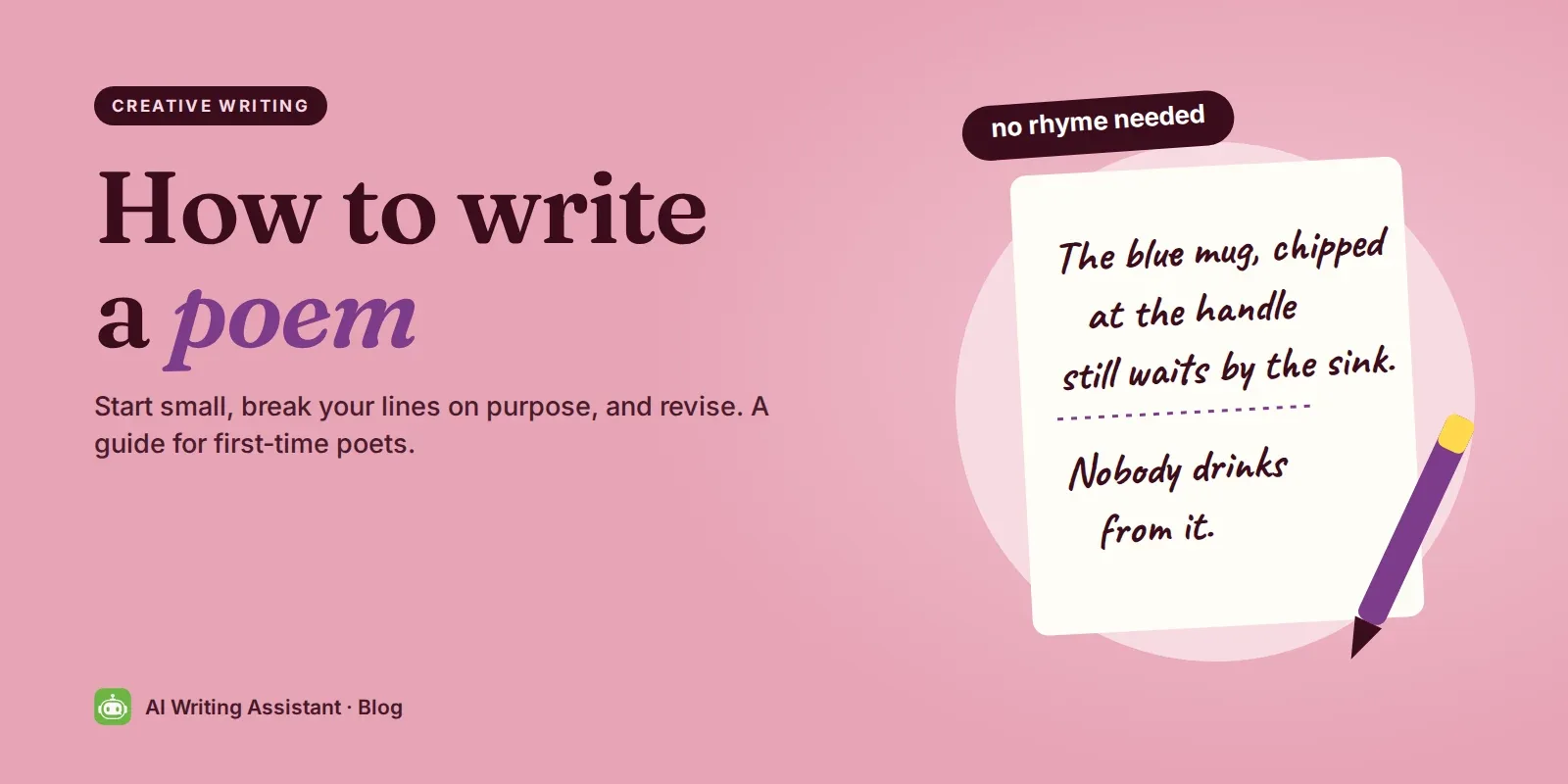
The blue mug, chipped
at the handle where his thumb went,
still waits by the sink.
Nobody drinks from it.
Nobody puts it away.
It doesn't rhyme or name the feeling. The details and the line breaks do that work.
For a ready-made starting point, try the free Poem Generator, which writes haiku, sonnets, rhyming poems and free verse. Treat what it gives you as a prompt, not a finished poem.
Frequently asked questions
Does a poem have to rhyme?
No. Free verse doesn't follow a set rhyme or meter, and much modern poetry is written this way.
How many lines is a sonnet?
Fourteen, traditionally in iambic pentameter.
Does a haiku have to be 5-7-5?
Not in English. The 5-7-5 pattern counts Japanese sound units, and the Haiku Society of America suggests about 12 to 15 English syllables.
How do I start writing a poem?
Pick one specific object, moment or memory and write down concrete details before you worry about lines or rhyme.
Where should I break a line in a poem?
Break where you want a pause or emphasis. End-stopped lines feel settled, and enjambed lines pull the reader forward.
What is a stanza?
A group of lines set apart from the rest of the poem, often separated by a blank line.
How long should a poem be?
As long as it needs. A haiku is three lines, a sonnet fourteen, and free verse has no fixed length.
 Grammar Checker
 Paraphraser
 Summarizer
 AI Writer
 AI Humanizer
 Text Compare