
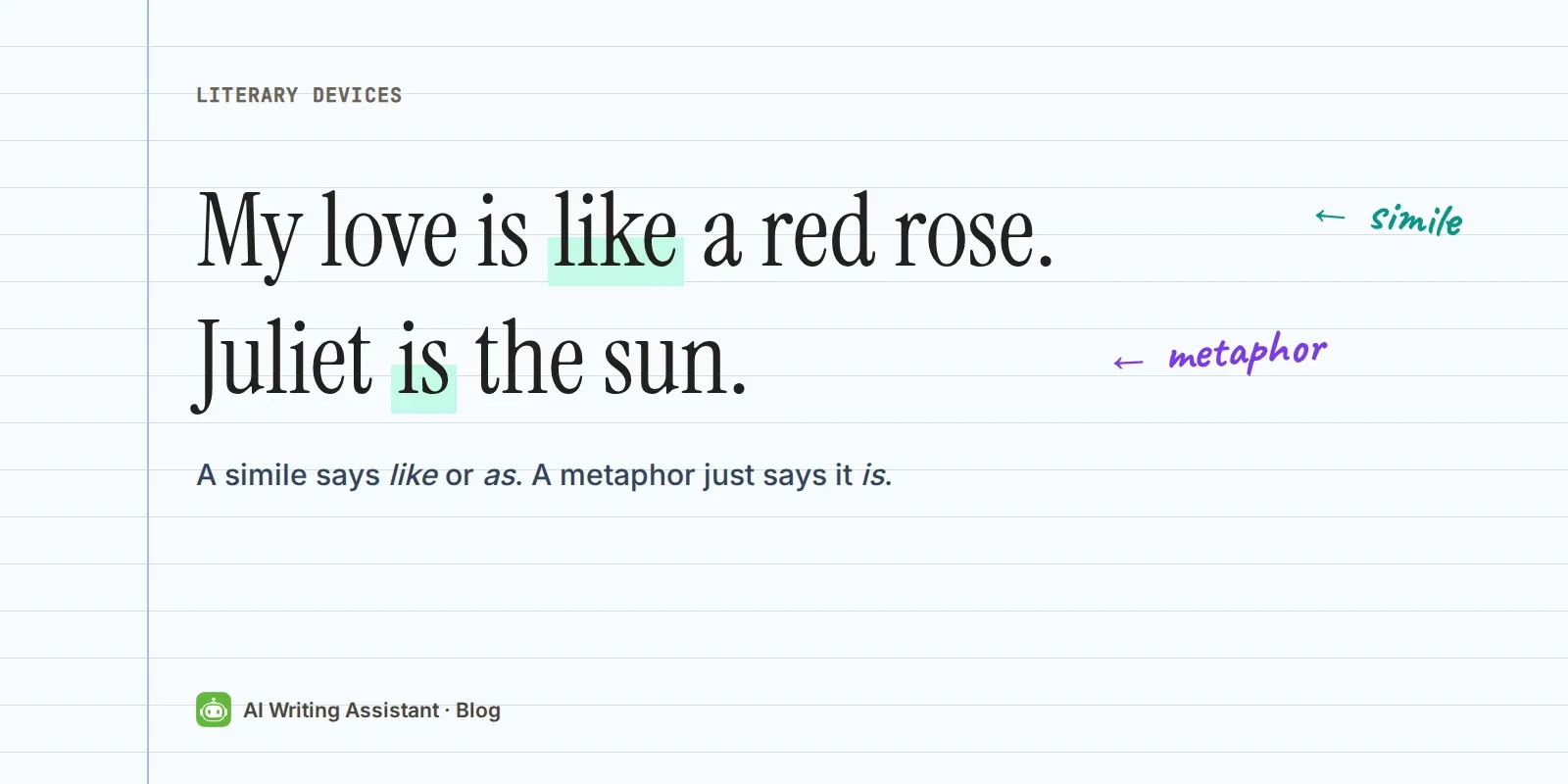
Metaphor and simile are the two most common ways writers make one thing vivid by comparing it to another. They're easy to tell apart once you know where to look, and knowing the difference helps in essays, literature exams and your own writing.
What is the difference between a metaphor and a simile?
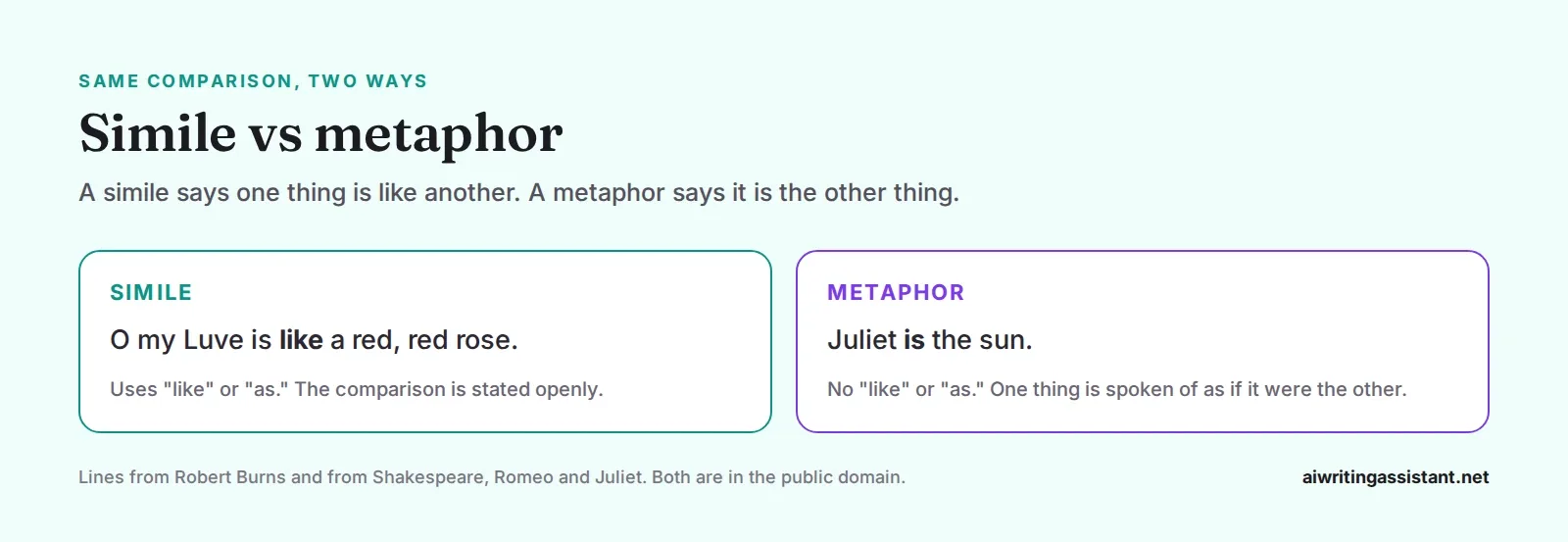
A simile compares two unlike things using a signal word, usually "like" or "as," as in Robert Burns writing "O my Luve is like a red, red rose." A metaphor makes the comparison without those words, describing one thing as if it were the other, as in "Juliet is the sun." Both point out a likeness between different things. A simile announces the comparison, while a metaphor asks the reader to make the leap.
What is a simile?
The Academy of American Poets defines a simile as "a comparison between two essentially unlike things," usually made with "like," "as" or "such as." The Poetry Foundation also counts comparisons made with "than."
- "O my Luve is like a red, red rose." Robert Burns, "A Red, Red Rose"
- "I wandered lonely as a cloud." William Wordsworth, "I Wandered Lonely as a Cloud"
- "Continuous as the stars that shine." Wordsworth, same poem
- Everyday similes include "busy as a bee," "sleep like a log" and "light as a feather."
A longer version, the epic or Homeric simile, stretches a comparison over several lines. Britannica describes it as "a descriptive comparison of greater length."
What is a metaphor?
A metaphor "does not use the words 'like,' or 'as,'" according to poets.org. The word comes from the Greek metaphora, meaning "a transfer." You carry the qualities of one thing over to another.
- "All the world's a stage." Shakespeare, As You Like It, Act 2 Scene 7
- "It is the East, and Juliet is the sun." Shakespeare, Romeo and Juliet, Act 2 Scene 2
- "Hope is the thing with feathers." Emily Dickinson, Poems, Series Two (1891)
- Everyday metaphors include "a heart of gold," "time is money" and "she's a night owl."
A metaphor doesn't need the word "is." In Aristotle's example about the warrior Achilles, "the lion leapt" is a metaphor, because it calls Achilles a lion without saying so.
Is a simile a type of metaphor?
Aristotle thought so. In Book 3 of the Rhetoric, he wrote that the simile is also a metaphor and that "the difference is but slight." His example was the line about Achilles. "Leapt on the foe as a lion" is a simile, but "the lion leapt" is a metaphor.
He also valued metaphor above most other skills. In the Poetics, he wrote that "the greatest thing by far is to have a command of metaphor."
Modern researchers still debate how close the two are. Psychologists Glucksberg and Keysar (1990) argued that the mind treats metaphors as category statements, not just similes with the "like" removed. And Lakoff and Johnson argued in Metaphors We Live By that metaphor shapes everyday thinking, as in "I'm running out of time."
Is every sentence with "like" or "as" a simile?
No. A simile compares things that are essentially unlike. "Her coat is like mine" or "He's as tall as his brother" are literal comparisons, because the things being compared are the same kind of thing. "Her laugh was like a door slamming" is a simile, because a laugh and a door are not alike.
Metaphor and simile vs other devices
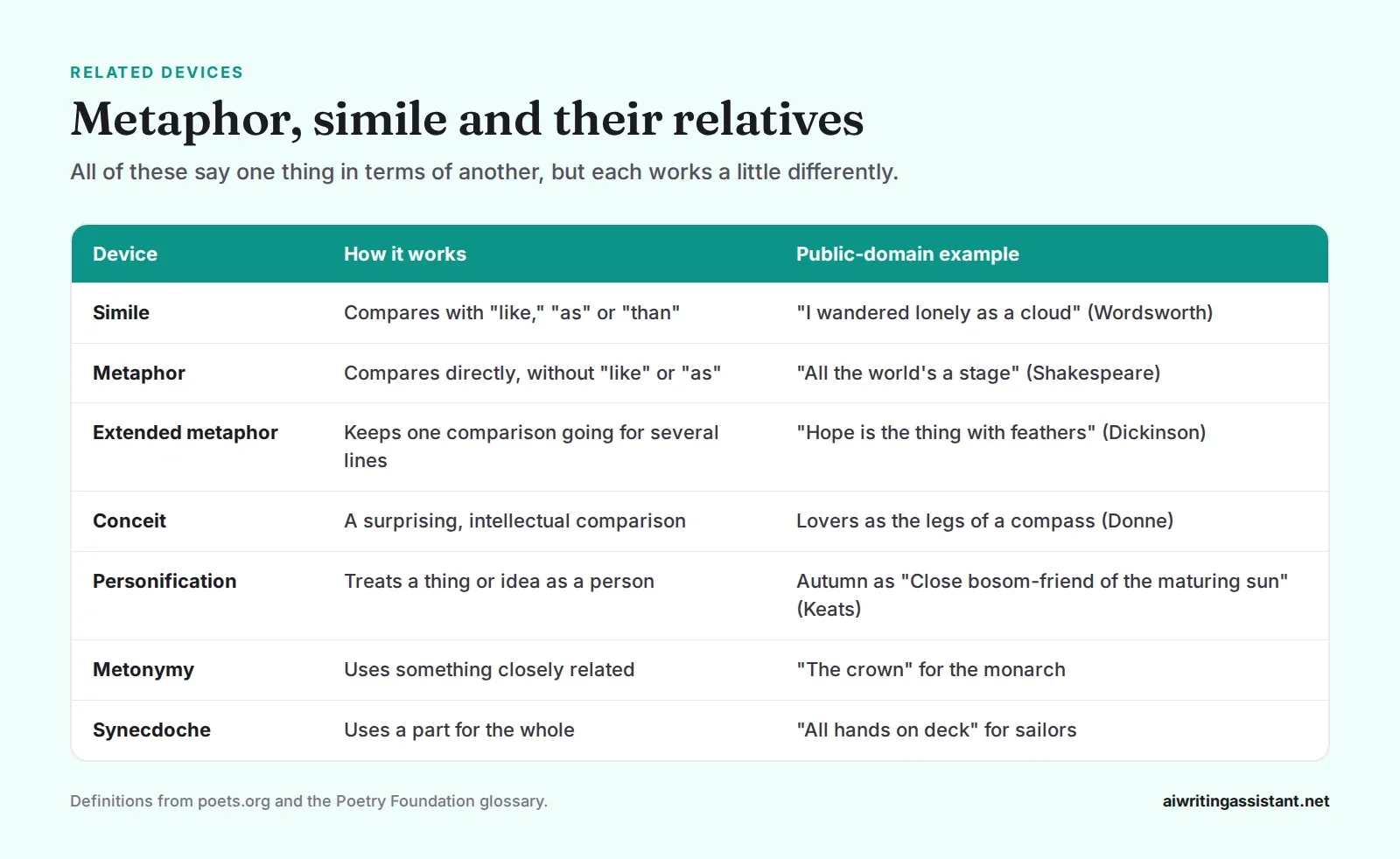
A conceit is an "often unconventional, logically complex, or surprising metaphor." John Donne compared two lovers to the legs of a drawing compass in "A Valediction: Forbidding Mourning". Personification gives human qualities to things, as when Keats calls autumn a "Close bosom-friend of the maturing sun." Metonymy and synecdoche swap in a related word or a part for the whole.
Should you use a metaphor or a simile?
Neither is better. It depends on what you need.
| Use a simile when | Use a metaphor when |
|---|---|
| The comparison might confuse readers without a signal | You want a stronger, more compact image |
| You're writing for children or a general audience | The comparison is familiar enough to land without help |
| You want to keep the two things clearly separate | You want to keep the image going across several lines |
Avoid mixing metaphors in the same sentence, as in "We'll cross that bridge when the ship comes in." Readers try to picture both and see neither. If you're writing poetry, our guide on how to write a poem shows how comparisons fit with line breaks and imagery.
How to write a fresh comparison
- Pick the quality you want to show, such as speed, loneliness or warmth.
- List things outside your topic that have that quality.
- Cross out the first three ideas. Those are usually clichés.
- Choose the one that fits the mood and the reader.
- Try it as a simile and as a metaphor, then read both aloud.
Frequently asked questions
What is the difference between a metaphor and a simile?
A simile compares using "like" or "as." A metaphor compares directly, describing one thing as if it were another.
Is "as busy as a bee" a simile or a metaphor?
A simile, because it uses "as" to compare a person to a bee.
Is a simile a type of metaphor?
Aristotle thought so, writing that the difference is "but slight." Many teachers still treat simile as a kind of metaphor.
Can a simile use "than"?
Yes. The Poetry Foundation counts comparisons made with "than" as similes, as in "busier than a beehive."
What is an extended metaphor?
A metaphor that continues across several lines or a whole poem, like Emily Dickinson comparing hope to a bird.
Is "all the world's a stage" a metaphor?
Yes. It compares the world to a stage directly, without "like" or "as."
What is a mixed metaphor?
Two metaphors that don't fit together in one sentence, which makes the image confusing.

 Grammar Checker
 Paraphraser
 Summarizer
 AI Writer
 AI Humanizer
 Text Compare