
A short story isn't a shrunken novel. It's closer to a single, well-aimed shot. There's room for one character to want one thing and for one change to happen. That constraint is what makes short stories satisfying to write.
This guide covers how long a short story is, a step-by-step process, structure and point of view, and how to revise.
How do you write a short story?
Start with a character who wants something specific, then put an obstacle in the way. Choose a point of view and open the story as close as possible to the moment things change. Build a few scenes that raise the tension toward a single turning point, then end with a change in the character or situation. Aim for one main effect or feeling, keep the cast small, and revise by cutting anything that doesn't serve that effect.
How long is a short story?
It depends on the award or market. Britannica describes the short story as brief prose fiction that is "usually concerned with a single effect." For word counts, the clearest definitions come from award rules.
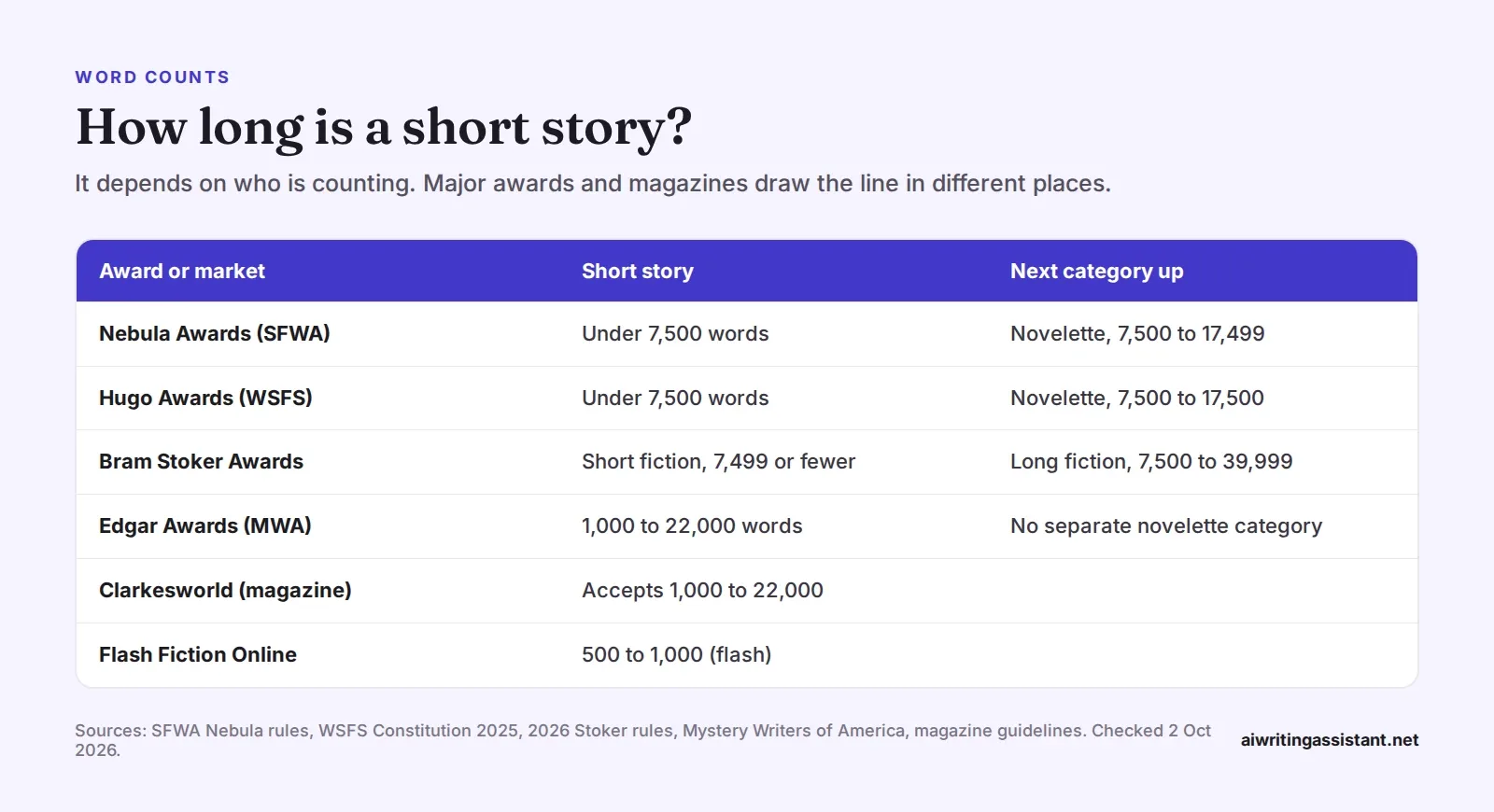
The Nebula Awards define a short story as "less than 7,500 words," and the Hugo Awards use the same line. The Hugo rules even let administrators move a story to another category if its length is within 20% of that category's limits. The Bram Stoker Awards set short fiction at 7,499 words or fewer.
Other markets use a wider range. The Edgar Awards for mystery writing accept short stories from 1,000 to 22,000 words, and Clarkesworld, a science fiction magazine, accepts submissions in the same range. Under about 1,000 words, many markets call it flash fiction. Flash Fiction Online, for example, takes 500 to 1,000 words.
If you're writing for a class, follow the assignment. If you're submitting, check each market's guidelines and count with our free Word Counter.
Step-by-step: writing a short story
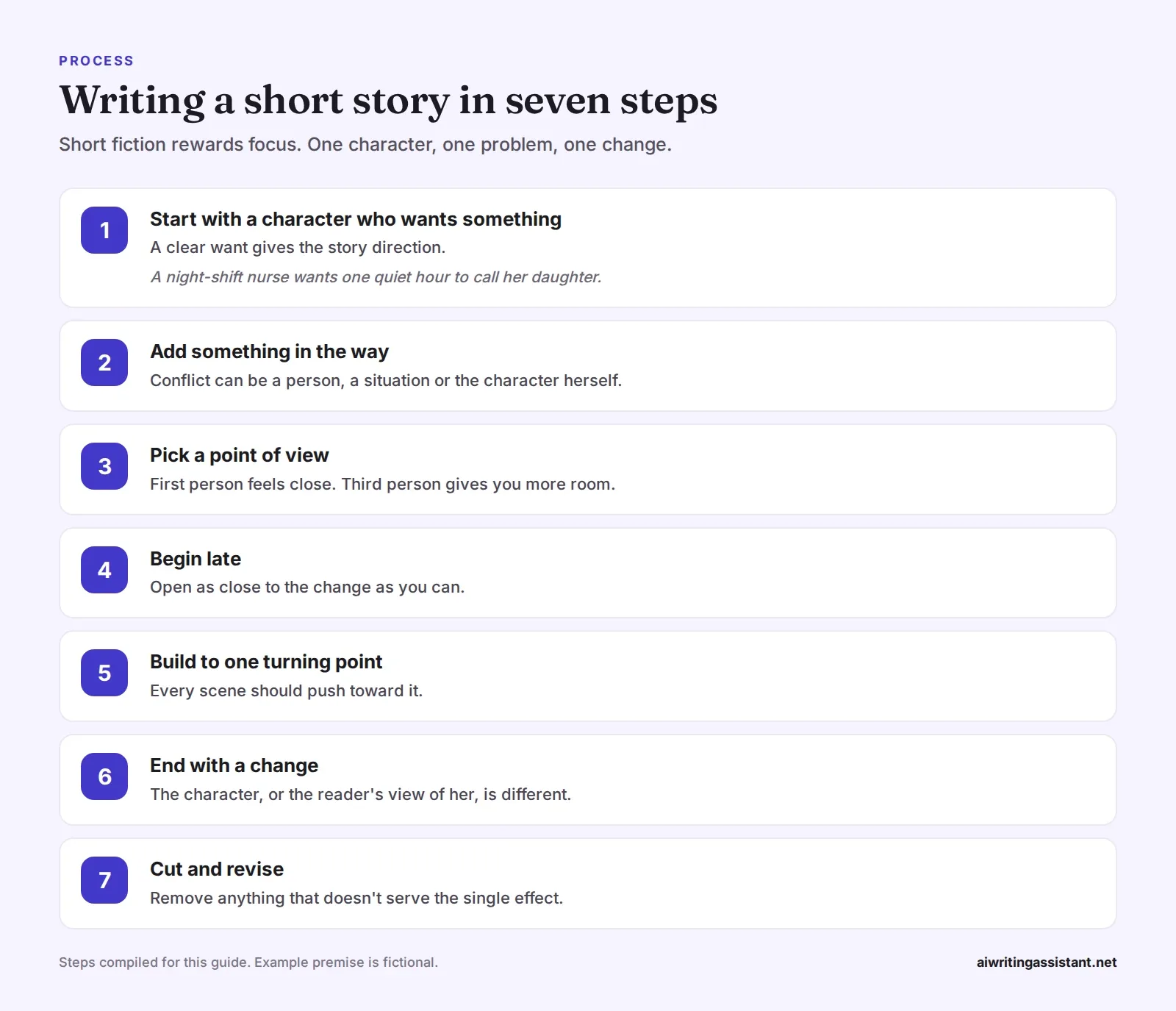
1. Start with a character and a want
Plot comes from desire. A nurse who wants one quiet hour to call her daughter during a night shift is already a story, because the hospital won't give her that hour. Keep the want concrete and small. "Wants to be happy" is too vague to write scenes about.
2. Put something in the way
Conflict doesn't have to be a villain. It can be a rule, a storm, a misunderstanding, or the character's own fear. The obstacle should force choices that reveal who the character is.
3. Choose a point of view
The Pasco-Hernando State College Writing Center lists the main options.
| Point of view | How it sounds | Good for |
|---|---|---|
| First person | "I grabbed my phone and hid in the supply closet." | Intimacy, voice, unreliable narrators |
| Second person | "You grab your phone and hide." | Experimental, immersive stories |
| Third person limited | "She grabbed her phone." (one character's thoughts) | Closeness with some distance |
| Third person omniscient | Narrator knows everyone's thoughts | Large casts, wide scope |
| Objective | Only actions and dialogue, no thoughts | Tension, ambiguity |
For most short stories, first person or third person limited works best. Both keep the reader close to one character, which suits a short form.
4. Begin as late as you can
Long setups kill short stories. Start the day the routine breaks, not the week before. Give background in a line or two once the reader cares. If your first page is mostly explanation, try starting on page two.
5. Aim for a single effect
In an 1842 review, Edgar Allan Poe argued that a writer should decide on "a certain unique or single effect" and build every sentence toward it. He also thought a tale should be readable in one sitting, "from a half-hour to one or two hours." Modern writers break his rules, but the idea of one main effect is still useful when deciding what to cut.
6. Build to a turning point
Many writers use a simple arc of setup, rising action, a turning point, falling action and resolution. It's adapted from the five-part structure Gustav Freytag described for drama in Technique of the Drama. In a short story, the turning point is often where the character finally acts, or finally understands something.
7. End with a change
Something should be different at the end. The character learns, loses, decides or sees the situation differently. Not every story needs a neat resolution, but the reader should feel the change. Our guide to narrative essays covers how to land a reflective ending, which works in fiction too.
Show the story through scenes
A scene happens in a specific place and time, with action and often dialogue. Summary moves the reader quickly between scenes. Short stories need both, but the important moments belong in scenes. Use concrete detail and fresh comparisons. Our guide to metaphor vs simile can help with imagery.
| Summary | Scene |
|---|---|
| Rosa was exhausted and missed her daughter. | Rosa checked the clock, 3:12 a.m., and pressed her daughter's name before the call light blinked again. |
How to revise a short story
- Cut the first paragraph and see if the story starts better without it.
- Check every scene for a reason to exist. If removing it changes nothing, remove it.
- Read dialogue aloud. People interrupt, dodge and speak in fragments.
- Swap general words for specific ones. "Car" becomes "rusted Corolla."
- Look at the ending again after a day away from it.
If you want a prompt to react to, the free Story Generator writes a short draft from any idea. Use it for practice, then write your own version.
Frequently asked questions
How many words is a short story?
It depends on the market. The Nebula, Hugo and Stoker awards use under 7,500 words, while the Edgar Award accepts 1,000 to 22,000.
What is the difference between a short story and flash fiction?
Flash fiction is shorter, often under about 1,000 words. Flash Fiction Online, for example, asks for 500 to 1,000.
What is a novelette?
A story longer than a short story but shorter than a novella, 7,500 to about 17,500 words for the Nebula and Hugo awards.
How do you start a short story?
As close to the change as possible, with a character who wants something and a concrete detail.
What point of view should I use?
First person or third person limited suit most short stories, because they keep the reader close to one character.
What are the elements of a short story?
Character, setting, conflict, plot and theme, usually focused on one main effect.
Does a short story need a twist ending?
No. It needs a change the reader can feel, which might be quiet rather than surprising.

 Grammar Checker
 Paraphraser
 Summarizer
 AI Writer
 AI Humanizer
 Text Compare