
A literature review sounds like a reading list with commentary. It's actually an argument about a field. You're telling the reader what's known, what's disputed and what's missing, so they understand why your question matters.
This guide covers what a literature review is, how to structure one, how to synthesize sources, and a step-by-step process.
How do you write a literature review?
Define your topic and research question, then search for and read the most relevant sources, taking notes on each one's findings, methods and arguments. Group the sources by theme, method, theory or time period, and choose the pattern that best fits your question. Write an introduction that sets the scope, a body that compares and connects sources within each group, and a conclusion that names the gaps your work addresses. Revise to make sure you're analyzing, not just summarizing.
What is a literature review?
The UNC Writing Center describes it as a text that "discusses published information in a particular subject area." The USC Libraries guide adds that it surveys prior research in books and scholarly articles and helps place your work within that body of research.
It can be a section of a thesis or research paper, or a standalone assignment. Either way, the job is the same. Show the reader the state of knowledge and where it runs out.
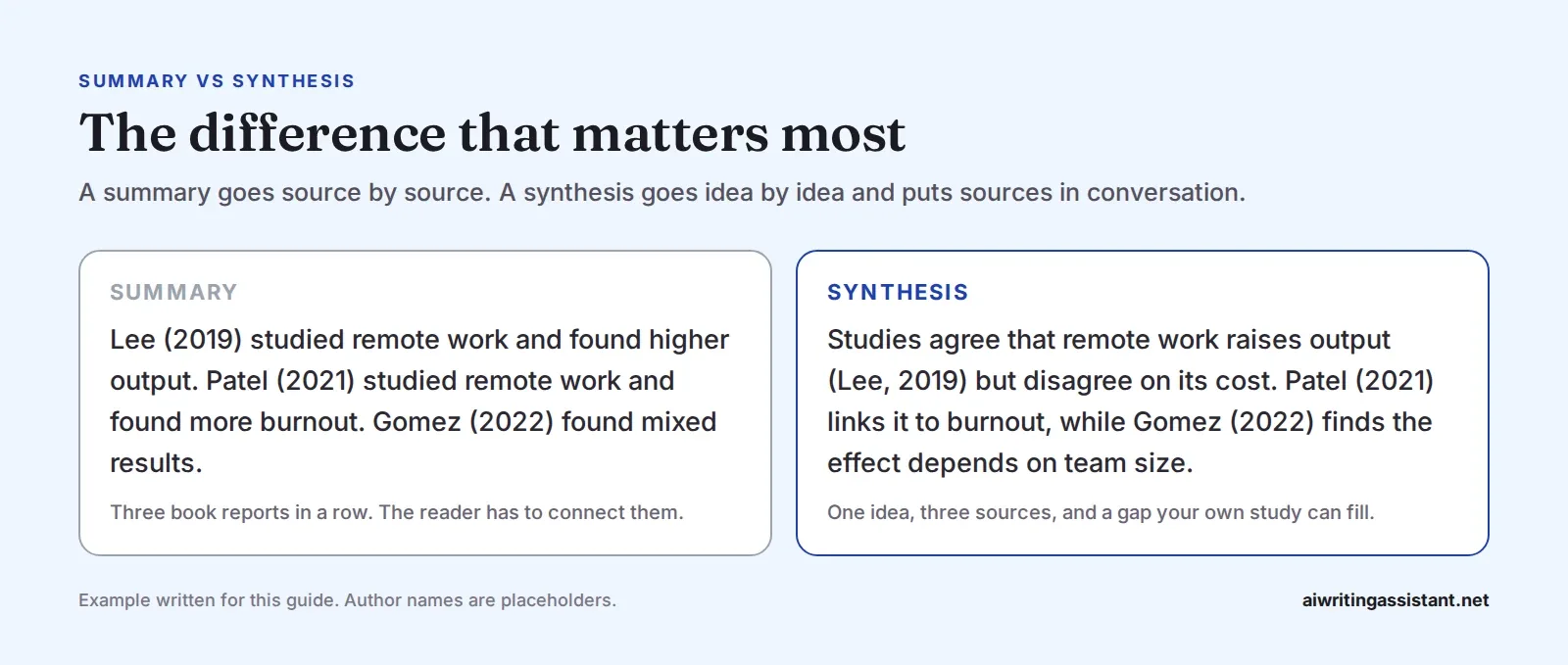
Summary vs synthesis
This is the skill that separates a strong review from a weak one. UNC explains that a summary recaps sources, while "a synthesis is a re-organization, or a reshuffling, of that information." In a 2013 article, Marco Pautasso made the same point. A good review "does not just summarize the literature, but discusses it critically."
How to structure a literature review
Most reviews have three parts.
- Introduction. Define the topic, explain why it matters, and set the scope, such as dates, populations or types of study included.
- Body. Discuss the sources in groups. Each section or paragraph should make a point about the research, supported by several sources.
- Conclusion. Summarize what the field knows, name the gaps or disagreements, and connect them to your own question.
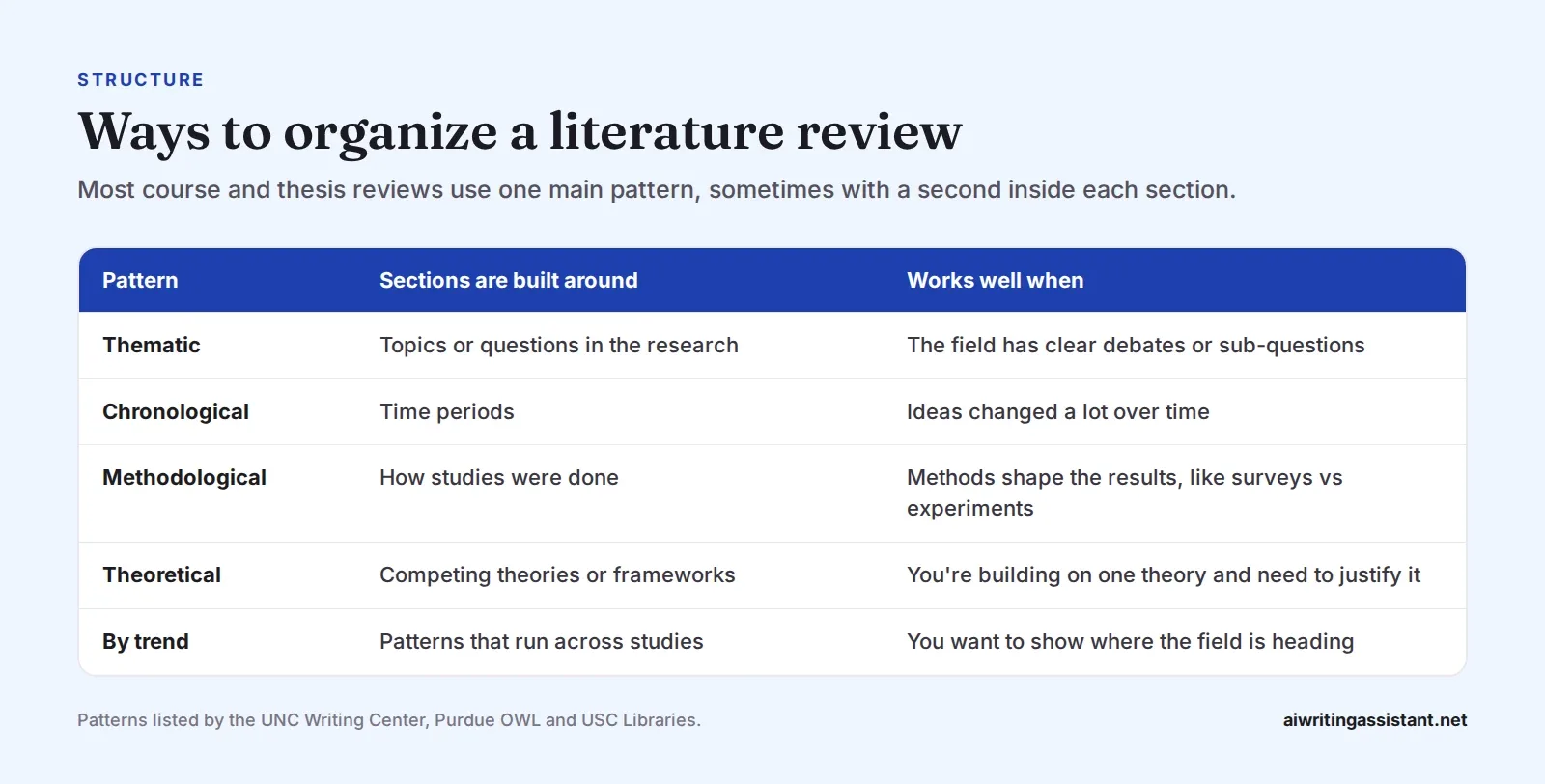
For the body, you need an organizing pattern. UNC, the Purdue OWL and USC list similar options. USC notes that a thematic structure is the most common in the social sciences.
Step-by-step: writing a literature review
1. Narrow your question
"Social media and teenagers" is too wide to review. "How does time on image-based social media relate to body image in teenage girls?" gives you clear search terms and clear limits.
2. Search, then search again
Use your library databases and the reference lists of the best papers you find. Pautasso's second rule is to search and re-search, because your understanding of the topic will change as you read.
3. Take notes in a grid
Make a simple table with one row per source and columns for the question, method, sample, main finding and limitations. Patterns jump out when the information sits side by side.
| Source | Method | Sample | Finding | Limitation |
|---|---|---|---|---|
| Author A (2020) | Survey | 1,200 students | Link between use and anxiety | Self-reported data |
| Author B (2022) | Experiment | 90 adults | Short breaks reduced anxiety | Small sample |
| Author C (2023) | Interviews | 24 teachers | Effects depend on the platform | One school district |
The rows above are placeholders to show the format.
4. Choose your structure
Look at your grid. If sources cluster around debates, go thematic. If methods clash, go methodological. If the story is how thinking changed, go chronological.
5. Write each section around a point
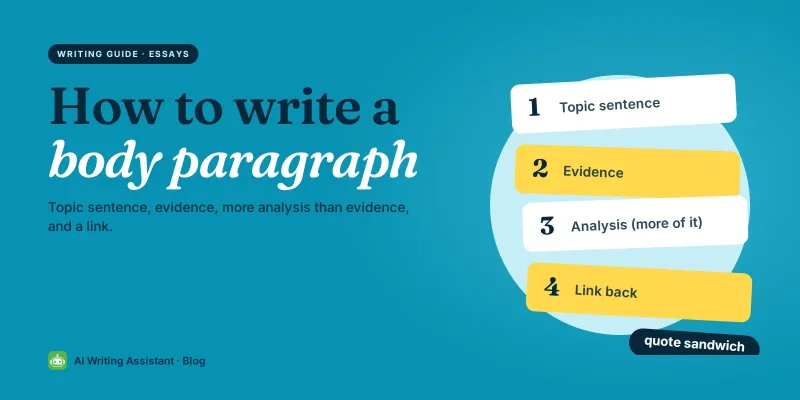
Start each paragraph with a claim about the research, such as "Most studies of X rely on self-reported data." Then bring in several sources as evidence, and finish with what that means for your question. The paragraph structure you use in essays works here too.
6. End with the gap
Your conclusion should leave the reader thinking, "So someone needs to study this." That someone is you.
Types of literature review
The label depends on the field and on whose typology you follow. Snyder (2019) describes three broad approaches (systematic, semi-systematic and integrative). USC lists six types, including argumentative, historical and systematic. A widely cited 2009 study by Grant and Booth, summarized in this Princeton library guide, analyzed 14 review types.
For most coursework and theses, you'll write a narrative or integrative review, not a systematic one. A systematic review follows a set search and selection protocol, so only call yours systematic if you followed one.
Common mistakes
- Summarizing source by source. Group by idea instead.
- Including everything you found. Pautasso warns that adding material for its own sake makes a review unfocused.
- Only recent studies. His tenth rule is to be up to date but not forget older studies.
- No critique. Point out weak samples, outdated methods and conflicting results.
- Losing your voice. Use your own topic sentences. The sources support your points. They don't make them for you.
When it's time to cite, the free Citation Generator formats references in APA, MLA, Chicago and more. Our guide on how to paraphrase covers putting findings in your own words.
Frequently asked questions
What is the purpose of a literature review?
To show what has already been published on a topic, how the research fits together, and where gaps remain that your work can address.
What is the difference between summary and synthesis?
A summary recaps each source separately. A synthesis groups sources by idea and shows how they agree, disagree or build on each other.
How do you organize a literature review?
Common patterns are thematic, chronological, methodological and theoretical. Choose the one that best fits your research question.
How long should a literature review be?
It depends on the assignment. In a thesis it may be a full chapter, while in a journal article it's often a few pages. Check your guidelines.
Is a literature review the same as an annotated bibliography?
No. An annotated bibliography covers sources one at a time, while a review puts them in conversation with each other.
How many sources should a literature review have?
There's no fixed number. It depends on the field and the scope. Focus on the most relevant sources rather than the most sources.
Should I include older studies?
Yes, when they're still important. Pautasso advises staying up to date without forgetting older work.
 Grammar Checker
 Paraphraser
 Summarizer
 AI Writer
 AI Humanizer
 Text Compare